


Introduction
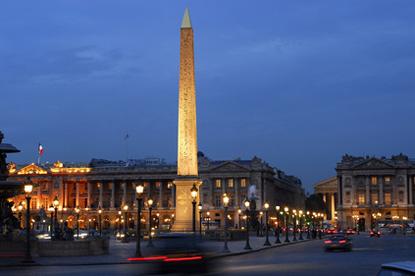
Spanning on 8.6 hectares (21 acres) between the Tuileries Gardens and the Champs-Élysées, Place de la Concorde is the largest square in Paris. It acts as a buffer between the Louvre and the Champs-Élysées and faces the National Assembly on the other side of the Seine.
Originally created in 1772 as Place Louis XV to honour King Louis XV, the square was designed by architect Ange-Jacques Gabriel in an octagonal layout. During the French Revolution, it was renamed Place de la Révolution and became the site where over 1,200 people were executed by guillotine, including King Louis XVI, Marie Antoinette, and Maximilien Robespierre. After the Reign of Terror ended in 1795, the square was renamed Place de la Concorde to symbolise national reconciliation.
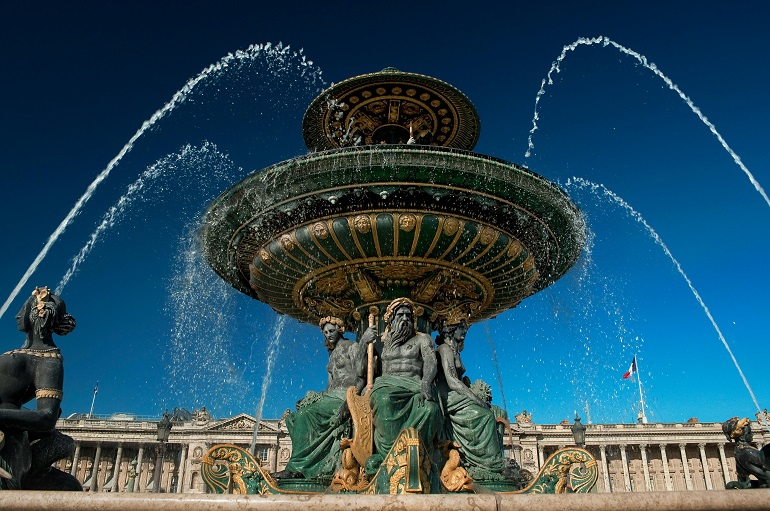
A giant Egyptian obelisk decorated with hieroglyphics stands in the middle of the square. Known as the Luxor Obelisk, it was presented by the Egyptian government to France in 1830. Two monumetal fountains also ornate the square. They were designed by architect Jacques Hittorff and completed in 1840, during the reign of King Louis-Philippe. One of the two Neoclassical palaces hosts the Hôtel de Crillon, one of the oldest luxury hotels in the world.
Interesting Facts about Place de la Concorde
- Place de la Concorde is Paris’s largest public square, covering roughly 7.6 hectares in an elegant octagonal layout.
- It was created in the mid-18th century to honour King Louis XV and originally bore his name.
- During the French Revolution it was renamed Place de la Révolution and became the city’s most infamous execution ground.
- King Louis XVI and Queen Marie Antoinette were among the many notable figures guillotined here.
- The square’s present name, “Concorde,” was adopted to symbolise national reconciliation after the Revolution.
- At its centre stands the Luxor Obelisk, over 3,000 years old and around 23 metres tall, gifted by Egypt and erected in 1836.
- The obelisk’s pedestal features diagrams showing the engineering feats used to transport and raise it in Paris.
- Two monumental 1830s fountains, inspired by Roman models, celebrate France’s maritime and riverine heritage.
- Statues at the eight corners personify major French cities, including Lyon, Marseille, Bordeaux, and Strasbourg.
- The square anchors Paris’s historical axis between the Tuileries Garden and the Champs-Élysées, with sweeping landmark views.
- On its north side stand the matching façades of the Hôtel de la Marine and the Hôtel de Crillon, icons of neoclassical architecture.
- Each year, stands are installed here for dignitaries to review the Bastille Day military parade along the Champs-Élysées.
- The site’s bridge to the south, today’s Pont de la Concorde, was built in the late 18th century partly from stone taken from the Bastille.
- A gilded pyramidion was added to the obelisk in the late 20th century to evoke its missing ancient capstone.
- The square’s mix of grandeur and grim history makes it a uniquely compelling stage for national ceremonies and public life.
History
The Place de la Concorde stands today as Paris's largest square and one of its most historically significant sites, carrying within its elegant confines a tumultuous and bloody past that spans centuries of French history. Originally conceived between 1755 and 1772 by architect Ange-Jacques Gabriel, the square was initially named Place Louis XV in honour of King Louis XV. The design featured balustraded parterres surrounding a magnificent equestrian statue of the king at its centre, commemorating his recovery from a serious illness in 1763. Gabriel's octagonal design enclosed the square with wide ditches and featured eight gatehouses with staircases providing access to the elevated square, whilst two palatial buildings graced the northern side. The square's original grandeur reflected the absolute monarchy's power and the king's divine right to rule over France.
The square's transformation during the French Revolution represents one of the most dramatic chapters in Parisian history, as it became synonymous with the Terror and the violent overthrow of the monarchy. In 1792, revolutionaries tore down the statue of Louis XV and renamed the square Place de la Révolution, installing a plaster statue of Liberty in its place. More ominously, a guillotine was erected at the centre of the square in November 1792, initially used to execute common criminals before becoming the site of royal executions. On 21st January 1793, King Louis XVI was guillotined before cheering crowds, followed nine months later by Queen Marie Antoinette. The square witnessed over 1,200 executions during the Revolution, including that of revolutionary leader Maximilien Robespierre himself, making it one of the bloodiest locations in French history. By 1795, as the Terror ended, the square was renamed Place de la Concorde as a symbol of French reconciliation, though it would change names several more times before permanently adopting its current name in 1830.
The modern appearance of Place de la Concorde emerged through a comprehensive redesign by German-born architect Jacques Ignace Hittorff between 1833 and 1846, who transformed the revolutionary killing ground into the elegant square visitors see today. The centrepiece of this transformation was the installation of the 3,000-year-old Luxor Obelisk in 1836, a gift from Egyptian governor Muhammad Ali that stands 74.9 feet tall and dates back to approximately 1300 BCE. Hittorff flanked the obelisk with two magnificent fountains representing France's maritime trade and rivers, whilst filling in the original defensive ditches and adding eight statues at the square's corners, each representing different French cities positioned according to their geographic locations. The square's northern boundary features the buildings of the French Naval Ministry and the prestigious Hôtel de Crillon, one of Paris's oldest luxury hotels. Today, the Place de la Concorde serves as a crucial junction connecting the Tuileries Gardens and Louvre to the east with the Champs-Élysées and Arc de Triomphe to the west, offering spectacular views across central Paris whilst standing as a testament to France's turbulent journey from absolute monarchy through revolution to modern democracy.
Description
Encompassing more than eight hectares, Place de la Concorde is a spectacular expanse at the heart of Paris where the city’s spirit of artistry and grandeur is fully revealed. Beyond its architectural triumphs and iconic monuments, the square is a living tableau, constantly animated by the flow of city life and by the shifting play of natural light upon stone, water, and gilded bronze.
From every vantage point, Place de la Concorde offers unparalleled vistas. Stand at its centre and you are surrounded by perspectives that capture the very essence of Paris: to the west, the Champs-Élysées stretches away in a triumphant axis, its tree-shaded avenues bustling with energy and activity, culminating at the proud silhouette of the Arc de Triomphe. To the east, the meticulously manicured lawns and gravel paths of the Tuileries Gardens guide your eye towards the Louvre’s glass pyramid, hinting at treasures within. To the south, the Seine glides past, spanned by the elegant Pont de la Concorde, with the imposing façade of the National Assembly visible on the river’s far bank. Everywhere you turn, Paris’s recognisable landmarks anchor the horizon, and the city’s history seems woven into the very air.
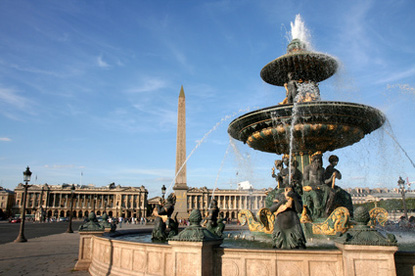
In the midst of this urban splendour, the Obelisk of Luxor commands particular attention. Dating back over 3,000 years, its austere lines rise in dignified contrast to the ornate French architecture, while the golden capstone at its summit gleams against the sky. Surrounding it, luxuriously detailed bronze and marble fountains are adorned with maritime motifs—reclining figures of river gods, muscular tritons, delicate dolphins, and water-spraying swans—that pay tribute to the rivers and seas of France. The fountains’ playful choreography, the sound of cascading water and the flicker of sunlight through the spray, create a refreshing oasis of movement and sound.
Flanking the square, the majestic palaces—the Hôtel de la Marine and Hôtel de Crillon—epitomise classical French elegance. Their stately façades, with perfectly spaced columns and ornate cornices, encapsulate the refinement of Parisian urban design. Peek behind their magnificent doors, and you encounter worlds of plush salons, historic courtyards and, in the case of the Hôtel de la Marine, exhibitions spotlighting French decorative arts and craftsmanship.
As you move through Place de la Concorde, the sensory experience deepens. The persistent hum of traffic is offset by the cheerful calls of street vendors offering roasted chestnuts and fresh pastries. On market days or during festivals, the square acquires a carnival atmosphere, with colourful stalls, amusements, and a medley of enticing scents. In spring and summer, the air is infused with the scent of blooming linden trees and the soft grind of gravel beneath the feet of visitors.
The square’s design itself encourages both grand processions and solitary reflection. Wide pavements and carefully placed street furniture offer space to pause and contemplate, whether you are marvelling at the engineered symmetry of the radiating avenues or appreciating the intimate gestures between lovers meeting at the fountains’ edge. Despite its monumental scale, pockets of tranquillity can be found—along the shaded walkways skirting its borders, or among the stone plinths topped with exquisite statues representing French cities.
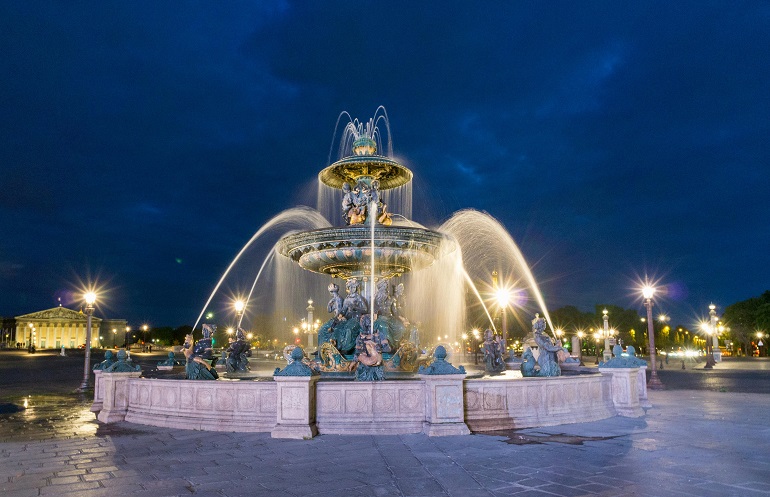
After dusk, Place de la Concorde becomes magically transformed. A gentle glow from the classic Parisian streetlamps mingles with the modern city lights, casting enchanting reflections in the swirling fountain waters and lending a sense of intimacy even as traffic continues to flow all around. The square acquires a cinematic allure: the illuminated obelisk serves as a beacon; passing headlights and the twinkle of the Eiffel Tower on the horizon add to the scene’s vibrant spectacle.
Serving as both a ceremonial gateway to Paris’s most prestigious districts and an inviting destination in its own right, Place de la Concorde rewards both those who linger for hours and those who simply pass through on their way to other wonders. Whether accompanied by the gentle hum of city life in the morning, the golden glow of a late-afternoon sun, or the soft radiance of evening, a visit to Place de la Concorde offers an immersion in the living beauty, grandeur, and ceaseless vitality of Paris itself.