


Introduction
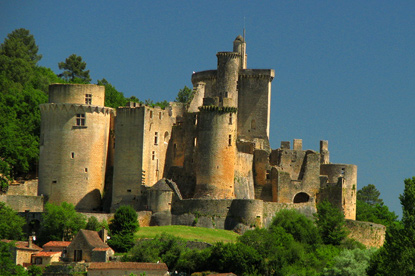
Bonaguil Castle, situated in Saint-Front-sur-Lémance in the Lot-et-Garonne department, stands as one of France's most remarkable examples of late medieval military architecture. Originally constructed in the 13th century by Arnaud de la Tour of Fumel on a strategic rocky spur, the castle was entirely rebuilt between the late 15th and early 16th centuries by Bérenger de Roquefeuil, who transformed it into a sophisticated fortress incorporating the latest innovations in artillery defence. This ambitious reconstruction project, which took approximately 40 years to complete, resulted in a formidable complex featuring 13 tall towers, over 400 metres of defensive perimeter, and more than 100 gun embrasures designed to counter the emerging threat of cannon warfare. Despite its impressive defensive capabilities and the considerable resources invested in its construction, the castle was never subjected to a major siege, making it an exceptionally well-preserved example of transitional medieval military engineering. Today, Bonaguil represents the final flowering of fortified castle design in France, bridging the gap between traditional medieval fortifications and the artillery-focused defences that would characterise later centuries.
Interesting Facts about Bonaguil Castle
- Bonaguil Castle is one of France’s last great fortified castles, dramatically planted on a rocky spur above Saint-Front-sur-Lémance in Lot‑et‑Garonne.
- The site’s first fortification dates to the 13th century, but its formidable late‑medieval defences were largely the work of Bérenger de Roquefeuil between about 1480 and 1520.
- Despite its fearsome artillery‑age design with towers, bastions and cannon embrasures, the castle was never actually attacked.
- The name “Bonaguil” is often linked to “bonne aiguille” or “good needle,” a nod to the steep rocky pinnacle that made the site so defensible.
- A network of secret passages threaded through the fortress allowed hidden movement, surprise sallies, and potential escape during a siege.
- Its barbican sits ingeniously between two drawbridges, creating a rare double line of defence at the main approach.
- The well was sunk deep into the bedrock—around fifty metres—so the garrison could endure siege conditions with an independent water supply.
- After periods of neglect, the 18th‑century owner Marguerite de Fumel restored parts of the complex and added more comfortable apartments.
- Classified as a Monument Historique in the 19th century, Bonaguil has seen multiple restoration campaigns that preserved its late‑medieval profile.
- From summer night tours to cinematic backdrops, the castle’s intact military architecture has long captivated visitors and filmmakers alike.
History
Medieval Origins and Early History
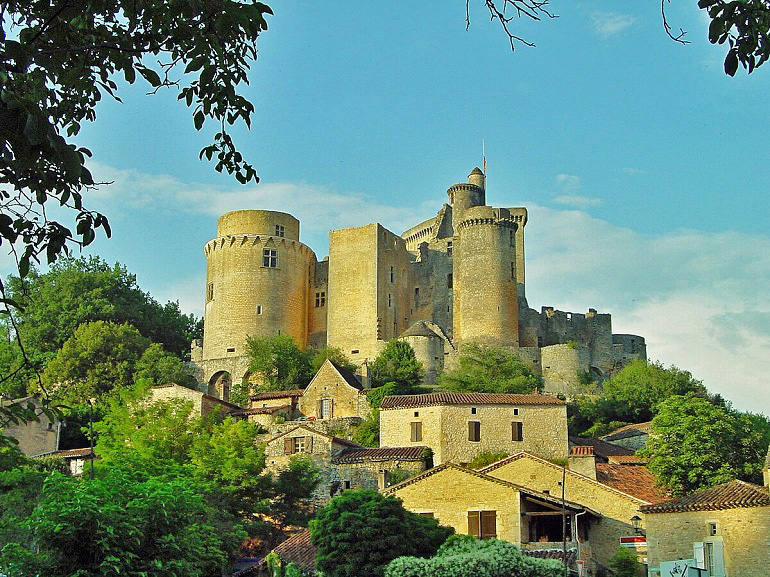
Bonaguil Castle stands majestically on a steep rocky promontory between the rivers Thèze and Lémance, earning its name from the French "bonne aiguille" meaning "good needle". The first fortress was constructed in the mid-13th century, between 1259 and 1271, by the knight Arnaud La Tour de Fumel, who later became Lord of Bonaguil. The castle received its first written mention in 1271 in a charter listing the possessions of King Philippe III le Hardi of France, when it served as a vassal of the fiefdom of Tournon. Originally, this medieval stronghold was a simple polygonal keep built above a natural cave, with its single entrance positioned six metres high and accessible only by ladder, accompanied by a small courtyard surrounded by walls and a lower courtyard protected by a palisade. During the Hundred Years War, the lords of Bonaguil sided with the English crown, resulting in the castle being repeatedly captured, burnt, and abandoned, though it remained within the Fumel family throughout these turbulent times. A remarkable engineering feat of this early period was the excavation of a well reaching 47 metres deep through a natural fracture in the rock.
Renaissance Transformation Under Bérenger de Roquefeuil
The castle's most significant transformation began in 1380 when Jean de Fumel-Pujols married the heiress Jeanne Catherine de Roquefeuil, adopting her more prestigious family name. Their grandson Jean de Roquefeuil moved to Bonaguil with his wife Isabeau de Peyre in 1444, establishing the Roquefeuil dynasty at the castle. The most ambitious reconstruction project commenced around 1483 under Bérenger de Roquefeuil, a powerful baron from Languedoc who had fallen into disfavour with King Charles VII due to his violent treatment of serfs and vassals. This extraordinary fortification project, financed by the Roquefeuils' considerable wealth from their lands in Gironde and the Golfe du Lion, extended over thirty to forty years and transformed Bonaguil into one of France's most sophisticated military fortresses. The reconstruction incorporated cutting-edge artillery defenses, including a 350-metre external wall with lower curtains designed to absorb cannon fire, thirteen tall towers, 104 embrasures for firearms, and a total defensive perimeter of 400 metres covering 7,500 square metres. Innovative features included caponiers built in the ditches for flanking fire, boulevards for rapid troop movement, and a barbican connected by two drawbridges, all designed to counter the latest developments in siege warfare. Ironically, despite these formidable defenses, the castle was never attacked, as Bérenger's death in 1530 coincided with the end of the era of fortified castles.
Decline, Revival, and Modern Preservation
Following Bérenger's death, the castle fell into disrepair due to financial difficulties and family divisions, with the situation worsening during the French Wars of Religion when two Roquefeuil brothers fought on opposing sides, leading to temporary seizures of the fortress. In 1618, Antoine de Roquefeuil was forced to sell the castle, though he later repurchased it. The 18th century brought renewed attention when Marguerite de Fumel acquired the property, undertaking significant restoration work and adding comfortable living apartments outside the inner walls, whilst removing the drawbridges to create a more habitable residence. She resided there regularly until her death in 1788, shortly before the French Revolution brought fresh challenges. During the revolutionary period, the castle was plundered and damaged, and in 1793, a law mandated the partial demolition of the fortress and the reduction of tower heights, giving Bonaguil its present form. The castle's preservation began in earnest when the local council purchased it in 1892, leading to its classification as a Monument Historique. Multiple restoration campaigns have since been undertaken, with the most recent major works completed in 1985, ensuring that this masterpiece of medieval military architecture continues to captivate visitors as one of France's most remarkable fortified castles.
Description
First Impressions
Approach by the lower village and the castle appears almost organic, its tiers of curtain walls, towers and turrets seeming to grow straight from the rock. A broad, rock-hewn ditch guards the base; beyond it, a double drawbridge funnels visitors through a semicircular barbican before they can even glimpse the inner ward. The sense of scale is immediate: Bonaguil sprawls over 7,500 m² and is ringed by 350 m of outer wall punctuated with more than a hundred embrasures cut for cannon and culverin.
The Defensive Genius
- Double drawbridge and barbican – Two independent bridges work in tandem: the inner is raised only after the outer has been lowered, forcing assailants into a killing ground overlooked from every angle.
- Six mighty towers – Circular on the flanks for better deflection of artillery, square on the western curtain for living quarters, each topped with gun platforms reached by spiral staircases.
- Casemates and caponiers – Low, vaulted gun rooms allow defenders to rake the ditches at ground level, while rooftop platforms mount larger calibre pieces for long-range fire.
- 48 m well – Sunk directly into the bedrock to guarantee water during siege, it still plunges vertiginously beside the honour court.
- Secret passages – A honeycomb of tunnels links gatehouse, keep and outer batteries, enabling troops to manoeuvre unseen or launch surprise sallies.
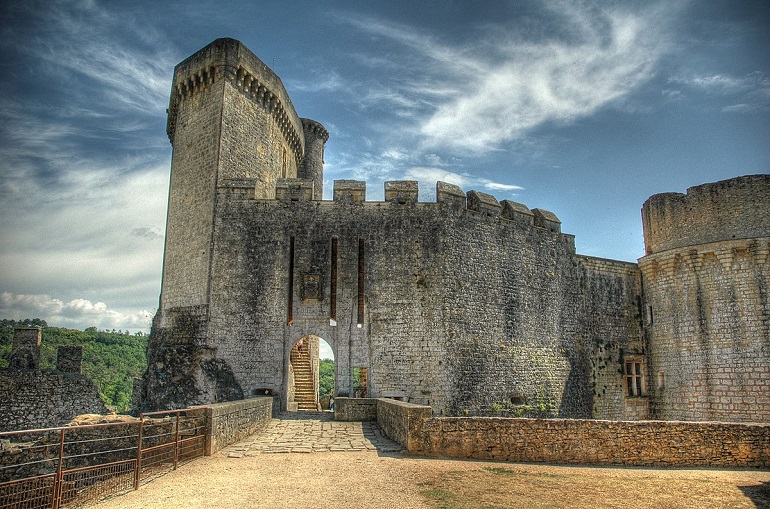
Although Bonaguil was never attacked, these features illustrate the transition from arrow-slits to full gunpowder warfare and make the fortress a living manual of late-15th-century defence theory.
Inside the Walls
- Seigneurial hall – Once draped in tapestries, this lofty chamber still boasts a monumental fireplace and fine Gothic windows.
- Chapel and oratory – Compact yet richly vaulted, tucked inside the south curtain. Medieval graffiti—pilgrim crosses, merchants’ symbols—survive on its walls.
- Boat-shaped keep – The heart of the stronghold rises six storeys; climb to the rooftop terrace for sweeping views across the Lémance valley and the patchwork of forest and farmland beyond.
- Cave refrigerator – A natural grotto beneath the kitchen wing where constant cool air once preserved meat and wine.
- “Spiral” ceiling store room – An unusual fan-vault pattern spirals overhead, a decorative flourish amid otherwise martial architecture.
- Open-air theatre – On summer evenings the western earthworks double as a stage, the ramparts providing an atmospheric backdrop for plays and concerts.
Atmosphere and Experience
Exploring Bonaguil feels wonderfully untamed. Many roofs are long gone, so sunlight streams into ruined chambers where saplings now root in crevices, yet stairways, parapets and the donjon remain accessible. The contrast of intact defensive engineering with romantic decay invites both imagination and discovery; one moment you are ducking through a musket-port, the next emerging onto a lofty battlement where red kites ride the thermals at eye level.
Families delight in the freedom to roam: children can cross the working drawbridge, trace tunnels beneath the curtain wall and clamber to the keep without restrictive one-way circuits. In summer the castle buzzes with living-history weekends, craft workshops and a popular escape-game that threads through its underground labyrinth.
Practical Highlights for Visitors
- Wear sturdy shoes: uneven stone steps, steep ramps and rooftop walks reward the sure-footed.
- Allow at least two hours; enthusiastic castle buffs often linger half a day.
- Panoramic picnic spots abound on the western terrace—arrive early to secure a table-sized chunk of rampart.
- After dusk, periodic night tours illuminate casemates and towers with subtle lighting, casting theatrical shadows that reveal arrow-slits, machicolations and the full drama of the defences.
Getting There
By train The nearest rail stop to Bonaguil Castle is Monsempron-Libos, 11 km away; frequent regional services run there from Agen, which sits on the main Bordeaux–Toulouse line, and connections from Paris or Toulouse are straightforward. From Monsempron-Libos you can book a local taxi or, in summer, use the limited Fumel–Bonaguil shuttle for the last stretch.
By coach or bus Long-distance coach routes serve Agen and Cahors; from either town TER buses link to Fumel, whose centre lies 10 minutes from the castle by taxi. In high season, an onward local bus (line 890) stops at Saint-Front-sur-Lémance village at the foot of Bonaguil, saving the uphill walk.
By car Driving offers the most direct access: exit the A62 motorway at Agen, then follow the D656 and D710 through rolling Lot-et-Garonne countryside before joining the D158 to Saint-Front-sur-Lémance; the castle car park sits just below the ramparts, with overflow spaces in the village for busy days.