


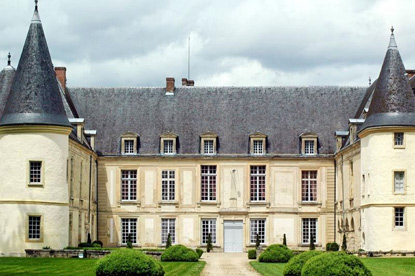
Introduction
The Château de Condé is a private estate situated in Condé-en-Brie, built on a site inhabited since Gallo-Roman times. The castle's medieval foundations date to the late 12th century when Enguerrand III de Coucy constructed the original keep with walls two metres thick, though it was extensively rebuilt in Renaissance style during the 16th century by Cardinal Charles de Bourbon. The property passed through several noble families before becoming associated with the Princes of Condé, and underwent significant transformation in the 18th century under the ownership of Jean-François Leriget, Marquis de la Faye, who commissioned the Italian architect Servandoni and renowned artists including Jean-Baptiste Oudry, François Boucher, and followers of Watteau to create the sumptuous interior decorations.
Today the castle remains privately owned and inhabited year-round. It is notable for its exceptional collection of 18th-century paintings featuring hunting scenes, trompe-l'oeil work, and illustrations of La Fontaine's fables and tales, representing one of the finest examples of aristocratic French interior decoration from the period.
Interesting Facts about Condé Castle
- The château is a privately owned, year-round inhabited estate whose lavish 17th–18th-century interiors were created for the Princes of Savoy and the Marquis de la Faye by artists such as Watteau, Boucher, Oudry and Servandoni.
- A Renaissance spirit lingers in the ensemble, with the celebrated “Watteau wing,” freshly uncovered frescoes, and a grand salon famed for Servandoni’s virtuoso trompe-l’œil illusions.
- The castle’s storied guest list includes Jean de La Fontaine and Cardinal Richelieu, while Olympe Mancini’s chamber whispers of intrigue and her notorious “powders.”
- Origins reach back to the medieval Coucy lineage, whose 12th-century keep remnants with two-metre-thick walls still anchor the site’s defensive past.
- The estate later dazzled under the marquis Jean-François Leriget de la Faye, a royal councillor and Académie Française member who summoned leading painters and architects to refit its spaces.
- The grounds lie on the Champagne route, marrying aristocratic art with vineyard landscapes and a park threaded with playful family discovery trails.
- Among its rarities are a tower display of some 1,200 toy soldiers, a “magic mirror” surprise, and a hidden-in-plain-sight world of painted fêtes galantes.
- The right-hand gatehouse once housed the captain and still conceals an underground jail with an ingenious historic locking mechanism.
- Legends of the Princes of Condé, Protestant strongholds, confiscations under Louis XIV, and careful 20th-century restorations all converge within its walls.
- Today the château is listed as a historic monument, celebrated as “the jewel inside” for its sumptuous decorations and singular atmosphere.

History
The history of Condé Castle stretches back to pre-Roman civilisation, with the site having been inhabited since ancient times. In 500 BCE, the Senones fought a battle against the Condrusi near the village, and archaeological evidence suggests the location served as a Gallo-Roman villa, with ancient Roman pavement still existing beneath the present château floors. The village derives its name from the confluence of two rivers, the Surmelin and the Dhuys, which merge before feeding the River Marne—'Condé' originates from the Celtic word 'condatum', meaning 'confluent'. The castle's medieval history began with Jean de Montmirail as the first lord of Condé, whose son-in-law, Enguerrand III, Lord of Coucy, constructed a formidable keep at the end of the 12th century with walls two metres thick and towering chimneys, parts of which remain visible today.
The castle's Renaissance transformation commenced when it passed through marriage alliances from the House of Coucy to the House of Luxembourg, and finally in 1487 to the House of Bourbon when Marie of Luxembourg married Francis de Bourbon, Count of Vendôme. Cardinal Charles de Bourbon rebuilt the castle in Renaissance style during the 16th century, creating the two distinctive gatehouses that survive today—the right gatehouse housed the Captain of the Castle and contained an underground jail with an exceptional locking system, whilst the left served as the house-keeper's lodge. The property's most illustrious period began when Louis de Bourbon became the first Prince of Condé, who frequently visited the château for hunting during his childhood. The castle served as one of the strongholds of the Prince of Condé, who led the Protestant party during the French Wars of Religion, with his wife Eleonore de Roye and their children often retreating there to escape religious conflicts. The House of Condé retained ownership until 1624, when Marie de Bourbon, Countess of Soissons, married Thomas, Prince of Carignan, transferring the property to the House of Savoy.
The castle's fortunes declined dramatically when King Louis XIV confiscated it in 1711 during the Franco-Austrian War, as the owner was related to an Austrian general. From 1711 to 1719, troops occupied and severely damaged the property before it was purchased by Jean-François Leriget, Marquis de la Faye, Louis XIV's private secretary, councillor, diplomat, and member of the French Academy. The Marquis transformed Condé into an 18th-century masterpiece, commissioning renowned artists including the Italian architect Servandoni (master of trompe-l'œil effects and architect of Palazzo Farnese in Rome), painters Watteau, Boucher, Lemoyne, Lancret, and Jean-Baptiste Oudry to create the sumptuous interiors that survive today. He restructured the castle's southern wing to allow sunlight into the rooms and painted false windows on the medieval walls to achieve architectural symmetry. The property later passed to the Count de la Tour du Pin Lachaux through marriage, then to the Countess de Sade in 1814, remaining with the Sade family until 1983. The castle suffered significant damage during both World Wars—shelled during the Battle of the Marne in 1914 and occupied, bombed, and pillaged between 1940-1945—but underwent careful restoration by the Sade family after 1946. Today, the Château de Condé remains a private estate, classified as a historic monument and inhabited year-round, showcasing its remarkable collection of 17th and 18th-century decorations.
Description
Condé Castle in Condé-en-Brie is a lived-in country residence with a refined, intimate character, set within gentle parkland and framed by a light-filled courtyard. It presents harmonious classical façades softened by painted trompe-l’œil “windows” that subtly regularise the exterior, while a sundial and noon mark above the great door hint at the house’s long, sun-tracked days. Inside, the visit unfolds as a sequence of richly atmospheric rooms where painted décor, carved woodwork and period furnishings coalesce into an elegant, well-paced circuit.
The approach leads through the Renaissance Gallery, a portrait-lined introduction that sets a courtly tone with wood panelling and measured symmetry. From here, the Grand Staircase rises ceremonially to the noble floor, its generous sweep and carefully balanced proportions designed for effect as well as comfort. Sightlines are managed to reveal rooms in stages, allowing painted vistas, textiles and carved details to emerge gradually as one moves through the house.
At the heart of the ensemble is the Servandoni Room, once a music-and-theatre salon, where immersive trompe-l’œil architecture creates the illusion of sculpted niches, columns and vaulted space. Painted on canvas and hung close to the walls for acoustic warmth, the décor draws on Versailles and Roman sources, giving the room a lyrical stage-set quality well suited to performance. Adjoining this is the Servandoni Gallery, which carries the theme into a linear perspective of maps, engravings and fête imagery, a promenade of paper and paint that reads like a visual overture to the grander salons beyond.
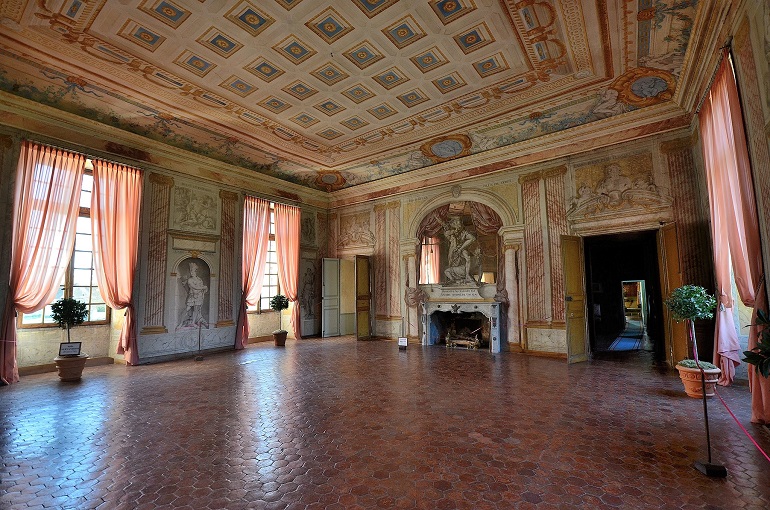
The Oudry Salon offers a contrasting intimacy: oak panelling and an original “à la Versailles” parquet underfoot, with suites of paintings devoted to hunting and fishing that speak to the art of the table as much as the chase. Here, still-life trophies, hounds and game birds animate the walls with seasonal abundance, while a concealed “magic mirror” protects a rediscovered panel behind it, adding a playful, almost theatrical reveal to the experience. Light filters in softly, catching gilt seams and picture frames, and drawing out the warmth of the wood.
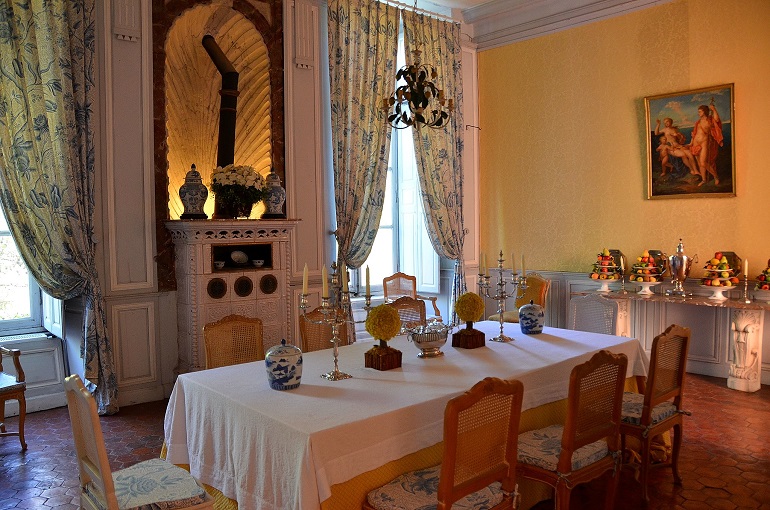
The Dining Room is among the earliest in France purpose-built for meals rather than adapted from a hall, and it shows in its clear axial layout and serviceable elegance. A shell-like stucco niche at the far end houses a tall Prussian stove, a functional centrepiece that also lends vertical punctuation to the room. Compositions attributed to leading 18th-century painters add mythic flourish, giving a festive cadence to table talk and ceremony.
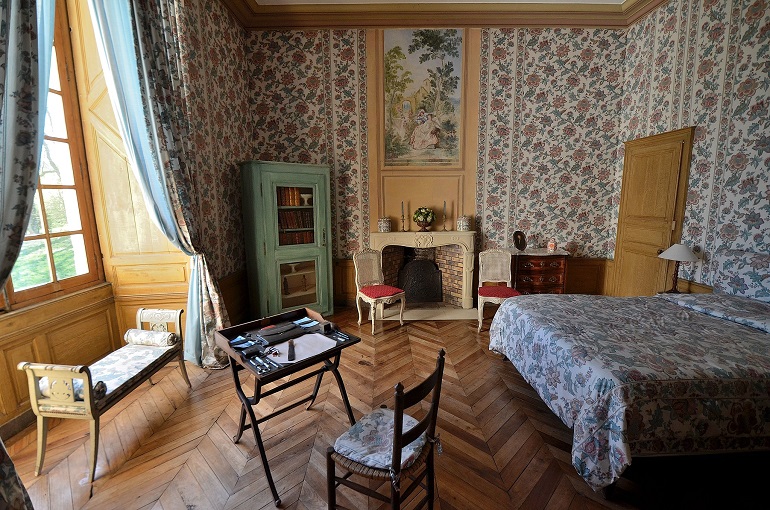
Private apartments deepen the mood. Olympe Mancini’s chamber is set within thick-walled medieval masonry, its low, protective feel offset by portraits and narrative panels that animate the fireplace and pier-glasses. Furnishings are practical yet plush, arranged to make the most of natural light and to shelter from draughts. Nearby, the Study is cosier still: oak-lined, with hidden doors leading to the old librarian’s quarters and the former library, a discreet suite of rooms designed for quiet work, conversation and retreat.
The Richelieu Bedroom carries a more formal, state-bedroom register, anchored by a painted overmantel and balanced by textiles that temper the symmetry of the boiseries. Details—sedan chairs scaled for children, a large Tugot plan of Paris—sit like footnotes in the flow of rooms, lending texture without crowding the spaces. Throughout the first floor, a painter’s atelier attributed to Watteau’s circle preserves scenic fragments on the plaster itself: imaginary landscapes, fêtes galantes and rustic clearings that turn walls into windows.
Circulation alternates between salons with theatrical amplitude and corridors that hug the building’s spine, keeping the visitor close to the cadence of the house. Tucked into a tower, a cabinet of toy soldiers adds a curious, almost whimsical pause, a miniature world at attention beneath sloped ceilings. Across the interiors, parquet patterns shift subtly from salon to salon, signalling changes in function while maintaining a unified material language of timber, plaster and canvas.
Back at ground level, the entrance hall exhibits small finds recovered during conservation, bridging the exterior court and the more ornate rooms within. From the threshold, views open to the park, laid out in a restrained, early-18th-century country-house manner, where lawns and trees are handled with light intervention to frame the castle’s pale façades. The overall effect is of a dwelling that blends theatre and domesticity: salons staged with painterly illusion, balanced by workaday rooms that reveal the rhythms of a house designed to be lived in as well as admired.
Getting There
By train, the nearest major railway station to Condé Castle in Condé-en-Brie is Château-Thierry, which is well connected to Paris and other cities by regular TER and Transilien services; from Château-Thierry you can continue by local bus or taxi to the village.
By coach or bus, hop on regional bus line 507 linking Château-Thierry and Condé-en-Brie several times daily, with a stop in the village centre just a short stroll from the castle.
By car, leave the A4 motorway at the Château-Thierry exit and follow the D4 south for about 15 km; parking is available in the village centre, making for an easy visit at your own pace.
| Travel destinations in Picardy | ||||||||||||||
|---|---|---|---|---|---|---|---|---|---|---|---|---|---|---|
|
|
|
|
| ||||||||||
|
|
|
|
| ||||||||||


