


| Contents |
|---|

Introduction
Nestled in the heart of the Loire Valley, the magnificent Fontevraud Abbey stands as one of Europe's most remarkable monastic complexes and a testament to medieval spiritual and political power. Founded in 1101 by the hermit Robert d'Arbrissel, this extraordinary abbey was unique amongst religious institutions as a double monastery where both monks and nuns lived under the progressive rule of an abbess. The sprawling complex, which once housed over 5,000 residents at its peak, is perhaps best known as the eternal resting place of the Plantagenet dynasty, including the formidable Eleanor of Aquitaine, her husband Henry II of England, and their son Richard the Lionheart, whose striking effigies lie within the abbey church. Today, visitors can explore the beautifully preserved Romanesque and Gothic architecture, wander through the serene cloisters, marvel at the unusual octagonal kitchen with its soaring chimneys, and discover the fascinating history of this UNESCO World Heritage site that seamlessly blends spiritual heritage with royal legacy, making it an unmissable destination for anyone exploring France's rich historical tapestry.
Interesting Facts about Fontevraud Abbey
- Founded in 1101 by Robert d’Arbrissel, Fontevraud led a dual monastic order of men and women under the authority of an abbess.
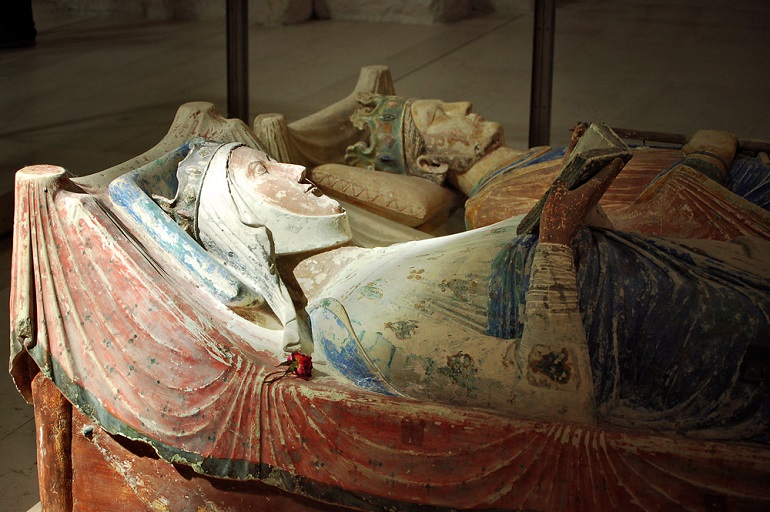
- It became the Plantagenet royal necropolis, with the effigies of Henry II, Eleanor of Aquitaine, and Richard the Lionheart in the abbey church.
- The abbey is among Europe’s largest preserved monastic complexes, often described as a “monastic city.”
- After the French Revolution, Napoleon converted the abbey into a prison, a role it held until 1963.
- The striking “Romanesque kitchens” with fish‑scale roofing long puzzled historians and are now widely understood as medieval smokehouses for fish.
- From the 12th century to the Revolution, 36 abbesses governed Fontevraud, an exceptional continuity of female leadership.
- Today the site blends heritage and culture, hosting a modern art museum, a hotel, and a Michelin‑starred restaurant within its historic walls.
- The cloister and chapter house display Renaissance additions, including Bourbon‑era murals depicting the Passion of Christ.
- Fontevraud sits in the Loire Valley UNESCO World Heritage landscape, near Saumur and Chinon.
- The abbey’s design reflects a “city within a city,” with separate quarters for nuns and monks linked by contemplative spaces.

History
Fontevraud Abbey was founded in 1101 by Robert d'Arbrissel, an itinerant preacher who created one of medieval Europe's most revolutionary religious establishments. Unlike traditional monasteries of its time, Fontevraud operated as a double order comprising both monks and nuns living in separate quarters within the same complex, all governed by an abbess—a radical departure from conventional Church hierarchy. The abbey consisted of four distinct monastic communities spread across 14 hectares, making it one of the largest monastic settlements in Western Europe. By Robert d'Arbrissel's death in 1117, approximately 3,000 nuns resided at the abbey, whilst the order had established nearly 100 priories stretching from Spain to England. The first permanent structures were constructed between 1110 and 1119, with Petronilla of Chemillé becoming the first elected abbess in 1115.
The abbey's most illustrious chapter began when it became the favoured sanctuary of the Plantagenet dynasty, rulers of the vast Angevin Empire that encompassed much of western France and England. Eleanor of Aquitaine, one of medieval Europe's most powerful women, chose Fontevraud as her retirement home in 1200 and designated it as the royal necropolis for her family. The abbey church houses the magnificent polychrome recumbent effigies of four royal figures: Henry II of England (died 1189), Eleanor of Aquitaine (died 1204), their son Richard the Lionheart (died 1199), and Isabella of Angoulême, wife of King John (died 1246). At its zenith, fifteen members of the Plantagenet dynasty were interred here, though only four tombs survive today. The abbey enjoyed royal patronage and immense wealth, with thirty-six abbesses succeeding one another over the centuries, many drawn from noble families including five from the Bourbon dynasty who ruled for nearly 150 years.
Following the French Revolution, Fontevraud underwent a dramatic transformation when Napoleon converted it into a central house of detention in 1804, a function it served until 1963. During its prison years, the abbey housed up to 2,800 inmates from 19 départements and was considered France's harshest penal institution, with the writer Jean Genet among its notable prisoners. Paradoxically, this conversion preserved many buildings that might otherwise have been destroyed, though revolutionary forces had already looted the abbey and scattered the royal remains in 1792. The abbey was classified as a historic monument in 1840 by Prosper Mérimée, though major restoration work only began in the early 20th century under architect Lucien Magne. Since 1975, Fontevraud has flourished as a cultural centre within the UNESCO-listed Loire Valley, hosting contemporary art exhibitions, concerts, and since 2021, a Museum of Modern Art featuring works by Degas and Delaunay.
Description
The Abbey Church
The spiritual heart of Fontevraud is the magnificent Abbey Church (also known as Notre-Dame), a 90-metre-long Romanesque masterpiece consecrated in 1119. This imposing structure showcases a four-cupola nave crowned by soaring stone vaults and adorned with exquisitely carved capitals that represent the pinnacle of 12th-century craftsmanship. The church follows a classical cruciform design with a substantial transept and ends in a sanctuary surrounded by an ambulatory featuring three elegant apse chapels.
The nave houses the renowned royal necropolis of the Plantagenets - the polychrome recumbent effigies of Henry II of England, Eleanor of Aquitaine (who died at the abbey in 1204), Richard the Lionheart, and Isabella d'Angoulême. These painted tomb sculptures, with their remarkably preserved colours, were originally positioned near the transept but relocated in 1504. Eleanor's effigy is positioned higher than her husband's and shows her holding a book - a deliberate artistic choice reflecting her desire to be remembered as his intellectual superior.
The Grand-Moûtier Cloister
The 16th-century cloister, measuring 59 metres along each side, forms the true heart of monastic life and was completely rebuilt in 1548 under the de Bourbon abbesses. This Renaissance masterpiece serves as both a meditative space and the main circulation hub, connecting all the monastery's key areas through graceful stone arcades. The cloister's galleries provide shelter while allowing natural light to flood the central courtyard.

The Chapter House
Adjacent to the cloister lies the Chapter House, described as the second most important room after the church. This intimate 16th-century chamber served as the community's daily meeting room where nuns discussed abbey affairs, elected leadership, and received papal proclamations. The walls are adorned with exceptional Renaissance murals by Thomas Pot depicting scenes from the Passion of Christ, with successive abbesses of Bourbon portrayed prominently in the foreground - a unique feature that evolved over decades as new abbesses added their portraits to the existing artwork.

The Refectory
The imposing monks' refectory stretches 40 metres in length, creating one of the most dramatic interior spaces in the abbey. The hall retains its original 12th-century Romanesque walls, but the ceiling was transformed in the 16th century when a soaring Gothic arched structure replaced the original wooden roof. Here, the nuns took their meals in complete silence while a reader recited passages from Scripture, maintaining the strict Benedictine atmosphere that defined daily life.
The Great Dormitory
The Great Dormitory once housed one of the abbey's three sleeping quarters, accommodating part of the community that at its peak numbered some 3,000 nuns. This imposing timber-floored hall with its massive stone walls and vaulted ceiling now serves as an exhibition space for temporary displays on heritage, history and contemporary art. The dormitory provides visitors with a sense of the scale and austerity of monastic living quarters.
The Romanesque Kitchens (Tour Evraud)
Perhaps Fontevraud's most iconic and mysterious structure, the octagonal Romanesque kitchens stand as the sole remaining example of such medieval culinary architecture in France. This 28-metre-high tower, crowned by a distinctive conical hood roofed with overlapping fish-scale tiles and adorned with slender stone chimneys, was long debated by scholars. Only in 2020 did archaeological research finally confirm its function as the abbey's medieval kitchen.
Originally surrounded by eight round chapels, three were dismantled in the 16th century to facilitate connection to the adjacent refectory. The interior features grand fireplaces installed in 1904 during Viollet-le-Duc's 19th-century restoration, creating an atmospheric space now used to display contemporary artworks.

The Saint-Benoît Complex
The Chapelle Saint-Benoît and adjacent buildings formed the abbey's infirmary complex, originally constructed in the 12th century but rebuilt in the mid-16th century. This classical architectural ensemble accommodated sick or elderly nuns who could no longer maintain regular monastic life. The complex now houses exhibitions dedicated to the monument's various functions and uses throughout history, with contemporary works displayed in the cellars and ancient water drainage systems.
The Prison Gallery
Above the main cloister galleries runs the prison gallery, constructed during the abbey's transformation into a penitentiary from 1804 to 1963. This upper level enabled warders to circulate and supervise prisoners more efficiently. Today, it hosts a permanent exhibition revisiting the abbey's prison period through archive documents and testimonials from former inmates and guards.

La Fannerie - Museum of Modern Art
The elegant 18th-century stables, known as La Fannerie, originally served as barn and granary but now house the Fontevraud Museum of Modern Art. These spacious stone buildings with their classical proportions provide striking galleries where contemporary paintings, sculptures and installations create a compelling dialogue between medieval architecture and modern creativity.
Gardens and Outdoor Spaces
Beyond the built heritage, Fontevraud's landscaped gardens encompass aromatic herb plots, reconstructed medieval kitchen gardens, and peaceful apple orchards. The gardens of the noviciate occupy the grassed square beside the refectory, while the former nuns' cemetery lies in the area bordered by the church's ambulatory and apse chapels. Contemporary sculptures punctuate these outdoor spaces, and the sunny Orangerie terrace offers dining with views across the abbey's lawns.
Getting There
By train Travel to Saumur station—well served by TGV and TER services from Paris (via Angers) as well as regional services from Tours—then continue the final 15 min by local bus (Linea 1, Saumur → Fontevraud-l’Abbaye) or a pre-booked taxi.
By coach or bus Direct long-distance coaches do not reach the village, so the simplest option is to take a regional bus from Saumur; summer timetables are more frequent, while off-season services require careful planning.
By car Fontevraud sits just off the D947; the drive takes about 15 min from Saumur, 45 min from Tours or Angers, and under three hours from Paris. Free parking awaits on Place du 8 Mai 1945 at the village entrance, a short walk from the abbey.
Best Time to Visit
The best time to visit Fontevraud Abbey is late spring (May–June) and early autumn (September–October), when mild weather suits the cloisters and gardens and crowds are lighter than in the July–August peak. Summer offers longer opening times and occasional special events, but it is busier and can be warm. The calmest experience is found on weekday mornings or late afternoons, away from the 11:00–16:00 rush. Winter is pleasantly quiet, though daylight is short and some services run reduced schedules with occasional weekday closures; checking opening times in advance is advisable.