


| Contents |
|---|

Introduction
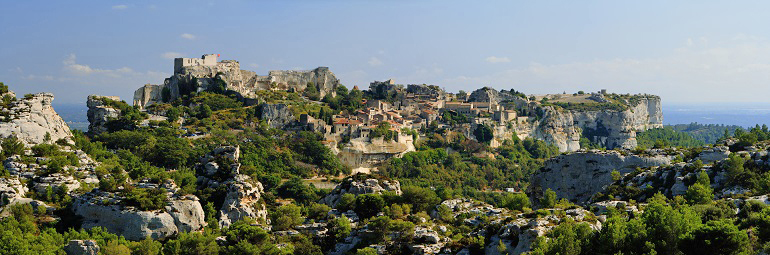
Overlooking the spectacular Alpilles plateau, the ruined stone village of Les Baux, perched on a craggy hill, is nearly indistinguishable from the cream-coloured rocks of the landscape. It is one of France's most visited villages and is officially recognised as one of France's Most Beautiful Villages. Abandoned since the 17th century, the historical hilltop citadel of Les Baux is a dead town, which confers it a surreal atmosphere. All the hotels, restaurants and shops are in the much smaller living village (pop. 400) below.
This ancient settlement was once the seat of the powerful Lords of Baux who controlled the region during the Middle Ages from their fortress that now stands in picturesque ruins above the village. Today, whilst only 22 permanent residents call the village home, Les Baux-de-Provence attracts over 1.5 million visitors annually who come to explore its cobbled streets lined with Renaissance mansions, its 22 classified historical monuments including troglodyte houses carved directly into the rock, and the impressive Château des Baux with its medieval siege engines and defensive towers. The village offers sweeping panoramic views across the Provençal valley below, dotted with ancient olive groves and vineyards, whilst its strategic position on the rocky outcrop demonstrates why this site has been continuously inhabited since prehistoric times.
Interesting Facts about Les Baux-de-Provence
- Les Baux-de-Provence is perched on a dramatic limestone plateau in the Alpilles, offering far-reaching views towards Arles and the Camargue on clear days.
- The village’s name comes from the Provençal word “bau,” meaning rocky escarpment, reflecting its cliff-edge setting and natural defences.
- Once a powerful medieval stronghold, the Lords of Baux claimed legendary descent from Balthazar, one of the Biblical Magi, and ruled dozens of Provençal territories.
- The ruined Château des Baux dominates the skyline, with replicas of medieval siege engines recalling the site’s turbulent military history.
- Bauxite, the main source of aluminium, was discovered near Les Baux by the French geologist Pierre Berthier in 1821 and named after the place.
- Despite its tiny resident population, the village contains 22 protected historic monuments, from chapels to Renaissance façades.
- Carrières de Lumières, an immersive art show in vast ancient quarries at the foot of the village, projects masterpieces onto soaring stone walls.
- Archaeological traces show habitation since the Neolithic era, drawn by caves, springs, and the plateau’s strategic vantage.
- The Chapelle des Pénitents Blancs surprises with contemporary murals inside its centuries-old walls, blending past and present.
- Olive groves and vineyards cloak the surrounding slopes, sustaining a long tradition of fine olive oil and Provençal wine.

History
Les Baux was first settled in the Neolithic period, 8,000 years ago, and stayed occupied during in the Bronze Age and the Iron Age. Around the 2nd century BCE it became a Celtic oppidum (hill fort) of the Salyes tribe.
The medieval castle was built in the 10th century, and expanded into a fortified town in the 11th century. Les Baux became the seat of a powerful feudal lordship that controlled 79 towns and villages in the region. The lineage of the local rulers died out in 1427 and the lordship passed to the Counts of Provence. In 1482, Provence is annexed to the Kingdom of France and Louis XI orders the dismantlement of the citadel.
In 1515, Louis XII appoints a governor with the title of Baron des Baux and the town experiences a new golden age. Renaissance houses are built, and the castle is partially repaired. Hotbed of the Protestant Reformation in Provence, Les Baux revolts against the king's authority in 1632, which prompts Cardinal Richelieu too raze the citadel and expel the residents. For the next 200 years, the ruined town would be inhabited only by bats and crows.
In 1642, Louis XIII cedes the Duchy of Valentinois and Marquisate of Les Baux to Honoré II Grimaldi, first Prince of Monaco. Up to this day, Marquis of Baux is one of the Prince of Monaco's many hereditary titles, and one which is usually given to the reigning Prince's eldest son (the equivalent of Prince of Wales in the UK).
Main Attractions
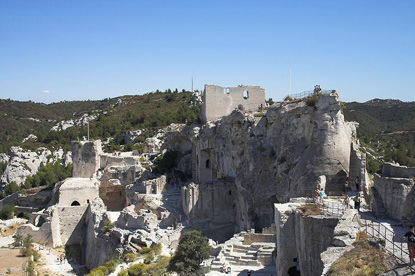
The old town is dominated by the Château des Baux, a large medieval citadel spreading on 7 ha (17 acres), and now housing a museum. Visitors can see replicas of wooden siege engines, including a trebuchet (the largest in France), a couillard, a battering ram, a balista, and catapults. The weapons are fired every day at 11:00 am, 1:00, 3:00 and 5:00 pm during the high season (from April to September). Visitors can also try to shoot with a medieval bow or with a crossbow. The best preserved towers are the Tour Paravelle and Tour Sarrasine (which owes its name to its original function to spot Saracen invaders). Admission to the castle is 8.5 € for adults and 6.5 € for children during the high season. It is 1 € cheaper during the low season.
The old town hall houses the Musée des Santons, a museum dedicated to 17th- and 18th-century hand-painted nativity scene figurines. They are either made of wood or terracotta and are typically Provençal.

The St Vincent's Church, built between the 12th and the 16th centuries, has the particularity of being partially dug in the rock. Its contemporary stained glass windows by Max Ingrand (1960) were presented by Prince Rainier III of Monaco.
Noteworthy Renaissance-style buildings include the Pavillon dAmour de la Reine Jeanne ("Queen Jane's love pavilion"), the Hôtel de Manville, the Hôtel des Porcelets (home to the Yves-Brayer Museum), and the Post Tenebras Lux Window.
A few hundreds metres north of the castle is the ominously named Val d'Enfer (Valley of Hell), said to have inspired Dante for its description of the nine circles of the Inferno in the Divine Comedy. The bizarrely shaped rocks are actually the result of erosion and over 2000 years of sandstone quarrying, then bauxite exploitation from 1821 to 1935. The site is now used for a large-scale sound-and-light spectacle, known as the Cathédrale d'Images. The show, which changes every year, is very colourful and truly impressive. It is open daily from 10:00 am to 7:00 pm (to 6:00 pm in the low season).
Top Museums
Immersive Art & History
Carrières des Lumières
One of the most remarkable artistic experiences in France awaits beneath the limestone cliffs of Les Baux-de-Provence, within the Carrières des Lumières. This former quarry, now an expansive digital art centre, merges natural grandeur with contemporary creativity. Carved out over centuries, the space retains traces of its industrial past, with soaring stone walls and a peculiar cavernous chill. Its history reaches back to the Roman period, when the region’s uniquely bright stone was sought for construction; in the nineteenth century, the quarry bustled with workers extracting material for the area’s celebrated buildings, while in the modern era, it became a stage for Jean Cocteau’s surreal film “The Testament of Orpheus”.
Since 2012, the Carrières has been transformed into an avant-garde centre for immersive digital exhibitions. Giant projectors cover every surface – floor, pillars, arches, ceilings – with moving masterpieces, accompanied by powerful soundtracks that reverberate throughout the galleries. Each year, new themes attract global visitors, inviting guests to “step inside” the works of iconic artists such as Monet, Van Gogh, Picasso, and Dalí. Past installations have brought to life the swirling skies of Van Gogh’s “Starry Night”, the flamboyant abstraction of Picasso, and the dreamlike jungles of Rousseau. Current shows highlight Claude Monet’s journeys through light and landscape for the 150th anniversary of Impressionism, as well as Henri Rousseau’s fantastical creations in a dazzling celebration of naïve art.
The exhibitions unfold in total darkness, illuminated only by glowing images that dance and shift around visitors. The effect is deeply atmospheric: at times, the sensation is like wandering through a living painting; at others, the shifting images create dizzying tableaus of colour and form. Special sound and light events are held throughout the year, with themes ranging from Egyptian pharaohs to Orientalist painters, deepening the cultural resonance of each visit.
Provençal Art & Culture
Musée Yves Brayer
Located in the stately Hôtel de Porcelet, the Musée Yves Brayer is dedicated to Provençal landscapes rendered in vivid colour and light by Yves Brayer, a foremost local artist. The elegant Renaissance mansion, with stone walls and period décor, provides the perfect setting for exploring Brayer’s Mediterranean scenes – from sun-drenched olive groves and bustling village markets to tranquil seascapes and refined interior studies. The permanent collection charts the painter’s travels across southern France, Spain, Italy, and Morocco, revealing his fascination with everyday life and rural tradition.
Rotating exhibitions introduce visitors to other figures from modern French art and literature, such as Cocteau. Alongside paintings, there are Brayer’s prints, watercolours, and preparatory sketches, highlighting the versatility and vibrant personality of his artistic output. The museum’s intimate rooms and historic architecture invite lingering reflection, allowing visitors to immerse themselves in the world-view of a master deeply attuned to the region’s light and culture.
Traditional Provençal Craftsmanship
Musée des Santons
The Musée des Santons preserves the enchanting tradition of the Provençal nativity, displaying collections of artisanal “santons” – small, hand-painted figurines that evoke the people, animals, and characters of rural France. Set in a charming Provençal house, this museum delights children and adults with meticulously arranged displays, bringing to life pastoral scenes and legendary local stories. The collection showcases Neapolitan figures from the seventeenth and eighteenth centuries, ecclesiastical creations from the nineteenth century, and celebrated works by master santon-makers including Carbonnel, Fouque, and Neveu.
Each vignette tells a story: shepherds leading flocks at dawn, villagers baking bread, musicians playing in the square. Attention to detail is everywhere – from miniature loaves and tiny baskets to lavish robes and expressive faces. The museum transports visitors into a world of folklore and faith, celebrating pastoral rituals like the “Pastrage” and providing a gentle lesson in Provençal heritage.
Medieval History & Heritage
Château des Baux Open-Air Museum
The ruined fortress of the Château des Baux, perched high above the valley, is itself a living museum, chronicling the proud and turbulent centuries of feudal life in Provence. Visitors roam the exposed ramparts, towers, and courtyards, discovering interpretive displays on the military prowess and aristocratic lineage of the Lords of Baux. The remains of ancient siege engines – including giant trebuchets and catapults – can be found scattered on the grounds, giving a vivid sense of medieval warfare. Inside the ruins, historic photographs and diagrams reconstruct daily life within the castle, while panoramic views sweep across the Alpilles and olive groves far below.
Several chapels and outbuildings still stand, their weathered stones echoing with centuries of legend. Special exhibitions and performances are staged during the summer, reviving traditions and tales from the castle’s long history. The Château offers not just a window onto the past, but a chance to inhabit it, to contemplate the ambitions and tragedies of those who once ruled this imposing stronghold.
Contemporary Art Spaces
Village Galleries and Art Spaces
Les Baux-de-Provence’s winding streets shelter a number of smaller galleries and art spaces, often located within renovated mansions and historic buildings. These venues champion both international and Provençal artists, with regular exhibitions of painting, photography, and modern sculpture. Seasonal shows introduce visitors to young talents or offer elegant retrospectives of established figures, ensuring that the village remains a hub of creativity and dialogue. Many spaces take advantage of their unique setting, blending art and architecture in memorable ways – with works displayed against centuries-old stone, beneath medieval beams, or in sunlit courtyards threaded with wisteria.
Additional Cultural Experiences
Cultural Events and Performances
The immersive quality of Les Baux’s museums is matched only by the village’s heritage as an artistic beacon. Throughout the year, special events highlight literature, film, and classical music, with open-air concerts and readings in picturesque surroundings. The Carrières des Lumières, in particular, embraces works beyond painting, projecting the words of Saint-Exupéry and the poetry of Jean Cocteau on cavernous walls and floors. The interplay between landscape, history, and contemporary creation gives each museum – and each visit – a sense of majesty and renewal.
Les Baux-de-Provence’s museums invite visitors to step into other worlds: from the luminous depths of digital art, through the serenity of Provençal landscapes, into the miniature pageantry of nativity scenes and the dramatic grandeur of medieval fortresses. These spaces are not merely repositories, but living environments that celebrate the enduring connection between creativity, heritage, and the spirit of Provence.
Local Cuisine
Tucked amid sun-bleached limestone, Les Baux-de-Provence celebrates a cuisine anchored in its prized AOP olive oil from the Vallée des Baux, spooned over everything from juicy heritage tomatoes to delicate slices of courgette. Rustic platters arrive heaped with tapenade made from the village’s briny green and black olives, while wood-fired bakeries perfume the lanes with chewy fougasse studded with rosemary. Menus often feature succulent lamb shoulder slow-roasted with heady herbes de Provence, paired with velvety aubergine caviar and peppery rocket, and finish with rounds of pélardon goat’s cheese drizzled with lavender honey. Even desserts nod to the terroir: almond-rich calissons and sun-yellow apricots steeped in muscat that capture the valley’s inimitable south-of-France sweetness.
Getting There
By train The swiftest rail route is to ride the TGV to either Avignon TGV or Nîmes-Pont-du-Gard, both about 30 km away, then switch to a local TER train to Arles or Avignon Centre before completing the last leg by taxi or the 707 ZOU! bus that climbs into the Alpilles hills.
By coach or bus Regular ZOU! regional buses, notably the 707 from Avignon and Arles, set you down at the “Les Baux” stop a short walk from the village gate, making public transport surprisingly convenient for day-trippers.
By car Drivers can join the A7 or A54 motorways, exit towards Saint-Rémy-de-Provence, and follow the D27’s serpentine ascent through olive groves and limestone crags; parking is signed beneath the citadel, so arrive early in high season to secure a space.