


| Contents |
|---|

Introduction
Auxerre (pop. 35,000; urban 110,000) is a charming medieval town situated in north-western Burgundy, approximately 90 minutes from Paris by train along the scenic River Yonne. The town possesses a rich historical heritage dating back to the 5th century when Queen Clotilde founded its monastic complex. Auxerre's well-preserved medieval centre features cobblestone streets lined with colourful half-timbered houses, Gothic and Romanesque architecture including the magnificent Cathédrale Saint-Étienne, and the historic Abbaye Saint-Germain which once housed the prestigious Auxerre School during the Carolingian Renaissance. The town's strategic position near the famous Chablis vineyards, just 20 kilometres away, makes it an excellent base for exploring Burgundy's wine country, whilst its recently renovated riverfront quays along the Canal du Nivernais provide pleasant walking opportunities with views of the historic monuments. With its maze of ancient alleyways, religious buildings, charming squares, and proximity to world-class vineyards, Auxerre offers visitors an authentic glimpse into rural French life whilst maintaining its significance as a cultural and historical centre in the heart of Burgundy.
Interesting Facts about Auxerre
- Auxerre is the historic capital of the Yonne department and the fourth-largest city in Burgundy, famed for medieval streets and half-timbered houses.
- The city’s Roman name was Autissiodorum, a key stop on the Via Agrippa from the 1st century CE.
- Auxerre was designated a “Town of Art and History” in 1995 for its remarkable heritage and architecture.
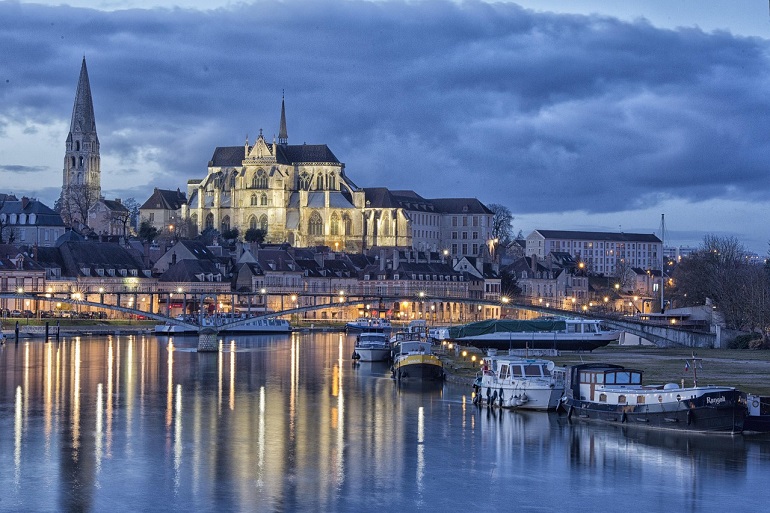
- The skyline is dominated by the Gothic Cathédrale Saint-Étienne, renowned for superb stained glass and an 11th-century crypt with rare frescoes.
- The Abbey of Saint-Germain, founded in the 5th century, preserves Carolingian crypts with some of the oldest mural paintings in France.
- Auxerre sits on the River Yonne and the Canal du Nivernais, giving it a long tradition of river trade and picturesque quays.
- Nearby vineyards produce celebrated wines including Chablis, Crémant de Bourgogne and Saint-Bris that pair with local specialities like gougères.
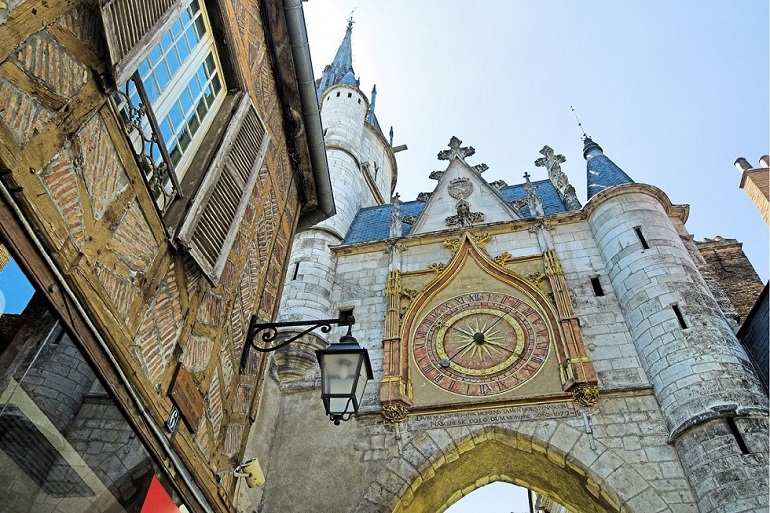
- The 15th-century Tour de l’Horloge stands on Roman foundations and anchors a district of Renaissance mansions and Art Deco façades.
- Inrap announced major recent archaeological finds in Auxerre, including a large Roman infant cemetery (2024) and one of Gaul’s largest Roman villas (2025).
- The La Marine district evokes the city’s river-borne commerce, with a fine 16th-century merchant’s house and views to the abbey.
- Auxerre’s museums range from the Brochet collection of polychrome woodcarvings to natural history holdings of around 140,000 specimens.
- The city’s identity blends Gallo-Roman roots, a medieval commune with its own town hall, and later Burgundian and French crowns.
- Auxerre is about two hours from Paris, with rail links and the A6 autoroute placing Burgundy’s heartland within easy reach.
- Local folklore celebrates Cadet Roussel, a famed court bailiff whose house stands near the clock tower.
- Auxerre’s old centre forms a protected 67-hectare conservation area, showcasing centuries of urban craftsmanship.
History
Auxerre's history stretches back to antiquity, when it was known as Autricum to the Gauls before becoming the Gallo-Roman settlement of Autissiodorum. The town flourished during pre-Roman and Roman times due to its strategic position at the intersection of land routes and waterways along the banks of the River Yonne. By the late 3rd century, it had been constituted as a provincial capital (civitas) and by 400 CE had become one of the seven cities of the civil province Lugdunensis IV. The settlement's importance continued to grow as it became the seat of a bishop in the 3rd century, marking the beginning of its significant religious heritage.
During the medieval period, Auxerre experienced considerable political upheaval and territorial changes. The town was in Frankish hands when Bishop Theodosius signed the acts of the Council of Orléans in 511. From the 10th century onwards, there was a hereditary County of Auxerre, with the first documented count being Ermenaud, a companion of Charlemagne who reigned around 770. The county changed hands multiple times: King Charles the Bald handed it over to his cousin Conrad the Younger around 853-858, before it was assigned to Robert the Strong and later administered by Hugh the Abbot of Saint-Germain d'Auxerre. The county was eventually included in the Burgundian dominion of Duke Richard the Justiciar before Count John IV sold it to the King of France in 1370. Following the Treaty of Arras in 1435 between Charles VII of France and Philip III of Burgundy, it returned to Burgundy once more before becoming definitively part of France in 1477 with the annexation of Burgundy.
Throughout its medieval and early modern periods, Auxerre maintained its status as an important religious centre whilst enduring various conflicts and reforms. The diocese was established with a true succession of bishops traceable from Marcellian (306-335), including notable figures such as Saint Amator (388-418) and Saint Germain (418-448), who was active in Britain. The bishops often served as feudal lords as much as prelates, and the diocese suffered during the Hundred Years War and the Wars of Religion. The episcopal domain, which had been established by 700 and confiscated by Pepin the Short, was later restored under Bishops Herbert I (971-995) and Hugh (999-1039). Jansenism gained a strong foothold in the region, particularly under Bishop Charles G. de Caylus (1704-1754). The religious significance of Auxerre continued until the French Revolution, when the 106th prelate, J.B.M. Champion de Cicé, witnessed the suppression of the diocese in 1790, with its territory being assigned to Sens before later reorganisations placed it under various archdioceses.
Main Attractions
Saint Stephen's Cathedral (Cathédrale Saint-Étienne)
The magnificent Saint Stephen's Cathedral dominates Auxerre's skyline with its soaring Gothic architecture and remarkable collection of stained glass windows. Construction began in the 13th century on the site of earlier Romanesque and Carolingian churches, creating a stunning example of French Gothic design that took centuries to complete. The cathedral's most captivating feature is its exceptional collection of 13th-century stained glass, considered amongst the finest in France, which bathes the interior in brilliant colours throughout the day. Visitors can explore the atmospheric 11th-century crypt beneath the main structure, adorned with rare Carolingian frescoes that provide a fascinating glimpse into medieval religious art. The cathedral's twin towers, though never completed according to the original plans, still rise impressively above the old town, offering a landmark visible from throughout the Yonne valley.

The Historic Quarter and Riverfront
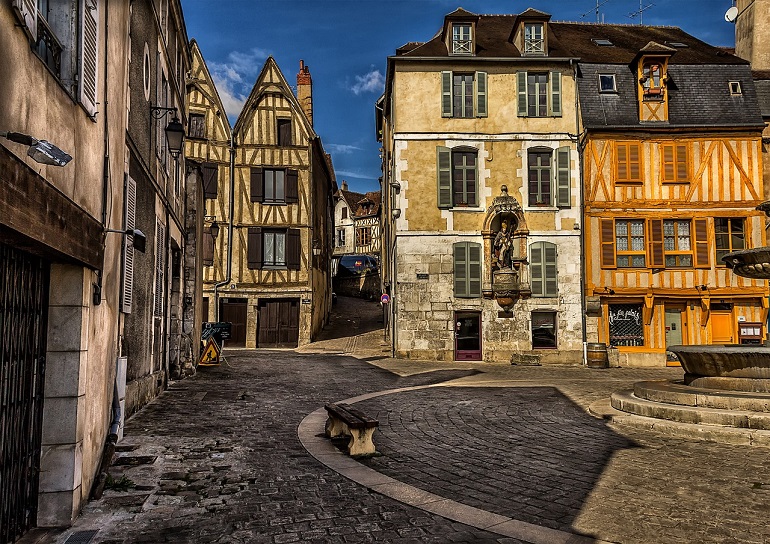
Beyond these individual landmarks, Auxerre's greatest attraction lies in wandering through its remarkably well-preserved medieval streets, where half-timbered houses lean companionably over narrow cobblestone lanes. The old town cascades down from the cathedral towards the River Yonne, creating a natural amphitheatre of historic architecture that has remained largely unchanged since the Middle Ages. Along the riverbank, tree-lined quays provide peaceful walking routes with excellent views back towards the cathedral and the old town's romantic silhouette. The Yonne itself adds to Auxerre's charm, with its slow-flowing waters reflecting the medieval buildings and creating opportunities for river cruises and waterside dining. The interplay between the ancient stone architecture and the natural beauty of the river valley makes Auxerre's historic quarter a perfect destination for leisurely exploration, photography, and experiencing the authentic atmosphere of provincial French life.
La Tour de l'Horloge (Clock Tower)
Standing proudly on Rue de la Draperie, the 15th-century Clock Tower serves as one of Auxerre's most recognisable landmarks and a symbol of the city's medieval prosperity. This imposing stone tower, with its distinctive astronomical clock, once formed part of the city's fortifications and served as both a timekeeper and watchtower for the prosperous merchant quarter. The tower's elaborate clock mechanism, featuring intricate astronomical displays, has been meticulously restored and continues to chime the hours as it has done for centuries. Visitors can admire the tower's Gothic stonework and the detailed carvings that adorn its façade, whilst the surrounding pedestrianised streets offer charming glimpses of Auxerre's well-preserved medieval architecture. The area around the tower buzzes with local life, featuring traditional shops, cafés, and weekly markets that maintain the authentic atmosphere of a French provincial town.
La Coulée Verte (Green Corridor)
La Coulée Verte represents Auxerre's commitment to green urban planning, creating a scenic linear park that stretches along former railway lines through the heart of the city. This innovative green space combines walking and cycling paths with carefully landscaped gardens, native woodland areas, and recreational facilities that serve both residents and visitors. The trail offers an excellent way to explore Auxerre's diverse neighbourhoods whilst enjoying views across the Yonne valley and glimpses of the cathedral's spires through the tree canopy. Along its route, the Coulée Verte features interpretive panels explaining local flora and fauna, making it both an educational and recreational experience. The path connects various districts of Auxerre, allowing visitors to discover hidden corners of the city away from the main tourist routes, whilst the well-maintained surfaces make it accessible for wheelchairs, pushchairs, and cyclists of all abilities.
Place du Maréchal Leclerc
The bustling Place du Maréchal Leclerc forms the vibrant commercial heart of modern Auxerre, where centuries of urban development have created a dynamic public space. Archaeological investigations have revealed that this square sits atop 2,000 years of continuous human settlement, with Roman, medieval, and modern layers creating a palimpsest of Auxerre's history beneath the contemporary paving stones. The recently renovated square now serves as the city's main gathering place, hosting regular markets, festivals, and cultural events that bring together locals and visitors throughout the year. Surrounded by a mixture of historic buildings, shops, and restaurants, the square provides an excellent base for exploring Auxerre's commercial quarter and sampling local Burgundian specialities. The space's design carefully balances historical respect with modern functionality, featuring accessible pathways, comfortable seating areas, and subtle lighting that enhances the square's appeal from morning markets through to evening entertainment.
Top Museums
Natural History & Scientific Collections
Muséum d’Auxerre
Set in a tranquil and inviting space, the Muséum d’Auxerre is a focal point for the exploration of natural sciences in Burgundy. Its collection is impressive in both scope and significance, with around 160,000 specimens that chronicle the region’s biodiversity, both past and present. The museum is particularly noted for its extensive geoscience collections, including fossils that reveal the prehistoric life that once flourished in the Yonne. Visitors can discover an array of minerals, skeletons, and taxidermied animals, displayed in comparative anatomy exhibits that are both educational and visually engaging. The museum is also an important centre for environmental education, serving both local schools and the general public with its resources and exhibitions.
In addition to its natural history holdings, the museum regularly hosts temporary exhibitions that delve into contemporary scientific topics, making it a dynamic destination for repeat visits. Its peaceful garden setting adds to the appeal, providing a reflective space for visitors to connect with both nature and scientific discovery.
Decorative Arts & Historical Collections
Musée Leblanc-Duvernoy
The Musée Leblanc-Duvernoy is an 18th-century private mansion, bequeathed to the town in 1926, that immerses visitors in both the art and domestic life of its era. As you walk through its beautifully preserved rooms, you encounter an arresting collection of Beauvais tapestries that evoke the grandeur of the period. The museum is particularly celebrated for its comprehensive array of regional ceramics, including fine examples of stoneware from Puisaye and distinctive pieces from the Revolutionary era.
Beyond ceramics, the collection features notable paintings by Charles de La Fosse and Jusepe de Ribera, among others, as well as antique furniture and decorative objects. The overall effect is one of intimacy and refinement, offering a personal encounter with the tastes and lifestyles of Auxerre’s former elite.

Sporting Heritage & Interactive Experience
AJA Expérience
AJA Expérience, inaugurated in March 2024, is a vibrant and innovative museum that delves into the heart of one of France’s most legendary football clubs, AJ Auxerre. Located within the Abbé Deschamps stadium, this immersive attraction is designed to appeal as much to sports fans as to those curious about local identity.
The experience is divided into 15 interactive stages that blend the thrill of football with museum storytelling. Visitors can relive the club’s greatest triumphs and dramatic moments through a rich display of trophies, memorabilia, and archival video footage. The museum also offers a behind-the-scenes look at the stadium, providing access to areas such as the changing rooms and pitch-side. AJA Expérience is not just about celebrating achievements; it is also about exploring the values, community spirit, and human stories that have defined the club for generations. This makes it a compelling symbol of regional pride, connecting the past, present, and future of both the team and its devoted supporters.
Local Cuisine
Classic dishes such as gougères—light, savoury cheese puffs—often feature as an appetiser, while oeufs en meurette serves up poached eggs bathed in a vivid red wine sauce. The city is famed for its chablis, a crisp white wine produced from nearby vineyards, frequently enjoyed together with jambon persillé, a parsley-laced ham terrine. For a sweet finish, visitors can sample pain d’épices, a subtly spiced honey cake, or delicious produits du terroir including artisan cheeses and charcuterie sourced from the region’s lush countryside.
Getting There
Auxerre is easily accessible from major French cities and makes for a convenient destination in the heart of Burgundy. The most straightforward way to reach Auxerre is by train from Paris, with regular services departing from Gare de Bercy taking approximately 1 hour and 45 minutes. Trains typically run every two hours in both directions, and you may need to connect at Larroche-Migennes depending on your service. The town's railway station, Gare d'Auxerre-Saint-Gervais, is conveniently located within a pleasant 10-15 minute walk of the historic old town centre. For those travelling by car, Auxerre sits directly on the A6 autoroute, roughly 170 kilometres south of Paris and 150 kilometres north of Dijon, making it an ideal stopping point when exploring Burgundy. The town is also well-connected by train to other regional centres, with journeys of approximately 2 hours from Dijon and 4 hours from Lyon. Bus services operate from Paris, though these take considerably longer than the train, whilst international visitors can easily reach Auxerre via Paris using Eurostar connections from London, with the total journey time around 6 hours.
| Travel destinations in Burgundy | ||||||||||||||
|---|---|---|---|---|---|---|---|---|---|---|---|---|---|---|
|
|
|
|
| ||||||||||
|
|
|
|
| ||||||||||
| >
| |||||||||||||


