


| Contents |
|---|
Introduction
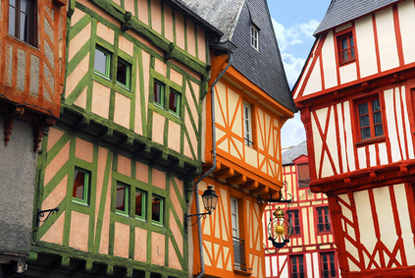
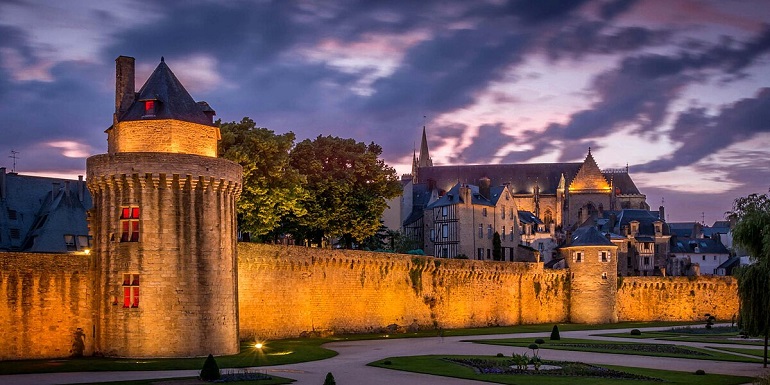
Facing the Gulf of Morbihan, Vannes (pop. 55,000) is a delightful fortified city featuring 13th to 17th-century ramparts that remain intact on the eastern side, enclosing a historic centre filled with colourful half-timbered houses, cobblestone streets, and medieval gates. The town's heart is dominated by the Gothic and Renaissance Saint-Pierre Cathedral, originally built in 1450 after the Norman destruction of its predecessor in the 10th century. As a designated City of Art and History, Vannes serves as both an important agricultural and light industrial centre, producing poultry, cattle feed, tyres, and prefabricated building materials, whilst its scenic port provides access to boat trips around the Gulf of Morbihan and its numerous islands. The historic old town, largely pedestrianised and dating primarily from the 16th century, offers visitors an authentic medieval atmosphere with its network of narrow streets, ancient defensive towers including the 15th-century Connétable Tower, and beautifully maintained rampart gardens.
Interesting Facts about Vannes
- Vannes takes its name from the ancient Celtic Veneti tribe and grew around a strategic harbour on the Gulf of Morbihan.
- The medieval old town is famed for its brightly painted half-timbered houses clustered around Place Henri-IV.
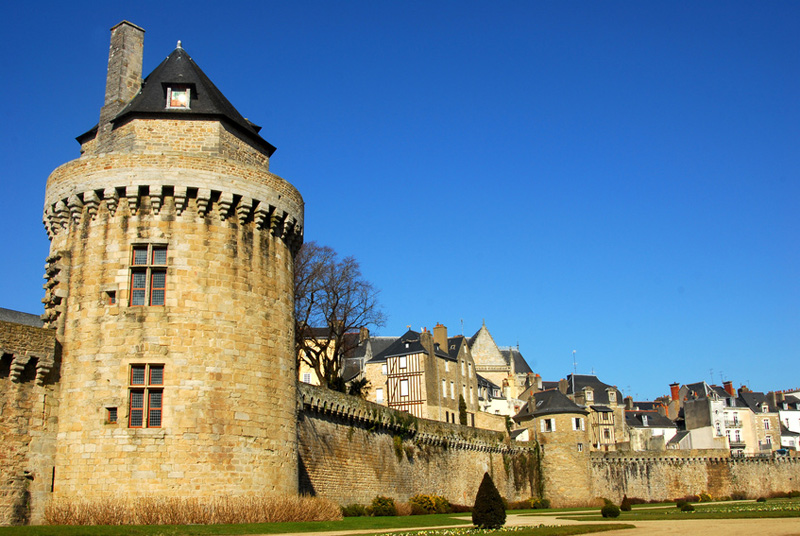
- Well-preserved ramparts and towers still encircle much of the historic centre, with manicured gardens laid out below.
- Saint-Peter’s Cathedral in Vannes was rebuilt over several centuries, blending Gothic elements with later additions.
- The city’s 17th-century Porte Saint-Vincent gate leads from the old town towards the marina and harbourfront.
- Vannes served for a time as a ducal seat in Brittany, with the Château de l’Hermine historically linked to the dukes.
- Markets remain a lively tradition in Vannes, reflecting its long role as a regional trading centre.
- The city provides a gateway to the island-studded Gulf of Morbihan, prized for sailing and coastal scenery.
- Public washhouses known as lavoirs survive along the river by the ramparts, evoking everyday medieval life.
- Vannes balances its historic core with modern amenities, making it a popular base for exploring southern Brittany.
History
Vannes's history began with the Celtic Veneti tribe who established a settlement in this strategically positioned location at the mouth of the Marle and Vincin rivers. The seafaring Veneti were skilled traders who maintained extensive commercial networks with Britain for thousands of years, likely using hide boats and perhaps Ferriby boats to transport goods including wheat from the Middle East. Archaeological evidence suggests that around 150 BCE, trade with the Thames estuary area of Great Britain dramatically increased, demonstrating the Veneti's sophisticated maritime commerce. However, this prosperous Celtic civilisation met its end in 56 BCE when Julius Caesar's fleet decisively defeated the Veneti in front of Locmariaquer, resulting in the slaughter or enslavement of many tribal members.
The Roman conquest transformed the region completely, with the Romans establishing the settlement of Darioritum on the site of the former Veneti stronghold. By the end of the 1st century BCE, the Romans had constructed the first fortifications known as the Ramparts of Vannes to protect the city during periods of crisis. The Roman period established Vannes as a key administrative centre in the province of Armorica, with its strategic location making it a vital trading hub. From the 5th to 7th centuries, waves of Briton immigrants fleeing Saxon invasions of Britain displaced or assimilated the remaining Gauls, bringing new cultural influences to the region. Under the Breton name Gwened (also derived from the Veneti), the town became the centre of an independent principality or kingdom called Bro-Wened or Bro-Ereg, with its ruling dynasty claiming descent from Caradog Strongarm. The diocese of Vannes was established in the 5th century, and the important Council of Vannes was held there in 461. As the Duchy of Brittany was formed, the old Celtic kingdom evolved into the feudal County of Vannes in 799.
The medieval period witnessed Vannes' emergence as one of Brittany's most significant cities, particularly during the tumultuous Breton War of Succession when the city was besieged four times in 1342 by forces from both sides. The city's defending commander, Olivier IV de Clisson, was captured by the English and later executed by the French who suspected him of treason due to the unusually low ransom demanded. During the 14th century, Duke John IV chose Vannes as his capital and extended the impressive ramparts to enclose nearly 25 acres within the city walls, whilst also constructing the Château de l'Hermine to house the dukes of Brittany until 1458. A pivotal moment in Breton history occurred in 1532 when the Union of Brittany and France was signed in Vannes, officially integrating Brittany into the Kingdom of France after François I stayed in the city to prepare the union treaty. The 18th century brought renewed military significance when Vannes served as the staging point for a planned French invasion of Britain in 1759, though the assembled army never sailed following the French naval defeat at the Battle of Quiberon Bay. During the French Revolution in 1795, French forces based in Vannes successfully repelled a planned British-Royalist invasion through Quiberon. The 19th century saw the completion of the neo-Renaissance Hôtel de Ville in 1886, symbolising the city's continued importance as a regional centre.
Main Attractions
Les Remparts de Vannes and Jardins des Remparts
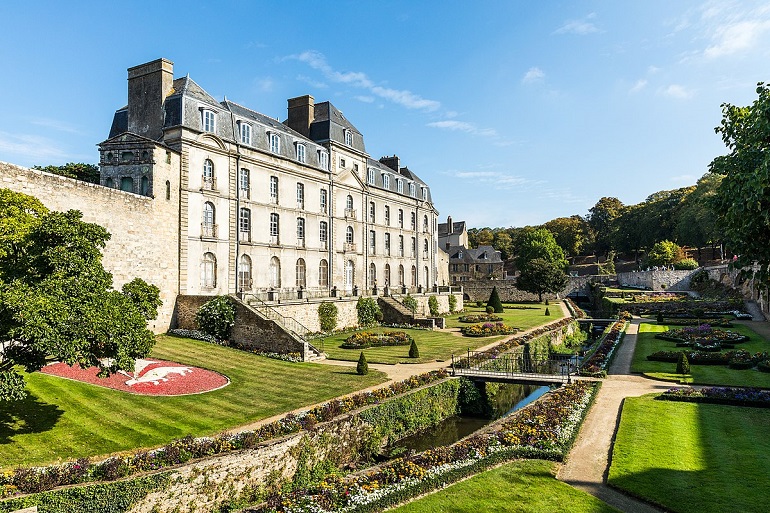
Les Remparts de Vannes and Jardins des Remparts form the city's most distinctive feature, with Vannes being one of the rare medieval cities to preserve more than three-quarters of its original defensive walls. These fortifications evolved continuously from the 3rd century through to the 17th century, beginning with Roman foundations and expanding through successive periods to adapt to changing military needs. The ramparts encompass impressive buttresses, gates, and watchtowers that offer stunning views across the medieval architecture of the old town. Adjacent to these ancient walls lie the enchanting Rampart Gardens, where manicured lawns, colourful flowerbeds, and the meandering Marle River create a peaceful retreat from the bustling cobbled streets. The gardens provide some of the finest panoramic views in Vannes, looking out across the city's rooftops and historic monuments, making them an essential stop for any visitor seeking to appreciate the city's medieval grandeur.
Historical Centre
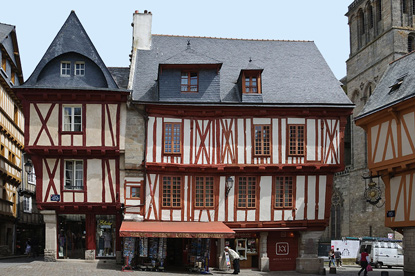
Centre Historique de Vannes presents a remarkably well-preserved medieval townscape that appears virtually untouched by time, earning it recognition as one of Brittany's finest historic quarters. The old town's narrow cobbled streets wind between magnificent timber-framed houses dating from the 15th and 16th centuries, their colourful facades creating a photographer's paradise around every corner. This historic heart encompasses numerous significant squares and landmarks, with the entire quarter enclosed within the ancient city walls that have protected it for centuries. Visitors can spend hours wandering these atmospheric streets, discovering hidden courtyards, admiring the intricate woodwork of the medieval houses, and soaking up the authentic Breton atmosphere that has been carefully preserved through the ages.
Château de l'Hermine
Château de l'Hermine occupies a prime position within the city ramparts, its elegant 18th-century façade replacing the original 14th-century castle that once served as a residence for the Dukes of Brittany. Built in 1798 after the original fortress was demolished during the reign of Louis XIV, the current château maintains the site's historical significance whilst presenting a more refined architectural approach typical of the late 18th century. The castle's strategic location backing onto the Rampart Gardens creates a particularly scenic setting, allowing visitors to appreciate both the building's architectural merits and its integration into Vannes's defensive landscape.
Port de Vannes (Harbour)
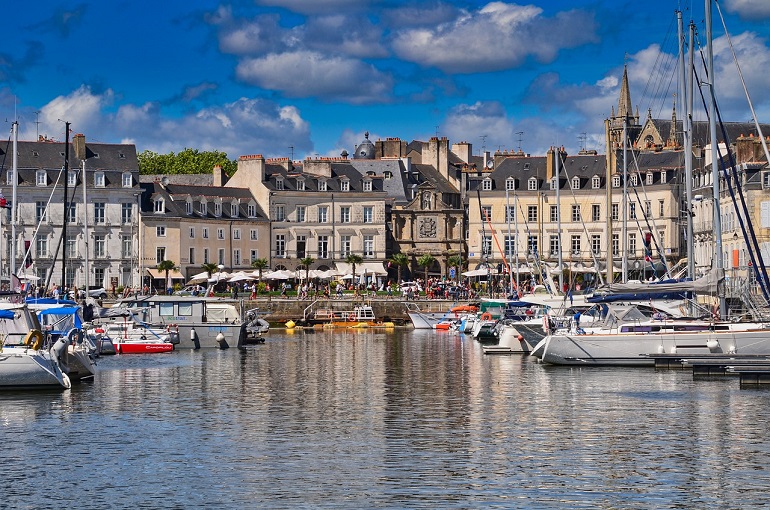
Port de Vannes offers a picturesque maritime escape at the confluence of the Marle and Vincin rivers, where the inlet opens into the sheltered waters of the Gulf of Morbihan. The harbour comes alive with colourful fishing boats and pristine yachts gently swaying in the salty breeze, whilst the waterfront promenades provide perfect spots for leisurely strolls and al fresco dining at the numerous seafood restaurants. This working port maintains its authentic character as both a commercial fishing harbour and a pleasure boat marina, offering visitors the opportunity to observe daily maritime life or embark on boat trips to explore the nearby islands and stunning coastal landscapes of the Gulf of Morbihan.
Place Henri IV
Place Henri IV stands as one of Vannes's most photographically rewarding locations, situated beneath the cathedral and showcasing a spectacular collection of 16th-century buildings. This historic square serves as a showcase of medieval and Renaissance architecture, with its surrounding timber-framed houses creating an almost theatrical backdrop that has remained largely unchanged for centuries. The square's strategic position in the heart of the old town makes it a natural gathering point for visitors exploring the historic quarter, whilst its proximity to the cathedral and other major attractions ensures it remains at the centre of Vannes's tourist trail.

Cathédrale Saint-Pierre
Cathédrale Saint-Pierre stands as Vannes's most imposing architectural masterpiece, dominating the city's skyline with its soaring 66-metre spire. This magnificent Gothic cathedral represents over 600 years of continuous construction, beginning in the 13th century and extending through to the 19th century, resulting in a fascinating blend of architectural styles including Romanesque, Gothic, and neo-Gothic elements. The cathedral's exterior features an ornately carved tympanum above the main door and a striking neo-Gothic façade, whilst the interior captivates visitors with its vaulted ceiling, vivid stained-glass windows, and impressive religious artefacts including a 17th-century organ and an 18th-century carved wooden altarpiece. Built upon the site of an ancient 10th-century Romanesque church, the cathedral also houses the tomb of Saint Vincent Ferrier, the Spanish monk who became Vannes's patron saint after living and dying in the city during the 15th century.
Porte Saint-Vincent
Porte Saint-Vincent serves as the grand ceremonial entrance to Vannes's historic quarter, this imposing 17th-century gateway having been reconstructed in the 18th century to create the magnificent stone portal visitors see today. Named after Saint Vincent Ferrier, the Spanish monk who became the city's patron saint, this beautifully preserved gate features intricate stone carvings depicting scenes from Vannes's rich history. As the traditional entrance where traders and fishermen once entered the city from the nearby port, passing through this towering gateway provides visitors with an authentic sense of stepping back in time and experiencing how medieval merchants would have first encountered this fortified city.
Hôtel de Ville (Town Hall)
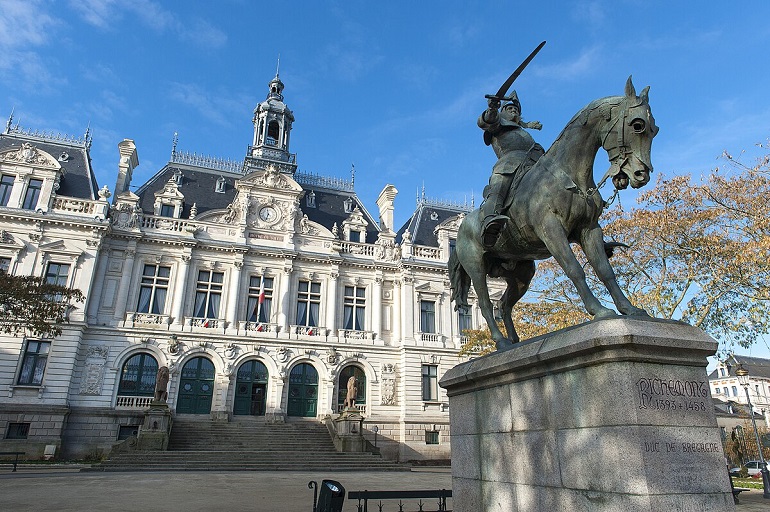
Dominating Place Maurice-Marchais, the Hôtel de Ville rises as a paean to Vannes’s Belle-Époque ambition. Completed in 1886 to plans by architect Amand Charrier, the ashlar-stone building embraces a lavish neo-Renaissance vocabulary, earning it a reputation as a miniature echo of Paris’s city hall. Its perfectly symmetrical eleven-bay façade centres on a five-arched loggia reached by shallow steps, with Corinthian columns and pilasters framing tall mullioned windows capped by alternating pediments. A clock flanked by sculpted caryatids sits beneath a segmental pediment, all crowned by a 37-metre belfry that presides over the old town’s rooftops. Inside, a grand marble staircase sweeps up to the chandelier-lit Salle des Fêtes, an ornate council chamber and elegant wedding room, each space radiating the civic pride of late-19th-century Brittany.
Place des Lices
Place des Lices transforms into one of Vannes's most vibrant attractions during the weekly markets held on Wednesdays and Saturdays, when this medieval square dating from the 14th century fills with local vendors selling fresh produce, crafts, and regional specialities. Historically, this square served as the venue for jousting tournaments during the Middle Ages, and its spacious layout still reflects its original purpose as a gathering place for public events. The surrounding architecture maintains its medieval character, whilst the regular markets provide visitors with an authentic glimpse into local Breton culture and an opportunity to sample regional delicacies and artisanal products.
Golfe du Morbihan Natural Regional Park
Golfe du Morbihan Natural Regional Park extends beyond Vannes's urban boundaries to encompass an extraordinary natural landscape of coastal waters, islands, and diverse ecosystems that make it one of Brittany's most treasured environmental areas. This expansive park offers numerous hiking trails, kayaking opportunities, birdwatching sites, and fishing spots, all within easy reach of Vannes city centre. The park's combination of maritime environments, wetlands, and coastal paths provides visitors with access to pristine nature and wildlife viewing opportunities, whilst its network of well-maintained trails and facilities ensures that outdoor enthusiasts of all abilities can explore this remarkable corner of Brittany's coastline.
Top Museums
Old Town Heritage Museums
Museum of Fine Arts – La Cohue
Nestled in the heart of Vannes, overlooking the cathedral square, La Cohue is not just a museum but a living monument to the city’s layered history. Its name, derived from an old Breton word for a market hall, aptly reflects its origins as a 13th-century covered market. Through the centuries, this grand hall with its imposing timbered ceiling and thick stone walls has served as the market for butchers, the judicial seat of the Dukes of Brittany, and later, after the French Revolution, as a theatre.
Today, La Cohue stands as the foremost art museum in Vannes, its very architecture a counterpoint and backdrop to the collections within. The ground floor, once bustling with merchants, now hosts temporary exhibitions—often large-scale contemporary installations—in a dramatic, vaulted space. The play of light through the narrow windows and the echo of footsteps on stone emphasise the dialogue between art, history, and place.
On the upper floors, the permanent collections are arranged with sensitivity to both chronology and atmosphere. The museum boasts an impressive selection of 19th- and 20th-century paintings, many by artists deeply connected to Brittany. You will find works by Eugène Delacroix, including his arresting Christ on the Cross, alongside those of Charles Cottet, Henri Moret, and Jean Frélaut—artists who captured the region’s rugged landscapes, seascapes, and the daily life of its people.
One of the museum’s most distinctive features is its dedicated room for Geneviève Asse, a celebrated abstract artist born in Vannes. Her luminous canvases, dominated by a signature blue, evoke the shifting light and vast horizons of her native region. The Geneviève Asse Room is not just a tribute but a place of quiet contemplation, where colour and space interact in unexpected ways.
The museum carefully balances its historical and artistic roles, often hosting special exhibitions that spotlight local artists or thematic explorations of Breton culture. Its ongoing renovation, led by a renowned architectural firm, promises to further enhance these experiences, blending medieval grandeur with modern curatorial vision.
Museum of History and Archaeology – Château Gaillard
Château Gaillard, a beautifully preserved 15th-century mansion tucked into the cobbled streets of the old town, is home to the Museum of History and Archaeology. Its ornately carved stone façade and interior courtyards evoke the opulence of late medieval Vannes, once the seat of the Duchy of Brittany’s chancellor.
Today, the mansion’s lofty halls and intimate chambers are filled with artefacts that trace the city’s story from prehistoric times to the present. The museum’s most celebrated collection is its prehistoric section, featuring finds from the iconic megalithic sites of Carnac and Locmariaquer. Here, visitors encounter beautifully polished stone axes, displayed in the same stacked arrangement in which they were discovered, alongside exquisite Neolithic jewellery such as bracelets and necklaces made from local materials.
The journey continues with the region’s rich Bronze and Iron Age heritage, highlighted by bronze axe hoards and everyday objects that reveal the technological and artistic achievements of ancient Brittany. The displays are meticulously curated, with informative panels—some in English—that contextualise the significance of each artefact.
The museum also dedicates space to the Gallo-Roman era, with coins, pottery, and glassware attesting to Vannes’ importance as a Roman settlement. The scale is intimate, allowing for a contemplative pace that encourages visitors to linger over each display and imagine the lives of those who once walked these same streets.
Special exhibitions are occasionally held, focusing on themes such as maritime archaeology or the medieval guilds of the city. Château Gaillard’s current closure for renovation means its remarkable collections may temporarily be relocated or featured in special displays elsewhere in Vannes.
Contemporary Art Galleries and Creative Spaces
Le Kiosque
Located near the ramparts of the old town, Le Kiosque is a contemporary art space dedicated to showcasing the work of emerging and established artists. Its programming is eclectic, often featuring multimedia installations, photography, and experimental works that engage with both local and international themes. The venue’s open, adaptable layout encourages interaction and reflection, making it a hub for creative dialogue within the community.
Galerie les Funambules
Galerie les Funambules prides itself on a dynamic programme of exhibitions by local and visiting artists. The gallery’s focus is on accessibility and engagement, with frequent artist talks, workshops, and community events. Its exhibitions span painting, sculpture, and conceptual art, with a special emphasis on works that respond to the unique cultural and environmental context of Brittany.
Other Notable Galleries
Vannes’ smaller galleries, such as Galerie Melrose Arts and La Galerie Les Bigotes, contribute to the city’s vibrant cultural scene. These spaces often feature solo or group shows by regional artists, offering a more intimate setting for encountering contemporary art. The exhibitions are frequently rotated, ensuring that repeat visitors always discover something new and unexpected.
Local Cuisine
Visitors can savour exquisite seafood, with fresh oysters and mussels from the Gulf of Morbihan being unmissable highlights, often enjoyed at harbourside brasseries. The city is famed for its crêpes and galettes, delicate pancakes made from wheat or buckwheat flour and filled with an array of sweet or savoury ingredients. Sweet lovers should try the kouign-amann, a decadent buttery pastry unique to Brittany, or the far breton, a traditional prune-studded custard tart. Wash it all down with a glass of crisp Breton cider, the perfect accompaniment to these regional delights.
Getting There
By train Frequent high-speed TGV services link Paris Montparnasse to Vannes in under three hours via Rennes, while regular TER regional trains connect the town with Rennes, Nantes and Quimper; the station sits a short stroll north of the medieval centre, making onward exploration effortless.
By coach Long-distance coaches such as BlaBlaCar Bus and FlixBus run direct routes from Paris, Nantes, Rennes and other Breton cities, calling at the coach park beside the railway station, a handy option if you prefer a budget-friendly, luggage-friendly journey or are starting from a town the rail network barely touches.
By car Vannes lies just off the N165/E60 dual carriageway that sweeps along Brittany’s south coast between Nantes and Brest; leave at junctions signed for Vannes-Centre and follow the ring road to plentiful park-and-ride sites or the covered car parks outside the ramparts, with scenic detours possible along the Gulf of Morbihan’s coastal roads.