Introduction
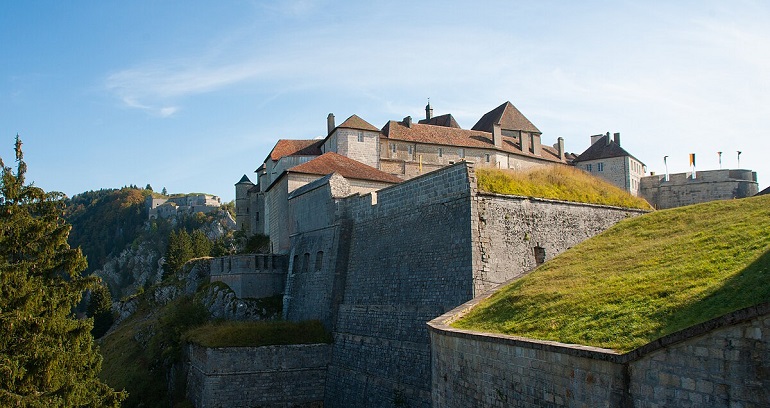
Known alternatively as the Fort de Joux or Château de Joux, this castle perched on the edge of a cliff in the Jura mountains commands the mountain pass "Cluse de Pontarlier" between France and Switzerland. Originally constructed in the 11th century as a wooden fortress and subsequently rebuilt in stone, this imposing structure has evolved through successive expansions and modifications by various rulers, from medieval lords to the Duke of Burgundy, Spanish monarchs, and ultimately French kings. The fortress comprises five defensive rings, three moats, three drawbridges, and over 250 rooms spread across two hectares, reflecting centuries of military engineering development. Beyond its military significance, the château served as a state prison from the 17th to 19th centuries, housing notable figures including the revolutionary leader Mirabeau and Haitian independence hero Toussaint Louverture, who died within its walls in 1803. Today, this historical monument houses a museum displaying over 600 rare weapons and features one of France's deepest wells, originally reaching 147 metres into the bedrock. The château's commanding position overlooking the narrow mountain pass that connects France with Switzerland underscores its enduring strategic importance throughout European history.
Interesting Facts about Joux Castle
- The Château de Joux crowns a rocky promontory above the narrow Cluse pass near Pontarlier, commanding a historic trade and military route between France and Switzerland.
- It uniquely showcases the full evolution of European fortification across roughly 1,000 years, from a wooden 11th-century outpost to a modernised border fortress.
- The fortress was repeatedly remodelled by successive powers—Burgundian, Habsburg, Spanish and French—reflecting its strategic value at Europe’s crossroads.
- Vauban, Louis XIV’s famed military engineer, modernised the stronghold in the late 17th century, adding major defensive works that reshaped its profile.
- With five concentric lines of defence, three moats and three drawbridges, the site forms a layered bastion complex sprawling over two hectares and some 250 rooms.
- In the 18th and 19th centuries it served as a state prison, confining figures such as Mirabeau and Toussaint Louverture, the Haitian revolutionary leader who died there in 1803.
- A remarkable well plummets about 147 metres into the rock—once reputed the deepest in France—now measured around 101 metres due to partial infill.
- Captain Joseph Joffre, later Marshal of France, oversaw 19th-century modernisations that integrated the site into a regional defensive system with nearby Larmont forts.
- Today the fortress houses an arms museum with 600-plus weapons, including a rare 1717 rifle, tracing technological change from the early 18th to 20th centuries.
- Recognised as a historic monument, the château remains a dramatic symbol of the Jura, open to visitors as a living lesson in military architecture and memory.
History
First built in wood in the 11th century, the castle was rebuilt in stone in the next century. After passing into the hands of the Ducjy of Burgundy, then of the Habsburgs Empire, a new fortress was planned by Vauban, Louis XIV's celebrated military architect, in 1690.
During the 18th and 19th centuries, including the French Revolutionary period, the fortress was used as a state prison, among whose most famous residents were Mirabeau, André Rigaud, Heinrich von Kleist and Toussaint Louverture (who died there from cold and malnutrition).
In 1879, Captain (later General) Joffre, then a military engineering officer, modernises the citadel by installing casemates that could accommodate 155 mm cannons, the largest pieces of artillery at the time.
The fortress currently houses a museum of arms that exhibits more than 600 rare weapons dating from the early 18th to the 20th centuries.
Description
Scale and Layout
- The complex sprawls over roughly two hectares and is organised in five concentric enclosures.
- Visitors pass through three drawbridges and as many dry moats before reaching the innermost courtyard, a progression that reveals new angles on the fort at every turn.
- More than 250 rooms—from vaulted powder magazines to officers' quarters—are threaded together by covered walkways, caponiers and a network of underground corridors.
Architectural Highlights
- Horseshoe Tower – A massive, semi-cylindrical bastion whose thick masonry once absorbed cannon shot. Today its three-tiered gun platforms offer a spectacular balcony over the valley.
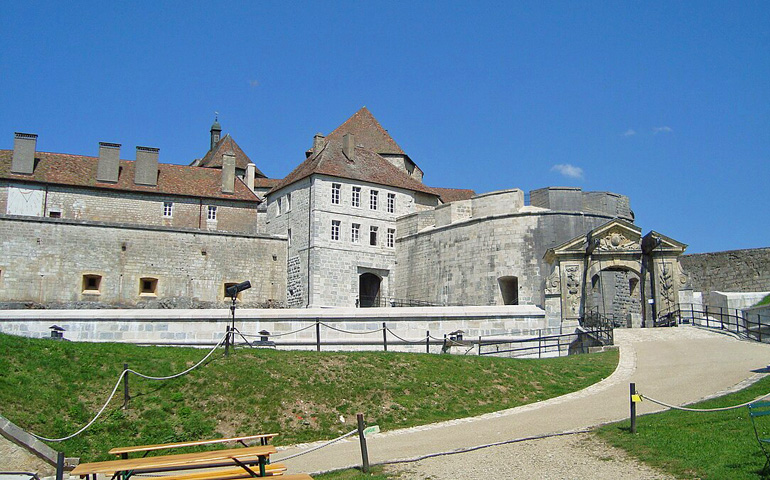
- Vauban Gate of Honour – An elegant stone portal crowned with sculpted trophies; its discreet symmetry contrasts with the fortress's otherwise martial silhouette.
- Great Well – Dropping over 140 m through solid rock, this vertiginous shaft is visible from a suspended platform. A pulley once hauled buckets with the aid of a human hamster wheel—still in place and impressively intact.
- Joffre Staircase – A tight spiral of some 250 steps linking the lower parade ground to cliff-top batteries. The climb rewards walkers with a panoramic gallery peering across French and Swiss countryside.
Interior Atmosphere
Thick, lime-washed walls hold a constant, cool hush even on summer afternoons. In the dungeons, the air feels noticeably damper and the stone blocks glisten under discreet uplighting, while the high barrack rooms remain bright thanks to deep-set windows that frame alpine scenery like living watercolours.
Exhibitions and Collections
- Museum of Historic Arms – Over 600 pieces chart the evolution from flintlock to repeating rifle. Labels are bilingual, and several showcase drawers allow closer viewing of ornate lock-plates and damascened barrels.
- Multimedia Installations – Short, subtitled films explain engineering feats such as the angled bastions and the 19th-century earth-covered casemates. Interactive touch tables let children plot imaginary artillery arcs across the surrounding slopes.
Visitor Experience
- Guided Routes – Standard tours last 1 hr 15 min and traverse three levels; an extended option explores off-lit galleries seldom open to the public. Audio guides in multiple languages are included in the basic ticket.
- Accessibility – Surfaces are predominantly cobbled or natural rock, and gradients can be steep; sturdy footwear is essential. A free shuttle minibus links the reception area to the upper gate for those with limited mobility.
- Facilities – Within the former bake-house you'll find a small café serving local charcuterie and mountain cheeses. The adjoining terrace doubles as a lookout platform with telescopes. A well-stocked book and gift shop occupies the old guardroom, and sheltered picnic tables stand beside the outer moat.
Setting and Surroundings
Encircling pine forests perfume the air with resin, while the cliff-edge platforms deliver unbroken views towards the Alps on clear days. Golden eagles are occasionally spotted surfing the up-draughts at eye level, and in early autumn the grassy slopes below the walls blush with crimson bilberry leaves—adding a final splash of colour to an already breathtaking scene.
Getting There
By train Pontarlier is the nearest station, served by direct TER regional services from Besançon and faster TGV connections via Frasne; from Pontarlier, local taxis cover the 5 km uphill stretch to the castle, or keen walkers can follow the signed footpath in about an hour.
By coach or bus Long-distance BlaBlaCar and regional coaches stop at Pontarlier’s bus station, where you can change to the seasonal Line 590 or the Pontarlier–La Cluse-et-Mijoux local bus, alighting at Frambourg for the final 15-minute walk through the forest to the fortress.
By car Take the D437 from Pontarlier towards La Cluse-et-Mijoux, then follow signs for Route du Château; the access road climbs steeply but ends at two small car parks right below the ramparts, with overflow spaces in the village if these are full.


