


| Contents |
|---|

Introduction
The Château de Dampierre in Dampierre-en-Yvelines stands as one of France's finest examples of Baroque architecture, designed by Jules Hardouin-Mansart between 1675 and 1683 for Charles Honoré d'Albert, Duke of Chevreuse and son-in-law of Jean-Baptiste Colbert. Built of sandstone and brick, this medium-sized château replaced an earlier 16th-century structure that had belonged to the dukes of Chevreuse for over four centuries. The estate features formal gardens designed by André Le Nôtre, complete with ornamental lakes and canals that reflect the château's elegant façade, whilst the interiors showcase sumptuous decorations and a reconstructed grande galerie that houses archaeological collections. Protected by fine wrought iron gates installed in 1758, the château welcomed French royalty including Louis XIII, Louis XIV, and Louis XV, and continues to serve as one of the largest privately-owned châteaux in the Paris region.
Interesting Facts about the Château de Dampierre
- The Château de Dampierre was built between 1675 and 1683 by Jules Hardouin-Mansart, the celebrated architect of Versailles, for Colbert’s son-in-law, the duc de Chevreuse.
- Its formal park was laid out by André Le Nôtre, featuring axial vistas, water features and parterres emblematic of French Baroque garden design.
- Despite its grandeur, the château is of relatively modest scale, often compared with contemporaries like Het Loo for its harmonious proportions.
- The estate belonged to the powerful d’Albert de Luynes family for centuries, hosting royal visitors including Louis XIII, Louis XIV and Louis XV.
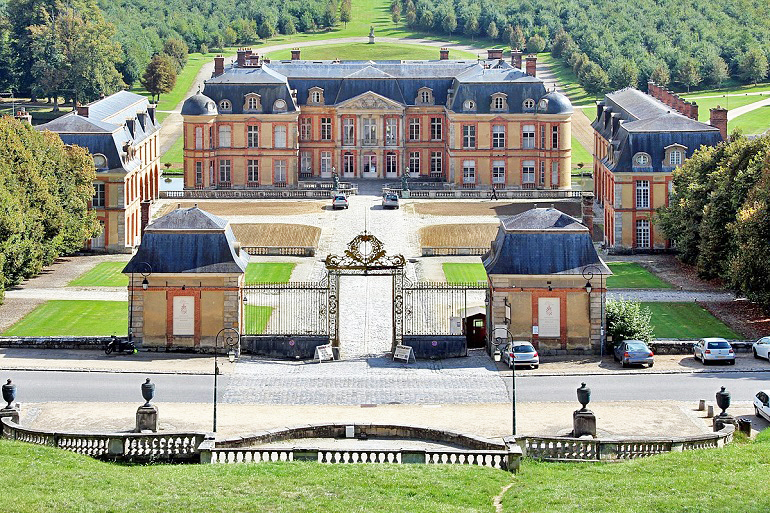
- The entrance is marked by elegant wrought-iron gates, framing a classical cour d’honneur with a symmetrically arranged corps de logis and outbuildings.
- In the 19th century, Félix Duban reimagined the grande galerie for the antiquarian duc de Luynes, with Hellenic friezes by Pierre-Charles Simart.
- Jean-Auguste-Dominique Ingres’s Age of Gold is linked to an unrealised fresco project for the château’s decoration.
- The park suffered heavy storm damage on 26 December 1999, yet still preserves its canal and an 18th-century garden folly.
- The wider 400-hectare domain in the Vallée de Chevreuse blends Baroque formality with bucolic woodland, lakes and long hunting vistas.
- The château and grounds have periodically reopened after restoration campaigns, drawing visitors with architecture, landscape and film connections.
History
The Château de Dampierre, located in Dampierre-en-Yvelines within the picturesque Vallée de Chevreuse, has a fascinating history that spans several centuries. Originally serving as a residence for the Cardinal Charles de Lorraine, Archbishop of Reims and Duke of Chevreuse during the 15th century, the original castle was deemed too austere by its owner and was subsequently enlarged and embellished in the 16th century. During the 15th century, the château passed to the prestigious Luynes family through the Duchess Marie of Rohan, widow of Charles d'Albert de Luynes. The property became even more prominent when Charles Honoré d'Albert, grandson of the duchess, married Colbert's eldest daughter, making him an influential member of the royal court.
The château we see today is largely the creation of the late 17th century, when Charles Honoré d'Albert de Luynes commissioned the renowned architect Jules Hardouin-Mansart to undertake a massive reconstruction between 1675 and 1688. Hardouin-Mansart, who was simultaneously working on the Palace of Versailles for King Louis XIV, created a masterpiece of French Baroque architecture of medium size. The building was constructed from sandstone and brick, featuring a main block and outbuildings arranged symmetrically around a formal courtyard, protected by fine wrought iron gates. The famous garden designer André Le Nôtre created the park with its formally shaped water features, canals, and French formal gardens, making Dampierre one of the finest examples of 17th-century French estate design.
Throughout the 18th and 19th centuries, Dampierre continued to evolve whilst maintaining its historical significance. During the 18th century, whilst the exterior remained largely unchanged, many interior improvements were made with intricate woodwork replacing worn 17th-century ornaments, and an imposing entrance gate was installed in 1758. The 19th century brought significant renovations under Honoré Théodoric d'Albert de Luynes, the eighth Duke of Luynes, who was an amateur archaeologist and collector. He employed the architect Félix Duban, famous for his restoration of Sainte-Chapelle in Paris, to remodel parts of the castle whilst preserving its historical character. Duban reconstructed the grande galerie and created a new grand staircase, with sculptor Pierre-Charles Simart contributing Hellenic friezes and reliefs. The château attracted royal visitors throughout its history, including Louis XIII, Louis XIV, and Louis XVI, who frequently visited to enjoy hunting in the game-rich forests of the Chevreuse Valley.
Description
Exterior and Architectural Details
The principal elevation presents a restrained Louis XIV symmetry: rusticated ground-floor masonry rises to smooth ashlar on the piano nobile, divided by slim pilasters that carry an unbroken entablature. Central double doors, framed by chiselled stonework and flanked by fluted columns, are crowned with a low pediment bearing the family crest in high relief. Wrought-iron balconies, hand-forged in swirling arabesques, project subtly beneath tall French windows, adding a filigree grace against the stone.
Slate mansard roofs tilt at a shallow angle, pierced by dormer windows whose carved surrounds resemble folded linen. At each corner, compact turrets capped with ogee domes soften the skyline, their lead finials catching the light and glinting like discreet jewellery.

The Entrance Hall and Staircase
Crossing the threshold, visitors are greeted by a vestibule of considerable grandeur. The floor stretches in an alternating pattern of Carrara marble and Belgian black stone, each square polished to mirror-like perfection. Overhead, a coffered ceiling painted in soft grey and gold creates an impression of measured height without overwhelming the space. Four Ionic columns of rose-veined marble support the structure, their capitals picked out with discreet gilding that catches the light from tall windows.
The monumental staircase rises in a graceful double sweep, its limestone treads worn smooth by centuries of footsteps yet still gleaming. The wrought-iron balustrade represents the pinnacle of French metalworking: each baluster twists in a spiral motion, punctuated by rosettes and palmettes executed with extraordinary delicacy. At the newel posts, bronze dolphins support torch-like finials that once held oil flames and now house subtle electric fixtures.
Above the first landing, a spectacular trompe-l'œil ceiling dissolves the architectural boundaries. Painted clouds drift across an azure sky, whilst cherubs bearing garlands of roses and jasmine appear to float just beyond reach. At the corners, painted balustrades extend the illusion, creating the sensation of ascending not merely to the piano nobile but towards celestial realms.
Ground Floor Reception Rooms
The Grand Salon
The Grand Salon occupies the full width of the central block, its three tall windows offering uninterrupted views across the parterre. Walls are panelled in boiseries of exceptional refinement: cream-painted oak frames enclose panels of pale blue silk damask, whilst gilded mouldings trace delicate patterns of acanthus leaves and ribbon-tied bouquets. The carved overdoors depict pastoral scenes in grisaille, executed with such precision that visitors often mistake them for actual reliefs.
Two chimneypieces of Languedoc marble anchor the room's shorter walls. Above each mantel, pier glasses framed in carved and gilded wood multiply the sparkle of three magnificent crystal chandeliers. These luminaires, crafted in the Bohemian tradition, cascade in tiers of faceted drops that cast rainbow fragments across the walls when afternoon sun streams through the windows.
The parquet de Versailles floor presents an intricate geometry of oak, walnut and ebony, its pattern radiating from a central medallion that echoes the ceiling's painted roundel above. Furniture includes a pair of Beauvais tapestry settees depicting mythological scenes, their silk threads still vibrant after two centuries. Scattered about the room, marquetry side tables display Sèvres porcelain figurines and silver-mounted mother-of-pearl boxes.
The Blue Drawing Room
Adjacent to the Grand Salon, the Blue Drawing Room provides a more intimate gathering space. Here, Chinese silk wallpaper hand-painted with exotic birds and flowering branches creates an atmosphere of gentle exoticism. The ceiling is divided into geometric panels, each containing a painted cameo depicting the four seasons, framed by delicate stucco mouldings picked out in white and gold.
A magnificent Aubusson carpet covers much of the floor, its design of cabbage roses and trailing ribbons complementing the wall decoration. The room's centrepiece is an octagonal gaming table veneered in tulipwood and decorated with brass inlay, surrounded by eight caned chairs with silk cushions embroidered in petit point.
Two corner chimneys fitted with ceramic tiles from Rouen warm the space; their mantels support Chinese export porcelain vases filled with seasonal arrangements. Between the windows, a secrétaire à abattant displays its marquetry panels depicting musical instruments and flowering branches, whilst small bonheur-du-jour writing desks tucked into alcoves suggest former occupants' taste for correspondence.
The Music Room
The Music Room showcases the château's cultural refinement. Acoustic panels concealed behind silk damask ensure perfect sound quality, whilst the coved ceiling painted with musical cherubs and trailing staves creates an appropriately harmonious atmosphere.
A Érard grand piano from 1847 occupies the room's centre, its ebony case inlaid with mother-of-pearl arabesques. The instrument still bears the maker's original bronze plaque and ivory keys yellowed to a mellow cream. Around the walls, glass-fronted cabinets display a collection of period musical instruments: a baroque violin attributed to the Amati workshop, silver flutes, a theorbo with ivory tuning pegs, and a positive organ whose painted case depicts King David with his harp.
Gilt wooden music stands can be arranged for chamber performances, whilst delicate side chairs upholstered in sage-green silk provide seating for intimate audiences. The room's acoustic qualities are enhanced by parquet flooring laid in a herringbone pattern, chosen specifically for its resonant properties.
The Library
The Library spans two interconnected rooms, their walnut bookcases rising from floor to ceiling in perfect alignment. Each shelf is topped with carved pediments alternating between triangular and segmental forms, whilst Corinthian pilasters divide the sections. Hidden spring mechanisms reveal secret compartments that once concealed precious manuscripts and private correspondence.
The rolling ladder crafted in brass and mahogany provides access to higher shelves, its wheels running on tracks inlaid into the floor. Reading tables positioned beneath the windows feature tooled leather tops and fitted drawers containing ivory paper knives, sealing wax and quill pens.
A marble bust gallery populates the spaces between bookcases: Voltaire surveys the philosophy section, whilst Molière overlooks dramatic works and Cicero presides over classical texts. The room's central reading circle comprises leather armchairs grouped around a globe table whose terrestrial and celestial spheres can be rotated to study geography and astronomy.
Persian carpets in rich crimson and navy blue cover specific areas of the oak parquet, creating defined spaces for different scholarly pursuits whilst allowing the beautiful woodwork to remain visible.
The Formal Dining Room
The Grand Dining Room achieves a masterly balance between ceremonial splendour and convivial warmth. Trompe-l'œil wall decorations create the illusion of rich fabric hangings gathered with golden cords, whilst the coffered ceiling features painted panels depicting the four elements surrounded by carved and gilded rosettes.
The room's centrepiece is a mahogany dining table capable of extending to seat thirty-six guests. When fully extended, its surface stretches nearly the room's entire length, supported by six pedestal bases each carved with lion's paw feet and acanthus scrolling. Place settings might include Sèvres porcelain painted with the château's heraldic motifs, Christofle silverware in the Louis XV pattern, and Baccarat crystal glasses whose faceted surfaces catch and multiply the candlelight.
Two dessert tables positioned between the windows display silver-gilt épergnes and seasonal fruit arrangements, whilst side buffets of mahogany and bronze house additional serving pieces and rare vintages. The servant's passages concealed behind the wall panels allowed discrete service, maintaining the room's theatrical perfection during formal entertainments.
Upper Floor Private Apartments
The Master Bedroom Suite
Accessed via a private staircase concealed within the building's fabric, the Master Bedroom occupies the château's southeast corner. Silk wall coverings in palest rose create a cocoon of warmth, whilst white and gold boiseries frame panels depicting pastoral love scenes in the manner of Boucher.
The four-poster bed dominates the space: its mahogany frame supports silk hangings lined with quilted taffeta, whilst the canopy features hand-painted ceiling panels showing cherubs scattering rose petals. Bedside commodes of marquetry house china washbasins and silver-mounted toilet articles, whilst a chaise longue positioned to capture morning light provides a reading retreat.
The adjoining dressing room contains built-in wardrobes whose doors reveal intricate inlay work depicting flowering branches and exotic birds. Powder tables topped with marble and fitted with swing mirrors create vanity stations, whilst small jewellery cabinets lined with silk and fitted with miniature drawers suggest the luxurious appointments of former occupants.
The Blue Bedroom
This guest chamber takes its name from Chinese export wallpaper depicting pagodas, weeping willows and exotic birds against an azure ground. The lit à la polonaise features carved posts supporting a dome canopy draped in coordinating silk, whilst the bergère chairs and ottoman continue the blue and white colour scheme.
A secretaire positioned between the windows provides correspondence facilities, its marquetry panels showing musical instruments and books of learning. The marble-topped washstand retains its original porcelain basin and silver-mounted accessories, whilst warming pans and bed warmers stored in a corner cupboard recall less comfortable eras.
The Yellow Salon
This private sitting room adjacent to the guest bedrooms creates a sunny retreat. Primrose silk damask covers the walls, whilst the ceiling painted with trailing roses and love-birds maintains the cheerful atmosphere. Louis XV furniture includes a marquise chair upholstered in coordinating fabric and side tables bearing Chinese porcelain vases and silver photograph frames.
A small bookcase contains light reading matter, whilst needlework frames and painting easels stored in a corner cupboard suggest former occupants' artistic pursuits. The marble chimneypiece supports Dresden figurines and crystal perfume bottles, creating an atmosphere of refined femininity.
The Gentleman's Study
Located in the north tower, this circular chamber served as a masculine retreat. Morocco leather binds volumes in mahogany bookcases, whilst maps and engravings in gilt frames cover the walls. The partners' desk positioned to capture north light features secret drawers and hidden compartments, whilst the leather armchair and ottoman provide comfort for extended reading.
Hunting trophies and sporting prints reflect traditional aristocratic pursuits, whilst a gun cabinet fitted with felt-lined compartments once housed a collection of fowling pieces. The circular carpet woven with the family arms anchors the furniture arrangement, whilst heavy curtains in forest green create an atmosphere of scholarly seclusion.
Ancillary Buildings
To one side of the forecourt, a harmonious ensemble of brick-and-stone stables and carriage houses echoes the main building's proportions. Inside the carriage hall, a small collection of vintage carriages and lacquered sleighs offers a glimpse into the château's ceremonial past. A compact chapel, its modest bellcote visible above the roofline, surprises with its jewel-box interior of lapis-coloured walls and stained-glass quatrefoils.
The former dairy, converted into a visitor centre, explains the château's restoration programme and houses a tasteful boutique where linen sachets, handmade jams and locally produced terrines line oak shelves. Nearby, a light-filled orangery-turned-tearoom invites unhurried refreshment amid potted citrus trees and gently burbling stone fountains.
Gardens and Parkland
Spilling out from the south terrace, the parterre de broderie unfurls like an embroidered carpet. Low box hedges trace swirling arabesques filled with crushed marble chips, while clipped yew obelisks provide vertical punctuation. Seasonal bedding—tulips in spring, heliotropes in summer—introduces subtle waves of colour and perfume.
A broad, arrow-straight canal extends the central axis into the surrounding park. Its glassy water reflects sky and foliage alike, occasionally rippled by visiting moorhens. Rowing boats are available for leisurely exploration, and electric buggies glide along the perimeter path towards a more informal English landscape garden where sweeping lawns meet scatterings of specimen trees.
Beyond, a network of woodland rides and winding paths tempts walkers with dappled shade, sudden clearings and glimpses of the distant Chevreuse hills. Benches placed at strategic viewpoints invite moments of quiet contemplation; in autumn the ground is strewn with chestnuts, and the scent of damp leaves mingles with wood smoke from the gardeners' bonfires.
Getting There
Château de Dampierre is conveniently located in the picturesque Chevreuse Valley, approximately one hour from central Paris. The most straightforward public transport route involves taking a train from Paris Gare Montparnasse to La Verrière, followed by the 5347 bus service to Mesnil Sevin, with the journey taking around 1 hour and 48 minutes. Alternatively, visitors can travel from Saint-Michel Notre-Dame to Saint-Rémy-lès-Chevreuse by train, then connect with the same 5347 bus line. Once you arrive, the château is just a 3-minute walk from the "Château" bus stop. For those travelling by car, the château is easily accessible via the D91 road at 2 Grande Rue in Dampierre-en-Yvelines, with the drive from Paris taking approximately 42 minutes. Several local bus routes including lines 5296, 5313, 5331, and 5337 also serve the area, providing additional connectivity from nearby towns in the Yvelines region.
Best Time to Visit
The best time to visit Château de Dampierre is during the warmer months from spring through autumn, particularly between April and October, when the magnificent grounds and gardens designed by Le Nôtre are at their most enchanting. The château operates year-round with extended opening hours during weekends, school holidays, and public holidays (10AM-6:30PM) compared to regular weekdays (Tuesday-Friday 10AM-5:30PM), making weekends particularly appealing for visitors. Spring and early summer offer the perfect combination of pleasant weather for exploring the vast 400-hectare park, blooming gardens, and outdoor activities such as carriage rides, boat rentals, and pony rides around the estate's picturesque lake. The château also hosts special seasonal events, including winter festivities with ice skating in February and the annual Rendez-Vous aux Jardins celebration in early June, though visitors should note that the interior guided tours are currently limited while restoration work continues.
| Travel destinations in Île-de-France | ||||||||||||||
|---|---|---|---|---|---|---|---|---|---|---|---|---|---|---|
|
|
|
|
| ||||||||||
|
|
|
| |||||||||||


