


| Contents |
|---|
Introduction
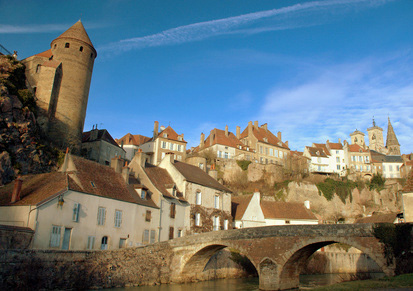
Semur-en-Auxois (pop. 4,200) is a picturesque medieval town located on the northeast edge of the Morvan National Park, half-way between Auxerre and Dijon. Founded on a pink granite outcrop, Semur had a defensive role from the start and was fortified at least since the Merovingian period.
The town is dominated by massive round towers and city walls. The collegiate church, started in 1225, is in Flamboyant Gothic style.
Semur-en-Auxois is a medieval town of approximately 4,100 inhabitants situated in the Côte-d'Or department of Burgundy, built on a pink granite bluff that is more than half-encircled by the River Armançon. The town retains its fortified medieval character with substantial ramparts and four surviving towers from its 13th-century castle, including the 44-metre-high Tour de l'Orle d'Or with walls five metres thick. Key landmarks include the Collégiale Notre-Dame, a flamboyant Gothic church founded in 1225 and restored by Viollet-le-Duc in the 19th century, and several historic bridges spanning the Armançon, notably the Pont Joly and Pont des Minimes. The town centre features cobblestone streets, half-timbered houses, and pedestrianised areas within the medieval walls, while the ramparts provide elevated walkways with river views. Semur-en-Auxois has served as a backdrop for French films and maintains its historical atmosphere whilst functioning as a regional centre with shops, restaurants, and a museum housed within its well-preserved medieval architecture.
Interesting Facts about Semur-en-Auxois
- Semur-en-Auxois is a medieval hill town dramatically perched on a pink granite bluff more than half encircled by the River Armançon.
- The town’s silhouette is defined by imposing ramparts and towers, including the 44‑metre Tour de l’Orle d’Or with walls up to five metres thick.
- Its name gave rise to the Sinemurian Age of the Early Jurassic, reflecting local geological significance.
- La Collégiale Notre‑Dame, founded in 1225, showcases Burgundian Gothic and was later restored by Viollet‑le‑Duc.
- Semur-en-Auxois hosted the départ of Stage 6 in the 2007 Tour de France.
- The Armançon once powered tanneries and mills here, before the 19th‑century Lac de Pont dam reduced the river’s flow.
- A famous inscription from 1552 at the gate proclaims the locals’ pleasure in meeting strangers, echoing a long tradition of welcoming travellers.
- The town earned a regional heritage prize in 2005 for the quality of its ramparts.
- Picturesque viewpoints abound from medieval bridges like Pont Joly and Pont des Minimes across the Armançon.
- Recognised as a “Remarkable Heritage Site,” Semur-en-Auxois pairs cobbled lanes and half‑timbered houses with sweeping river‑loop panoramas.
History
Ancient Origins and Medieval Foundation
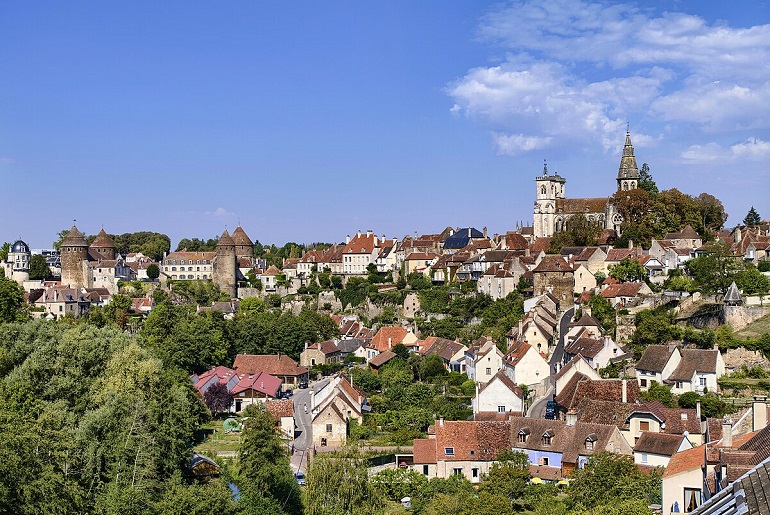
Semur-en-Auxois boasts a rich history stretching back to the Roman era, with evidence of a settlement on the strategic granite hilltop dating from 606 A.D. The town's name first appeared in historical records during the 8th century in the founding document of the Abbey of Flavigny, with its etymology deriving from the Latin "senes muros," meaning "the old walls." According to local legend, the town was founded by Hercules upon his return from Spain, though more reliable historical evidence points to its development as a fortified settlement perched on a pink granite bluff that rises dramatically above the meandering River Armançon. The river's strategic position provided both natural defence and economic opportunity, as it powered the mills and tanneries that formed the backbone of the medieval economy. By the 7th century, a castle had been established on the site, marking the beginning of Semur's role as an important defensive stronghold in the region.
Medieval Prosperity and Fortification
During the medieval period, Semur-en-Auxois flourished as an important trading centre, its prosperity reflected in the substantial fortifications that still dominate the townscape today. The town's defensive capabilities were significantly enhanced in the 14th century when the Dukes of Burgundy reinforced the walls and constructed a formidable dungeon and keep. The original fortified castle, built in the 13th century, featured multiple towers including the impressive Tour de l'Orle d'Or, which stands 44 metres high with walls 5 metres thick, along with the Tour de la Gehenne, Tour de la Prison, and Tour Margot. Religious life flourished alongside commercial activity, with the construction of the Collégiale Notre-Dame beginning in 1225 in the flamboyant Gothic style. The church's construction spanned several centuries, with the main structure completed in the first half of the 13th century, the façade and towers added during the 14th century, and the porch and side chapels constructed in the 15th and 16th centuries. The intensity of religious activity was further enhanced by the presence of nearby abbeys at Flavigny and Fontenay.
Renaissance Welcome and Modern Heritage
The town's welcoming attitude towards visitors has deep historical roots, as evidenced by the inscription above the main entrance dating from 1552: "Les Semurois se plaisant fort en l'acointance des estrangers," which translates to "The people of Semur take great pleasure in meeting strangers." This early embrace of tourism makes Semur-en-Auxois arguably one of Europe's oldest tourist destinations. The 15th century saw the construction of the Porte Sauvigny, the fortified medieval city gate with its twin towers that served as the main entrance to the city. Despite the dismantling of much of the castle in the 17th century, enough survived to showcase the town's medieval grandeur. The 19th century brought renewed attention to the town's architectural heritage when the famous architect Viollet-le-Duc restored the Notre-Dame church, ensuring its preservation for future generations. The town has also gained scientific recognition, as the Sinemurian Age of the Jurassic Period in geological time is named after Semur-en-Auxois, reflecting its importance beyond tourism and heritage. Notable figures associated with the town include the military engineer Vauban, who was educated at the local Carmelite college, and several prominent citizens including the politician François Patriat and the Encyclopédiste Philippe Guéneau de Montbeillard.
Main Attractions
Collegiate Church of Our Lady (Collégiale Notre-Dame)
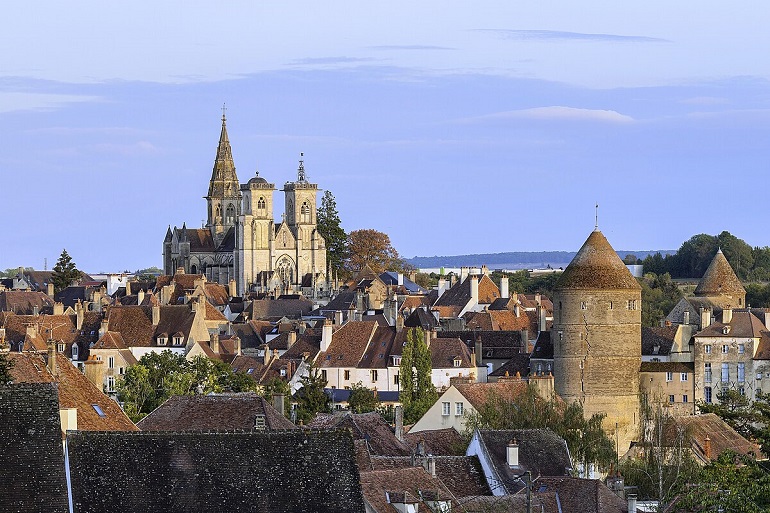
The Collégiale Notre-Dame stands as an architectural centrepiece, its elaborate Gothic form rising from the medieval core of Semur-en-Auxois. Constructed between the 13th and 15th centuries, the church is famed for its high, slender nave, richly detailed west façade and sculpted portals. The atmosphere inside is ethereal, as sunlight pours through panels of mediaeval stained glass, casting multi-coloured reflections onto carved capitals and ribbed stone vaults. Particularly striking are the medieval gargoyles and imaginary animals peering down from the upper eaves, alongside a collection of religious art and ancient woodwork that evoke the deep spiritual roots of the town. The church also remains a rallying point for local festivals and choral performances, further cementing its importance to community and culture.
Medieval Fortifications and Towers
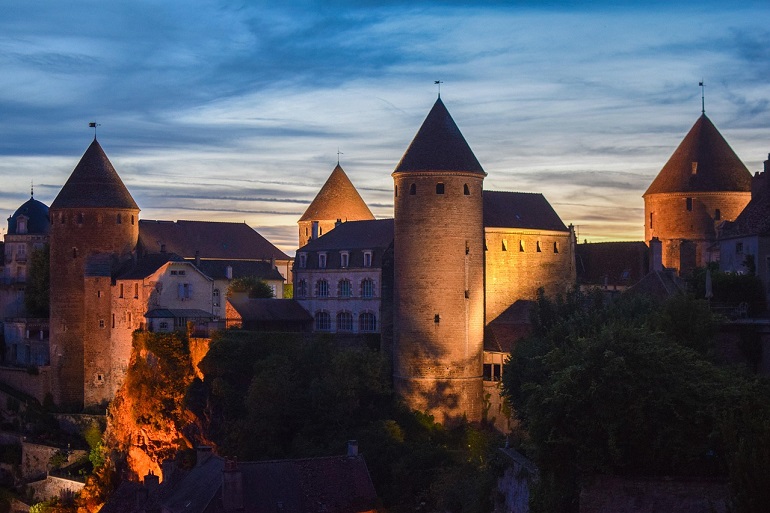
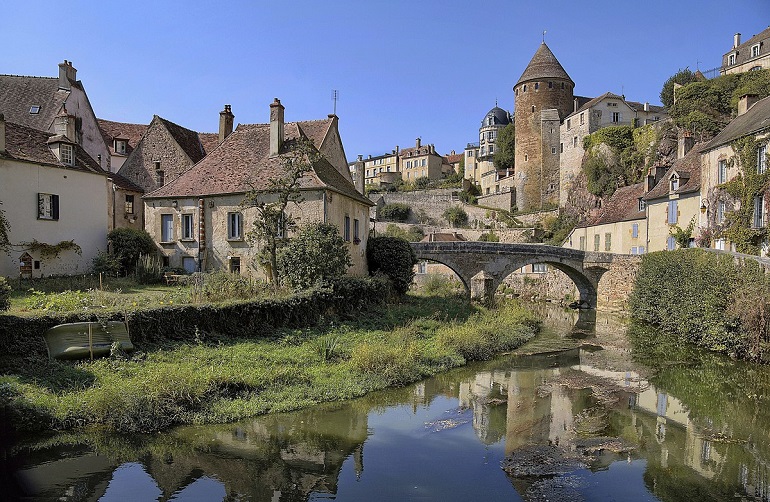
Perched dramatically on a pink granite promontory, Semur-en-Auxois is encircled by robust ramparts and four monumental towers, the most famous of which is the Tour de l’Orle d’Or. Constructed at the end of the 13th century, these towers were part of a once-mighty fortress, with defensive walls up to five metres thick in places. Today, the structures continue to dominate the skyline, with the Tour de l’Orle d’Or presenting an imposing cracked façade, a lasting legacy of attempted demolition in the early 17th century. The surviving towers and curtain wall offer panoramic lookouts over the river and countryside—while strolling along the ramparts, the sense of history is tangible, and the views are breathtaking. The ramparts and towers are central to the town’s identity, evoking centuries of conflict and daily life sheltered behind stone.
Pont Pinard
At the foot of the rocky outcrop, the elegant Pinard Bridge spans the calm Armançon, linking the lower banks to the ancient gates of the town. Dating from the 18th century, this robust stone bridge is not only a functional link but also a scenic vantage point. From here, one can admire the dramatic ensemble of towers, fortifications, and the church, all reflected in the river’s tranquil waters. Poets and artists have long celebrated this spot, as it offers possibly the best photographic viewpoint in Semur-en-Auxois. The sight is especially enchanting in the early morning or evening, when the red-tiled roofs glow in the changing light and the whole fortress appears to float above the river.
Medieval Streets and Entrances
The ancient heart of Semur-en-Auxois is a labyrinth of winding, cobbled streets, punctuated by grand gateways such as the Guillier and Sauvigny gates. These portals date back to when the town was an unassailable stronghold, and remain integral to the present historic quarter. Meandering through the warren of medieval lanes, visitors discover overhanging timber-framed houses, ornate ironwork, and charming squares enlivened by weekly markets. Inscriptions above the main gate—dating to 1552—proudly proclaim the locals’ hospitality to strangers, a tradition that continues today. The streets bustle with local bakeries, craft shops, and cafés, encouraging leisurely wanderings and encounters with French village life.
Riverside Walks and Natural Views
Surrounded on three sides by the looping Armançon, Semur-en-Auxois enjoys a supremely picturesque geographical setting. Riverside paths trace the base of its granite cliffs, delivering ever-changing perspectives of the soaring ramparts and towers above. Along these shaded walkways, one may discover remnants of medieval laundries, traces of old watermills, and tranquil spots for picnics beneath trailing wisteria and fragrant lilac. The river, once vital to the town’s industry, now provides a peaceful backdrop for strolls, birdwatching, and reflections on the seamless union of landscape and man-made beauty.
Seasonal Festivals and Events
Beyond its built heritage, Semur-en-Auxois is renowned for its rich calendar of traditional events. The annual Medieval Festival in August transforms the town with banners, historical costumes, and fairs that recreate scenes from centuries past. Another extraordinary spectacle is the Course de la Bague—the oldest horse race in France, held since 1639, which takes place around the town’s ramparts and brings together locals and visitors in a spirited competition. Summer also brings music festivals, open-air performances, and the lively Sunday market, each occasion reinforcing the strong sense of community and timelessness that characterise Semur-en-Auxois.
Top Museums
Musée Municipal de Semur-en-Auxois
Housed in the distinguished former convent of the Jacobines, the municipal museum of Semur-en-Auxois is an institution with a two-century legacy, making it integral to the town’s cultural landscape. Nestled within the historic centre and organised over three levels, the museum unfolds across eight galleries, showcasing an eclectic mix of scientific, historical, and artistic treasures in a setting that preserves the atmosphere of 19th-century museum curation.
Collection Highlights
Archaeology & Prehistory
The archaeology collections originated from methodical excavations carried out in the surrounding region. They feature tools and artefacts unearthed from prehistoric, Gallo-Roman, and Merovingian sites, providing a direct connection to the ancient civilisations that once frequented the Auxois area. Notably, the collection includes palaeolithic arrowheads and evidence of early domestic life in Burgundy.
Plaster Casts and Sculpture
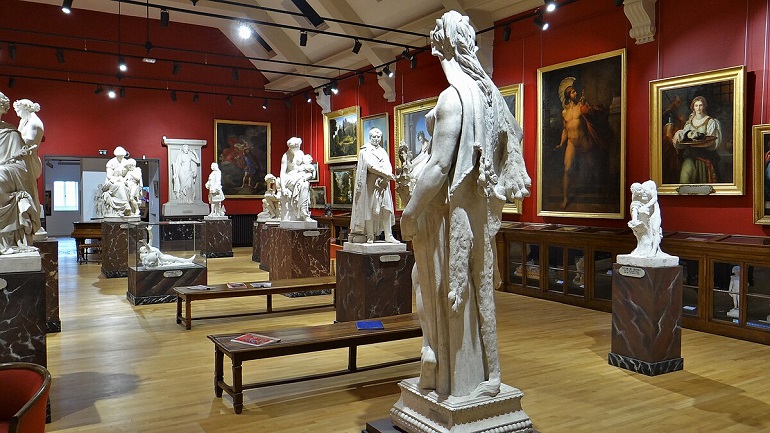
One of the museum’s most celebrated features is its gallery of plaster casts, comprising original works from the studio of Augustin Dumont, a 19th-century sculptor famed for his monumental creations such as the "Génie de la Liberté" atop the July Column in Paris. Alongside Dumont’s works, sculptures span the 13th to 19th centuries, with religious figures and decorative pieces gleaned from local churches, including two original angels from Notre-Dame in Semur-en-Auxois.
Fine Art
The fine arts section presents paintings, drawings, and prints ranging from the 15th to the 20th century. Highlights include landscapes by Camille Corot, views of Semur by Étienne Bouhot (who played a pivotal role in the museum’s founding), and works by artists such as Vignon, Boilly, and Maire. These are housed in atmospheric rooms that evoke the scholarly spirit and aesthetic of the 1800s.
Natural History and Geology
Particularly renowned within academic circles, the natural history collection boasts more than 10,000 geological specimens, with special emphasis on ammonites and fossils from the Sinemurian stage—a geological period named after Semur-en-Auxois itself. The palaeontology room exhibits impressive fossilised molluscs, vast snail shells, and an array of local geological samples. Complementing these are displays of zoological specimens and taxidermy, which recall the curiosity cabinets of the Enlightenment era.
The Middle Ages
Two dedicated rooms immerse visitors in the medieval history of Semur-en-Auxois, featuring stone carvings, artefacts, and objects drawn from the town’s long role as a fortified stronghold at the crossroads of Burgundy. Items tell the story of the town’s religious, civic, and military heritage, deepening appreciation for its dramatic setting and ancient towers.
Local Cuisine
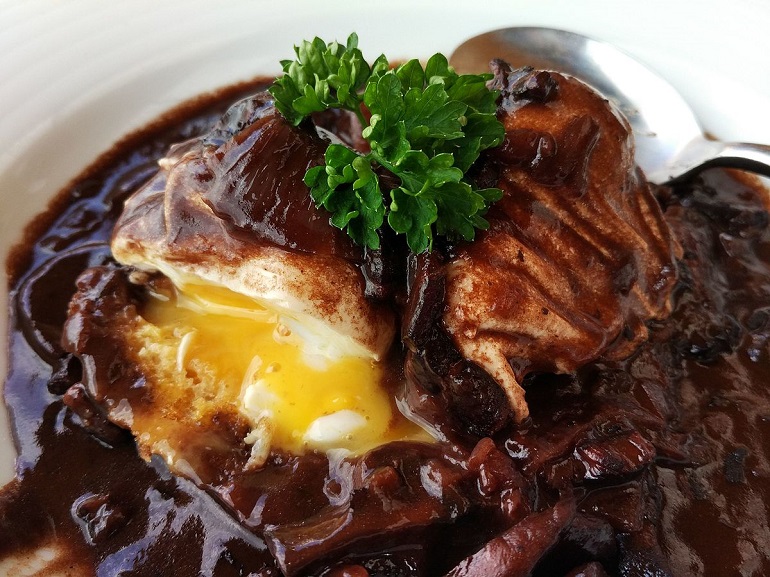
Semur-en-Auxois serves up the comforting, wine-laden dishes that make Burgundy a gastronomic heartland: start with oeufs en meurette, Burgundy’s famous poached eggs bathed in a silky red-wine sauce, or a plate of garlicky escargots de Bourgogne lifted by parsley butter; follow with melting boeuf bourguignon, slow-braised Charolais beef enriched with Pinot Noir, or savour the pungent creaminess of Époisses cheese served at room temperature with crusty pain de campagne; and finish with spiced pain d’épices or wash everything down with a crisp kir made with local blackcurrant liqueur – all best enjoyed in a rustic stone-vaulted bistro overlooking the medieval ramparts.
Getting There
By train The simplest rail route is via Paris–Bercy Bourgogne-Pays d’Auvergne, where frequent TER services run south to Montbard; from there, a 20-minute taxi or local bus completes the 15 km journey into Semur-en-Auxois.
By coach or bus Regional Burgundy coaches link Semur-en-Auxois with Dijon and Auxerre several times daily, while FlixBus and other long-distance operators stop at nearby Avallon and Montbard, both offering easy onward bus connections into town.
By car Driving is straightforward: exit the A6 autoroute at Bierre-lès-Semur (junction 23) and follow the D980 west for 8 km, or approach from Dijon on the scenic D905, which threads through rolling Morvan foothills before crossing the Armançon into Semur-en-Auxois’s medieval centre.
| Travel destinations in Burgundy | ||||||||||||||
|---|---|---|---|---|---|---|---|---|---|---|---|---|---|---|
|
|
|
|
| ||||||||||
|
|
|
|
| ||||||||||
| >
| |||||||||||||


