


Introduction
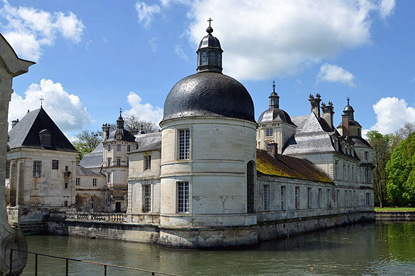
Tanlay is a Renaissance castle erected and expanded between 1550 and 1650 on the foundations of a 13th-century fortress. Although the castle has always had a residential purpose, it was designed around a rectangular moat and dotted with round towers at its extremities, in reminiscence of the previous medieval castle which it replaced. The limestone castle features cylindrical towers at its four corners, tall slate roofs, and is entirely surrounded by rectangular moats, creating a harmonious example of Renaissance architecture.
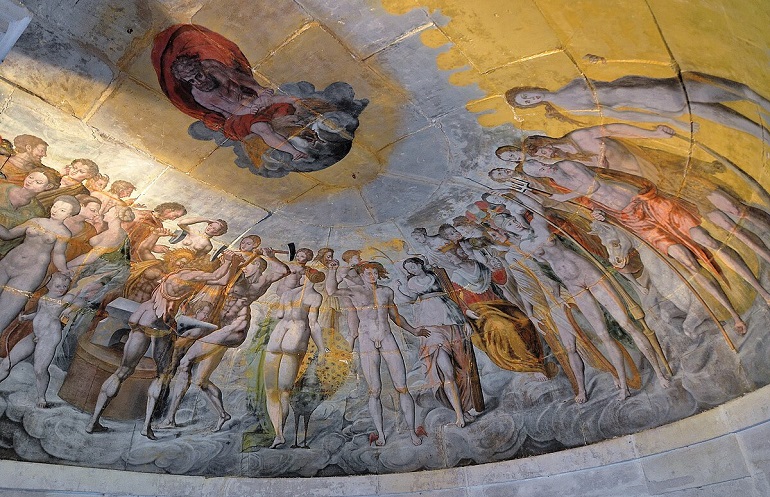
During the Wars of Religion, Tanlay served as an important meeting place for Huguenot leaders, and the castle is particularly renowned for its trompe-l'œil gallery and the frescoes in the Tower of the League, where historical figures from the religious conflicts are depicted as Olympic deities.
The château has remained in the same family since the early 18th century and continues to be a private residence whilst offering guided tours to visitors.
Interesting Facts about Tanlay Castle
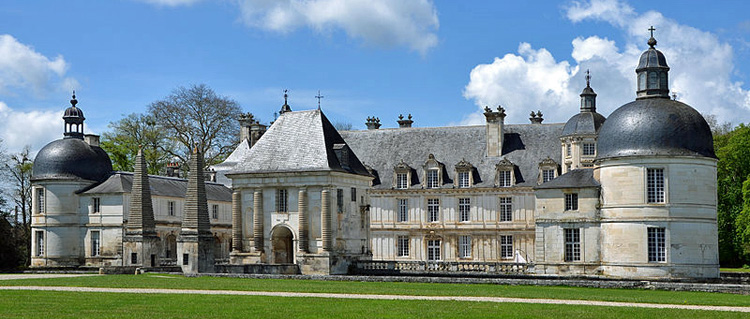
- Tanlay Castle is a French Renaissance château encircled by a rectilinear moat and approached by a bridge flanked with paired obelisks, creating a strikingly symmetrical cour d’honneur.
- The estate stands on medieval foundations of a thirteenth-century fortress, later rebuilt in the sixteenth and seventeenth centuries in pale limestone with tall slate roofs.
- François de Coligny d’Andelot began the Renaissance rebuilding in the 1550s, making Tanlay a discreet centre for Huguenot strategy during the French Wars of Religion.
- The Tour de la Ligue preserves remarkable frescoes depicting the war’s protagonists as Olympian deities, a vivid allegory of the age’s religious conflict.
- Michel Particelli d’Hémery, Mazarin’s Superintendent of Finances, completed the grand château in the 1640s to designs by Pierre Le Muet.
- The château is famed for its long gallery in trompe‑l’œil, whose illusionistic painted architecture remains a highlight of Burgundy’s Renaissance interiors.
- Tanlay’s composition—grand and petit châteaux, stables, and a canal leading to a nymphaeum—forms an elegant ensemble characteristic of seventeenth‑century taste.
- Since the early eighteenth century, the castle has remained in the same lineage, created the marquisate of Tanlay in 1705 under Louis XIV.
- The approach through the substantial “petit château” and across the moats sets a theatrical sequence that heightens the impact of the main façade.
- Often considered among Burgundy’s finest Renaissance residences, Tanlay offers a Loire‑Valley grace transplanted into the quiet Tonnerrois countryside.
History
Tanlay Castle rose on the ruins of a 13th-century fortress first held by the Capetian Courtenay family. The estate passed in 1533 to Louise de Montmorency, sister of the great statesman and constable, Duke Anne of Montmorency, and widow of Marshal Gaspard I de Coligny. It is her son, the Huguenot leader François de Coligny d’Andelot, who began tthe construction of today's grand château, built between 1550 and 1568, and the adjoining petit château, built from 1558, but interrupted by the Wars of Religion.
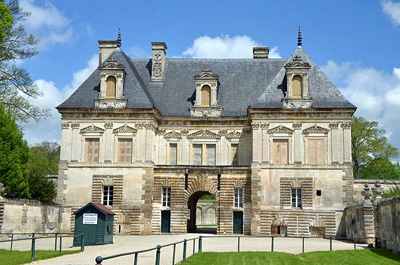
During the French Wars of Religion, the château became a discreet Protestant stronghold: Admiral Gaspard de Coligny convened Huguenot allies in the now-famous “Tour de la Ligue,” whose frescoes portray Catholic and Protestant protagonists as Olympian gods. Work stalled after François’ death in 1569, leaving the elegant gatehouse (1558) and petit château unfinished. The latter was completed in 1610 by his son-in-law, Jacques Chabot, marquis de Mirebeau.
A new chapter opened in 1642 when Cardinal Mazarin acquired Tanlay for his finance minister, Michel Particelli d’Émery, who hired architect Pierre Le Muet to complete the grand design. Le Muet’s campaign (1643-1649) added the right wing, sculpted obelisk-topped bridge, nymphaeum, canal and vast stables, unifying the complex around a limestone-walled cour d’honneur and broad water-filled moat. Inside, Particelli commissioned a trompe-l’œil gallery attributed to Nicolas Poussin’s circle, while Remy Vuibert frescoed the “Caesar’s Gallery” with illusionistic classical scenes. These embellishments cemented Tanlay’s reputation as one of Burgundy’s purest embodiments of French Renaissance symmetry and Italianate taste.
Tanlay entered its longest-standing lineage in 1704 when counsellor Jean Thévenin, governor of Saint-Denis, purchased the estate and was created Marquis de Tanlay by Louis XIV the following year. The family has retained the property ever since, enriching the 18th-century interiors yet preserving the Coligny and Particelli legacies. Visitors today admire its cylindrical corner towers, slate roofs, mirror-like moat and verdant parkland threaded by the Burgundy Canal. From Huguenot refuge to aristocratic seat, Tanlay Castle embodies nearly five centuries of political intrigue, architectural refinement and unbroken private stewardship—a living chronicle of France’s turbulent Renaissance and graceful classical age.
Description
The Exterior
Tanlay Castle presents a masterful example of French Renaissance architecture, elegantly rising from the tranquil waters of a wide moat that encircles it completely. The château's design is a harmonious blend of defensive heritage and courtly refinement, creating a powerful yet graceful impression.
The Approach and Gatehouse
The first structure to greet visitors is the formidable gatehouse, often referred to as the "petit château." This impressive building, itself surrounded by a dry moat, serves as a grand prelude. Its arcaded entrance, crowned with a distinctive slate-roofed dome, provides a theatrical passage across a stone bridge. The gatehouse's robust, almost medieval character, with its rusticated stonework and imposing proportions, contrasts beautifully with the more delicate main residence that lies beyond.
The Main Courtyard and Façades
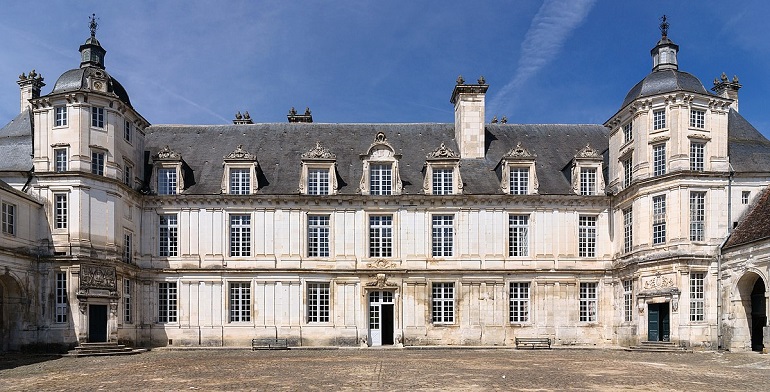
Beyond the gatehouse, a second bridge leads across the main moat to the Cour d'Honneur, an expansive courtyard that exudes symmetry and order. The main château building is a U-shaped structure crafted from warm, creamy-white Burgundy stone. The façades are a study in classical harmony, with a rhythmic arrangement of pilasters, cornices, and pedimented windows that draw the eye horizontally along its elegant lines.
The round towers that anchor the corners of the château are a nod to the region's fortified past, but their large windows and refined detailing mark them as features of a noble residence rather than a military stronghold. Their conical roofs, clad in dark slate, provide a striking contrast to the pale stonework below.
Architectural Details
The castle's exterior is rich with decorative elements. Above the entrance, an obelisk rises, adding a touch of Renaissance classicism. Carved reliefs and motifs adorn the walls, telling stories of mythology and noble lineage. The interplay of light and shadow across the articulated surfaces—from the smooth pilasters to the deep-set windows—gives the building a dynamic quality that changes throughout the day.
The Moat and Water Features
The moat is more than a defensive relic; it is a key aesthetic element. Its placid surface perfectly mirrors the château's façades, doubling their beauty and creating a sense of serene isolation. The water reflects the shifting colours of the sky and the surrounding greenery, making the castle appear to float dreamily in its watery embrace. Canals extend from the moat, leading the eye into the surrounding parkland and integrating the castle seamlessly with its landscape.
The Park and Gardens
Beyond the immediate structure, the grounds of Tanlay unfold into a formal park designed with geometric precision. Manicured lawns, avenues of mature trees, and formal gardens create a sense of controlled, cultivated nature that complements the castle's architectural order. The overall impression of Tanlay Castle's exterior is one of balance, sophistication, and a deep connection to its tranquil, watery setting.
The Interior
Grand Entrance Hall
Stepping through the main portal, visitors enter a lofty hall where pale Burgundian stone underfoot contrasts with a barrel-vaulted ceiling painted in soft sky-blue. Slim Ionic pilasters march along the walls, framing niches that hold classical busts in Carrara marble. Two vast wrought-iron lanterns, suspended by discreet chains, cast a golden glow that picks out the subtle veining of the stone.
Monumental Staircase
To the left rises an oak staircase that spirals in a single majestic sweep to the upper floors. Each tread is carved from solid heartwood and polished to a muted sheen; the continuous balustrade, punctuated by delicately turned balusters, feels silk-smooth beneath the hand. At each landing, tall sash windows admit shafts of natural light that dance across the staircase's sculptural curves.
State Apartments
- Grand Salon – This formal reception room stretches nearly the entire depth of the château. Rich walnut boiseries climb from parquet de Versailles flooring to a coved ceiling embellished with gilded rosettes. Aubusson tapestries depicting pastoral scenes soften the acoustics, while a pair of marble fireplaces anchor opposing walls, their mantelpieces crowded with ormolu clocks and Sevres porcelain.
- Royal Bedchamber – Reserved for esteemed guests, the bedchamber centres on a canopied four-poster draped in crimson damask. The domed ceiling features a trompe-l'œil oculus ringed with cherubs, creating the illusion of open sky at dusk. An inlaid writing desk, discreetly positioned near the window, affords views over the south canal.
- Cabinet de Travail – Panelled in satinwood with polychrome marquetry borders, this intimate study houses a collection of travel atlases and naval charts. A secret door, seamlessly disguised as shelving, leads to a narrow service corridor used by retainers.
Tour de la Ligue
Inside the Tour de la Ligue, every inch of the winding staircase is enveloped by highly detailed trompe-l’œil frescoes that transform the confined stone shaft into an illusionistic gallery of colour and movement. Delicate grotesques weave around painted pilasters, framing panels where allegorical figures—Justice, Fortitude and Prudence among them—stand beneath imaginary coffered vaults. Jewel-toned pigments still shimmer in the half-light, from deep ultramarine robes to the burnished gold of celestial orbs scattered across the ceiling. Elsewhere, playful putti tug at trailing ribbons, and the spines of painted columns appear to project outward, tricking the eye into perceiving depth where none exists. The cumulative effect is one of theatrical splendour: an intimate, spiralling narrative that leads the visitor upward through layers of myth, virtue and artifice until the final steps open onto the tower’s quiet summit.
Chapel of the Holy Cross
Set deep within the east wing, the chapel is an unexpected jewel of Italianate design. Soft stucco cherubim hover above an alabaster altar, and stained-glass lancets bathe the interior in jewelled light. The organ loft, reached by a hidden stair, contains a still-functioning 17th-century pipe organ; its mellow voice resonates during summer recitals.
Long Gallery
Running the length of the west façade, the Long Gallery serves as both picture gallery and promenade. Portraits of past owners line one wall, each framed in heavy gilded wood, while the opposite side is punctuated by a rhythmic sequence of arched windows overlooking the moat. The chequerboard marble floor, alternating noir de Mazy and Bourgogne beige, amplifies the sense of measured grandeur.
Library
Warm and hushed, the library exudes scholarly charm. Ceiling-height walnut shelves bristle with calf-bound volumes on botany, astronomy and the liberal arts. A central reading table, topped with green leather, rests beneath an ornate brass chandelier whose multiple arms bear hand-blown glass shades. Hidden vents channel warm air from the kitchens below, ensuring the room remains comfortable during Burgundian winters.
Dining Hall
This convivial space balances formality with rustic elegance. An eighteen-seat oak refectory table occupies the centre, flanked by high-backed chairs upholstered in sage-green brocade. The far wall boasts a monumental stone hearth, large enough to roast an entire wild boar, while the adjacent buttery stores locally produced Chablis in cool limestone alcoves.
Service Quarters and Kitchens
Descending to the semi-basement reveals vaulted kitchens where copper pans hang in regimented rows and an immense open range still bears the patina of centuries of use. Beyond lies a network of stone-flagged passages connecting larders, cellars and the former servants' hall, all illuminated by narrow slit windows that admit slivers of daylight.
Getting There
By train Hop on a regional TER service from Paris‐Bercy or Dijon and alight at Tonnerre, the nearest station to Tanlay; from here the pre-bookable Mobigo taxi link reaches the château in under 10 minutes.
By coach or bus Regional buses connect Auxerre and Montbard with the Tonnerrois area; the most convenient stop is in Tanlay village, a short stroll through leafy streets to the château gates.
By car From the A6 motorway take exit D965 (Nitry if arriving from the south) and simply follow the D965 north-east through rolling Burgundy countryside until signposts direct you into Tanlay, where on-street parking is available near the moat.
| Travel destinations in Burgundy | ||||||||||||||
|---|---|---|---|---|---|---|---|---|---|---|---|---|---|---|
|
|
|
|
| ||||||||||
|
|
|
|
| ||||||||||
| >
| |||||||||||||


