


| Contents |
|---|

Introduction
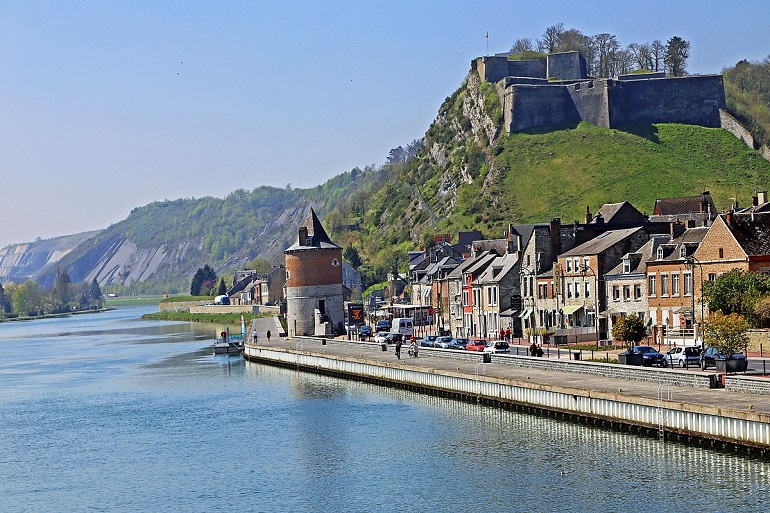
Givet (pop. 6,500) is a small historic town located in the Meuse Valley, right across the border with Belgium. The town is dominated by the Charlemont fortress, built top of a prominent hillock.
With its distinctive Mosan architecture (grey stones mixed with red bricks), Givet bears striking resemblance to Walloon cities such as Namur, Huy or Liège.
Givet is a small historic town of approximately 6,500 inhabitants situated on the banks of the Meuse River in the Ardennes department of northeastern France, directly adjacent to the Belgian border. The town is dominated by the imposing Fort of Charlemont, a 16th-century citadel originally constructed by Charles V of the Holy Roman Empire that overlooks the settlement from its elevated position. Dating back to the 7th century, Givet possesses a rich medieval heritage evident in its picturesque streets, historic churches, defensive towers, ramparts, and fortified gates that reflect its strategic importance throughout European history. The town serves as a gateway to the broader Ardennes region whilst maintaining its character as a riverside settlement that has been shaped by centuries of military and commercial significance along this major European waterway.
Interesting Facts about Givet
- Givet sits in a narrow French salient almost encircled by Belgium, straddling a scenic bend of the River Meuse.
- Emperor Charles V ordered the mighty Charlemont fortress above Givet in the 16th century to control the Meuse corridor.
- The town is split by the Meuse into Givet-Saint-Hilaire and Givet-Notre-Dame, linked by bridges with views to the citadel.
- Vauban later strengthened Givet’s defences, leaving a distinctive imprint on its ramparts and gateways.
- During the Napoleonic Wars, Givet held British prisoners of war, where an improvised navigation school was set up inside the camp.
- In the Second World War, Givet was occupied in May 1940 and became a strategic Meuse crossing during the Battle of the Bulge.
- The Church of Saint-Hilaire is notable for its unusual passageway beneath part of the building along Rue de la Fausse Porte.
- The Porte de France is a surviving gate that once controlled access through the town’s fortifications.
- The Meuse is navigable up to Givet, connecting the town to the North Sea and to France’s inland canal network.
- The former railway to Dinant is now a popular cross-border bus and cycling corridor, with parts converted into greenways.
- Givet inspired Georges Simenon’s Maigret novel “The Flemish House,” capturing its riverine and frontier atmosphere.
- The Pointe de Givet National Nature Reserve protects calcareous grasslands and rare species on the surrounding limestone hills.
- Local industry historically ranged from quarries to river port trade, with modern logistics revived by rail reconnection in the 21st century.
- Givet’s twin cultural strands reflect French and Walloon influences, evident in toponyms and local traditions.
- Panoramas from Charlemont offer sweeping views over the Meuse valley, the town’s slate roofs, and the Belgian borderlands.
History
Before the Roman period, two distinct Gallic tribes inhabited the area: the Aduatiques on the left bank of the Meuse and the Trevires on the right bank. Local legends claim that Saint Hubert lived in the settlement around 720 CE and performed a miracle there, establishing early Christian significance in the region. During the medieval period, Givet alternately belonged to the prince-bishops of Liège until the early 16th century, when it was ceded to Emperor Charles V, ruler of the rest of the Low Countries (that is, aside from the Principality of Liège). It was Charles V who ordered the construction of the fortress of Charlemont in 1555, which was named after him. This fortification project required 3,000 workers alongside 20,000 infantry and 3,000 cavalry, as the walls were built during active military campaigns. The town's strategic position on the River Meuse, where it merges with the Houille, made it a crucial crossing point and trading centre throughout the centuries.
The Spanish possession of Givet ended in 1678 with the Treaty of Nijmegen, which transferred the Charlemont-Givet stronghold to Louis XIV of France. The renowned military engineer Vauban subsequently inspected and improved the fortress, proposing major enhancements in 1698 following an attack by Dutch General Menno van Coehoorn, who had bombarded Givet from the heights of Mont d'Haurs during the Nine Years' War in 1696. By 1740, Charlemont had taken on its definitive structure with the addition of the Asfeld crown to the west and the gherkin enclosure to the east.
Givet's military importance continued through subsequent conflicts, serving as a supply depot for French forces and housing British prisoners of war from 1804 to 1814 during the Napoleonic Wars. Notable prisoners included Captain Jahleel Brenton and Naval Chaplain Robert B. Wolfe, who established a navigation school for imprisoned British sailors. During the First World War, Charlemont fell after just three days of bombardment in 1914, as the fortress had become technically obsolete. The Second World War brought German occupation on 12 May 1940, followed by liberation on 7 September 1944, with 11,000 American soldiers billeted in the ancient fortress by December 1944. The German Ardennes Offensive specifically targeted Givet and its crucial Meuse crossing, but British forces under General Montgomery organised a successful defence, halting the German advance just 10 kilometres from the town on 24 December 1944.
Main Attractions
Fort of Charlemont
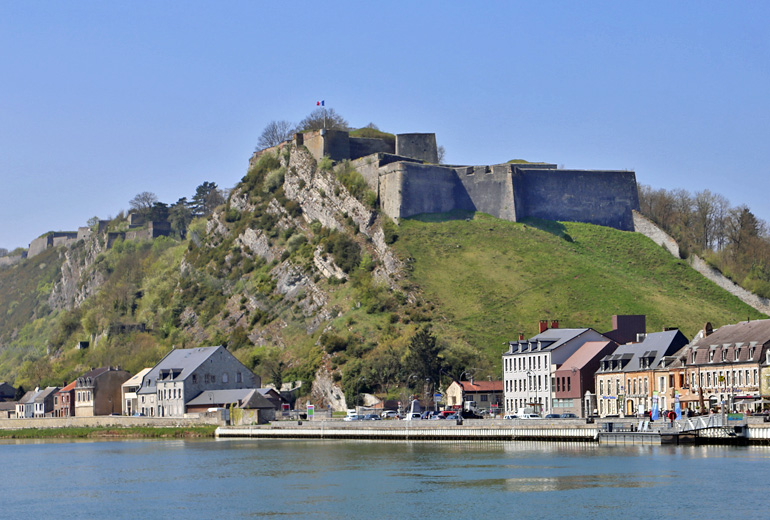
Perched high above the town, the Fort of Charlemont is the region’s most compelling landmark and a marvel of defensive architecture. Constructed in the mid-16th century at the behest of Charles V, Holy Roman Emperor, as a bulwark against French advances, this powerful stronghold witnessed centuries of military strife and strategic importance. Later reinforced and redesigned by the legendary military engineer Vauban and by successive French rulers, Charlemont consists of extensive ramparts, outworks, and intricate subterranean galleries. Its star-shaped bastions and sweeping stone walls snake across nearly 60 hectares, blending into the cliffs that offer natural defence, with the Meuse River far below. Visitors can explore the vaulted passageways and commanding terraces, which today reveal breathtaking views and an atmospheric glimpse into military life. The fort is now situated within the Pointe de Givet nature reserve, offering the bonus of rare flora and serene natural surroundings within the shadow of its ancient battlements.
The Old Town and Medieval Fortifications
The historic heart of Givet retains a captivating medieval atmosphere brought to life through its vestiges of ancient walls, gates, and blue-stone houses. Remnants of the old fortifications include the imposing France, Rancennes, and Charbonnière gates—rare survivors of the town’s original six gateways, each once equipped with drawbridges and watchtowers. The cobbled streets reveal homes built from distinctive blue stone, picturesque alleys, and hidden courtyards, many dating from the era when Givet protected the northernmost frontier of France. Exploring on foot evokes the layered history of a town which has been disputed by French, Spanish, and Dutch forces across the centuries.
The Meuse Riverfront and Quays
Givet’s riverside is a delightful place to meander, with wide quays offering panoramic views of the Fort of Charlemont rising dramatically above the water. Historically, the Meuse provided a vital trade and transport artery, shaping the town’s urban life and prosperity. Today, the banks host vibrant markets, summer festivals, and regular pleasure boat cruises, creating a lively hub in the shade of mature plane trees. It is here that travellers can best appreciate the confluence of Givet’s military heritage and present-day conviviality—often accompanied by a gentle breeze drifting upriver.
Mont d’Haurs Circuit and Grégoire Tower
Rising opposite Charlemont, Mont d’Haurs provided both a key strategic viewpoint and an additional defensive outpost for the town. The plateau was heavily fortified by Vauban at the turn of the 18th century, with ramparts, bastions, and military roads winding through what is now a peaceful nature reserve. Walking the Mont d’Haurs circuit, starting near the Grégoire Tower, offers panoramic vistas over the Meuse valley and the fortifications themselves. In spring and summer, the chalk grasslands bloom with wildflowers, making this an exceptional spot for photographers and nature lovers alike.
Église Saint-Hilaire and Église Notre-Dame
Givet’s religious heritage is exemplified in two distinct churches. Saint-Hilaire, built between 1680 and 1702, possesses an unusual passageway underneath and was one of the few large churches reconstructed after Givet’s integration into France. Its slender spire and simple classical lines recall the central-European influences of the borderlands. The Église Notre-Dame, constructed just before, sits prominently on the edge of the Meuse, with stately baroque details and a calm, contemplative interior. Both serve as landmarks that mirror the town’s cultural and architectural evolution from Spanish possession to French border town.
Pointe de Givet Nature Reserve
Just northwest of town, the Pointe de Givet national nature reserve is a haven for biodiversity, supporting chalk grasslands, rare plants like white mugwort and orchids, and a host of animal species—including protected bats that hibernate within tunnels beneath Charlemont. Walking trails criss-cross the reserve, offering peaceful rambles through landscapes that oscillate between rocky outcrops and lush woodland. The area’s tranquillity and ecological richness provide both escape from urban life and a fascinating counterpart to the imposing fort above.
Annual Onion Fair
One of Givet’s most cherished traditions is its Onion Fair, held each November. This exuberant event takes over the quays and market squares with a boisterous blend of local food, traditional crafts, and carnival rides. Vendors sell everything from regional cheeses, charcuterie, and, of course, strings of onions, to hand-made wares and clothing. The fair, with roots tracing back to the 19th century, has become a cross-border celebration drawing crowds from Belgium as well as France and highlights Givet’s role as a historic place of exchange and conviviality.
Top Museums
Convent of the Récollectines / Pierre Tassin Cultural Centre
Located in the heart of Givet, the former Convent of the Récollectines stands as a testament to the town's layered past. Founded in 1680 by nuns from Philippeville with the blessing of King Louis XIV, this building has experienced several transformations, reflecting the changing fortunes of Givet. After serving as a military requisition in the late 18th century and later as a school, the surviving convent buildings were preserved and listed as a historic monument in 1978. Today, this elegant structure houses the Pierre Tassin Cultural Centre, a hub for cultural life in Givet. Inside, visitors discover a vibrant mix of spaces including exhibition halls, where both thematic and permanent displays – such as a notable collection of Gambier pipes – are frequently on view. The centre also contains a media library and hosts performances, workshops, and seasonal cultural events, all within a building that evokes centuries of religious, educational, and community significance.
Local Cuisine
Givet’s cuisine is robust and rustic, featuring platters of jambon d’Ardenne, the region’s delicately smoked dry-cured ham, and steaming bowls of cacasse à cul nu, a bacon-laced potato stew once favoured by Meuse bargemen; you might also encounter silky boudin blanc de Rethel or tangy salade au lard, both perfect partners for a malty local beer. Sweet tooths should not miss the slate-shaped blue chocolates called Ardoises de Givet, while farmers’ markets brim with nutty goat’s cheeses and honey from the surrounding forests, completing a flavoursome introduction to Ardennes gastronomy.
Getting There
By train The most straightforward public transport link is the hourly TER service from Charleville-Mézières, which threads through the verdant Meuse valley and delivers passengers directly to Givet’s small riverside station in under an hour, with easy onward connections from Reims and Paris.
By coach Regional bus routes, operated by Fluo Grand Est, call at Givet from Charleville-Mézières and Dinant, offering a practical alternative for travellers coming from nearby Ardennes towns or across the Belgian border, though timetables are more limited at weekends.
By car Motorists can reach the town via the A304/N51 trunk route before joining the scenic D8051, a winding road that hugs the Meuse and delivers panoramic views as it curves into Givet; ample parking is clustered around the citadel and marina.
| Travel destinations in Champagne-Ardenne | |||||||||||
|---|---|---|---|---|---|---|---|---|---|---|---|
|
|
|
| ||||||||
|
|
| |||||||||


