


Introduction
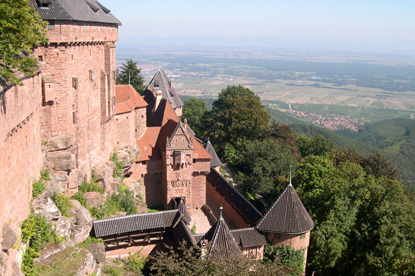
Haut-Koenigsbourg Castle (Hohkönigsburg in German) stands as one of Alsace's most significant medieval fortresses, perched dramatically on a rocky outcrop at 757 metres above sea level, commanding incredible views on the vineyards of the Alsatian Plain. Originally erected in the 12th century by the Hohenstaufen dynasty and first documented in 1147, the castle served as a strategic stronghold controlling important strategic trade routes between the Vosges and the Black Forest. After centuries of conflicts and changing ownership, the fortress was destroyed during the Thirty Years War in 1633 when Swedish forces besieged and burned it following a 50-day siege, leaving it abandoned for over two centuries. The castle experienced a remarkable revival when German Kaiser Wilhelm II commissioned architect Bodo Ebhardt to undertake an extensive restoration between 1900 and 1908, transforming the ruins into the impressive medieval fortress visitors see today. The restored castle now features furnished medieval chambers, a weapons room, the Kaiser's Hall with monumental frescoes, and defensive elements including drawbridges, ramparts, and artillery displays, attracting more than 500,000 visitors annually to experience its nine centuries of turbulent history.
Interesting Facts about Haut-Koenigsbourg Castle
- Rising on a rocky spur at about 750–757 metres, the castle commands sweeping views across the Alsace Plain to the Vosges, the Black Forest, and, on very clear days, the Alps.
- First recorded in the 12th century, it guarded vital trade routes for wine, wheat and salt between the Vosges and the Rhine.
- After being ruined during the Thirty Years’ War in 1633, the fortress lay abandoned for roughly two centuries before its celebrated 20th-century rebirth.
- From 1900 to 1908, Kaiser Wilhelm II commissioned architect Bodo Ebhardt to reconstruct it as a showcase of medieval power and imperial heritage.
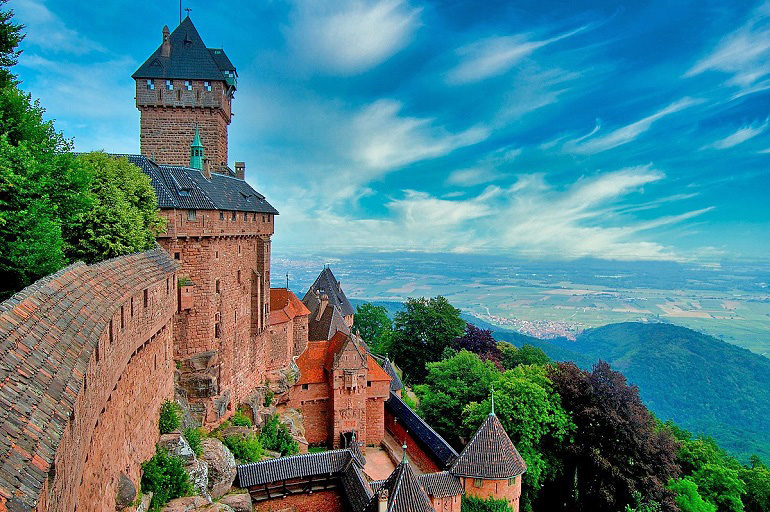
- Its pink Vosges sandstone walls, star-shaped bastion, and lofty keep create the romantic silhouette that has made it one of Alsace’s most photographed landmarks.
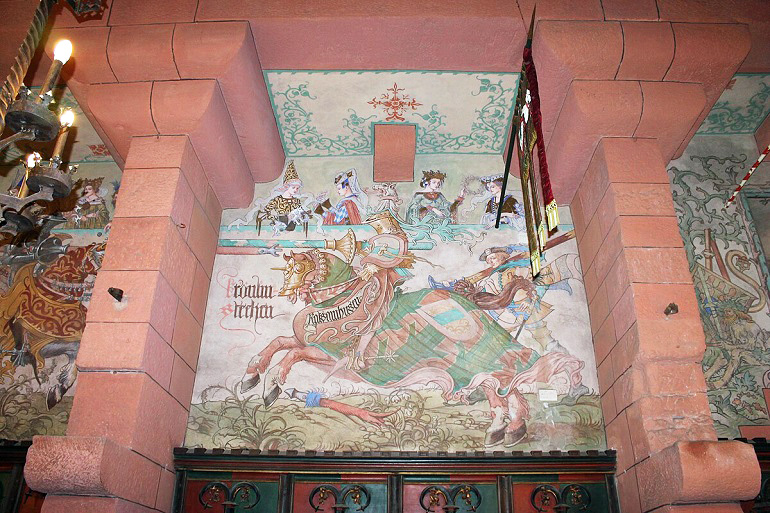
- The interior mixes medieval-style rooms with early 20th-century imperial touches, including the richly painted Kaiser’s Hall and an eagle emblazoned on the ceiling.
- A recreated medieval garden outside the ramparts grows culinary, medicinal and dye plants, echoing the castle’s historic self-sufficiency.
- The weapons rooms and Grand Bastion display artillery and arms that illustrate the site’s strategic role across centuries of conflict.
- The Lions’ Gate, approached by a drawbridge over a rock-cut ditch, sets a theatrical scene worthy of the castle’s storied past.
- Its layered Franco-German history mirrors Alsace itself, shifting from Habsburgs to Hohenzollerns to the French state across nine centuries.
History
The exact age of the castle is unknown. The first explicit mention of a castle built by the Hohenstaufen kings of Germany was in 1147. The castle's name appears in 1192 as Königsburg, German for the 'King's Castle'.
At the onset of the 13th century, the Hohenstaufen grant the castle to the Dukes of Lorraine. They in turn entrust it to the Ratsamhausen family, who remained lords of the castle until the 15th century.
In 1462, a coalition of cities besieged and burnt the castle. Frederick III of Habsburg, Holy Roman Emperor, bestows the ruins to the Thiersteins, who rebuilt and enlarge the castle from 1479, setting up a new defence system against artillery.
At the height of the Thirty Years' War, despite its state-of-the-art fortifications, the castle succumbs to the artillery of the Swedish army in 1633, after a 52-day siege. The castle is burnt down and looted, and left abandoned for two centuries.
In 1882, the municipality of Sélestat undertakes restoration works under the supervsion of the architect Winkler, but the project was suspended due to insufficient funds. Sélestate then presented the castle to Kaiser Wilhelm II, who was looking for a place to indulge in his Romantic fantasies. The emperor then entrusted Bodo Ebhardt to refurbish the castle to the splendour of its heyday. Works started in 1900 and were completed in 1908.
Description
Setting and First Impressions
At 757 metres above sea level, the castle crowns a rocky spur of the Vosges, its pink sandstone turrets and crenellated ramparts catching the light and dominating the plain of Alsace. Approaching through dense forest, visitors suddenly emerge into a vast forecourt where the fortress rises in theatrical layers: lower bailey, inner curtain walls and, soaring above everything, a square keep capped with a verdigris copper roof.
Lower Courtyard – A Self-Sufficient Hamlet
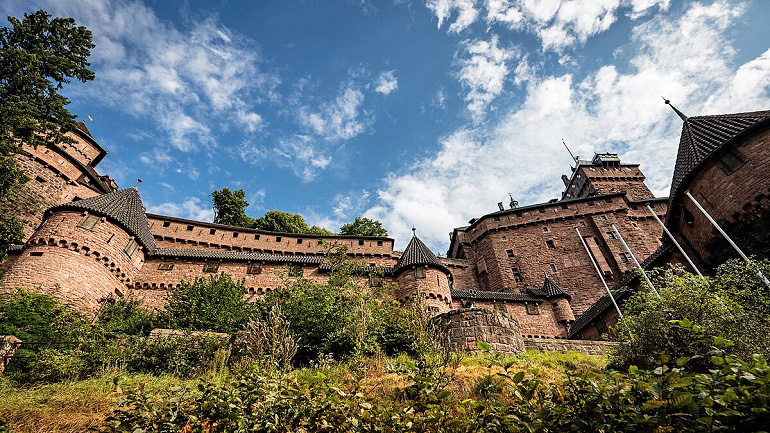
Beyond the main gate you step into the lower courtyard, essentially a miniature village designed to withstand prolonged siege. Half-timbered stables, a blacksmith’s forge and a reconstructed inn cluster around a central fountain, while grain stores, a mill and cellars lie hidden behind thick walls. The atmosphere is comfortably domestic, yet defensive details—arrow slits, murder holes and a portcullis track—remind you that survival came first.
The Lions’ Door and Access Ramp
A gently rising cobbled ramp snakes between battlements towards a narrow ditch spanned by a drawbridge. Two weather-worn stone lions flank the entrance portal, their heraldic posture signalling both welcome and warning. From here, the route climbs by switchback ramps and covered walkways, offering glimpses of the sheer drop that once deterred attackers.
Inner Courtyard and Grand Stair
Passing the Lions’ Door, you reach an intimate hexagonal courtyard framed by timber galleries and overlooked by the massive 62 metre keep. An elegant spiral stair tower—its steps broad enough for armoured knights—connects every level. Carved lintels display intertwined initials of successive owners, while the well at the centre plunges 62 metres to reach a reliable spring.
State Apartments
Lord’s Chambers
A suite of paneled rooms warmed by monumental sandstone fireplaces. Oak benches, wrought-iron chandeliers and tapestries lend an austere comfort; leaded windows frame endless views over vineyards below.
Empress’s Suite
Two interconnected chambers clad in lime-washed panelling, one hung with late-Gothic wall-paintings of hunting scenes, the other fitted with an alcove bed and carved cupboards.
Kaiser’s Hall
The ceremonial heart of the castle, vaulted in dark timber and emblazoned with the imperial eagle. Shields of the Hohenzollern dynasty ring the cornice; beneath them, hunting trophies and crossbows illustrate the romantic medievalism of the 1900 reconstruction.
Military Galleries and Bastion
A covered chemin de ronde runs along the outer wall, punctuated by bartizans and firing slits angled for early artillery. The culminating feature is the great bastion: twin towers linked by a cannon platform projecting over the cliff. From this aerie the panorama stretches across the Rhine to Germany’s Black Forest and, when skies are crystalline, the faint ridge of the Swiss Alps.
Armoury and Service Rooms
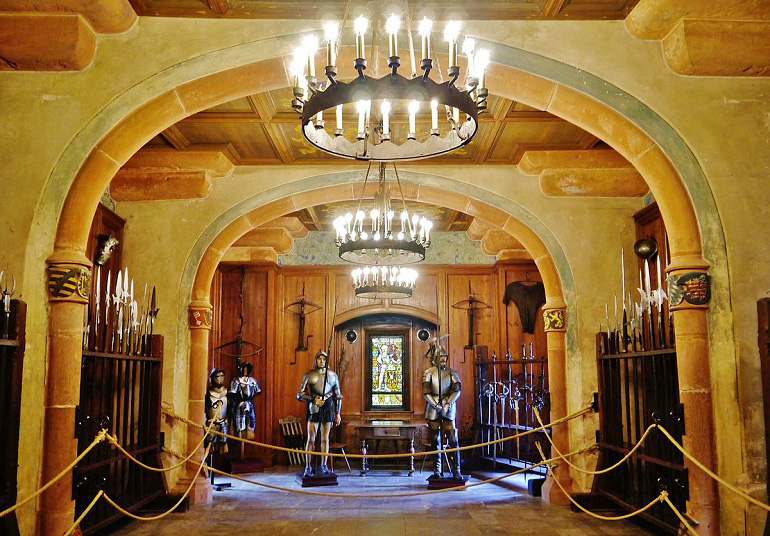
The armoury displays pikes, halberds, arbalests and early hand-guns, meticulously ordered on oak racks. Adjacent rooms include a vaulted bread oven capable of baking for a garrison of 200, a vaulted wine cellar tiled in Alsatian green, and a tiny chapel whose stained glass glows with cobalt saints and ruby heraldry.
Medieval Garden
Outside the fortress proper lies a walled garden arranged in knot-bed squares edged with woven willow. Beds contain culinary herbs, medicinal simples and dye plants such as woad and madder, while espaliered fruit trees lean against the sun-warmed masonry. Benches under rose-covered arbours offer a final, tranquil pause before leaving the castle.
Visitor Facilities
- Modern ticket hall and shop discreetly housed in a timber lodge at the approach road
- Audio guides in several languages, plus family trail sheets for children
- On-site cafeteria serving regional tarts flambées, pretzels and Alsace wines
- Seasonal events: costumed night tours, falconry displays, open-air concerts on summer evenings
Getting There
By train Alight at Sélestat station—served by regular TER Alsace services from Strasbourg and Colmar—then take the dedicated shuttle bus or seasonal navette that climbs the forested ridge to the château’s entrance.
By coach or bus Several regional routes link Strasbourg, Colmar and nearby wine-route villages to Sélestat, where the Haut-Koenigsbourg shuttle connects conveniently; in summer, special Kutzig open-top coaches and Alsace Wine Route buses also stop at the castle car park.
By car Follow the A35 or N83 to Sélestat, exit toward Orschwiller and wind up the well-signed D159 through vineyards and dense Vosges woodland; ample parking awaits just below the ramparts.
| Travel destinations in Alsace | ||||||||||||||
|---|---|---|---|---|---|---|---|---|---|---|---|---|---|---|
|
|
|
|
| ||||||||||
|
|
|
|
| ||||||||||


