


| Contents |
|---|
Introduction
Situated in the heart of the Loire Valley, Blois (pop. 45,000), has been a major centre since the Middle Ages, once serving as a royal residence for several French monarchs, including Louis XII and Francis I. The city is renowned for its stunning Château de Blois, which showcases four distinct architectural styles: medieval, Gothic, Renaissance, and classical. Visitors can explore the city's picturesque streets, visit the Gothic-style Saint-Louis Cathedral, and enjoy the scenic views of the Loire River. Blois is part of the UNESCO World Heritage site of the Loire Valley, making it a must-visit destination for those interested in history and culture.
Interesting Facts about Blois
- Blois was the favourite residence and political capital of France under King Louis XII in the late 15th and early 16th centuries.
- The Château Royal de Blois showcases four distinct architectural styles spanning from the 13th to the 17th century.
- Joan of Arc visited Blois in 1429 to be blessed before leading her army against the English at Orléans.
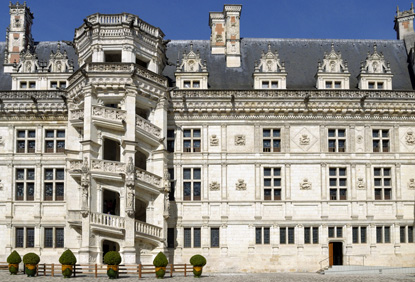
- The château's François I wing features a remarkable spiral staircase, considered a masterpiece of Renaissance architecture.
- Blois Castle boasts an impressive 564 rooms, including 100 bedrooms each with its own fireplace.
- The city's Musée des Beaux-Arts, located in the Louis XII wing of the château, houses art collections dating from the 16th to the 19th century.
- Blois was the birthplace of King Louis XII, who was born in the château in 1462.
- The town features the Denis-Papin Staircase, a monumental stairway offering panoramic views of the city and Loire Valley.
- Blois became an independent diocese from Chartres in 1697, leading to the creation of beautiful bishopric gardens.
- The Foundation of Doubt, opened in 2013, is a contemporary art space in Blois featuring works by artists such as Yoko Ono.

History
First mentioned in the 6th century by Gregory of Tours, it rose to prominence as the seat of the powerful counts of Blois in the early Middle Ages. The city's strategic location on the Loire River made it an important centre of power, and by the end of the 14th century, it was acquired by Louis de France, duc d'Orléans. This marked the beginning of Blois' golden age as a royal residence.
The 15th and 16th centuries saw Blois flourish as a second capital of France. In 1498, Louis XII, born in the château, ascended to the French throne, cementing the city's royal status. The magnificent Château de Blois, a testament to the city's royal heritage, showcases an impressive array of architectural styles from Gothic to Renaissance. It was here that Joan of Arc set out in 1429 to raise the siege of Orléans, and where the States-General convened twice under Henry III. The château also witnessed darker moments in history, such as the assassination of Henri de Guise in 1588 and the death of Catherine de Médicis shortly after.
Blois continued to play a significant role in French politics and culture throughout the 17th century. In 1626, Gaston de France, duc d'Orléans, began extensive renovations of the château, though these were halted following the birth of the future Louis XIV. Despite a period of decline, the château was saved from demolition in 1840 when it was added to the list of French historical monuments. Today, Blois stands as a City of Art and History, offering visitors a captivating glimpse into France's royal past through its well-preserved architecture, picturesque streets, and the majestic Château de Blois.
Main Attractions
Château Royal de Blois
The Château Royal de Blois stands as a testament to the rich architectural history of France. This magnificent structure, perched atop a hill overlooking the Loire River, showcases a unique blend of Gothic, Renaissance, and Classical styles. Each wing of the château represents a different period of French architecture, offering visitors a visual journey through time. The courtyard, accessible without entering the museum sections, provides an excellent vantage point to appreciate the château's diverse façades. The ornate stonework, intricate sculptures, and grand staircases exemplify the craftsmanship of their respective eras. The château's silhouette, particularly when illuminated at night, creates a striking backdrop for the town of Blois.
Pont Jacques Gabriel
Spanning the Loire River, the Pont Jacques Gabriel is an 18th-century stone bridge that serves as both a functional crossing and a scenic viewpoint. This elegant structure, with its series of graceful arches, offers pedestrians and motorists alike panoramic views of Blois and its surrounding landscape. From the bridge, one can observe the flow of the Loire, the town's skyline dominated by the Château Royal, and the picturesque riverbanks. The bridge itself is a fine example of 18th-century engineering, its sturdy construction having withstood centuries of use and the river's occasional floods. At sunset, the golden light reflecting off the Loire and illuminating the bridge creates a particularly enchanting scene.
Vieux Blois (Old Town)
The heart of Blois lies in its Old Town, a labyrinth of narrow streets and historic buildings that transport visitors back in time. Half-timbered houses, their wooden frames exposed and often painted in vibrant colours, line cobblestone streets that wind their way up and down the hillside. Interspersed among these medieval dwellings are grand Renaissance mansions, known as hôtels particuliers, showcasing the wealth and sophistication of Blois' past residents. The Rue des Trois Marchands, one of the main arteries of the Old Town, is particularly noteworthy for its concentration of historic architecture. Small squares and hidden courtyards reveal themselves to those who explore, each offering a glimpse into the daily life of centuries past.
Cathédrale Saint-Louis
Dominating the skyline of Blois, the Cathédrale Saint-Louis blends Gothic and Classical architectural elements into a harmonious whole. Its imposing façade, with its ornate stone carvings and large rose window, draws the eye upward. Inside, the cathedral's soaring vaults and columns create a sense of grandeur and spiritual elevation. What sets this cathedral apart are its contemporary stained-glass windows, designed by Dutch artist Jan Dibbets. These modern additions, with their abstract patterns and vivid colours, create a striking contrast with the cathedral's ancient stonework. Behind the cathedral, the Jardin de l'Évêché offers a tranquil space for reflection and unparalleled views over the rooftops of Blois and the Loire Valley beyond.
Eglise Saint-Nicolas
The Eglise Saint-Nicolas, with its roots in the 12th century, stands as one of the oldest religious buildings in Blois. Its architecture showcases the transition from Romanesque to Gothic styles, visible in the rounded arches of its lower sections and the pointed arches above. The church's exterior is adorned with an array of gargoyles, each a unique work of medieval sculpture. These fantastical creatures, frozen in stone, have watched over the streets of Blois for centuries. Inside, the church is illuminated by vibrant stained-glass windows that fill the space with coloured light. The peaceful interior, with its stone columns and vaulted ceilings, provides a stark contrast to the bustling Old Town outside.
Eglise Saint-Vincent-de-Paul
The Eglise Saint-Vincent-de-Paul stands out among Blois' religious buildings for its Baroque style, a rarity in the Loire Valley. Built in the 17th century, this church exemplifies the Jesuit architectural tradition. Its façade, though relatively simple, hints at the opulence within. The interior is a feast for the eyes, with ornate red marble columns lining the nave and elaborate gilded decorations adorning the altar and side chapels. The church's acoustics, designed for optimal sound projection, make it an excellent venue for classical music concerts. Surrounding the church are peaceful gardens, providing a green oasis in the heart of the city and offering quiet spots for contemplation.
Basilique Notre-Dame de la Trinité
In stark contrast to Blois' medieval and Renaissance architecture, the Basilique Notre-Dame de la Trinité represents 20th-century religious design. This modern basilica, with its striking 60-metre-high bell tower, cuts a distinctive silhouette against the sky. The basilica's clean lines and geometric forms represent a departure from traditional church architecture, yet its scale and presence ensure it holds its own among the city's historic monuments. Inside, the vast, light-filled space creates an atmosphere of serenity and contemplation. The basilica's unique design makes it a point of interest not only for the religiously inclined but also for architecture enthusiasts.
Escalier Denis Papin
The Escalier Denis Papin is more than just a means of ascending the steep hillside of Blois; it is a cultural landmark and artistic canvas. This grand staircase, named after the inventor Denis Papin who was born in Blois, connects the lower and upper parts of the city. What makes this staircase unique is its periodic transformation into a giant work of art. At regular intervals, the risers of the steps are painted to create a massive image when viewed from below. These artistic installations change over time, ensuring that the Escalier Denis Papin offers a new experience with each visit. As one climbs the stairs, panoramic views of the town unfold, revealing the layers of Blois' architectural history.
Place du Château
The Place du Château serves as the grand entrance to the Château Royal de Blois and acts as a central hub for the Old Town. This expansive square offers unobstructed views of the château's façade, allowing visitors to appreciate the full scale and grandeur of the building. The square is surrounded by historic buildings, including the Eglise Saint-Vincent-de-Paul, creating a harmonious ensemble of architectural styles. On market days, the square comes alive with stalls selling local produce and crafts, providing a glimpse into the daily life of Blois' residents. The open space of the square also serves as a venue for cultural events and festivals throughout the year.
Hôtel d'Alluye
The Hôtel d'Alluye stands as one of the finest examples of early Renaissance architecture in Blois. This 15th-century mansion, once home to the influential Robertet family, boasts an exquisitely decorated façade that reflects the artistic innovations of the Italian Renaissance as they were interpreted in France. The building's exterior is adorned with intricate stone carvings, including medallions featuring profiles of Roman emperors, a common motif of the period. The courtyard, visible from the street, offers a glimpse of the elegant loggia and additional sculptural details. While the interior is not open to the public, the Hôtel d'Alluye's exterior alone provides valuable insight into the architectural tastes of the French nobility during the transition from the medieval to the Renaissance period.
Tour Beauvoir
The Tour Beauvoir, one of the oldest structures in Blois, offers a glimpse into the city's medieval past. This sturdy stone tower, originally part of a larger fortification, dates back to the 11th century. It once stood as a keep surrounded by a moat, serving as a key defensive structure for the early settlement of Blois. In 1256, it became part of the property of the Counts of Blois, further cementing its importance in the city's history. Today, the tower stands as a solitary reminder of Blois' medieval fortifications, its weathered stones telling tales of sieges and celebrations long past. While not open for interior visits, the exterior of the Tour Beauvoir provides an excellent example of early medieval military architecture and offers a stark contrast to the later Renaissance buildings that dominate much of Blois' historic centre.
Top Museums
Musée des Beaux-Arts (Fine Arts Museum)
Located within the Château Royal de Blois, the Musée des Beaux-Arts is one of France's premier fine arts museums. It features an impressive collection of artworks by famous artists such as Ingres, Rubens, and Boucher. The museum's unique thematic approach groups works from different eras around specific subjects, offering a fresh perspective on art history. The collection includes over 300 remarkable paintings, sculptures, and other artworks, making it a must-visit for art enthusiasts.
Fondation du Doute
This museum is dedicated to contemporary art, particularly the Fluxus movement, which emerged in the 1960s. It houses over 300 works by 50 artists, including George Brecht, Nam June Paik, Joseph Beuys, and Ben Vautier. The Fondation du Doute offers a unique insight into avant-garde art and its efforts to blur the boundaries between art and life.
Bd Boum-Maison de la BD (Comics Museum)
For fans of comics and graphic novels, the Bd Boum-Maison de la BD is a fascinating destination. It celebrates the art of bande dessinée, offering a diverse collection of comics and related exhibits.
Natural History Museum
Situated in the former Jacobins convent, the Natural History Museum provides an engaging look at the natural world. It is an excellent place for those interested in science and the environment.
Centre de la Résistance, de la Déportation et de la Mémoire (Centre for Resistance, Deportation and Remembrance)
This centre serves as a historical archive and museum, housing a collection of documents and objects related to the French Resistance and deportation during World War II. It offers a poignant reflection on the city's history and its role in the war.
Local Cuisine
Visitors can savour the Poularde 1550 au safran, a Renaissance-inspired dish featuring local poultry and saffron, alongside the Verger blésois, a delectable dessert that marries chocolate and apples, paying homage to the area's confectionery traditions. The city is also known for its Pavés de Blois, a delightful blend of nougatine, praline, and chocolate, as well as the Malices du loup, a sweet treat made with almond paste, honey, and spices. For those with a penchant for savoury fare, the canard à la solognote, a succulent stuffed duck dish, is not to be missed. Blois also boasts excellent local produce, including asparagus, goat's cheese, and a variety of Loire Valley wines, which perfectly complement these regional specialties.
Getting There & Around
To reach Blois, travellers can take a direct train from Paris Austerlitz to Blois-Chambord station, a journey of approximately 1.5 hours. For those driving, the city is conveniently connected via the A10 motorway, making it a two-hour trip from Paris. Once in Blois, getting around is simple with the Azalys bus network, which operates 35 routes across the city. Bike rentals are also a popular and eco-friendly way to explore Blois and its surroundings. Additionally, taxis and ride-sharing services like Uber are available for shorter trips or when public transport is less convenient. For excursions to nearby attractions such as Château de Chambord or ZooParc de Beauval, shuttle services operate regularly from the Blois-Chambord station. Whether by foot, bike, or public transport, navigating Blois is both efficient and enjoyable.


