


| Contents |
|---|
Introduction
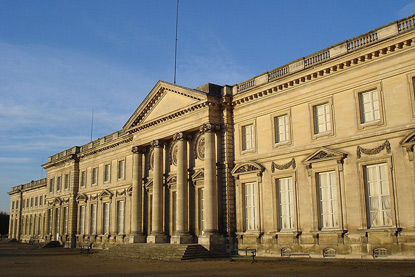
The Château de Compiègne, located 80 kilometres from Paris, stands as one of France's three most important royal and imperial residences alongside Versailles and Fontainebleau. Originally established by King Charles V in the 14th century, the château acquired its current neoclassical appearance through major renovations undertaken by Louis XV beginning in 1751, with further work completed under Louis XVI. The palace later became a significant centre of power during the First and Second Empires, particularly under Napoleon I and Napoleon III, who established his court here from 1853 to 1855. From 1856, the emperor threw one-month-long hunting parties in autumn that attracted hundreds of aristocrats from all over Europe.
The palace has 1337 rooms (including 105 guest apartments), eight courtyards and two parks. Today, visitors can explore the royal and imperial apartments, featuring the emperor and empress' bedrooms, as well as a ballroom lit by 15 chandeliers. In addition to the lavish state apartments from the 18th and 19th centuries, the palace hosts the Museum of the Second Empire (retracing the life of Napoleon III), the Empress Museum (dedicated to Empress Eugénie) and the National Car Museum (collection of old cars and motorcycles, including pre-combustion automobiles), and a park designated as a 'Remarkable Garden'. The château is open daily except Tuesdays and certain holidays, with the surrounding 40,000-hectare forest offering additional natural beauty.
Interesting Facts about the Château
- The Château de Compiègne originated as a medieval fortress built in the 12th century.
- Charles V commissioned the construction of the first royal residence in Compiègne in 1374.
- Louis XV transformed the château into a neoclassical masterpiece with architect Ange-Jacques Gabriel's designs.
- Napoleon I turned the château into an imperial estate and signed the decree for the Legion of Honour there in 1808.
- The Armistice ending World War I was signed near the château in the Rethondes clearing in 1918.
- After the fall of the Second Empire, it became a museum showcasing Imperial France's art and history.
- The château's gardens include both French formal and English landscape styles, reflecting evolving tastes over centuries.
- The Avenue des Beaux-Monts, created by Napoleon I, offers a stunning perspective inspired by Schönbrunn Palace.
- Listed as a historic monument, it remains a significant cultural heritage site of France.
History
The Château de Compiègne boasts a rich history dating back to the 14th century. The first royal residence was constructed in 1374 for Charles V, who sought a more secure location within the city walls. Over the centuries, numerous French monarchs visited and modified the château, with Louis XIV residing there some 75 times. However, it was Louis XV who truly fell in love with Compiègne and its vast forest, perfect for indulging his passion for hunting.
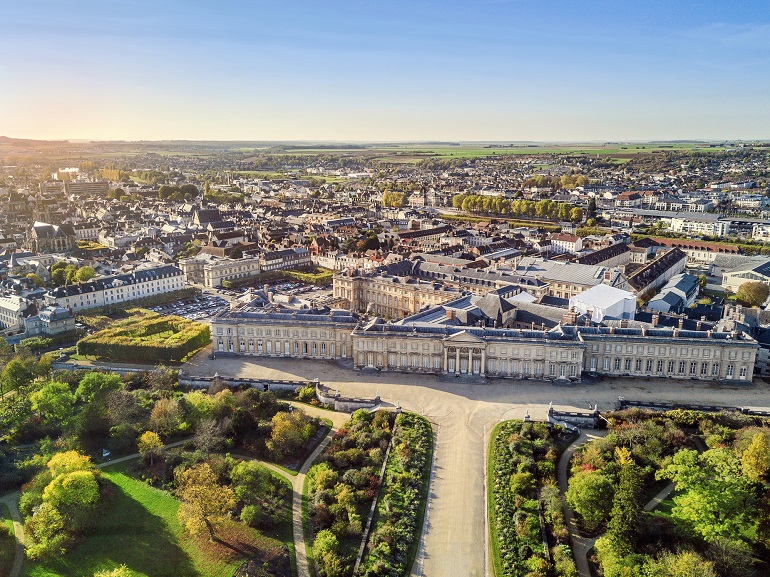
In 1750, Louis XV commissioned a complete renovation of the château, entrusting the project to the renowned architect Ange-Jacques Gabriel. Construction began in 1751 and was completed in 1788 by Gabriel's student, Le Dreux de La Châtre. The result was a magnificent neoclassical palace covering approximately 5 acres, featuring a distinctive triangular plan dictated by the ancient town ramparts. This new design made Compiègne a pioneer of the neoclassical style that would later dominate European architecture.
The château's fortunes fluctuated during the tumultuous years that followed. During the French Revolution, it was stripped of its furnishings and artwork. However, it regained its former glory under Napoleon I, who ordered its restoration in 1807. The Emperor and Empress occupied the former royal apartments, and new decor was added between 1808 and 1810. Later, Napoleon III and Empress Eugénie further enhanced the château, hosting the famous 'séries' or autumn gatherings that brought together royalty, diplomats, artists, and scientists for several weeks each year. These events solidified Compiègne's place as a centre of imperial court life and cultural exchange.
Description
The Château de Compiègne: A Royal Masterpiece
The Château de Compiègne stands as one of France's most magnificent royal residences, a splendid testament to neoclassical architecture and royal ambition. Situated approximately 80 kilometres northeast of Paris, this grand palace rises majestically from the edge of the Compiègne Forest, creating an imposing silhouette against the Picardy landscape. The château's elegant façade, characterised by its balanced proportions and refined ornamentation, exemplifies the architectural ideals of 18th-century France.
The building's trapezoidal layout presents a fascinating architectural solution to its site constraints. The garden façade, set at an oblique angle to the grand cour d'honneur, creates a dynamic visual experience as one approaches the palace. This ingenious design, attributed to Ange-Jacques Gabriel, Louis XV's principal architect, demonstrates the sophisticated spatial thinking that underpinned royal architectural projects of the period.
The exterior of the château features a harmonious rhythm of windows, pilasters, and balustrades that emphasise horizontal lines whilst maintaining a sense of monumental grandeur. The central pavilion, slightly projecting forward, is crowned with a triangular pediment adorned with intricate sculptural reliefs. This subtle hierarchy of architectural elements guides the visitor's eye and creates a sense of balanced magnificence that avoids the excessive ornamentation found in earlier baroque palaces.
The Magnificent Interior Spaces
Upon entering the château, visitors are immediately struck by the grandeur of the ceremonial staircase, a masterpiece of spatial design that seems to float upward with remarkable lightness despite its monumental scale. The stone steps, bordered by delicate wrought-iron balustrades with gilt accents, create a theatrical ascent to the state apartments above.
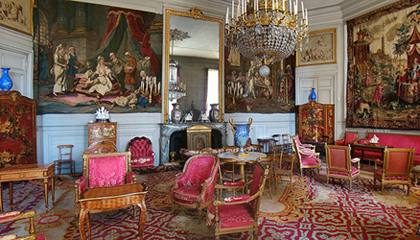
The King's Apartment, restored to its Napoleon III-era splendour, offers a dazzling display of Second Empire opulence. The suite begins with an antechamber decorated with crimson silk damask wall coverings and gilt wooden panelling. This leads to the Council Chamber, where the Emperor would meet with his ministers, featuring an imposing marble fireplace and walls lined with portraits of imperial dignitaries.
The Emperor's Bedroom presents a symphony of imperial symbolism, with its massive canopied bed positioned on a raised platform. The bed's headboard and canopy are adorned with embroidered imperial bees and eagles, whilst the surrounding walls display silk hangings in the imperial green. The ceiling, painted with allegorical scenes celebrating imperial virtues, completes this expression of sovereign power.
The Empress's Apartment, located in the opposite wing, offers a fascinating contrast with its more intimate scale and feminine aesthetic. The boudoir, with its pale blue silk wall coverings and delicate white and gold furniture, exemplifies the refined taste of Empress Eugénie. The adjacent bedroom features an exquisite collection of Sèvres porcelain and a ceiling painted with floral motifs that create an atmosphere of elegant tranquillity.

The Spectacular State Rooms
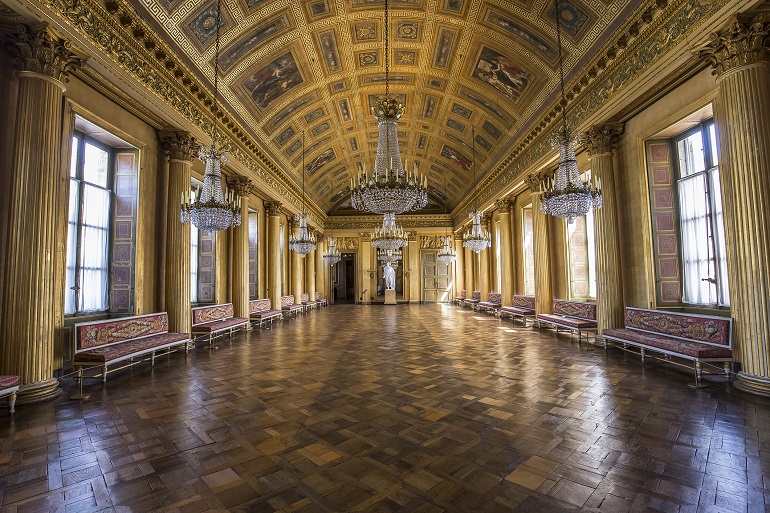
The Ballroom, one of the château's most breathtaking spaces, stretches nearly 40 metres in length. Its double-height ceiling, supported by Corinthian columns, creates a sense of airy grandeur. Enormous mirrors line the walls, multiplying the light from the crystal chandeliers and creating an illusion of infinite space. The parquet floor, laid in an intricate geometric pattern, was designed to accommodate hundreds of dancers during the lavish imperial balls.
The Theatre, constructed under Napoleon I and renovated by Napoleon III, represents one of the finest examples of imperial theatrical architecture in France. Its horseshoe-shaped auditorium, lined with red velvet and gilt decoration, could seat over 500 spectators. The ceiling, painted with scenes from classical mythology, crowns this intimate yet sumptuous performance space that hosted everything from Molière comedies to operatic productions.
The Map Room serves as a testament to the strategic importance of Compiègne as a royal hunting residence. Its walls are covered with detailed topographical maps of the surrounding forests, marking hunting routes, game reserves, and notable landmarks. The central table, inlaid with a composite map of the entire domain, allowed the royal hunting parties to plan their expeditions with military precision.
The Gallery of Columns provides a majestic connection between the state apartments and the ballroom. This long gallery, illuminated by tall windows overlooking the gardens, features paired Ionic columns supporting a coffered ceiling. Between the columns stand marble busts of Roman emperors, creating a symbolic lineage between ancient imperial power and Napoleon's own imperial ambitions.
The Museums Within
The Museum of the Second Empire occupies several rooms within the château, housing an exceptional collection of paintings, sculptures, furniture, and decorative arts from Napoleon III's reign. Highlights include Franz Xaver Winterhalter's portraits of the imperial family, sumptuous Boulle furniture, and an impressive array of Sèvres porcelain commissioned for imperial use.
The National Carriage Museum, located in the former royal stables, presents one of Europe's finest collections of historical carriages and sleighs. The coronation coach of Napoleon I, with its gilt wood carvings and velvet upholstery, stands as the collection's centrepiece. Other notable exhibits include the elegant berline used by Empress Eugénie and the children's carriages of the Imperial Prince.
The Empress's Turkish Boudoir offers a fascinating glimpse into 19th-century Orientalism. This small but exquisitely decorated room features walls covered in embroidered silk panels, low divans heaped with tasselled cushions, and a ceiling painted to resemble a star-studded night sky. The room reflects Empress Eugénie's fascination with Ottoman culture and stands as a perfect example of Second Empire exoticism.
The Formal Gardens
The formal gardens that extend from the château's rear façade represent a masterful example of French garden design. Originally conceived by André Le Nôtre, Louis XIV's legendary garden architect, and later reimagined by Louis-Martin Berthault under Napoleon I, these gardens create a seamless transition between architecture and landscape.
The Parterre, directly adjacent to the château, presents an intricate pattern of low boxwood hedges forming geometric shapes around central fountains. These precisely clipped hedges frame beds of seasonal flowers that create changing tapestries of colour throughout the year. From spring tulips to summer roses and autumn chrysanthemums, the Parterre offers a constantly evolving display of horticultural artistry.
The Grand Canal, extending perpendicular to the château's central axis, creates a magnificent reflecting pool that doubles the visual impact of the palace façade. Flanked by neatly trimmed lawns and statuary, this water feature draws the eye toward the forest beyond, creating a sense of the château commanding not just its immediate surroundings but the wider landscape as well.
The Orangery Garden, located to the south of the main parterre, features a collection of citrus trees in monumental terracotta pots that are brought outdoors during the summer months. The symmetrical arrangement of these trees, some over 200 years old, creates a Mediterranean atmosphere that contrasts delightfully with the more formal elements of the main garden.
The English-Style Park
Beyond the formal gardens lies an extensive English-style park that offers a more naturalistic landscape experience. Created in the early 19th century, this area represents the Romantic ideal of landscape design, with winding paths, artfully placed tree groups, and carefully constructed "natural" vistas.
The Serpentine Lake, with its irregular shoreline and small wooded island, creates a picturesque focal point within this landscape. A rustic stone bridge arches gracefully over the narrowest part of the lake, offering visitors charming views across the water to carefully framed vistas of the château in the distance.
The Temple of Love, a small neoclassical pavilion set on a gentle rise, provides a romantic retreat within the park. This circular structure, supported by Ionic columns and topped with a shallow dome, houses a marble statue of Cupid. From this elevated position, visitors can enjoy sweeping views across the park toward the château and forest beyond.
The Grotto, an artificial cave constructed from rough-hewn stones and decorated with stalactite-like formations, offers a cool retreat on warm summer days. A small stream trickles through this whimsical structure, creating gentle background music that enhances the atmosphere of mysterious seclusion.
The Allée des Beaux-Monts
Perhaps the most spectacular landscape feature of Compiègne is the famous Allée des Beaux-Monts, a monumental avenue that extends for nearly 5 kilometres from the château into the heart of the forest. This remarkable perspective, 60 metres wide and rising gradually to the crest of a distant hill, represents landscape design on a truly imperial scale.
The avenue is lined with four rows of lime trees, creating three parallel alleys. The central alley, twice the width of those on either side, forms a grand green carpet that draws the eye irresistibly toward the horizon. This masterpiece of landscape design demonstrates the French genius for imposing geometric order upon nature, creating a statement of human dominance over the natural world.
From the château terrace, the Allée creates a breathtaking vista that seems to extend infinitely into the distance. Conversely, when viewed from the summit of the Beaux-Monts hill, the château appears as a distant jewel at the end of this green corridor, emphasising the palace's position as the crown jewel of this vast domain.
The Rose Garden
The Rose Garden of Compiègne represents one of the finest historical rose collections in France. Created in 1820 on the site of the former King's Grove, this garden has been meticulously restored to showcase the evolution of the rose from ancient varieties to 19th-century hybrids.
The garden is arranged in a series of circular beds, each dedicated to a particular class of roses. The central beds feature ancient roses such as Rosa gallica officinalis (the Apothecary's Rose), Rosa damascena (the Damask Rose), and Rosa centifolia (the Cabbage Rose). These venerable varieties, some dating back to Roman times, offer visitors a glimpse into the long history of rose cultivation.
Surrounding these ancient varieties are beds of 18th and early 19th-century roses, including the Portland, Bourbon, and Noisette classes. These represent the first wave of hybridisation that revolutionised rose breeding. Notable examples include 'Souvenir de la Malmaison', a pale pink Bourbon rose named after Empress Josephine's famous garden, and 'Blush Noisette', one of the first climbing roses to feature repeat flowering.
The outer beds showcase roses popular during the Second Empire, including early Hybrid Perpetuals and Tea roses. These more modern varieties, with their larger blooms and extended flowering seasons, reflect the horticultural advances of the 19th century. Interspersed among the roses are companion plants such as lavender, catmint, and lady's mantle, which complement the roses while providing continuous colour and texture.
A small pavilion at the centre of the garden houses a collection of botanical illustrations and historical documents relating to rose cultivation at Compiègne. From this central point, gravel paths radiate outward like the spokes of a wheel, allowing visitors to explore the garden systematically while appreciating the subtle differences between the various rose families.
The Forest of Compiègne
While technically beyond the château grounds, the Forest of Compiègne forms an integral part of the visitor experience. This vast woodland, covering over 14,000 hectares, served as the royal hunting ground for centuries and remains one of France's most historically significant forests.
The forest features an extensive network of straight avenues, known as laies, that intersect at regular intervals, creating a geometric pattern superimposed upon the natural woodland. These avenues, originally created to facilitate royal hunts, now provide excellent walking and cycling routes through the ancient woodland.
Throughout the forest, visitors will encounter small clearings, known as carrefours, often marked by stone obelisks or monuments. These served as meeting points during hunts and now provide peaceful spots for picnics or rest. Particularly notable is the Carrefour du Puits du Roi, marked by an 18th-century well that supposedly dates back to the time of Saint Louis.
The forest boasts remarkable biodiversity, with ancient oak, beech, and hornbeam trees creating a magnificent canopy above a rich understorey of holly, hawthorn, and elder. In spring, parts of the forest floor are carpeted with bluebells, wood anemones, and wild daffodils, creating a magical atmosphere that has inspired artists and poets for centuries.
Conclusion
The Château de Compiègne represents far more than a mere architectural monument; it embodies the evolving ideals of French royalty and empire across centuries. From its elegant neoclassical façades to its sumptuous interiors, from its formal gardens to its romantic park, every aspect of Compiègne speaks to a sophisticated understanding of how architecture, decoration, and landscape can combine to create a comprehensive expression of power, taste, and cultural refinement.
As visitors move through the various spaces of the château and its grounds, they experience a carefully orchestrated progression from formal grandeur to intimate luxury, from geometric precision to romantic naturalism. This thoughtful integration of seemingly opposite aesthetic principles creates a uniquely harmonious whole that continues to captivate visitors today.
Whether admiring the exquisite craftsmanship of the imperial apartments, strolling through the rose garden's fragrant displays, or gazing down the monumental perspective of the Allée des Beaux-Monts, visitors to Compiègne encounter a masterpiece of European cultural heritage that rewards repeated visits and careful contemplation. The château stands as a testament to the artistic vision and technical skill that created one of France's most perfect expressions of the art of royal living.
Getting There
The Château de Compiègne, located 80 km from Paris, is easily accessible by car or train. By car, take the A1 motorway and exit at junction 9 towards Compiègne Sud, then follow signs to Soissons. Parking is free at Place du Général de Gaulle near the château. If travelling by train, direct services run from Paris Gare du Nord to Compiègne in 40 minutes to 1 hour 20 minutes. From the station, it’s a 10-minute walk to the château or a short ride on free buses (lines 1 or 2, stop at Saint Jacques) available Monday to Saturday. The château’s GPS coordinates are 49°25’06.34’’N and 2°49’48.23’’E, ensuring a smooth journey to this historic site.
Best Time to Visit
The best time to visit Château de Compiègne is during the spring and summer months, from April to September, when the castle's gardens are in full bloom and the weather is pleasant. During this period, the Royal and Imperial Apartments are open from 10am to 6pm, allowing ample time to explore the opulent interiors. The National Car Museum and the Museum of the Second Empire also operate on extended hours during these months. Additionally, visiting on the first Sunday of each month offers free admission for everyone, making it an ideal time for budget-conscious travellers. The castle is closed on Tuesdays and certain public holidays, so it is advisable to plan your visit accordingly.
| Travel destinations in Picardy | ||||||||||||||
|---|---|---|---|---|---|---|---|---|---|---|---|---|---|---|
|
|
|
|
| ||||||||||
|
|
|
|
| ||||||||||


