


| Contents |
|---|
Introduction
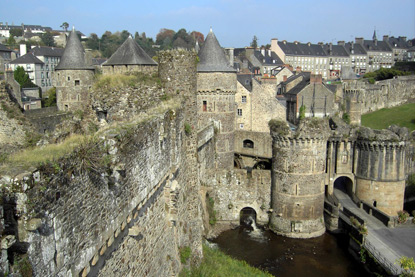
Fougères (pop. 20,000) is a medieval town renowned for one of Europe's largest and best-preserved fortresses. Positioned at the historic border between the Duchy of Brittany and France, this town of approximately 20,000 residents served as a crucial defensive stronghold for centuries, with its imposing granite castle featuring 13 towers and formidable ramparts dominating the landscape.
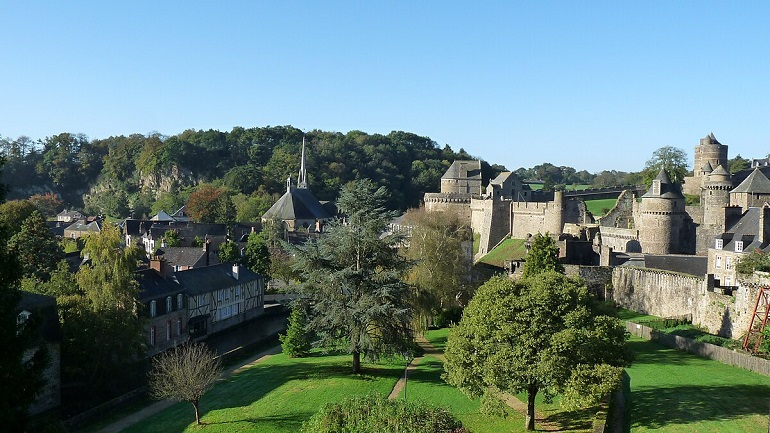
The medieval heart of Fougères remains remarkably intact, particularly in the Bourg-Viel district at the foot of the castle, where visitors can explore cobbled streets lined with 17th-century half-timbered houses, Gothic churches including Saint-Sulpice and Saint-Léonard, and traditional squares such as Place du Marchix.
The town offers a fascinating glimpse into Brittany's military heritage whilst providing modern amenities for tourists, surrounded by the natural beauty of the Forêt de Fougères and characterised by its authentic medieval atmosphere that has been carefully preserved over the centuries.
Interesting Facts about Fougères
- Fougères is home to the Château de Fougères, often cited as the largest medieval fortress in Europe, guarding the historic border of Brittany.
- The town’s name is commonly linked to “ferns” and sits where two ancient Roman roads once crossed, shaping its strategic growth.
- Fougères boasts Brittany’s oldest belfry, a 14th‑century symbol of civic pride funded by local merchants.
- The lower town, or Ville Basse, grew around water‑powered trades like tanning and weaving, with half‑timbered houses still visible today.
- Victor Hugo, Balzac and Flaubert visited and wrote about Fougères, inspired by its dramatic vistas and public gardens.
- In the early 20th century, Fougères was famed as the “capital of women’s footwear,” with dozens of shoe factories driving its economy.
- The Nançon River curls around the castle like a natural moat, contributing to the site’s formidable layered defences and towers.
- Nearby Fougères Forest shelters marked trails and megalithic sites, adding prehistoric intrigue to the medieval setting.
- The town regularly earns top “four‑flower” honours for its abundant planting and green spaces, making strolls especially picturesque.
- Fougères’ upper and lower towns reveal a striking medieval panorama, with church spires, ramparts and gardens unfolding across the valley.
History
Medieval Foundations and Early Development
Fougères was founded around the year 1000 on a strategic rocky islet in a narrow valley between marshland and the River Nançon. The settlement developed at the crossroads of two important Roman roads, one connecting Chartres to Carhaix and the other linking Avranches to Nantes. The first wooden fortress was built by the House of Amboise in the 11th century, positioned to defend the north-eastern borders of the Duchy of Brittany from powerful neighbours including Normandy (controlled by the kings of England) and Anjou and Maine (under French control). By the 12th century, the population expanded beyond the original riverside location, with the town divided into two parishes: Saint-Sulpice for the lower town and Saint-Léonard for the upper town. The more prosperous inhabitants began establishing the Haute Ville on higher, rockier ground above the valley, which became the civic focus of the settlement. Crafts flourished during this period, particularly tannery, weaving, and drapers in the lower town.
Fortress Development and Medieval Conflicts
The wooden castle was destroyed in 1166 after being besieged and captured by Henry II of England, but Baron Raoul II immediately undertook reconstruction in stone, creating a more imposing structure that became a crucial stronghold defending Brittany's borders from Mont Saint-Michel to Nantes. The distinctive crescent-shaped plan was adopted to fit the natural contours of the land, with local shale used for most fortifications and harder granite reserved for more vulnerable elements like doors, windows, and tower bases. The geographical position and interests of the lords of Fougères often favoured the Kingdom of France, leading to complex political struggles throughout the medieval period. In 1231, when Raoul III offered the castle to Louis IX of France, Breton prince Pierre Mauclerc captured the city, though it was subsequently recaptured by the king. The end of the 13th century marked a period of peace and prosperity, but political instability continued with Philip IV of France purchasing the domain in 1307, though the kingdom showed little interest in maintaining it. After various conflicts and changing allegiances, Bertrand du Guesclin entered the town in 1373, but conditions remained poor until the population requested assistance from the Duchy of Brittany, leading to the town joining the duchy in 1428.
Renaissance to Modern Era
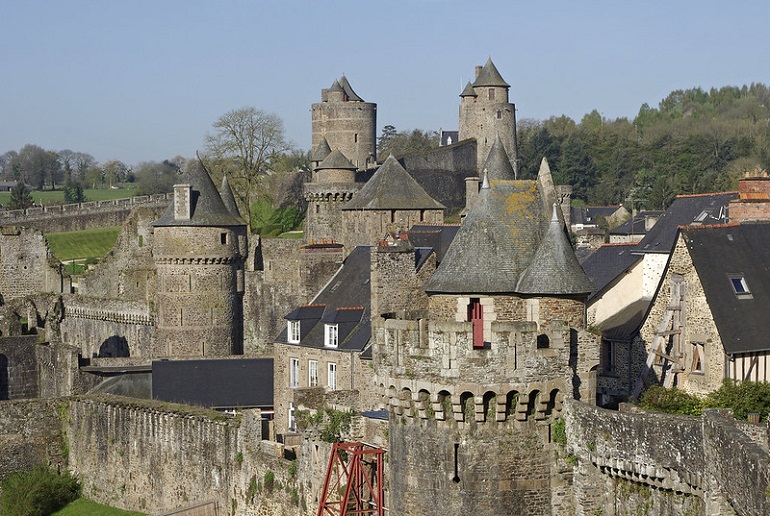
The 15th century brought renewed conflict when François de Surienne, an Aragonese mercenary serving the English, captured and sacked Fougères in 1449, causing massacres that prompted Francis I, Duke of Brittany, to ally with Charles VII of France and reclaim the town. The Dukes of Brittany acquired the fortress in the 1430s and undertook extensive improvements, including the construction of the impressive Tour Raoul and Tour Surienne as artillery towers responding to the development of firearms. By the 16th century, Fougères had lost its defensive role as the town's military importance declined with changing warfare and Breton boundaries. The marriage of Claude of Brittany to François I of France in 1532 ended centuries of struggle and marked Brittany's integration into the French kingdom. During the Industrial Revolution, Fougères experienced economic growth as a centre for glass and shoe manufacturing, with the population expanding and the town growing around the medieval castle. The town suffered during World War II under German occupation before liberation by American troops, with many historic buildings damaged or destroyed. Throughout its thousand-year history, Fougères has maintained its status as one of Europe's largest and best-preserved medieval fortresses.
Main Attractions
Château de Fougères
At the heart of the town, the Château de Fougères stands as one of the largest and best-preserved medieval fortresses in France. Dating from the end of the tenth century, it occupies an extensive area of over two hectares and offers a striking example of military architecture developed over four centuries. The castle's evolution is evident in its many towers, walls, and defensive features, including curtain walls, machicolations, arrow slits, and a well-maintained chemin de ronde. Its three main enclosures—the bayle (outer courtyard), the crescent-shaped main enceinte, and the elevated high court protected by a donjon—reflect the strategic adaptations made across ages. Inside, while the seigneurial residence is in ruins, visitors can explore towers such as the Tour de la Haye-Saint-Hilaire, Tour Raoul, Tour Mélusine, and Tour du Hallay, many of which afford sweeping views of Fougères and the surrounding countryside. The entry is marked by the Poterne d'Amboise, originally fitted with a drawbridge, once connecting to the now-absent Rocher de la Couarde. Around the fortress, a moat, water mill, and vestiges of artillery towers further illustrate the castle's defensive ingenuity.

Tour Mélusine
Within the castle grounds, the Tour Mélusine ranks as a masterpiece of fourteenth-century military architecture. Its cylindrical form rises 31 metres high with an impressive diameter and walls up to 3.5 metres thick, built to withstand sieges and serve as a lookout. The tower's name links to local legend: Mélusine, a mythical builder and protector, was thought to have gifted her skills to the fortresses of Brittany. Today, the Tour Mélusine can be visited and climbed, offering panoramic vistas of both the castle ramparts and the wider region. For those interested in medieval warfare, the tower is a prime example of how fortress design evolved to support artillery, as illustrated by nearby horseshoe-shaped artillery towers dating from the fifteenth century, with massive walls engineered for both defence and offensive capabilities during times of siege.
The Medieval Quarter and the Beffroi
Fougères' medieval quarter envelops visitors in centuries-old ambience, teeming with timber-framed houses, narrow passageways, and ornamental façades. The streets here radiate from the castle and are punctuated with notable civic buildings and charming squares. The Beffroi, constructed in 1397, claims the distinction of being Brittany’s oldest belfry and has long served as a focal point for community gatherings and the rhythm of town life. Alongside the beffroi, the neighbourhood rewards exploration with its historic washhouses (lavoirs), three storied churches, and examples of Renaissance and medieval domestic architecture. The high town features the Église Saint-Léonard with its ancient stained glass, reputed to be the oldest in Brittany. Every corner of the district reveals new architectural curiosities and opportunities to experience authentic Breton character, ideal for leisurely strolls and photography.
Parks and Open Spaces
Fougères is surrounded by green spaces that provide recreational respite and scenic beauty for both locals and travellers. The Parc Botanique de Haute Bretagne lies just beyond the town limits, boasting over twenty-five hectares of themed gardens. Here, guests can wander through tranquil pathways, admire vibrant floral displays, and discover global garden styles in a calm, leafy setting. Within the town, areas such as the Parc de la Meslais and the municipal camping grounds offer playgrounds, cycling lanes, and picnic spots. These parks are popular with families, walkers, and those wishing to enjoy Fougères' natural bounty after a day of historical exploration.
Top Museums
Art Museums and Collections
Musée Emmanuel de la Villéon
Situated in one of Fougères’ oldest timber-framed houses, the Musée Emmanuel de la Villéon occupies a sixteenth-century townhouse on Rue Nationale. This museum is devoted to the locally celebrated landscape painter Emmanuel de la Villéon, an artist whose vibrant, evocative canvases and works on paper are displayed throughout the museum’s atmospheric rooms.
The permanent collection offers a compelling retrospective of Villéon’s artistic journey, featuring a wide range of oils, pastels, gouaches, charcoals, and inks that demonstrate his versatility and expressive use of colour. Among the highlights are the charming theatrical décor pieces he created for his children, which provide rare insight into the artist’s personal life and creative process. The museum also hosts thematic exhibitions, workshops, and educational activities for all ages, making it a dynamic cultural hub.
The building itself is notable: it is the last remaining house in the Haute Ville to feature both timber frame and stone porch construction, and is recognised as a historic monument. Visitors are thus able to experience both the artist’s world and a finely preserved example of Fougères’s architectural heritage.
Specialised and Technical Museums
Atelier-Musée de l’Horlogerie (Watchmaking Workshop and Museum)
Nestled on Rue Nationale, the Atelier-Musée de l’Horlogerie offers a distinctive journey into the world of timekeeping and mechanical art. The experience begins in an active watchmaker’s workshop, where master craftsmen demonstrate traditional restoration techniques on antique clocks and watches. Visitors can observe the meticulous process of repairing gears, springs, and other components—a tradition of craftsmanship that remains vibrant in Fougères.
The museum proper houses a remarkable collection of timepieces, including large pendulum clocks, pocket watches, automata, and animated tableaux. These items, some of which date back over 400 years, showcase the evolution of horological engineering in France and Europe. The displays highlight both the technical advances and the aesthetic beauty of clocks, with particular emphasis on the creativity and precision of local artisans. Demonstrations and commentary by expert curators bring the collection to life, making this museum a fascinating stop for anyone interested in the intersection of science, history, and art.
Occasionally, the museum also offers hands-on workshops in calligraphy and illumination—medieval arts intimately connected with written timekeeping devices.
Contemporary Art Spaces
Galerie Albert Bourgeois
Set within the former Convent of Urbanists in the centre of Fougères, the Galerie Albert Bourgeois is the town’s primary venue for contemporary artistic expression. The gallery’s airy, eighteenth-century rooms—reached by a striking stone staircase—provide a fitting setting for regular exhibitions of painting, sculpture, photography, performance, and multimedia art. Curated shows feature both local artists and internationally known figures, fostering a dialogue between the city’s heritage and contemporary creativity.
In addition to exhibitions, the gallery frequently organises workshops, talks, and educational programmes, making it a lively anchor for the town’s cultural life. Its emphasis on supporting emerging artists and engaging with new ideas ensures that there is always something fresh to discover.
Cultural Centres and Exhibition Venues
Centre Culturel Juliette Drouet
The Centre Culturel Juliette Drouet is a modern venue dedicated to the arts in all their forms. Named after the nineteenth-century actress who lived in Fougères, the centre presents a diverse programme including visual arts exhibitions, live performances, concerts, and cultural workshops. Its welcoming spaces are designed to foster community participation and creative exchange, and the centre often collaborates with local schools, artists, and community groups.
Exhibitions here typically showcase work by contemporary artists from Brittany and further afield, making the centre a vital hub for anyone interested in the region’s artistic landscape.
Local Cuisine
The cuisine of Fougères reflects the rich culinary heritage of Brittany, offering visitors a true taste of the region’s traditions. In local restaurants and bustling markets, one can savour the celebrated galette de sarrasin, a savoury buckwheat crêpe often filled with ham, cheese, or eggs. Seafood is also prominent, with dishes showcasing fresh mussels, oysters, and scallops brought in from the nearby coast. For a sweet treat, do not miss the far breton, a custard-like dessert studded with prunes, or the beloved kouign-amann, a decadent pastry layered with butter and sugar. These specialities pair beautifully with a glass of crisp Breton cider, the region’s signature beverage.
Getting There
By train Fougères lacks its own railway station, so the easiest rail route is to alight at Rennes on the Paris–Brittany high-speed line; from there, local coaches complete the final 55-minute hop to Fougères’ centre.
By coach Several regional bus services fan out from Rennes bus station and connect directly with Fougères, an option that dovetails neatly with rail arrivals and spares visitors the need for a car.
By car Motorists can reach Fougères swiftly via the A84 autoroute: exit at junction 31 and follow the well-signed D798 north-east, a scenic drive skirting gentle Breton countryside before the medieval towers of Fougères come into view.