


| Contents |
|---|

Introduction
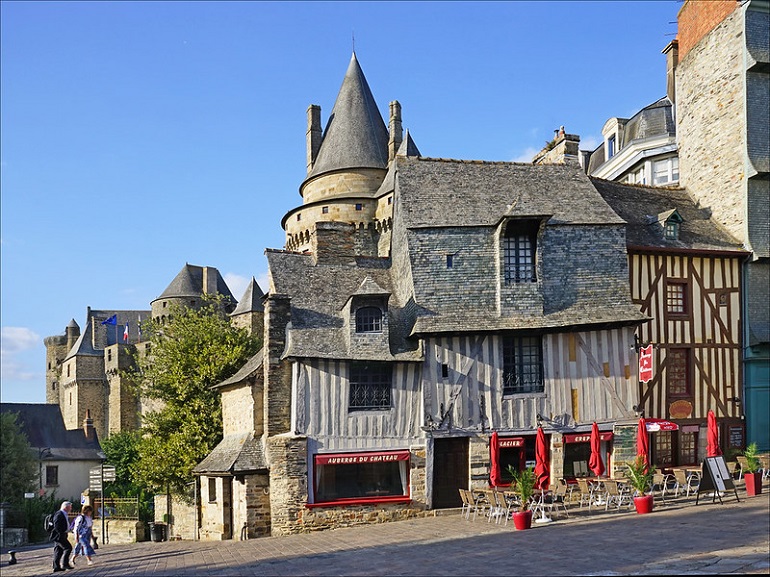
Vitré (pop. 19,000) is a medieval town recognised as one of the most well-preserved examples of medieval architecture remaining in the country. The town's centrepiece is the imposing Château de Vitré, a 13th-century fortress that dominates the skyline and once served as a strategic defensive stronghold on the border of Brittany. Vitré's historic centre spans 11.4 hectares and is characterised by its network of cobbled streets lined with half-timbered houses dating from the 15th and 16th centuries, Gothic churches including the 15th-century Église Notre-Dame, and well-preserved medieval ramparts and towers. The town has been officially designated a 'ville d'art et d'histoire' by the French Ministry of Culture in recognition of its exceptional cultural heritage, whilst its Old Quarter features key streets such as Rue de la Baudrairie and Rue d'En-Bas where visitors can explore artisan boutiques and experience the atmosphere of this remarkably intact medieval settlement.
Interesting Facts about Vitré
- Vitré is a remarkably well-preserved medieval town in Ille‑et‑Vilaine, Brittany, famed for its cobbled lanes and half‑timbered houses that cluster around a storybook castle.
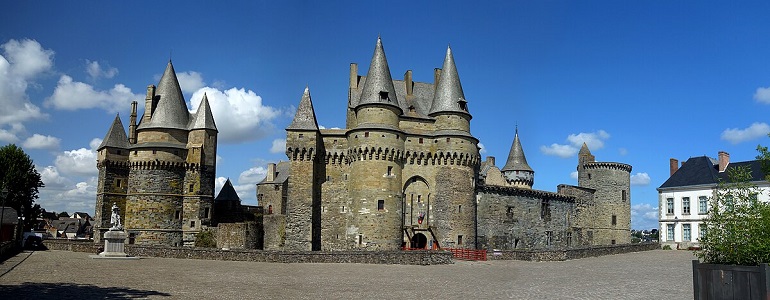
- The formidable Château de Vitré, with origins in the 11th century and major rebuilds in the 13th–15th centuries, once guarded Brittany’s eastern border.
- Vitré’s silhouette is defined by stout ramparts and crenellated towers, giving it one of the most striking fortified skylines in western France.
- The town’s Breton name is Gwitreg, reflecting Brittany’s distinct Celtic heritage and bilingual cultural traditions.
- Vitré flourished in the late Middle Ages through the cloth trade, which funded its merchants’ grand timber-framed residences.
- The historic centre radiates from the castle gates, where narrow passages lead to lively squares lined with colourful façades.
- Vitré’s church of Notre‑Dame showcases Gothic architecture and centuries of local devotion in finely worked stone.
- Perched above a bend of the Vilaine, the town commands scenic views across the river valley and wooded countryside.
- French kings and travellers alike praised Vitré for its beauty, helping cement its reputation as a jewel of Brittany’s heritage.
- Today, Vitré balances small‑town charm with excellent rail links, making it an easy medieval day trip from Rennes.
History
The origins of Vitré stretch back to Gallo-Roman times when the site was already inhabited, with the town's name deriving from the Gallo-Roman designation "Victor" or "Victrix" after the owner of a local farm in the region. The formal establishment of Vitré began in the year 1000 when Geoffrey I, Duke of Brittany, granted feudal powers to Riwallon Le Vicaire, tasking him with maintaining this strategic area as a crucial buffer zone known as the "Marches of Brittany"—a defensive frontier similar to the Welsh Marches. The first fortification was a modest wooden motte-and-bailey castle built on Sainte-Croix hill, though this structure suffered repeated destruction by fire, leading Baron Robert I to construct a more durable stone castle in 1070 on the current rocky outcrop overlooking the Vilaine river valley, with portions of this original stone fortress still visible today.
During the medieval period, Vitré evolved into a formidable walled city that epitomised defensive architecture. In the 13th century, the castle underwent substantial enlargement and fortification, incorporating robust towers and curtain walls in the architectural style favoured by Philip II Augustus. The town passed through various noble families, including Guy IX de Laval in 1295 upon his marriage to the heiress, followed successively by the houses of Rieux, Coligny, and La Trémoille. The comprehensive fortification system, built between 1220 and 1591, encompassed ramparts constructed by Baron André III in 1240 and later reinforced in the 15th century to accommodate advances in artillery. The medieval city took its definitive form during this period, featuring not only the fortified castle but also religious buildings, colleges, and privileged boroughs that defined the linear street layout still evident in Vitré's present neighbourhoods.
The Renaissance marked Vitré's golden age, when the town became one of the most prosperous cities in the Duchy of Brittany, reaching its zenith in the 16th century. The economy flourished through the activities of the "Confrérie des Marchands d'Outre-Mer"—merchant venturers who traded locally produced hemp throughout Europe, enabling wealthy merchants to construct grand private mansions adorned with ornate Renaissance decorations that remain visible within the city walls today. This prosperity was so remarkable that when Henry IV visited in 1598, he famously declared: "If I were not King of France, I would be a burgher of Vitré!" However, the city's Protestant allegiance during the French Wars of Religion led to a five-month siege by Catholic League forces under the Duke of Mercœur at the century's end, though Vitré successfully resisted and remained one of the few bastions in western France to withstand the Leaguers. The early 17th century marked the beginning of decline when the Laval family line ended with Guy XX's death in Hungary, and the new La Trémoille lords abandoned the town for the Court of Versailles, causing Vitré to lose much of its former vitality and significance.
Main Attractions
Centre Historique du Vitré
Vitré’s old quarter is a maze of narrow cobbled lanes lined with flamboyantly painted half-timbered houses whose carved beams overhang the street like theatrical balconies. Rue de la Baudrairie and Rue de la Poterie showcase the wealth of Vitré’s medieval cloth-merchants, while tiny passages such as Rue de la Bridole reveal hidden courtyards, ornate well-heads and traceried window frames. Wander without hurry: every turning offers a fresh perspective on stacked gables, wrought-iron signs and flower-decked façades that make the whole district feel like an open-air period film set. Evening illuminations add a soft glow to timber and slate, rewarding those who linger after dusk.
Château de Vitré (Exterior & Grounds)
Soaring above the Vilaine valley, the castle’s dagger-like turrets, machicolated ramparts and steep slate roofs proclaim Brittany’s turbulent past. Begun in the thirteenth century then embellished by the powerful Laval family, its triangular ground-plan follows the rocky spur on which it sits. Even if you skip the museum inside, circle the moat to admire the drawbridge, portcullis tower and polygonal keep; from the esplanade you gain panoramic views across the half-timbered rooftops. The adjacent war memorial and crescent of stout granite walls underline the fortress’s role as sentinel on Brittany’s eastern frontier.
Tour de la Bridolle
Embedded within the southern ramparts, this solid round tower is a relic of the town’s thirteenth-century defence system. Its rough-hewn granite blocks and arrow-slits conjure images of crossbowmen scanning the horizon for hostile forces. Today the tower is best appreciated while strolling the lower town: framed by climbing roses and weathered stone cottages, it provides an evocative photo stop and a tangible reminder that medieval Vitré was once a frontier stronghold rather than a sleepy provincial town.
Pré des Lavandières
Below the castle walls the river laps gently against an emerald meadow that once echoed with the slap of linen on stone. Local women used to gather here to wash clothes; now the site is a peaceful riverside park where willows trail their branches in the water and wooden footbridges connect shaded paths. Pack a picnic, watch dragonflies skim the surface, and enjoy one of the most romantic castle views in Brittany: the fortress rising sheer above sylvan foliage like something from a storybook illustration.
Jardin du Parc
Created in the nineteenth century on the former grounds of a noble estate, this landscaped garden offers sinuous paths through mature cedar, sequoia and copper beech. Seasonal flowerbeds supply colour from spring tulips to autumn dahlias, while a small aviary and children’s playground keep younger visitors content. Benches placed at subtle viewpoints frame the castle’s skyline beyond a sea of green, making the park an ideal spot for quiet reading or an unhurried sandwich between sightseeing forays.
Église Notre-Dame
Dominating Place Notre-Dame with its soaring Flamboyant Gothic façade, this fifteenth-century church blends delicate stone lacework with sturdy granite buttresses. Step inside to admire the lofty nave, rose-window light and intricately carved Renaissance rood screen. Outside, gargoyles peer over the square, and the slender south tower punctuates the townscape. Even non-religious travellers will appreciate the craftsmanship that mirrors Brittany’s seafaring prosperity during the Age of Discovery.
Église Saint-Martin
A short stroll from the ramparts, Saint-Martin surprises with its late nineteenth-century Neo-Romanesque style: rounded arches, pale stone and a graceful bell tower contrast with the Gothic mood elsewhere. Its calm, uncluttered interior makes a refreshing pause, and the churchyard offers an understated vantage point over the boulevard once occupied by the medieval moat.
Weekly Street Market
Every Monday morning Vitré’s central squares burst into life as stallholders erect striped awnings laden with farm-fresh strawberries, sea-salt caramels, andouille sausages and wheels of nutty local cheese. The scent of galettes sizzled on cast-iron billig griddles mingles with the chatter of Breton and Gallo accents. Browse handmade wicker baskets, try a cup of cider, and practise your French small-talk—this convivial ritual is as much about community as commerce and offers an authentic slice of regional culture.
Top Museums
Medieval History and Decorative Arts
Vitré Castle (Château de Vitré)
Dominating the town skyline, the Château de Vitré is a dramatically restored medieval fortress that now serves as the town’s principal museum. Within its massive ramparts, the castle houses a remarkable collection of religious art, including a 15th-century retable and a triptych depicting the life of Christ across 32 detailed scenes. Visitors can admire gold liturgical objects from the 17th, 18th, and 19th centuries, as well as historic altar frontals and vestments.
The castle is also home to a sculpted Adam and Eve doorway, and the Saint Laurent tower contains an impressive collection of Medieval and Renaissance sculptures—including the early 15th-century tomb of Guy X de Laval and a grandiose fireplace from 1583. The castle’s interior is further enriched by tapestries from Flanders and Aubusson, and within the Argenterie tower, a late 19th-century cabinet de curiosité offers a window into the eclectic collecting tastes of the era, paired with a fascinating natural science collection. Historical documents relating to the history of both the castle and the town are also on display, allowing visitors to retrace the estate’s evolution through the centuries.
Literary Heritage and Domestic Life
Museum of Rochers-Sévigné (Musée des Rochers-Sévigné)
Located just a few kilometres from the town centre, the Château des Rochers-Sévigné was the country residence of Madame de Sévigné, one of France’s most celebrated letter writers. This elegant 15th-century Gothic manor has been preserved as a museum dedicated to her life and work. Visitors can explore personal artefacts, period furniture, and portraits that help bring her world to life. It was here that she wrote 297 of her famous letters—many addressed to her daughter, the Countess of Grignan.
The tour leads through the manor and its orangerie, culminating in a visit to the octagonal chapel built by the Marquise herself in 1671. The estate’s park is a masterpiece of French formal gardening, with its alleys and vistas designed by André Le Nôtre, the celebrated gardener of Louis XIV. Strolling through the park, visitors encounter charmingly named pathways and enjoy a sense of the literary and horticultural taste of 17th-century France.
Global Cultural Heritage
Maison des Cultures du Monde
Housed in a former priory, the Maison des Cultures du Monde is the French Centre for Intangible Cultural Heritage. This institution is entirely dedicated to the documentation, preservation, and dissemination of the world’s living traditions. It is a hub for research and experience, offering a diverse programme of performances, exhibitions, and public events focused on rituals, performing arts, and craftsmanship from every continent.
Visitors will find a remarkable documentary centre and media library, with tens of thousands of books, photographs, films, and recordings accessible both onsite and online. The museum also displays a permanent collection of musical instruments from around the world, and regularly hosts thematic exhibitions that immerse guests in global cultural practices. The Maison des Cultures du Monde is a place of encounter and dialogue, where the intangible heritage of humanity is celebrated and shared.
Local Cuisine
Visitors are sure to encounter galettes de sarrasin, the classic Breton buckwheat pancakes, often filled with ham, cheese, or eggs, and best enjoyed in the cosy atmosphere of local crêperies. The region also takes pride in far breton, a custard-like prune tart that offers a true taste of local tradition. Sample freshly caught river fish and hearty stews flavoured with cider, and don’t miss the chance to try kouign-amann, a decadently caramelised, buttery pastry that’s a real treat for the senses. Local markets and family-run restaurants showcase the bounty of Brittany’s farmlands, with artisanal cheeses, sparkling cider, and salted butter playing starring roles on every menu.
Getting There
Vitré boasts a rich culinary tradition deeply rooted in Brittany’s heritage, where rustic simplicity is celebrated in every dish. Visitors are sure to encounter galettes de sarrasin, the classic Breton buckwheat pancakes, often filled with ham, cheese, or eggs, and best enjoyed in the cosy atmosphere of local crêperies. The region also takes pride in far breton, a custard-like prune tart that offers a true taste of local tradition. Sample freshly caught river fish and hearty stews flavoured with cider, and don’t miss the chance to try kouign-amann, a decadently caramelised, buttery pastry that’s a real treat for the senses. Local markets and family-run restaurants showcase the bounty of Brittany’s farmlands, with artisanal cheeses, sparkling cider, and salted butter playing starring roles on every menu.