


Introduction
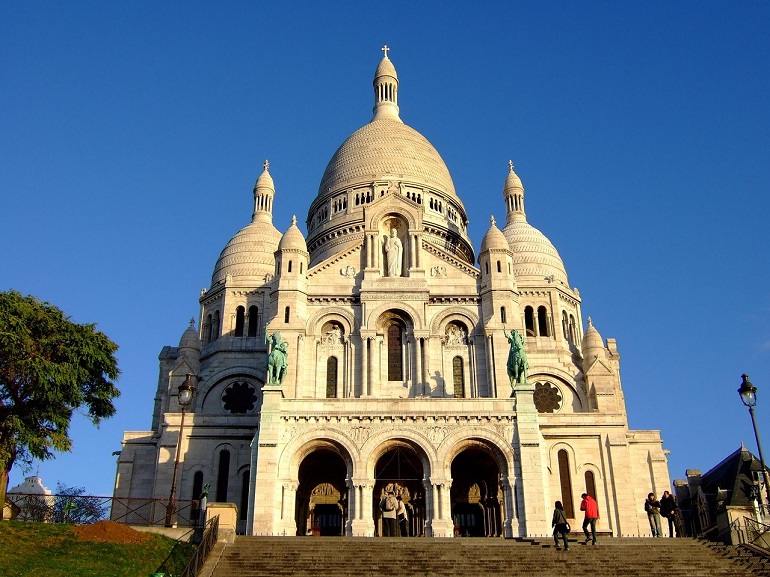
Vaguely reminiscent of the Taj Mahal, the Basilique du Sacré-Cœur, or Sacred Heart Basilica, is a Romano-Byzantine style Roman Catholic church situated atop Montmartre hill at 130 metres above sea level, making it one of the highest points in Paris. Conceived in the aftermath of the Franco-Prussian War of 1870-1871 and the Paris Commune as a symbol of national penance and spiritual renewal, the basilica was designed by architect Paul Abadie and constructed between 1875 and 1914, though its consecration was delayed until 1919 following the end of the First World War. The imposing structure stands 83 metres tall and features a distinctive white travertine limestone façade that remains luminous throughout the day, whilst its interior serves as a shrine of perpetual adoration where continuous prayer has been maintained since 1885. Notable for its architectural contrast to Paris's predominantly Gothic religious buildings, the basilica combines Romanesque and Byzantine elements, with Abadie's design drawing inspiration from his restoration work at Périgueux Cathedral and being selected from amongst seventy-seven competing proposals.
Interesting Facts about the Sacré-Cœur Basilica
- Perched atop Montmartre, the basilica crowns one of Paris’s highest points, offering sweeping views across the city from its prominent dome.
- Its brilliant white exterior is due to travertine from Souppes that releases calcite when it rains, effectively keeping the stone clean.
- The basilica’s apse holds a vast mosaic, Christ in Majesty, among the largest in France and a defining feature of its interior.
- Construction began in 1875 and finished in 1914, with consecration delayed until 1919 after the First World War.
- The immense bell nicknamed La Savoyarde weighs around 19 tonnes and is one of the largest in France.
- Perpetual adoration has continued day and night since 1885, making the church a living place of uninterrupted prayer.
- Entry to the basilica is free, with separate tickets needed to climb the dome’s roughly 300 steps and to visit the crypt.
- The site is linked to the martyrdom of Saint Denis and has been a place of Christian worship since late antiquity.
- Designed by Paul Abadie in a Neo-Byzantine-Romanesque style, its multiple domes and grand silhouette are instantly recognisable.
- Its origins are bound up with post–Franco-Prussian War vows and the turbulent legacy of the Paris Commune, giving the monument a complex civic symbolism.
History
The basilica's construction began following the devastating Franco-Prussian War of 1870-1871, when Bishop Felix Fournier of Nantes first proposed the church on September 4, 1870, attributing France's defeat to the nation's moral decline since the French Revolution. The project gained momentum through philanthropist Alexandre Legentil, who viewed the basilica as an act of penance and reparation for the nation's sins, with the entire construction funded through private donations totalling millions of francs from eight million contributors.
The basilica's architectural journey spanned nearly four decades, beginning with a design competition that attracted seventy-seven proposals before Paul Abadie's Neo-Byzantine-Romanesque plan was selected. Construction commenced on June 16, 1875, when the cornerstone was laid, but progress proved challenging due to unstable foundations requiring eighty-three wells, each thirty metres deep, to be dug and filled with rock and concrete as subterranean pillars. The project faced significant political opposition, particularly from left-wing politicians like Georges Clemenceau, who viewed the basilica as a symbol of repression against the Paris Commune and attempted multiple times to halt construction. Despite these obstacles, construction continued under five different architects following Abadie's death in 1884: Honoré Daumet, Jean-Charles Laisné, Henri-Pierre-Marie Rauline, Lucien Magne, and Jean-Louis Hulot. The interior was completed and opened for public worship in 1891, whilst the dome was finished in 1899 and the bell tower in 1912.
The basilica reached completion in 1914, though its formal consecration was delayed until 1919 due to World War I. Built from distinctive Château-Landon stone that bleaches to brilliant white when exposed to weather, creating its characteristic radiant appearance against the Parisian skyline, the structure exemplifies Romano-Byzantine architecture that contrasts sharply with other Parisian religious buildings. The central dome rises 83 metres (272 feet), making it the second tallest structure in Paris after the Eiffel Tower at the time of completion. Since 1885, the basilica has maintained perpetual adoration of the Holy Eucharist, with continuous prayer occurring day and night for almost 140 years. The site holds deep religious significance, traditionally associated with the martyrdom of Saint Denis, patron saint of Paris, who according to legend was beheaded at this location in the 3rd century. The interior features one of France's largest mosaics depicting Christ in Majesty, which dominates the choir area, whilst donor names are engraved throughout the basilica's stones and columns.
Description
The Sacré-Cœur Basilica stands majestically atop the Butte Montmartre, the highest point in Paris, and is instantly recognisable by its brilliant white façade and cascading domes. Approaching the basilica, visitors are greeted by sweeping stairways flanked with manicured lawns and vibrant flowerbeds, tangled with the animated hum of artists, musicians and local life that mark Montmartre as the city’s artistic quarter. The basilica’s main portal is adorned with grand bronze doors, embossed with religious motifs that hint at the treasures held within its walls.
Architecturally, Sacré-Cœur is an elegant fusion of Romanesque and Byzantine styles, with large rounded arches, broad columns, and ornate domes that rise gracefully into the Parisian sky. Its polished travertine stone not only retains its luminous whiteness whatever the weather, but also imparts a serene luminescence to the structure, visible from across the city. Guarding the entrance are imposing equestrian statues of France’s patron saints, Joan of Arc and King Saint Louis, rendered with exquisite attention to detail.
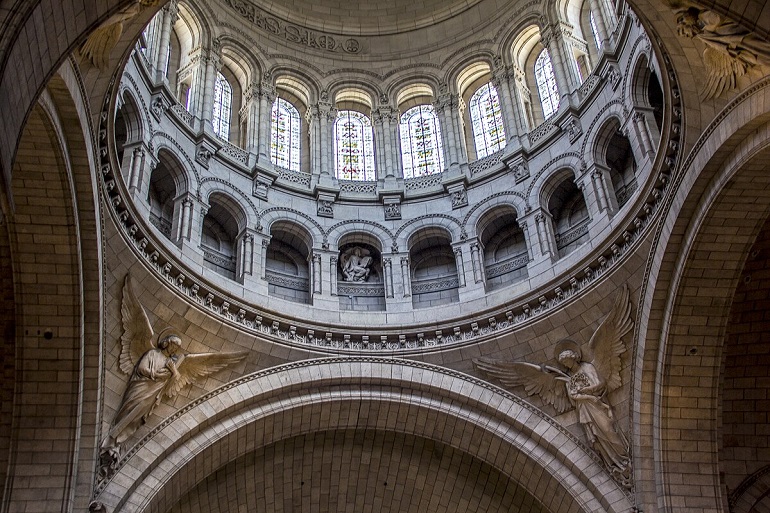
Inside, the basilica’s nave unfolds in a spacious expanse, suffused with gentle light that filters through the richly coloured stained glass windows. The atmosphere is one of reverent calm; the air scented faintly with candle wax and incense. At the heart of the basilica, the vast mosaic in the apse – one of the largest in the world – depicts Christ with outstretched arms in vibrant gold and azure, a focal point that encapsulates the spiritual purpose of the building. The ceilings of the side chapels curve gracefully overhead, each delicately adorned with religious iconography and flickering votive candles.
The central dome, accessible via a spiralling staircase, invites the adventurous to climb higher. From the viewing deck, the entire city of Paris unfurls in spectacular panorama: a tapestry of terracotta rooftops, leafy boulevards and iconic monuments sprawled beneath an ever-changing sky. On clear days, the view stretches all the way to the distant hills beyond the city’s edge. The ascent offers glimpses into the basilica’s architectural details, with intricately carved stonework and tiny arched windows framing secretive vistas over Montmartre’s cobbled streets.
Beneath the basilica, the crypt offers a tranquil retreat from the crowds above. It houses intimate chapels, softly illuminated and reverberating with a peaceful hush. Here, the polished marble altars and sepulchral monuments reflect the candlelit ambience, and niches dedicated to saints prompt quiet reflection. This quieter section of the basilica beckons those seeking solitude and solace, away from the more public grandeur above.
The Sacré-Cœur plays a vibrant role in daily life, with a steady stream of worshippers and visitors alike. Unlike many Parisian landmarks, it is distinguished by its tradition of continuous prayer, maintained day and night by local devotees since its opening. The basilica thus remains not just an architectural marvel, but a living centre of faith, serenity and community.
Surrounding the basilica, the Montmartre neighbourhood invites exploration. Bohemian cafés spill onto winding lanes, while small galleries and workshops showcase the works of contemporary artists keeping the district’s creative flame alive. The iconic steps are magnets for impromptu concerts, lively gatherings, and quiet moments to watch the sun set over the city’s skyline.
In every season, the Sacré-Cœur Basilica enchants with its harmonious blend of architectural beauty, spiritual ambience and breathtaking views. It is both a personal sanctuary and a cornerstone of Parisian culture, inspiring awe and contemplation in all who pass through its doors.