


Introduction
Located within the historic Marais district, Place des Vosges is the oldest planned square in Paris, built between 1605 and 1612 under King Henri IV as a groundbreaking example of European urban planning. Originally known as Place Royale until after the French Revolution, the square is a perfect square measuring 140 metres by 140 metres. It was modelled on the slightly smaller Place Ducale in Charleville-Mézières. Place des Vosges was designed by Louis Métezeau, the brother of Clément Métezeau, who built its sister square in Charleville one year earlier.

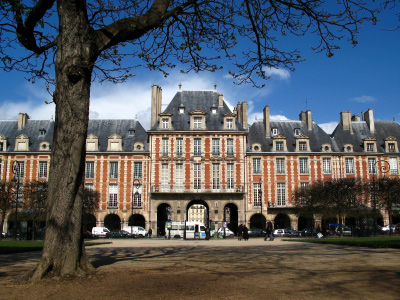
The square features 36 red brick and stone houses built to a uniform design, with steep slate roofs and elegant arcades supported by square pillars, creating a harmonious architectural composition that has remained largely intact for over 400 years. Two larger pavilions, the King's and Queen's Pavilions, mark the north and south entrances through triple arches, though no royalty ever permanently resided in the square.
The central garden space was originally used for tournaments, duels, and royal celebrations, including the inaugural carrousel in 1612 celebrating the engagement of Louis XIII and Anne of Austria. The square was renamed Place des Vosges in 1800 by Napoleon to honour the Vosges department, which was the first in France to pay taxes supporting the Revolutionary army. Today, the arcades house art galleries, antique shops, and cafés, whilst the central garden provides a tranquil public space surrounded by this remarkable example of 17th-century French architecture.
A surprising number of celebrities lived or currently live on Place des Vosges, among whom:
- Maximilien de Béthune (1560-1641), first Duke of Sully, who was Henri IV's most famous minister, lived at N°7.
- Cardinal Richelieu (1585-1642), 1st Chief Minister of Louis XIII, lived at N°21 from 1615 to 1627.
- Madame de Sevigné (1626-1696), an aristocrat remembered for her letter-writing, was born at N°1 bis.
- Marguerite Louise d'Orléans (1645-1721), wife of Grand Duke Cosimo III de' Medici, lived at N°15.
- Victor Hugo (1802-1885), poet and novelist, author of Notre-Dame de Paris and Les Misérables, lived at N°6 from 1832 to 1848.
- Théophile Gautier (1811-1872), poet, dramatist and literary critic, lived at N°8.
- Alphonse Daudet (1840-1897), novelist, lived at N°8.
- Colette (1873-1954), novelist and performer.
- Georges Simenon (1903-1989), Belgian writer, author of the fictional detective Jules Maigret.
- Annie Girardot (1931-2011), three-time César Award winning actress.
- Jack Lang (b. 1939), Socialist politician and former French Culture Minister.
- Dominique Strauss-Kahn (b. 1949), former IMF director, and his wife Anne Sinclair.
- Bertrand Delanoë (b. 1950), Mayor of Paris since 2001.
Interesting Facts about Place des Vosges
- Place des Vosges is the oldest planned square in Paris, laid out between 1605 and 1612 under Henri IV and inaugurated with festivities for Louis XIII and Anne of Austria in 1612.
- Originally called Place Royale, it was renamed in 1800 to honour the Vosges département, the first to pay taxes to the post‑Revolution government.
- The square is a perfect 140 m by 140 m, with uniform red‑brick façades, slate roofs and continuous vaulted arcades that define its harmonious Louis XIII style.
- The present square stands on the site of the medieval Hôtel des Tournelles, demolished after King Henri II died from jousting injuries sustained nearby in 1559.
- Two taller gateways, the King’s Pavilion to the south and the Queen’s Pavilion to the north, punctuate the otherwise even roofline and frame the main entrances.
- Victor Hugo lived at No. 6 from the 1820s to 1848; his apartment is now a free municipal museum showcasing the writer’s life and work.
- The central garden, often called Place Louis XIII, features an equestrian statue of Louis XIII and four identical fountains set among lime and chestnut trees.
- The square straddles the Marais between the 3rd and 4th arrondissements and remains a refuge of arcaded galleries, boutiques, cafés and art dealers.
- Place des Vosges became a fashionable aristocratic address in the 17th century and later a bourgeois one after properties were seized during the Revolution.
- Its strict architectural uniformity made it a prototype for later European residential squares and a landmark of early modern urban planning.

History
The Place des Vosges, originally known as the Place Royale, stands as Paris's oldest planned square and one of Europe's most beautiful examples of early urban planning. Constructed between 1605 and 1612 under the reign of King Henri IV, this perfectly symmetrical square measures 140 metres by 140 metres and was built upon the site of the former Hôtel des Tournelles, a royal residence dating back to 1388 that was demolished by Catherine de' Medici after her husband King Henri II died there following a tragic jousting accident in 1559. The square was officially inaugurated in 1612 with a grand carrousel celebrating the engagement of Louis XIII and Anne of Austria, establishing it as a prototype for residential squares across European cities.
The architectural design of the Place des Vosges represents a revolutionary approach to urban development, featuring 36 identical buildings with facades of red brick and white stone strips, steep blue slate roofs pierced with small dormer windows, and vaulted arcades running along the ground floor that were designed by architect Jean Baptiste Androuet du Cerceau. The square's perfect symmetry is broken only by two taller pavilions: the Pavilion of the King on the south side and the Pavilion of the Queen on the north side, both rising higher than the unified roofline and providing access through triple arches, though notably, no royalty ever actually resided in these aristocratic quarters except for Anne of Austria who briefly lived in the Queen's Pavilion. At the centre of the square stands a bronze statue of Louis XIII, originally erected by Cardinal Richelieu in 1619, destroyed during the French Revolution, and replaced with a new copy in 1825.
The square's name has undergone several transformations reflecting France's turbulent political history. During the French Revolution, it was renamed "Place de l'Indivisibilité" and later "Place de la Fabrication-des-Armes". In 1800, Napoleon gave it its current name, Place des Vosges, honouring the département of Vosges in eastern France, which was the first region to pay taxes supporting the Revolutionary army's campaigns. The name reverted to Place Royale during the Restoration periods (1814-1830 and 1852-1870) before permanently becoming Place des Vosges again in 1870. Today, the square serves as a cultural landmark housing the Victor Hugo Museum at number 6, where the famous author of "Les Misérables" lived from 1823 to 1848, while its arcades contain upmarket art galleries, antique shops, and elegant cafés, maintaining its status as a symbol of Parisian sophistication in the heart of the Marais district.
Description
Setting
Tucked within the Marais, this is a perfectly symmetrical square of red‑brick façades and slate roofs wrapped around a peaceful, fenced central garden. A low‑trafficked ring road encircles the garden, softening city noise and preserving a calm, residential feel.
Architecture
Uniform red‑brick‑and‑stone townhouses line all four sides, their steep slate roofs and repetitive dormers lending visual harmony from every angle. Continuous ground‑floor arcades create sheltered promenades, the rhythm of vaults and columns guiding an unhurried stroll beneath the arches.
Garden and layout
Gravel paths divide the lawn into neat quadrants, converging on the centre while four identical stone corner fountains add a gentle soundtrack. Shady rows of linden and horse chestnut trees frame clipped hedges and manicured grass, with ample benches inviting a long pause.

Under the arcades
Beneath the arcades, discreet art galleries, chic boutiques and quiet cafés invite browsing between sips of coffee with uninterrupted views of the square. Expect both contemporary galleries and beloved pâtisserie‑cafés such as Carette, ideal for a light bite or afternoon tea.
Simple pleasures
It is a favourite spot for picnics and people‑watching, whether stretched out on the lawns or settled on dual‑sided benches in the shade. The soft crunch of white gravel and the soothing splash of the fountains make a serene backdrop for sketching, reading or quiet conversation.
For families
Enclosed play areas and a small playground welcome children while keeping the atmosphere tranquil for everyone in the garden. Broad sightlines across the lawns make it easy to keep an eye on little ones while adults relax nearby under the trees.
Sensory details
Filtered light under the arches, the scent of fresh pastries and the echo of footsteps on stone set a measured, almost contemplative pace around the square. In warm weather the leafy canopy casts deep shade, and the grass becomes a patchwork of readers, sketchers and leisurely picnickers.
Practical feel
Seating is plentiful, with benches positioned along paths and under trees to frame views of the fountains and harmonious façades. The quiet perimeter street invites a slow loop beneath the arches before drifting back into the garden for one more unhurried pause.