


Introduction
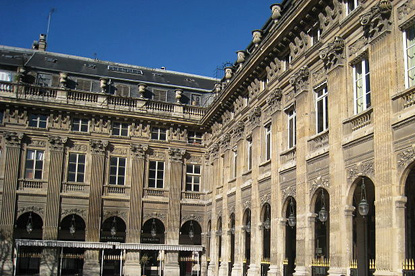
Originally built in the 1630s for Cardinal Richelieu as his residence, this palace facing the Louvre was later successively occupied by Louis XIV, his brother, and other members of the House of Orléans. Redesigned in the late 18th century with arcaded galleries around the Jardin du Palais-Royal, it became a major commercial and social hub and served as a Revolutionary flashpoint, notably with Camille Desmoulins’s speech on 12 July 1789. Today the site combines formal gardens, shops and cafés under the arcades, the Cour d’Honneur with Daniel Buren’s Colonnes de Buren (1986), and important institutions including the Conseil d’État, the Constitutional Council and the Comédie-Française. Today it houses the Council of State, the Constitutional Council, the Ministry of Culture, and the National Library. The adjacent Palais Brion is the seat of the Comédie-Française. It remains open to the public, with accessible courtyards and gardens set within a central historic ensemble.
Interesting Facts about the Palais-Royal
- The Palais-Royal was originally built in the 1630s by Cardinal Richelieu and was then known as the Palais-Cardinal.
- After Richelieu’s death, the palace passed to the crown and the young Louis XIV lived there during his childhood.
- In 1692, Louis XIV granted the Palais-Royal to his brother Philippe, Duke of Orléans, inaugurating a long Orléans family association with the site.
- The complex became a pivotal social hub in the 18th century, famed for its arcaded galleries, cafés, theatres and gambling houses.
- A fiery revolutionary speech by Camille Desmoulins delivered in the Palais-Royal gardens on 12 July 1789 helped spark the storming of the Bastille two days later.
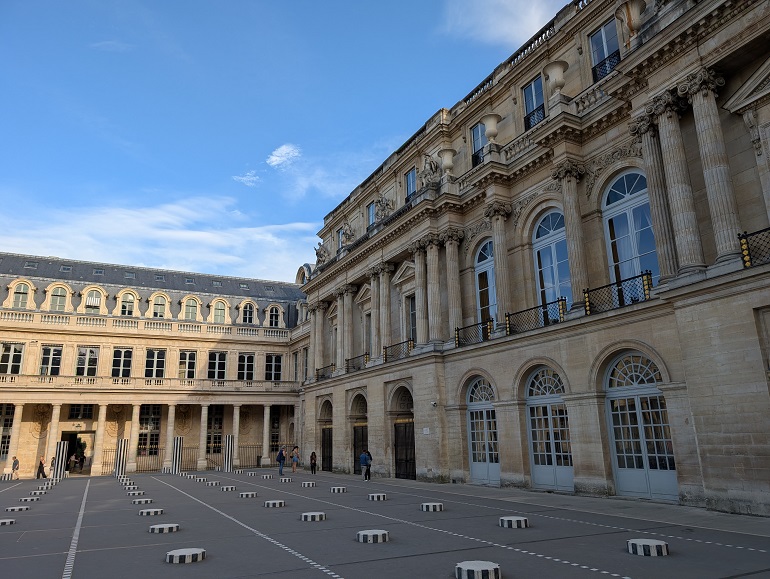
- The Cour d’Honneur features Daniel Buren’s striking black-and-white striped columns, a contemporary art installation completed in 1986.
- Today the Palais-Royal houses key French state bodies, including the Constitutional Council, the Council of State and the Ministry of Culture.
- The palace’s tranquil formal garden, bordered by elegant galleries, offers a serene retreat just steps from the Louvre.
- The Comédie-Française, France’s storied state theatre company, has its main theatre, the Salle Richelieu, at the Palais-Royal.
- The site’s name evolved from Palais-Cardinal to Palais-Royal after it became royal property, reflecting its elevated status in French history.
History
The Palais-Royal stands as one of Paris's most historically significant architectural complexes, with origins dating back to the early 17th century. Originally constructed as the Palais-Cardinal between 1633 and 1639, the palace was built as a personal residence for Cardinal Richelieu, chief minister to King Louis XIII, and designed by the architect Jacques Lemercier, who also created the Sorbonne. Upon Richelieu's death in 1642, the cardinal bequeathed the estate to the crown, whereupon it was renamed the Palais-Royal. The palace became home to the Queen Mother Anne of Austria and her young sons, including the future Louis XIV, who spent part of his childhood within its walls before eventually relocating to Versailles. The complex also provided refuge to English royalty during the English Civil War, sheltering the exiled Henrietta Maria and her daughter Henrietta Anne Stuart, wife and daughter of the deposed King Charles I.
Throughout the 18th century, the Palais-Royal underwent dramatic transformations that would define its character for centuries to come. Facing severe financial difficulties, Philippe d'Orléans decided in 1781 to commercialise the property by subdividing the garden and constructing buildings with arcades around its perimeter. This five-year construction project accommodated 90 merchants and established the palace as a pioneer of the covered retail arcade era, transforming European shopping habits by creating elegant passages removed from the dirty streets. However, these commercial additions attracted an unsavoury clientele, including gamblers, pickpockets, and prostitutes, giving the palace a notorious reputation for debauchery that would persist well into the 19th century. The palace gained particular historical significance during the French Revolution when, on 12 July 1789, revolutionary Camille Desmoulins delivered a rousing speech in its gardens that helped ignite the storming of the Bastille two days later.
The 19th and 20th centuries brought both turmoil and restoration to the Palais-Royal. Following the July Revolution of 1830, Louis-Philippe I, son of Philippe d'Orléans, ascended the throne and made the palace his principal residence. However, the palace suffered during the Revolution of 1848 when a Paris mob attacked and looted the royal residence, and it was briefly renamed the "Palais-National" during the Second French Republic. The building endured further damage during the Paris Commune of 1871 when Communards set it ablaze, though it suffered less destruction than other government buildings. Following these upheavals, the palace was restored in 1876 and subsequently became the permanent home of several state institutions, including the Conseil d'État (State Council), the Ministry of Culture, and the Constitutional Council. Today, the Palais-Royal remains one of Paris's most elegant architectural ensembles, with its peaceful gardens serving as a favourite leisure destination for both Parisians and visitors alike.
Description
Tucked discreetly behind the busy Rue de Rivoli, the Palais-Royal unfolds as a self-contained world of composure and charm. The first impression is one of symmetry: cream-coloured stone colonnades trace a perfect rectangle around a broad, open courtyard, their fluted pillars supporting neat rows of shuttered windows and fine wrought-iron balconies. Early morning light slips through the arcades, pooling on the paving stones and creating sharp bands of shadow that shift throughout the day; by late afternoon, the sun warms the façades to a gentle golden hue, lending the space an almost theatrical glow.
At ground level, the covered galleries offer an inspired alternative to Paris’s grand boulevards. Independent perfumers tempt passers-by with bespoke scents; antiquarian book dealers display leather-bound volumes in glass-fronted cabinets; and fashion ateliers showcase capsule collections that blur the line between art and apparel. The retail mix is curated rather than commercial, and browsing feels like an act of quiet discovery rather than a conventional shopping trip. Between boutiques, small doorways lead to intimate passageways, some opening onto secluded inner courtyards where potted citrus trees frame marble staircases.
Dominating the main courtyard is Daniel Buren’s contemporary artwork, a grid of monochrome columns rising in varying heights from the ground. Children hop from pillar to pillar while photographers angle for symmetry, yet the installation never disrupts the arcadian calm; it animates the space without overwhelming it. On warm days, the low murmur of the central fountain competes only with the rustle of newspaper pages and the distant clink of cups from surrounding cafés.
Slip beneath an archway and the mood changes again as you enter the Jardins du Palais-Royal. Neatly clipped lime-tree allées create green tunnels, their canopies offering dappled shade even at the height of summer. A long octagonal basin anchors the garden’s axis, sending gentle rings of water across its surface whenever a breeze disturbs the central jet. Classical statues stand at the ends of gravel paths, each figure framed by manicured box hedges and seasonal flower beds: tulips in spring; lavender and roses in early summer; chrysanthemums as the air cools.
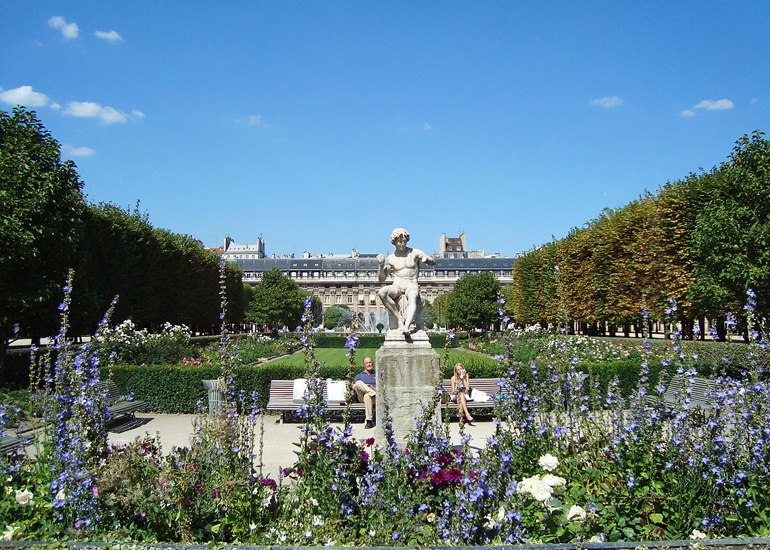
Benches and traditional green metal chairs are laid out with Parisian generosity, allowing visitors to arrange informal seating groups or claim a solitary spot beside the pond. Locals bring lunchtime sandwiches, artists balance sketchbooks on their knees, and office workers linger over takeaway espressos beneath the plane trees. Despite its central location, the garden retains a hushed resonance, broken only by the occasional squeak of a scooter wheel or the flutter of pigeons bathing at the fountain’s edge.
For refreshment, the arcades host several culinary hideaways. One petite salon de thé specialises in jewel-like fruit tarts and praline éclairs, served on delicate Limoges china. A few doors along, a polished brasserie proposes sea-bream ceviche at lunch and slow-braised beef cheeks come evening, complemented by a compact French wine list. Outdoor tables are gently heated in winter and shaded by linen parasols in summer, ensuring the ritual of people-watching remains a year-round pleasure.
Cultural life naturally threads through the complex. The Comédie-Française occupies a portion of the north wing, its discreet façade belying a richly decorated auditorium within. Even without attending a performance, visitors can glimpse posters of current productions and catch theatre-goers gathering under the marquee lights as dusk approaches. Occasional art installations, pop-up book fairs and photographic exhibitions add further layers of interest, ensuring no two visits feel quite the same.
Accessibility is thoughtfully addressed: wide, level walkways run beneath the colonnades and across the courtyard; wheelchair-friendly entrances are clearly signposted; and public conveniences are spotless and modern. Families appreciate the flat terrain for prams, while solo travellers find ample corners for reflection or journalling.
The Palais-Royal’s allure lies in its contrasts: open yet secluded, grand yet intimate, time-honoured yet alive with creative energy. Whether you pause for a macaron beneath a limestone arch, lose yourself in the scent of flowering lime trees, or simply sit and watch the play of light across Buren’s columns, this pocket of Paris offers an effortlessly elegant escape from the city’s faster rhythms—an address to savour slowly, one quiet detail at a time.