


Introduction
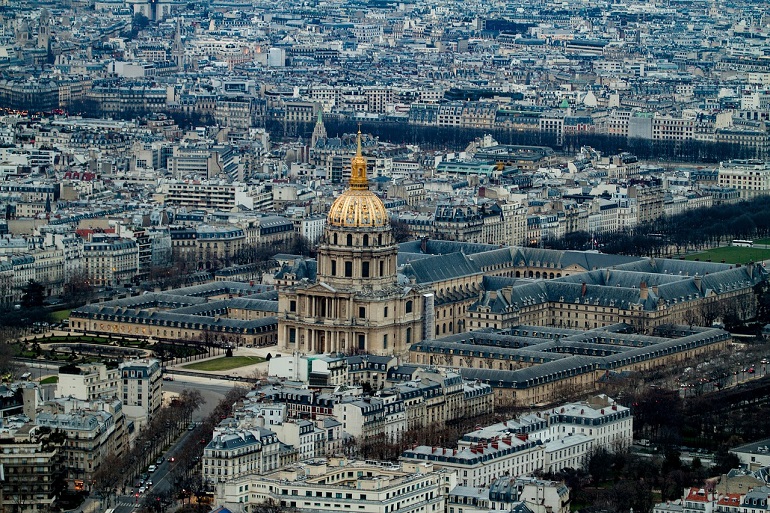
Formally known as the Hôtel National des Invalides, the complex was commissioned by King Louis XIV in 1670 to serve as a retirement home and hospital for the nation's aged and wounded soldiers. It now houses the Musée de l'Armée, France's national military museum, alongside other monuments related to the country's military history. A prominent feature of the site is the large golden dome of the Dôme Church, the chapel which today holds the tomb of Napoleon I.
Interesting Facts about Les Invalides
- Founded by Louis XIV in 1670, Les Invalides was created as a home and hospital for injured and elderly soldiers, giving the complex its name from the French invalide.
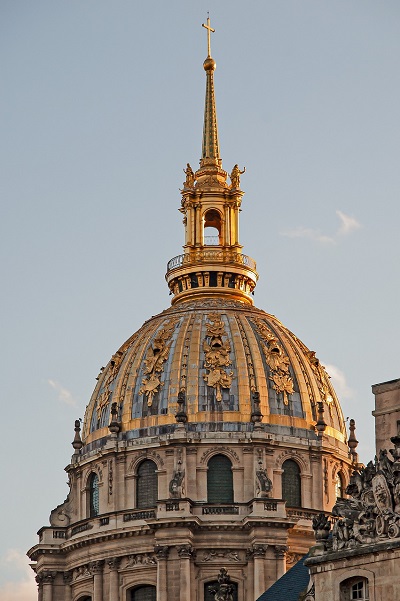
- The dazzling Dôme des Invalides rises to about 107 metres and is gilded with gold leaf, making it one of Paris’s most recognisable silhouettes.
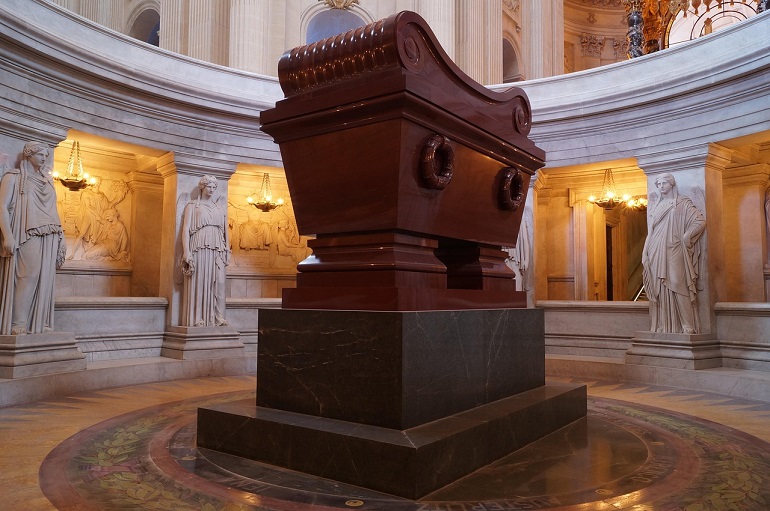
- Napoleon Bonaparte rests beneath the dome in a monumental sarcophagus set within a circular crypt completed in the 19th century.
- On 14 July 1789, Parisians seized thousands of muskets and cannons from Les Invalides in the morning and then used them to storm the Bastille that afternoon.
- The complex includes two linked churches: the richly decorated royal chapel (Église du Dôme) and the veterans’ church (Église Saint‑Louis‑des‑Invalides).
- Les Invalides still has an active military role, housing the Army Museum (Musée de l’Armée) and offices of the military governor of Paris.
- Enemy flags and war trophies captured by French armies have traditionally been displayed in the soldiers’ church, creating a striking martial décor.
- With fifteen courtyards arranged around grand axial vistas, Les Invalides was among the largest architectural projects of the French Baroque.
- The gold‑topped dome’s interior features a fresco by Charles de La Fosse depicting Saint Louis presenting his sword to Christ.
- Beyond Napoleon I, several notable figures of French military history—including members of the Bonaparte family and marshals—are interred at Les Invalides.
History
Les Invalides was commissioned by King Louis XIV on 24th November 1670 to serve as a home and hospital for aged and disabled (invalide) soldiers who had served in his numerous military campaigns. The architect Libéral Bruant was selected to design the complex on the suburban plain of Grenelle, and by the time construction was completed in 1676, the impressive façade facing the Seine stretched 196 metres in width.
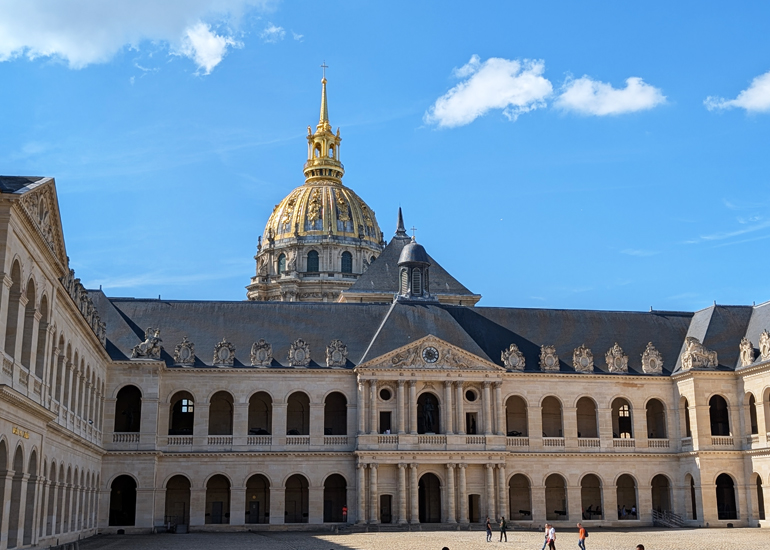
The complex featured fifteen courtyards, with the largest being the cour d'honneur specifically designed for military parades, and functioned as a comprehensive institution combining a hospice, barracks, convent, hospital, and factory all within one site.
The first disabled veterans from the Thirty Years' War were admitted as early as 1674, and by the period between 1676 and 1690, the building accommodated up to 6,000 invalides who were provided with substantial meals, excellent hygiene standards, and luxury infirmary services including 300 individual beds.
The architectural centrepiece of Les Invalides is its magnificent church complex, designed by Jules Hardouin-Mansart in 1676, which took inspiration from his great-uncle François Mansart's earlier designs. The structure features a unique hybrid design with two interconnected chapels: Bruant's nave became the soldiers' chapel (Église des Soldats), whilst Hardouin-Mansart created the royal chapel known as the Dome Church (Église du Dôme).
The golden dome, standing at 107 metres high and wrapped in gold leaf, represents one of the finest examples of French Baroque architecture and serves as an iconic symbol of France's absolute monarchy. The interior is decorated with a fresco by Charles de La Fosse depicting Louis IX presenting his sword to Christ, and the two chapels are linked by an oval sanctuary open to both sections.
Beyond its architectural significance, Les Invalides played crucial roles in French history, particularly during the Revolution when rioters broke into the building's cellars on 14th July 1789 to seize cannons and muskets, which were subsequently used in the storming of the Bastille that same day. During the Revolutionary period, the institution underwent dramatic changes: royal emblems and religious symbols were destroyed, courtyards were renamed (the Royal Court became the Court of the Republic), and even the four virtues adorning the dome's lantern were melted down to make bullets.
The complex continued to serve its original purpose as a military hospital and retirement home for French war veterans until the early 20th century, when the dwindling number of residents led to its transformation into the current museum and monument we see today. Throughout its 350-year history, Les Invalides has evolved from a royal institution to house Napoleon's tomb and the Army Museum, maintaining its status as one of Paris's most significant historical landmarks.
Description
Les Invalides stands as one of Paris’s most striking architectural ensembles, its gleaming golden dome rising above the cityscape like a beacon. The complex encompasses a grand military hospital, an elegant church, and a cluster of museums devoted to France’s martial heritage—all arranged around broad courtyards and formal gardens. Its scale and symmetry evoke a sense of ceremony and reverence, while the interplay between stone façades and gilded ornamentation lends an air of opulence.
As you approach, you first encounter the vast Cour d’Honneur, a paved parade ground framed by long colonnades. At its heart soars the Cathédrale Saint-Louis des Invalides, known as the Dôme des Invalides. Clad in burnished gold leaf, the dome’s tiers culminate in a lantern that catches the daylight, creating a radiant focal point visible from across the Seine. Beneath the dome, light filters through stained-glass windows, lending a solemn ambience to the interior’s soaring vaults and Baroque detailing.
Musée de l’Armée
The Musée de l’Armée is a vast repository, housing over half a million artefacts that span fifteen centuries of martial heritage. Its galleries are arranged both chronologically and thematically, allowing visitors to trace the evolution of the soldier’s life, the equipment of war, and the socio-political forces that shaped French and European history.
Ancient and Mediaeval Galleries
Visitors enter through rooms filled with gleaming armour, battle standards, and exquisitely crafted swords. Mannequins display the progression from chain mail to plate armour, presenting the ingenuity of mediaeval armourers. Shields, halberds, and crossbows adorn the walls, while illuminated manuscripts and ceremonial helmets reflect the pageantry of feudal France.

Renaissance, Ancien Régime and Revolutions
The transition into the Renaissance space reveals firearms, adorned pistols, and lavishly decorated suits of tournament armour. War trophies from conflicts with neighbouring states punctuate the display, accompanied by portraits of military leaders and kings. The galleries devoted to the revolutions feature dramatic depictions of mass mobilisation, transformation of uniforms and the birth of the citizen-soldier.
Napoleonic Halls
Perhaps the most evocative part, the Napoleonic halls focus on the life, battles, and legacy of Napoleon Bonaparte. Beyond the Emperor’s imposing tomb under the Dôme, vitrines showcase his iconic hats, elaborate ceremonial swords, campaign maps, and even personal trinkets. The uniforms of his marshals, regimental flags, and battlefield memorabilia transport visitors deep into the early 19th century, immersing them in the fervour and artistry of the era.
19th and 20th Centuries
Dioramas, wall murals, and display cases evoke the sweep of European conflicts, from the Franco-Prussian War through the First and Second World Wars. Trench artefacts, medals, letters, and propaganda offer insights into the horrors and camaraderie of industrialised warfare. Galleries devoted to aviation, mechanised vehicles, and modern regiments capture the continuing transformation of defence technology.
Permanent and Temporary Exhibitions
The museum also hosts regular temporary exhibitions that focus on specific campaigns, themes, or artistic interpretations, making every visit unique.
Musée des Plans-Reliefs
This museum’s unique collection—over a hundred scale models of fortifications—constitutes a treasure trove for enthusiasts of military engineering and urban planning. Each “plan-relief”, some spanning several metres, is accompanied by annotated maps, historical texts, and diagrams outlining the strategic thinking of the period.
These models served as decision-making tools for kings and generals, portraying not just battlements and outworks but also the adjacent topography: rivers, forests, farmland and even miniature soldiers. Explanatory screens and interactive kiosks allow visitors to zoom into details, helping them visualise how siege operations and city defences evolved as artillery and tactics advanced. Special guided tours are sometimes available, offering expert commentary and behind-the-scenes views.
Musée de l’Ordre de la Libération
This museum distinguishes itself through its poignant intimacy and ethical focus. The rooms pay homage to General Charles de Gaulle’s companions in the Resistance, narrating their stories through artefacts, personal effects, and multimedia stations. Uniforms worn by members of the Free French Forces sit beside diaries, radios used for clandestine communications, and items recovered from battlefields or prison camps.
The museum’s design encourages contemplation, with low lighting, quiet spaces and simple yet powerful displays. Special exhibits focus on the post-war years, honouring those who worked for reconstruction and reconciliation.
Additional Spaces and Features
The Dôme des Invalides and Napoleon’s Tomb
The centrepiece of Les Invalides is the resplendent Dôme, rising nearly 110 metres above the ground. Its golden surface commands attention, drawing visitors to the crypt beneath, where Napoleon is interred in a gigantic sarcophagus surrounded by marble bas-reliefs and statues representing his achievements. The circular arrangement and filtered natural light lend the space a solemn, almost reverential atmosphere.
Église Saint-Louis des Invalides
A functioning church, the Église Saint-Louis hosts regimental ceremonies and national memorials. Its nave is notable for the flags and standards of conquered armies, hanging as silent witnesses to past triumphs.
Courtyard and Artillery Collection
The main courtyard is lined with historic cannons and artillery pieces, some dating from the 17th century. Visitors can stroll amongst these relics, which illustrate advances in casting, ballistics and battlefield tactics.
Gardens and Open Spaces
Manicured lawns, tree-lined walkways and smaller courtyards create a striking contrast with the museum interiors. Statues, commemorative plaques and ornamental fountains punctuate these open spaces, offering peaceful spots for reflection or rest.
Cultural Activities and Outreach
Les Invalides regularly hosts concerts, lectures, and commemorative events, further cementing its role as a living monument. Educational workshops invite children and adults to engage with history through hands-on activities, guided tours, and re-enactments.
Atmosphere and Experience
Moving from the grandeur of the main halls to quiet galleries and sun-dappled outdoor spaces, visitors experience a remarkable journey through national memory and collective aspiration. Les Invalides blends architectural opulence with scholarly depth, making it not just a place for learning but one for personal reflection and emotional resonance. Each museum within the complex is meticulously curated, ensuring that military history is humanised and remembrance made vivid, while the extraordinary setting provides a fitting tribute to generations of service and sacrifice.