


Introduction
Standing at the western end of the Champs-Élysées, this Triumphal Arch was built by Napoleon in honour to those who fought and died for France in the French Revolutionary and the Napoleonic Wars.
The Arc de Triomphe de l'Étoile is a national monument situated at the centre of the Place Charles de Gaulle in Paris. Commissioned in 1806 by Napoleon I to honour the French army, the arch was inaugurated in 1836 and lists the names of French victories and generals on its inner and outer surfaces. Beneath its vault lies the Tomb of the Unknown Soldier from the First World War, accompanied by an eternal flame that has been lit since 1923. Visitors can access a small museum within the attic level before ascending to the panoramic terrace, which provides views over the twelve avenues radiating from the Place.
Interesting Facts about the Arc de Triomphe
- Commissioned by Napoleon in 1806 after the victory at Austerlitz, the Arc de Triomphe honours those who fought and died for France in the Revolutionary and Napoleonic Wars.
- It took roughly 30 years to complete and was inaugurated in 1836, long after Napoleon’s death.
- Standing about 50 metres high and 45 metres wide, it was inspired by Rome’s Arch of Titus and became a model for later patriotic monuments.
- The monument crowns Place Charles de Gaulle, where twelve grand avenues radiate like a star—hence its full name, Arc de Triomphe de l’Étoile.
- Beneath the vault lies the Tomb of the Unknown Soldier from the First World War, with an eternal flame rekindled each evening.
- The inner and outer surfaces bear the names of victories and 660 generals, with underlined names marking those who fell in battle.
- A spiral staircase of 284 steps leads to the rooftop terrace, offering sweeping views along the Axe Historique.
- Twice a year the sun aligns with the arch on the Champs-Élysées axis, creating a striking sunset framed within the vault.
- A daring aviator famously flew a plane through the arch in 1919 to protest being excluded from a victory parade.
- The Bastille Day military parade traditionally begins at the Arc, while the Tour de France finishes nearby on the Champs-Élysées.

History
Commissioned by Emperor Napoleon Bonaparte in 1806 following his decisive victory at the Battle of Austerlitz, the Arc de Triomphe stands as one of Paris's most iconic monuments. Napoleon promised his troops they would "only return to your homes through triumphal arches," leading him to order the construction of this monumental arch to honour his victorious armies. Designed by French architect Jean-François-Thérèse Chalgrin, the monument was inspired by the ancient Arch of Titus in the Roman Forum and combines Neoclassical architecture with commemorative symbolism. The cornerstone was laid on 15 August 1806, Napoleon's birthday, though construction would prove to be a lengthy endeavour spanning three decades.
Construction faced numerous interruptions and challenges throughout its 30-year building period. When Napoleon married Archduchess Marie-Louise of Austria in 1810, only the foundations had been completed, so a full-scale wooden mock-up painted on canvas was erected to mark her ceremonial entry into Paris. After Chalgrin's death in 1811, the project was taken over by Jean-Nicolas Huyot, but work dramatically slowed following Napoleon's abdication and the Bourbon Restoration in 1814. Construction remained largely suspended until 1823 when King Louis XVIII ordered work to resume, motivated by France's successful military intervention in Spain. The project was finally completed under King Louis-Philippe, who appointed Guillaume Abel Blouet as the new architect in 1832 with a revised dedication to the "Armies of the Revolution and the Empire".
The Arc de Triomphe was officially inaugurated on 29 July 1836 after three decades of construction at a final cost of approximately 10 million francs (equivalent to about €65 million today). The monument features elaborate decorative sculptures by renowned artists including François Rude, Jean-Pierre Cortot, and Antoine Etex, with Rude's famous relief "Departure of the Volunteers of 1792" (popularly known as "La Marseillaise") being the most celebrated. The arch's surfaces are adorned with the names of 30 decisive battles, 96 feats of arms, and 384 generals from the Revolutionary and Napoleonic periods. In 1921, the Tomb of the Unknown Soldier was placed beneath the arch, and since 1923, an eternal flame has been rekindled every evening at 6:30 pm. The monument has witnessed significant historical moments, including Napoleon's funeral procession in 1840 when his remains passed beneath it en route to Les Invalides, and Victor Hugo's state funeral in 1885 when his body lay in state under the arch.
Description
Standing majestically at the heart of Place Charles de Gaulle, the Arc de Triomphe commands one of the most prestigious positions in Paris. This colossal neoclassical monument serves as the crowning jewel at the western terminus of the Champs-Élysées, where twelve magnificent avenues converge like spokes of a wheel, creating the distinctive star-shaped layout that once earned the plaza its original name of Place de l'Étoile. The Arc de Triomphe represents the world's largest triumphal arch, an architectural masterpiece that dominates the Parisian skyline with its imposing presence and intricate artistic details.
Architectural Grandeur and Design
The monument's massive proportions immediately strike visitors with awe-inspiring dimensions that dwarf most other structures. Rising to a height of 50 metres (164 feet) and spanning 45 metres (148 feet) in width, with a depth of 22 metres (72 feet), the Arc de Triomphe presents an overwhelming sense of scale that was deliberately designed to impress. The central vault soars 29.19 metres high and measures 14.62 metres wide, whilst the smaller transverse vaults reach 18.68 metres in height and 8.44 metres in width.
Architect Jean-François-Thérèse Chalgrin drew inspiration from ancient Roman triumphal arches, particularly the Arch of Titus in Rome, but created something far more ambitious in scope. The astylar design features clean, unadorned lines without decorative columns, creating massive ashlar masonry walls that convey raw power and permanence. Built from limestone quarried from the Lias, along with stone from Conflans and L'Isle-Adam, the monument weighs approximately 50,000 tonnes above ground, with foundations extending 8.37 metres deep that bring the total weight to 100,000 tonnes.

Sculptural Masterpieces
The Arc's surfaces come alive with extraordinary sculptural programmes that transform the stone into vivid narrative tableaux. Four magnificent high-relief sculptural groups adorn the pedestals at the base of each pillar, representing defining moments in French military history. These masterworks, created between 1833 and 1836, showcase the talents of France's most celebrated sculptors.
The most famous of these sculptures, "Le Départ des Volontaires de 1792" (The Departure of the Volunteers of 1792), commonly known as "La Marseillaise", graces the right pillar facing the Champs-Élysées. François Rude's romantic masterpiece depicts the allegorical figure of Liberty as a winged woman crying out against enemy invasion, rallying French volunteers to defend their nation. Below her, a bearded warrior in cuirass drags a young man by the shoulder whilst waving his helmet as a sign of departure, embodying the spirit of patriotic sacrifice.
On the left pillar facing the Champs-Élysées stands "Le Triomphe de 1810" (The Triumph of 1810) by Jean-Pierre Cortot, whilst the northern face features Antoine Étex's companion pieces: "La Résistance de 1814" (The Resistance of 1814) on the right and "La Paix de 1815" (The Peace of 1815) on the left. These sculptural groups employ a deliberately universal visual language, avoiding period-specific costumes or contemporary weapons in favour of timeless allegorical representations.
Additional relief sculptures grace the façades above these main groups, including "The Funeral of General Marceau", "The Battle of Aboukir", "The Crossing of the Arcole Bridge", "The Capture of Alexandria", "The Battle of Austerlitz", and "The Battle of Jemappes". The spandrels feature subtle decorative elements including "The Renowned" by Pradier, whilst "The Infantry" and "The Cavalry" ornament the smaller arches.
Inscribed Honours and Commemorative Elements
The interior walls of the Arc de Triomphe serve as a vast stone memorial to French military glory. 660 patronymes (surnames) of officers and 128 battle names are meticulously carved into the walls, creating an impressive honour roll of French military achievement. Those officers who died in battle are distinguished by having their names underlined, adding a poignant element to this permanent record of sacrifice.
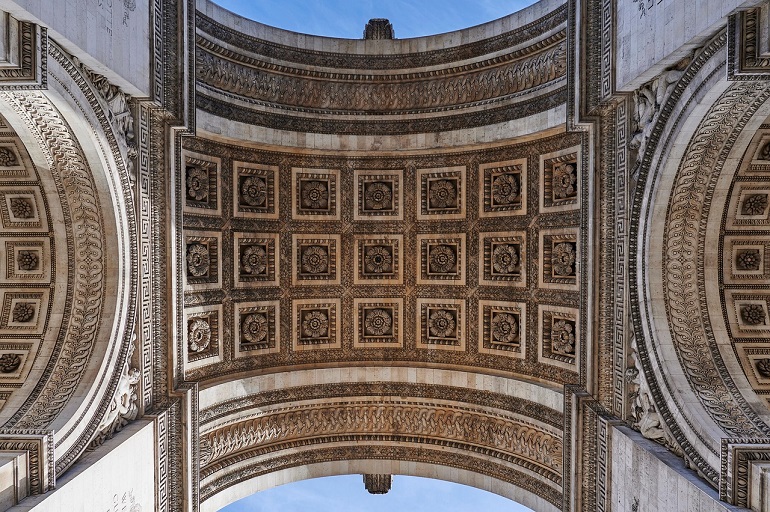
A magnificent frieze measuring 157 metres in length encircles the entablature, depicting "The Departure and the Return of the French Armies" in bas-relief. Above this, thirty shields bear the names of major French victories, whilst the Roman-style coffered vault displays the names of battles fought during the Republic and Empire periods.

Interior Spaces and Museum
Beyond its exterior grandeur, the Arc de Triomphe houses interior spaces that many visitors discover with surprise. The monument contains a museum managed by the Centre des Monuments Nationaux, featuring original documents, engravings, drawings, photographs, and scale models that illuminate the Arc's construction and its role in significant historical events.
The museum's exhibits chronicle pivotal moments such as the return of Napoleon's ashes in 1840, Victor Hugo's lying in state in 1885, the Victory Parade of 14 July 1919, and the arrival of the Unknown Soldier's remains in 1921. Interactive displays and informational materials available in eleven languages enhance visitors' understanding of this monumental achievement.
The Panoramic Terrace Experience
The Arc de Triomphe's rooftop terrace provides one of Paris's most spectacular viewing experiences. After ascending 284 steps through the monument's spiral staircases (with lift assistance available partway), visitors emerge onto a panoramic platform that offers 360-degree views across the capital.
From this elevated vantage point, Paris unfolds in all directions, with the Eiffel Tower prominently visible along the Avenue de la Grande Armée, the Sacré-Cœur Basilica crowning Montmartre in the distance, and the modern towers of La Défense business district creating a contemporary counterpoint to the historic cityscape. The Champs-Élysées stretches eastward in a perfectly straight line towards Place de la Concorde, whilst the dome of Les Invalides, the Panthéon's colonnade, and Notre-Dame Cathedral's towers complete the panoramic tableau.
Digital orientation devices and information panels help visitors identify more than twenty significant monuments visible from the terrace, whilst historical anecdotes and architectural details enhance the viewing experience. The terrace also features protective barriers that allow photography whilst ensuring visitor safety.
Architectural Context and Urban Setting
The Arc de Triomphe's position within Paris's urban fabric demonstrates exceptional city planning vision. The monument serves as the central focal point of the Axe Historique (Historic Axis), a grand perspective that extends from the Louvre's courtyard through the Tuileries Gardens, across Place de la Concorde, up the Champs-Élysées, through the Arc de Triomphe, and onward to the modern Grande Arche de la Défense.
The circular plaza surrounding the Arc measures 120 metres in diameter and accommodates the convergence of twelve major avenues: Avenue des Champs-Élysées, Avenue de la Grande Armée, Avenue Foch, Avenue Hoche, Avenue de Wagram, Boulevard Malesherbes, Avenue de Friedland, Avenue Hoche, Avenue Marceau, Avenue d'Iéna, Avenue Kléber, and Avenue Victor Hugo. This radiating pattern creates one of Europe's most complex traffic intersections, yet the underground pedestrian passages ensure safe access to the monument itself.
Practical Features and Accessibility
Modern amenities within the Arc de Triomphe cater to contemporary visitors whilst preserving the monument's historic integrity. Security checks are mandatory for all visitors, and the monument maintains strict guidelines regarding permitted items. The recently renovated spiral staircases provide the primary access route to the upper levels, though lift access is available for visitors with mobility requirements up to the museum level.
The Tomb of the Unknown Soldier lies beneath the central vault, marked by an eternal flame that is rekindled each evening at 6:30 PM in a solemn ceremony. This memorial adds a contemplative dimension to visits, representing all unknown fallen soldiers from World War I and subsequent conflicts.
Multilingual resources enhance the visitor experience, with information booklets available in eleven languages and a dedicated web application offering detailed interpretive content. The monument's gift shop provides commemorative items, whilst climate-controlled spaces offer respite during extreme weather conditions.
Whether viewed from ground level as part of a Champs-Élysées stroll or experienced from the panoramic terrace high above the city, the Arc de Triomphe delivers an unforgettable encounter with Parisian grandeur, artistic excellence, and architectural achievement that has inspired similar monuments worldwide whilst remaining uniquely and magnificently French.