


| Contents |
|---|
Introduction
The magnificent Château du Champ de Bataille stands as one of France's most spectacularly restored aristocratic residences, blending 17th-century grandeur with contemporary luxury. Originally built in the 1650s and meticulously brought back to life by renowned interior designer Jacques Garcia, this architectural jewel showcases an extraordinary collection of period furnishings, tapestries, and artworks that transport visitors into the opulent world of French nobility. The château's sumptuous interiors, from the richly decorated state rooms to the intimate private apartments, demonstrate Garcia's masterful eye for historical authenticity and theatrical drama. Beyond the palatial walls, visitors can wander through the estate's beautifully manicured French gardens, complete with topiary, water features, and scenic woodland walks that provide the perfect backdrop for this fairy-tale setting. Whether exploring as a day visitor marvelling at the exquisite restoration or indulging in the ultimate luxury experience as an overnight guest, Château du Champ de Bataille offers an unparalleled glimpse into the refined art of French living at its most magnificent.
Interesting Facts about Château du Champ de Bataille
- The château was built between 1653 and 1665 for Alexandre de Créquy after his exile during the Fronde, echoing Versailles in Baroque ambition.
- Its name, “field of battle,” recalls a legendary 10th-century clash tied to William Longsword and the rise of Normandy.
- Star decorator Jacques Garcia bought it in 1992, restoring lavish interiors and recreating vast formal gardens.
- The gardens reinterpret the grand French style with long axes, water features, and classical statuary across an immense parkland.
- Garcia installed an extraordinary private collection of royal-provenance furniture, tapestries and objets d’art.
- A devastating 1993 storm spurred a monumental garden redesign, including major earthworks and a long canal.
- Hints of Le Nôtre’s influence survive in the garden’s geometry, parterres, and theatrical vistas.
- Parts of the estate once served as a hospice and even a wartime prison before its late 20th-century revival.
- The Harcourt family were pivotal owners, with an 1866 family millennium celebrated here by French and English branches.
- Today it stands as a showcase of French Baroque splendour fused with contemporary garden artistry.

History
The Château du Champ de Bataille derives its evocative name from a legendary battle fought in 935 between Guillaume Longue-Épée and the Count of the Cotentin, a conflict that ultimately strengthened Norman unity when Guillaume emerged victorious. The château itself was constructed between 1653 and 1665 by Alexandre de Créqui-Bernieulles, a rebellious nobleman who had fallen foul of Cardinal Mazarin for his participation in aristocratic revolts against the young Louis XIV. Exiled to the provinces as punishment, Créqui channelled his considerable fortune into creating this magnificent Baroque masterpiece, complete with extravagant apartments, sumptuous stables, and vast formal gardens inspired by the Le Nôtre style of Versailles. The ambitious project remained unfinished at his death, leaving his nephew, the Marquis de Mailloc, to inherit the incomplete palace.
Following Mailloc's death, the château passed in 1754 to Anne-François d'Harcourt, Marquis de Beuvron (later Duke), who purchased the property at age 27 and transformed Champ de Bataille into the principal residence of the powerful Harcourt family. The Duke undertook enormous restoration works to demonstrate his authority and restore the château's former splendour, though these ambitious plans were dramatically interrupted by the French Revolution. In 1795, the château suffered the fate of many noble houses during this turbulent period—it was stormed by revolutionaries, systematically looted, and its precious furnishings sold throughout France. The Harcourt family was forced to flee for their safety, leaving the magnificent structure abandoned and deteriorating for more than a decade.
The château endured a chequered existence throughout the 19th and 20th centuries, serving various utilitarian purposes including a hospice, a post-war prison camp, and a women's prison before being sold by the city of Neubourg in 1947. The 11th Duke of Harcourt briefly restored family ownership, undertaking essential repairs to facades, roofs, and frameworks whilst replanting the 15-hectare French gardens and refurnishing the interior with family heirlooms salvaged from the war-damaged Château d'Harcourt in Thury-Harcourt. However, the château's true renaissance began in 1992 when renowned French interior designer Jacques Garcia purchased the property and embarked upon an extraordinary 30-year restoration project. Following a devastating storm in 1993 that destroyed much of the existing parkland, Garcia seized the opportunity to recreate the original 17th-century French gardens using a surviving plan attributed to André Le Nôtre. His ambitious vision involved moving over a million cubic metres of earth, creating artificial hills, digging a 550-metre canal, and transforming nearly 250 acres into what is now considered the largest private park in Europe.
Description
The Architectural Marvel
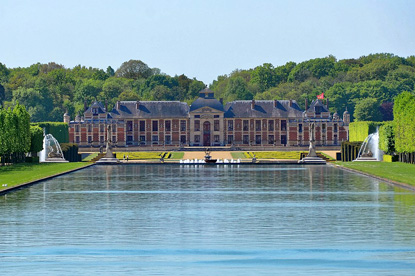
The estate's design is a masterful declaration of power and symmetry that announces its grandeur from the moment of arrival. The château consists of two monumental wings, each stretching 80 metres in length, constructed from warm honey-coloured brick and pale limestone. The buildings face each other across an imposing square court of honour, creating a theatrical sense of arrival that rivals the great châteaux of the Loire Valley.
The main residential wing displays the finest qualities of French Baroque architecture. Its perfectly proportioned façade rises through two main floors, crowned with a slate roof punctuated by elegant dormer windows and towering chimneys. The central pavilion is topped with a triangular pediment featuring intricate military trophies carved in stone, whilst the garden-facing elevation is adorned with a remarkable series of busts depicting Roman emperors, creating a gallery of antiquity that extends along the entire length of the building.
The opposing wing houses the grand stables, equally impressive in their scale and architectural treatment. These buildings, originally designed to accommodate the horses and carriages of a great nobleman, demonstrate the same attention to classical detail and proportion as the main château. The wings are connected by a magnificent balustraded gallery and an imposing ceremonial gateway crowned with allegorical statues representing the virtues of nobility.
The entire complex is unified by the meticulous use of classical orders, with pilasters, cornices, and pediments creating a harmonious rhythm across the facades. The interplay of brick and stone creates visual warmth whilst maintaining the dignity appropriate to such a noble residence.
The Sumptuous Interiors
Stepping through the château's doors is like entering a time machine that transports visitors to the height of French aristocratic splendour. Garcia's restoration has created interiors that surpass even those of many royal residences, earning the collection a coveted three-star rating from the Michelin Guide.
The Ground Floor
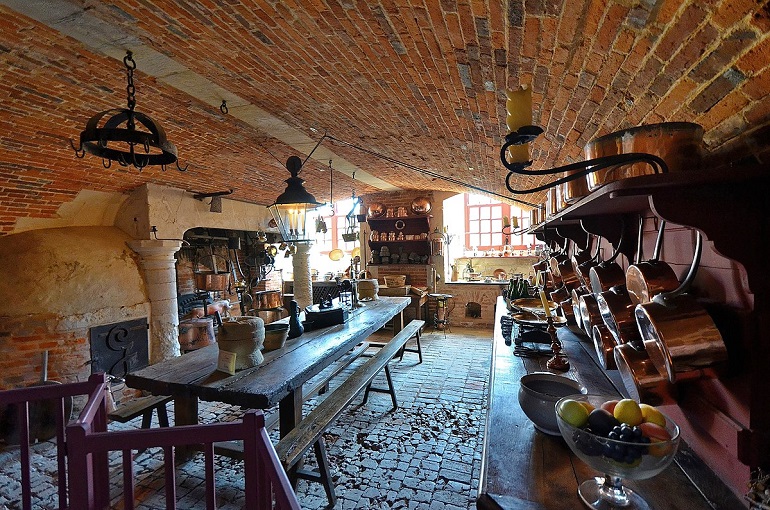
The ground floor houses some of the château's most atmospheric spaces. The historic kitchens, with their massive fireplaces and period copperware, evoke the bustling domestic life of a great estate. The chapel, intimate yet richly appointed, features original religious paintings and carved wooden furnishings that speak to the spiritual life of the nobility.
Perhaps most remarkable is Garcia's extraordinary library, a double-height masterpiece that serves as both a repository of knowledge and a cabinet of curiosities. The library walls, lined with leather-bound volumes from floor to ceiling, are accessed by elegant wooden galleries and ladders. Adjacent to this scholarly sanctuary are Garcia's personal collections of rare objects and an exceptional assemblage of antique Japanese armour, creating fascinating dialogues between Eastern and Western decorative traditions.
The Piano Nobile
A grand staircase, its walls adorned with family portraits and historical paintings, leads to the château's most spectacular floor. Here, the state apartments unfold in a magnificent enfilade that represents one of the finest sequences of reception rooms in any French château.
The journey begins in the Vestibule d'Honneur, where visitors are greeted by soaring ceilings decorated with allegorical paintings and gilded mouldings. This ceremonial entrance sets the tone for the splendours that follow.
The Salle des Gardes, also known as the Salon d'Hercule, serves as the first great reception room. Its walls are hung with Gobelins tapestries depicting the labours of Hercules, whilst the furniture includes pieces of royal provenance that once graced the palaces of Versailles and Fontainebleau.
The Cabinet des Porcelaines showcases Garcia's passion for Asian decorative arts, with rare Chinese and Japanese ceramics displayed in custom-made cabinets. The room's silk wall coverings and gilded woodwork provide an exquisite backdrop for these precious objects.
The grand dining room epitomises 18th-century elegance, with a magnificent table capable of seating thirty guests. The room's walls are adorned with paintings by court artists, whilst the silver-gilt service and Sèvres porcelain demonstrate the refinement of aristocratic entertaining.
The culmination of this spectacular sequence is the state bedroom, or chambre de parade. This opulent chamber, never intended for actual sleeping but rather for ceremonial receptions, features a bed that once belonged to Madame de Pompadour. The room's silk hangings, painted ceilings, and precious furniture create an atmosphere of almost overwhelming luxury.
Throughout these apartments, Garcia has assembled furniture and objects of extraordinary provenance, including pieces that belonged to Queen Marie-Antoinette, the Duchesse de Polignac, and other luminaries of the Ancien Régime. Many of these treasures were acquired during revolutionary sales when the contents of noble houses were dispersed, allowing Garcia to reunite objects with their appropriate architectural settings.
The Spectacular Gardens
The gardens of Champ de Bataille represent perhaps Garcia's greatest triumph, transforming 45 hectares of parkland into what many consider the most impressive new garden creation in Europe. When Garcia acquired the property in 1992, the grounds were largely given over to an English-style landscape park. However, the devastating storm of 1999 provided an unexpected opportunity to realise a far grander vision.
Working from an original drawing attributed to André Le Nôtre, Garcia embarked on one of the most ambitious garden projects of modern times. The creation required moving over a million cubic metres of earth to restore the original 17th-century levels and create the dramatic topography necessary for the garden's grand perspectives.
The Great Axis and Formal Gardens
The garden's design unfolds along a magnificent 1.5-kilometre axis that extends from the château's main terrace towards the horizon. This central perspective, flanked by massive earthworks and plantings, creates one of the longest garden vistas in Europe.
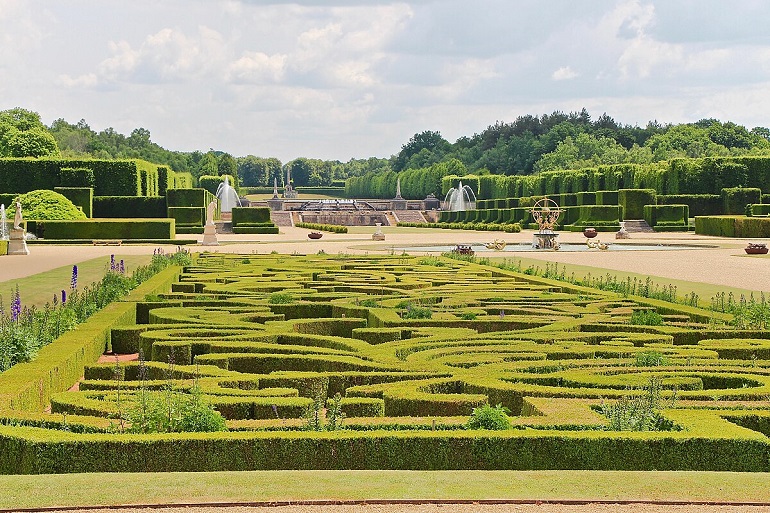
Immediately before the château, the Great Terrace provides a elevated viewing platform from which the entire garden composition can be appreciated. From here, the eye is drawn along parterres de broderie, intricate patterns created from thousands of boxwood plants that form elaborate scrollwork designs reminiscent of embroidered fabrics.
The first major element along the axis is a series of reflecting pools that mirror the sky and create ever-changing patterns of light and shadow. These waters are populated by elegant fountain sculptures and provide tranquil interludes in the garden's grand composition.
The Groves and Garden Rooms
Flanking the central axis, Garcia has created a series of garden rooms, each with its own distinct character and purpose. The groves, composed of thousands of lime and hornbeam trees, provide shaded walks and intimate spaces for contemplation. These wooded areas are punctuated by clearings containing classical statues, many of them antique pieces collected from across Europe.
One of the most enchanting spaces is the Bosquet de Diane, dedicated to the goddess of the hunt. This circular grove surrounds a central fountain featuring a sculptural group depicting Diana and her hunting companions. The space is enclosed by perfectly clipped hedges that rise to form green walls, creating an outdoor room of remarkable intimacy.
Water Features and Architectural Follies
Water plays a crucial role throughout the garden's design, with cascades, fountains, and pools providing both visual and auditory pleasure. The engineering required to supply these features is extraordinary, involving the creation of reservoirs and pumping systems that maintain constant water flow throughout the vast garden.
Among the garden's most remarkable features is the Temple of Leda, a classical pavilion surrounded by a circular moat. This architectural folly, inspired by ancient Roman garden buildings, serves as both a destination for garden walks and a viewing platform for the surrounding landscape. The temple's interior is decorated with frescoes depicting the myth of Leda and the Swan, executed by contemporary artists working in the classical tradition.
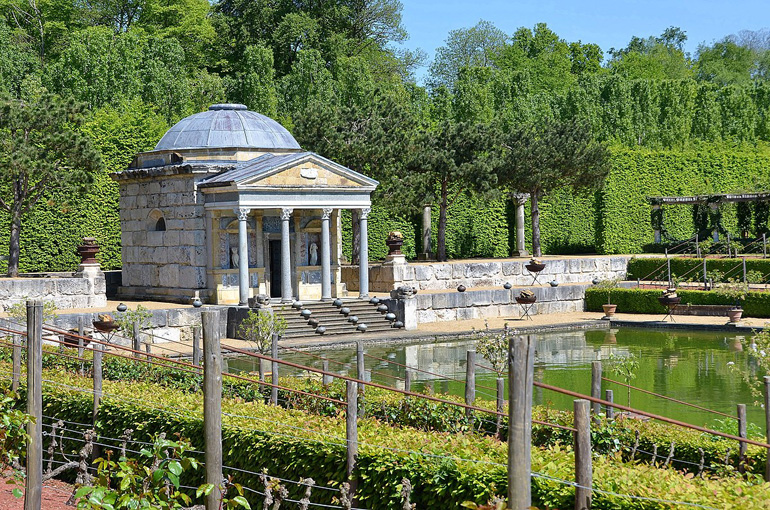
The garden also features a remarkable open-air theatre, modelled on ancient Roman examples. This semicircular amphitheatre, carved into a hillside and surrounded by cypress trees, provides a venue for concerts and theatrical performances that take advantage of the garden's dramatic setting.
Contemporary Elements in Classical Framework
While deeply rooted in classical tradition, Garcia's garden is unmistakably a contemporary creation. The designer has introduced elements that no 17th-century garden would have contained, including exotic plants from around the world and artistic installations that create dialogue between past and present.
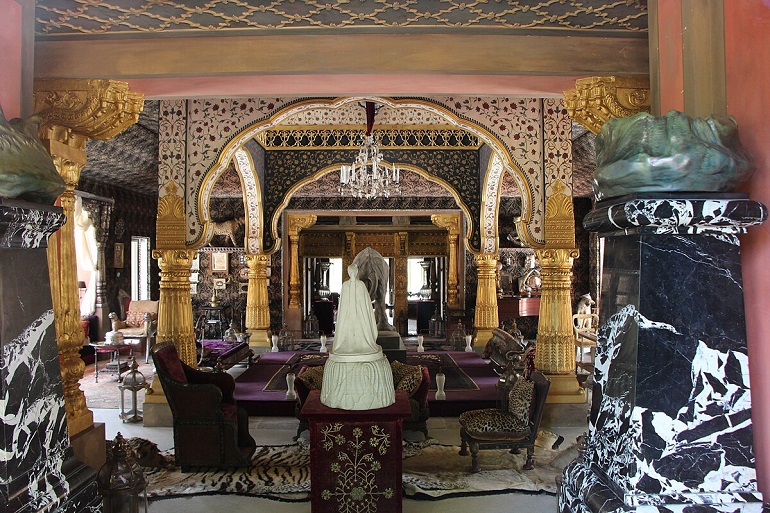
One of the most ambitious additions is the recreation of an Indian palace pavilion, dismantled piece by piece in India and reassembled in the Norman countryside. This extraordinary structure, complete with original carved columns and decorative elements, serves as a meditation pavilion and demonstrates Garcia's global approach to garden making.
The Philosophical Journey
Garcia has conceived the garden as a spiritual and philosophical journey, with different areas representing the stages of creation according to classical and Eastern traditions. As visitors progress through the garden, they encounter symbols and references that invite contemplation of life's deeper meanings. This conceptual framework elevates the garden beyond mere horticultural display to become a work of environmental art that engages both the senses and the intellect.
The scale of the undertaking is breathtaking: kilometres of perfectly maintained boxwood hedging, tens of thousands of trees and shrubs, and an infrastructure that includes underground irrigation systems and sophisticated lighting for evening illumination. The maintenance alone requires a team of gardeners working year-round to preserve the precision and beauty of this horticultural masterpiece.
Getting There
By train Take an SNCF TER from Paris-Saint-Lazare to Évreux, Brionne, or Serquigny; from any of these stations, local Nomad coaches or a short taxi ride reach Le Neubourg, just 5 minutes from the château.
By coach Nomad line 160 links Évreux to Le Neubourg several times a day, while longer-distance BlaBlaCar and FlixBus services from Paris or Rouen stop at nearby hubs, where you can connect to local buses or taxis for the final leg.
By car From Paris follow the A13, exiting at junction 19; drivers from Caen or Deauville can leave the A13 at junction 25, while those on the A28 should exit at junction 13, then follow signs to Le Neubourg and Sainte-Opportune-du-Bosc; free parking awaits beside the château.
Best Time to Visit
Late spring to early autumn is the best time to visit the Château du Champ de Bataille, when the vast formal gardens are at their lushest and most colourful, rewarding visits on clear, mild days. Visitors consistently single out the gardens as the highlight, so targeting months with reliable weather—roughly May to mid-September—offers the most enjoyable experience. For a quieter atmosphere, consider midweek outside the peak summer holiday period and allow ample time to wander the several kilometres of grounds with pools and fountains at an unhurried pace. Practicalities also help: public opening is typically Wednesday to Sunday in daytime hours, so plan around early-week closures to make the most of a visit.