


 Ireland Guide
 Scotland Guide
 Wales Guide
| Contents |
|---|
Introduction
Strawberry Hill House, Horace Walpole’s fanciful 18th-century “little Gothic castle” in Twickenham, is a dazzling manifesto of early Gothic Revival, its chalk-white battlements, traceried windows and fairy-tale turrets sheltering gilded, fan-vaulted interiors and a famed library that inspired The Castle of Otranto. Meander through serene riverside gardens, admire jewel-bright stained glass and theatrical vistas restored with meticulous care, and pause at the café before exploring seasonal exhibitions and guided tours that reveal Walpole’s playful imagination and collector’s eye. Easily reached from central London, this enchanting villa offers a richly atmospheric escape—part architectural fantasy, part literary pilgrimage, and wholly memorable.
Interesting Facts about Strawberry Hill House
- Horace Walpole transformed a pair of modest cottages called “Chopp’d Straw Hall” into his fanciful “little Gothic castle” after buying the site in 1747.
- The house popularised the Gothic Revival and even lent its name to the whimsical “Strawberry Hill Gothic” style.
- Walpole’s design team, his playful “Committee of Taste” of John Chute and Richard Bentley, crafted interiors inspired by medieval tombs, vaults and rose windows.
- The villa was built in distinct phases from 1749 to 1776, sprouting turrets, battlements and a picturesque silhouette.
- Strawberry Hill House doubled as one of London’s earliest tourist attractions, with strictly limited daily visits and printed rules.
- Thomas Gray praised the dazzling interiors as “all Gothicism, gold and looking glass,” capturing their theatrical flair.
- Walpole coined the mood of its interiors as “gloomth,” balancing mysterious rooms with a more cheerful, “riant” garden.
- A grand fireplace in the house is by celebrated architect Robert Adam, blending neoclassical finesse with Gothick fantasy.
- The estate eventually expanded to about 46 acres, enveloping the villa in ornamental gardens and wooded walks.
- A week-long “Great Sale” in 1842 dispersed much of Walpole’s treasured collection, a loss later partially reversed by restorations.
- Lady Waldegrave rescued and enlarged the house in the mid-19th century, adding Tudor-style chimney pots in homage to Hampton Court.
- St Mary’s University acquired the property in 1923, and the house has welcomed visitors in various forms for over 250 years.
- The celebrated Gallery’s fan-vaulted ceiling was modelled on Gothic church architecture, echoing Westminster inspirations.
- The garden once featured a giant rococo shell seat, meticulously recreated during modern landscape restoration.
- As the author of The Castle of Otranto, often called the first Gothic novel, Walpole made Strawberry Hill the perfect stage for literary Gothic.
History
Strawberry Hill House's remarkable history began in 1747 when Horace Walpole, son of Britain's first Prime Minister Sir Robert Walpole, discovered and purchased a modest 17th-century property originally called 'Chopp'd Straw Hall' on the banks of the Thames in fashionable Twickenham. The house was little more than a cottage built in 1698 by a coachman, but Walpole transformed it into his vision of a 'little Gothic castle' complete with pinnacles, battlements, and a round tower. Working alongside his 'Committee of Taste'—comprising connoisseur John Chute and draughtsman Richard Bentley—Walpole rebuilt the house in stages from 1749 to 1776, expanding the property from 5 acres to 46 acres over the years. The total cost of construction reached approximately £20,720, equivalent to over £3.5 million today. The house featured elaborate Gothic Revival elements including gilded ceilings, grand fireplaces designed by Robert Adam, enamelled door handles, carved wooden screens, and coats of arms of men Walpole pretended were his mediaeval ancestors.
Strawberry Hill House became a pioneering example of Gothic Revival architecture and earned international recognition as the first house without existing mediaeval fabric to be rebuilt from scratch in the Gothic style based on actual historic examples. Walpole opened his 'little Gothic castle' to visitors during his lifetime, allowing four guests per day with tours conducted by his housekeeper, though he published strict rules including no children allowed. The house attracted distinguished visitors including foreign ambassadors, royalty, and English aristocracy, becoming such a popular attraction that Walpole complained about keeping 'an inn' with the sign of 'the Gothic Castle'. The property's influence extended far beyond tourism, as it became a key contributing factor in the emergence of Gothic Revival architecture throughout the 18th and 19th centuries. Walpole also established the Strawberry Hill Press in 1757 and wrote his famous Gothic novel 'The Castle of Otranto' in 1764, inspired by a nightmare he experienced at the house.
Following Walpole's death in 1797, the house passed through several notable owners who each left their mark on its history. Anne Seymour Damer, the renowned sculptor and Walpole's cousin, inherited the property first, followed by the Waldegrave family who unfortunately fell into financial difficulties. The notorious 'Great Sale' of 1842 lasted twenty-four days and stripped the house of virtually all its contents when George Waldegrave, the Seventh Earl, vowed to let the house fall into ruin after being imprisoned for riotous behaviour. Frances Waldegrave revived the derelict estate in 1856, building extensions and creating elaborate entertaining spaces now known as the Waldegrave Wing. The property later passed to Baron Hermann de Stern in 1883, one of Britain's thirteen richest men, before being purchased by the Roman Catholic St Mary's University College in 1923. After being placed on the World Monuments Fund's list of most endangered structures in 2003, a remarkable £9 million restoration was completed in 2010, allowing this architectural treasure to reopen to the public and continue inspiring visitors over 250 years after its creation.
Description
Architectural Marvel and Exterior Details
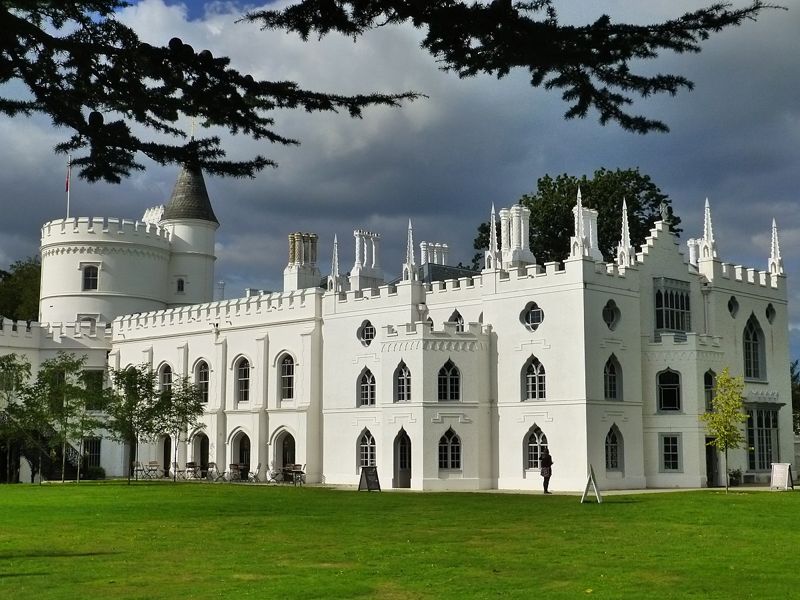
The exterior facade immediately captivates with its playful interpretation of Gothic castle architecture, where crisp white rendering contrasts dramatically with the dark tracery of pointed windows and decorative stonework. The building's deliberately irregular plan creates a picturesque composition designed for visual drama rather than classical symmetry. Crenellated battlements crown various sections of the building, while slender turrets and towers punctuate the roofline with medieval authority. The famous round tower, added during later construction phases, serves as a focal point with its distinctive cylindrical form topped by decorative pinnacles.
Gothic windows of varying sizes pierce the walls, their pointed arches filled with intricate tracery that filters light into jewelled patterns. Some windows feature authentic medieval stained glass panels, while others showcase later interpretations that maintain the overall aesthetic unity. The building's multiple levels and projecting bays create a sense of organic growth, as if the structure evolved over centuries rather than decades, perfectly capturing the romantic medieval revival spirit.
Grand Interior Spaces and Theatrical Rooms
Stepping inside reveals a sequence of interconnected chambers that unfold like elaborate stage sets, each room designed to evoke different aspects of medieval grandeur while maintaining domestic comfort. The interiors represent a masterpiece of decorative artifice, where every surface receives careful attention to create what was deliberately termed "gloomth" - a romantic, mysterious atmosphere that contrasts with conventional Georgian brightness.
Gilded ceilings stretch overhead throughout the principal rooms, their surfaces alive with intricate patterns derived from medieval manuscripts and architectural precedents. Fan vaulting inspired by Westminster Abbey's chapel creates dramatic overhead canopies, while elaborate plasterwork incorporates Gothic motifs with remarkable three-dimensional effect. The ceiling treatments vary from room to room, ensuring that each space maintains its individual character whilst contributing to the overall architectural narrative.
The Round Drawing Room
The Round Drawing Room serves as perhaps the most spectacular interior space, its circular plan creating an intimate yet grand atmosphere enhanced by rich crimson damask wall coverings. The room's centrepiece fireplace represents a masterwork of decorative adaptation, its design derived from Edward the Confessor's tomb at Westminster Abbey but interpreted through 18th-century sensibilities and executed in pristine white marble inlaid with colourful scagliola work. The chimney piece rises majestically from floor to ceiling, its Gothic detailing perfectly complementing the room's curved walls.
Above, the ceiling pattern takes inspiration from a great round window, its geometric design picked out in gold leaf against a coloured ground. Crimson and gilt create a sumptuous colour palette that bathes everything in warm, luxurious tones, whilst carefully positioned windows allow natural light to play across the ornate surfaces throughout the day. The room's circular shape creates perfect acoustics for conversation, making it an ideal setting for entertaining and intimate gatherings.
The Library and Gallery Spaces
The Library represents scholarly Gothic at its most refined, where tall bookcases with elaborate tracery house leather-bound volumes beneath soaring vaulted ceilings. The room achieves a perfect balance between learning and leisure, with comfortable seating areas positioned to take advantage of both natural light and the room's architectural drama. Historic prints and engravings line the walls between bookcases, creating a scholarly atmosphere that encourages both serious study and casual browsing.
Gallery spaces throughout the house feature extended vaulted ceilings that create dramatic perspectives and showcase the building's structural artistry. These circulation areas become destinations in themselves, their architectural treatment transforming movement through the house into a continuous aesthetic experience. Carved wooden screens, some original and others carefully recreated, divide spaces whilst maintaining visual connections between rooms.

Decorative Arts and Furnishings
Throughout the house, every decorative element receives meticulous attention, from the smallest door handles to the grandest architectural features. Enamelled door furniture provides jewel-like accents against dark wooden doors, whilst carved wooden screens incorporate Gothic tracery patterns that filter light and create intricate shadow play. Coats of arms appear throughout the interiors, some genuine historical pieces and others created to enhance the medieval atmosphere.
The painted glass collection represents one of the house's most significant treasures, with Renaissance panels creating pools of coloured light that animate the Gothic interiors throughout the day. These windows tell stories through their imagery - biblical scenes, heraldic devices, and decorative patterns that change character as light conditions shift from morning to evening. The glass panels are carefully positioned to create optimal visual impact, with some serving as room dividers whilst others provide focal points for seating areas.
Fireplaces throughout the house showcase remarkable variety, each designed to complement its particular room whilst maintaining the overall Gothic vocabulary. Some feature elaborate carved surrounds derived from medieval tomb designs, whilst others incorporate more restrained classical elements adapted to suit the Gothic setting. The combination of different periods and styles creates rich visual texture without sacrificing overall coherence.
Gardens and Landscape Setting
The five-acre garden provides the perfect complement to the house's elaborate interiors, offering a more restrained but equally romantic outdoor experience. Following 18th-century English landscape principles, the garden favours naturalistic arrangements over formal geometry, creating a series of interconnected outdoor rooms that invite exploration and contemplation.
Mature trees form the garden's backbone, their canopies providing dappled shade for winding gravel paths that connect different garden areas. Carefully maintained lawns create open spaces for views back towards the house, whilst more intimate groves and woodland edges offer secluded spots for quiet reflection. The planting scheme emphasises seasonal interest, with spring bulbs giving way to summer perennials and autumn foliage that maintains visual appeal throughout the year.
The restored shell seat represents the garden's most famous feature, its Rococo curves providing both functional seating and sculptural interest whilst serving as a focal point for views across the landscape. This whimsical piece perfectly captures the garden's playful yet sophisticated character, where serious design principles create settings for pure enjoyment.
Herbaceous borders showcase traditional English garden plants in naturalistic arrangements that appear effortless whilst requiring considerable skill to maintain. The garden's restoration utilised historical documents, paintings, and archaeological evidence to recreate original planting schemes and spatial relationships, ensuring authenticity whilst accommodating modern maintenance requirements and visitor access.
Stained Glass Mastery
The house's collection of painted glass deserves particular attention for its exceptional quality and historical significance. Panels range from genuine medieval fragments to Renaissance masterpieces and later interpretations, all carefully integrated into the Gothic window openings to create unified compositions. The glass serves multiple functions - providing privacy where needed, controlling light levels, and creating decorative focal points that animate interior spaces.
Biblical scenes predominate in the narrative panels, their rich colours and intricate detail rewarding close examination whilst contributing to the overall medieval atmosphere. Heraldic glass adds historical authenticity, with genuine coats of arms providing links to England's noble families and medieval heritage. Decorative panels featuring geometric patterns and foliate designs create more abstract compositions that complement the architectural detailing.
The technical quality of the glass represents the finest craftsmanship available during the collection period, with subtle variations in colour and texture creating depth and luminosity that changes throughout the day. Lead work maintains traditional patterns whilst accommodating the practical requirements of window glazing, ensuring both aesthetic success and long-term durability.
Art Collections and Cultural Treasures
Beyond its architectural significance, the house serves as a showcase for carefully curated collections of paintings, prints, decorative objects, and curiosities that enhance the medieval revival atmosphere. These collections reflect both historical importance and aesthetic quality, with pieces chosen to complement the Gothic setting whilst maintaining independent artistic merit.
Portrait paintings feature prominently, their subjects ranging from historical figures to family connections, all presented in period frames that harmonise with the architectural surroundings. Landscape paintings capture the romantic spirit of the Gothic revival, whilst religious subjects reinforce the medieval ecclesiastical references found throughout the building's decoration.
Print collections include architectural studies, historical views, and decorative designs that provide insight into the cultural interests that shaped the house's creation. These works are displayed in both permanent installations and rotating exhibitions that ensure regular visitors encounter new perspectives and interpretations.
Modern Amenities and Visitor Services
Contemporary facilities blend seamlessly with the historical character, providing necessary services without compromising the authentic atmosphere. The café occupies spaces designed to accommodate modern catering requirements whilst maintaining period character through careful design and furnishing choices. Menu selections emphasise local ingredients and traditional preparations that complement the historical setting.
The shop offers carefully selected merchandise that reflects the house's cultural significance and artistic achievements. Books, reproductions, and craft items maintain high quality standards whilst providing meaningful souvenirs that extend the visitor experience beyond the immediate visit.
Educational programmes cater to diverse interests and age groups, with specialist tours focusing on architecture, decorative arts, gardens, and historical context. Family activities ensure younger visitors engage meaningfully with the site's cultural significance whilst discovering the joy of historical exploration.
Accessibility provisions include step-free access to ground floor areas, lift access to upper levels, accessible toilet facilities, and dedicated parking for visitors with mobility challenges. Staff training ensures all visitors receive appropriate support whilst maintaining the site's historical integrity and conservation requirements.
The combination of architectural splendour, decorative richness, cultural significance, and modern accessibility makes Strawberry Hill House an unmissable destination for anyone interested in British architectural heritage, decorative arts, or simply the pleasure of experiencing one of England's most enchanting domestic buildings.
Getting There
Strawberry Hill House sits in Twickenham and is easiest to reach by South Western Railway from London Waterloo to Strawberry Hill station, then a clearly signposted 5–10 minute walk to the house on Waldegrave Road. Travellers coming via the Underground can take the District line to Richmond and change for the R68 bus towards Hampton Court, alighting at Michelham Gardens for a short walk along Waldegrave Road. Direct London buses also serve the area: the 33 between Hammersmith and Fulwell stops at Strawberry Vale opposite the house, while the R68 links Kew Retail Park, Richmond station and Twickenham to Michelham Gardens nearby. For cyclists, there are signed routes from Richmond, Kingston and Hampton Court with bike racks available on site, and drivers will find limited on-site parking with additional options in Twickenham town centre a 15–20 minute walk away.
Best Time to Visit
The best time to visit Strawberry Hill House is late spring to early autumn, when longer daylight and milder weather make both the glittering Gothic interiors and the landscaped garden especially enjoyable, with weekdays offering a calmer experience than busy weekends and bank holidays. Aim for May–June for lush greenery and frequent special events, or September for warm, settled days and vibrant late-season colour; October can be pleasantly quiet if you prefer fewer crowds. The house typically opens from late morning to mid-afternoon on set days, while the garden and café open earlier, so plan to arrive near opening for serene rooms and soft, natural light. Book ahead during popular periods, and consider aligning your visit with seasonal festivals or half-term openings if travelling with family.