


 Ireland Guide
 Scotland Guide
 Wales Guide
| Contents |
|---|

Introduction
Framlingham Castle is a late 12th-century fortress located in the market town of Framlingham, Suffolk. Built by Roger Bigod, Earl of Norfolk, around 1190-1200 to replace an earlier castle destroyed by Henry II, Framlingham represents one of the finest examples of medieval English baronial architecture. The castle is notable for its innovative design, consisting of 13 imposing square towers connected by a massive stone curtain wall standing 10.5 metres high and 2.3 metres thick, with no central keep—a departure from typical Norman castle architecture of the period. This formidable structure served as the seat of the powerful Earls and Dukes of Norfolk for over 400 years and played a pivotal role in English history when Mary Tudor was proclaimed Queen of England within its walls in 1553 following Edward VI's death. Today, managed by English Heritage, the castle remains exceptionally well-preserved and is open to the public daily from 10am to 5pm (10am to 6pm in summer), offering visitors the opportunity to walk the spectacular wall walk and explore its rich history. The castle sits surrounded by parkland and overlooks the picturesque Castle Mere, creating a striking outline that has dominated the Suffolk landscape for nearly 900 years.
Interesting Facts about Framlingham Castle

History
Framlingham Castle stands as a remarkable example of Norman and medieval fortification in the Suffolk countryside. The first castle on this site was likely built soon after the Norman Conquest, with the Bigod family—powerful Norman barons—constructing the earliest wooden structure between 1066 and 1107. Stone buildings were added from the mid-12th century, most notably under Hugh Bigod and his successor, Roger Bigod II, who erected the imposing curtain walls and 13 mural towers that define the castle’s present appearance. Unlike many castles of its age, Framlingham was designed without a central keep, relying instead on its massive stone walls and formidable towers for defence.
Throughout its turbulent history, Framlingham Castle repeatedly played a significant role in English national events and power struggles. The Bigods often found themselves at odds with the Crown: their castles were confiscated by King Henry II, regained after hefty fines, and sometimes dismantled following rebellion. In the early 13th century, King John besieged the castle after Roger Bigod II became one of the barons pressing for Magna Carta. Later, the castle came into the hands of other notable noble families, including the Mowbrays and the Howards, both holding high rank and often occupying central positions in English political life.
One of Framlingham Castle’s most historic moments occurred in 1553, when Mary Tudor, later Mary I, assembled her supporters there to claim the English throne against Lady Jane Grey. It was from the castle that Mary was declared Queen of England, starting her tumultuous reign. In the centuries that followed, the castle’s purpose shifted dramatically: after its decline as a noble residence, it became a workhouse for the local poor from the 17th to the 19th centuries. Today, managed by English Heritage, Framlingham Castle remains a popular visitor attraction, offering insight into centuries of English history as well as stunning views from its ancient walls.
Description
Perched atop a gentle Suffolk hill, Framlingham Castle presents itself as an arresting against the eastern horizon. Its nearly complete curtain wall—standing 10.5 metres high and 2.3 metres thick—encircles a grassy inner court, lending the site a sense of formidable grandeur far removed from the modern buzz of the market town below. Constructed of knapped flint and septaria, the walls retain thirteen stout mural towers, each offering a unique vantage point over the undulating countryside and the shimmering mere to the south.
Entrance and Outer Defences
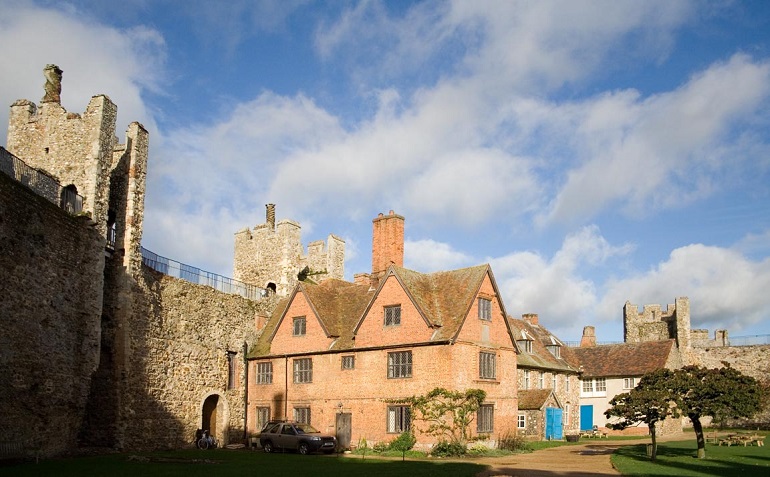
Entering through the Tudor-remodelled gatehouse, visitors step onto broad stone footings that have borne countless footsteps over eight centuries. Either side of the gateway lie meadows and tree-lined banks marking the outer and inner dry ditches—steep, eight-metre-deep recessed trenches crafted to frustrate unwelcome tunnelling and assault. Beyond the arch, the inner bailey spreads out as a verdant arena, its grassed floor encircled by the ramparts above.
Rampart Walk and Battlements
The rampart walk itself is the castle’s most compelling feature. A series of broad steps ascend from the gatehouse up to a mostly level chemin de ronde, interrupted only by occasional spiral staircases that open onto the turrets. Along the way, the oldest surviving Norman and Tudor chimneys pierce the battlements like architectural sentinels, their weathered stone contrasting with the bright flint walls beneath. At each tower, narrow embrasures frame distant views: to the south, the silver-glint mere; to the north, textile-stripe fields of Suffolk farmland; and to the west, the clustered rooftops of Framlingham’s honey-coloured cottages.
Workhouse and Visitor Facilities
Within the circuit of walls stands the solitary survivor of the castle’s post-medieval adaptation: the eighteenth-century workhouse. Today, its brick-and-stone façade houses an exhibition space where interactive displays recount daily life inside the fortifications. Adjacent, a small café pours tea and serves Suffolk scones beneath low-beamed ceilings, while a modest shop offers guidebooks, maps and locally made crafts. On warmer days, wrought-iron tables spill into the courtyard, inviting visitors to linger in the dappled shade of the ramparts.
Parkland and the Mere
Surrounding parkland extends from the outer ditch into gently rolling lawns, dotted with benches and picnic spots. To the south, the mere mirrors the castle’s crenellated outline, its placid waters a reminder of the site’s once-formidable fishery defences. A path around the lake affords framed views back to the walls, ideal for sketching or photography.
Getting There
By train, visitors should travel to Wickham Market station, which sits on the East Suffolk Line and is served by trains from Ipswich and Lowestoft. From there, a convenient electric minibus service known as Katch can be booked to take you directly to Framlingham Castle, making the remainder of the journey straightforward and eco-friendly.
By bus, regular bus routes such as Ipswich Buses 118 or First Bus 63 connect Ipswich with Framlingham; simply alight at Framlingham and enjoy a short walk through the market town to reach the castle.
By car, Framlingham Castle is easily accessible via the B1116; there is on-site parking for most vehicles, with additional pay-and-display options available in town should the castle's own facilities be full.
Best Time to Visit
The best time to visit Framlingham Castle is during the late spring to early autumn months, typically from May to September, when the weather is mild and the beautiful Suffolk countryside is in full bloom. During this period, visitors can fully appreciate the impressive curtain walls, stroll through the historic grounds, and often enjoy special events hosted at the castle. The extended daylight hours allow plenty of time to explore both the castle and its charming surroundings, making for an enriching and memorable experience.