


 Ireland Guide
 Scotland Guide
 Wales Guide
| Contents |
|---|

Introduction
Belton House is a 17th-century country house located near Grantham in Lincolnshire, managed by the National Trust since 1984. Built between 1685 and 1688 for Sir John Brownlow, the house exemplifies Carolean architecture and is considered one of England's finest examples of Restoration period domestic design. The property encompasses 1,300 acres of parkland and formal gardens, featuring a deer park, adventure playground, and various walking trails. The house contains an impressive collection of paintings, furniture, and decorative arts spanning several centuries, including works by Reynolds and Lely. Notable features include the Marble Hall with its carved wood staircase, the Library with its collection of rare books, and the Chinese Bedroom with hand-painted wallpaper. The estate also includes several outbuildings, including the Orangery and stables, and regularly hosts events ranging from outdoor theatre performances to seasonal exhibitions throughout the year.
Interesting Facts about Belton House
- Belton House was built between 1685 and 1687 by Sir John Brownlow, 3rd Baronet, and is considered a perfect example of Carolean architecture—the only truly vernacular architectural style England had produced since the Tudor period.
- The house was constructed using 1,750,000 bricks and faced with Ancaster stone from a quarry at Heydour in Lincolnshire.
- Despite his great wealth, Sir John Brownlow chose to build a comparatively modest house rather than one of the grand Baroque palaces being constructed by others at the time.
- The main façade of Belton House is believed to have inspired the design of modern British motorway signs that give directions to stately homes.
- During the First World War, Belton House and its park were transformed into a military training camp, with 20,000 trainee troops accommodated in barracks with the addition of electricity, water, and sewage services.
- The house featured cutting-edge innovations for its time, including sash windows for the principal rooms—the very latest technology of the 1680s.
- Belton House served as the seat of the Brownlow family for nearly three centuries until 1984, when mounting financial difficulties forced the 7th Baron Brownlow to donate it to the National Trust.
- The estate is home to a wild herd of fallow deer that has roamed the 1,300 acres of parkland for over 300 years.
- During World War II, RAF Belton Park was established in the grounds, and by November 1944, 1,850 military personnel were based at the property.
- The house has served as a filming location for numerous productions, including appearing as "Rosings Park" in the BBC's 1995 television adaptation of Pride and Prejudice.
- Belton House contains remarkable collections including the first road map of England, three huge canvas paintings of birds by Melchior d'Hondecoeter, and an exquisite lapis lazuli cabinet.
- The Marble Hall at Belton House is licensed for civil weddings, providing additional revenue for the National Trust's conservation efforts.
- In 2021, Belton House welcomed 340,290 visitors, making it one of the most popular National Trust properties.
History
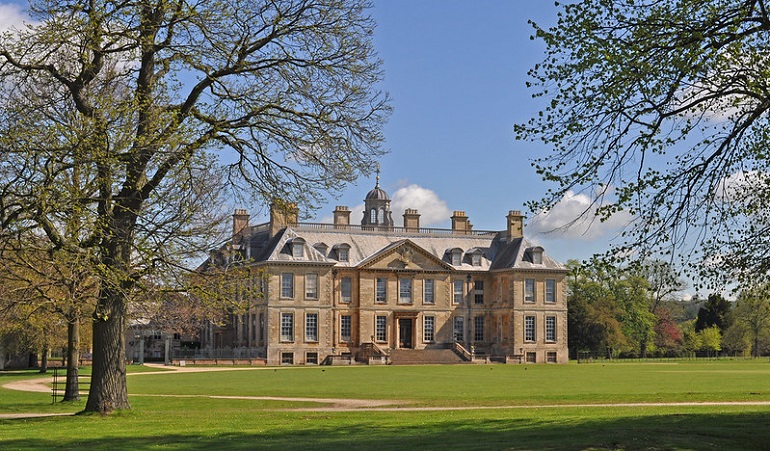
Belton House stands as a quintessential example of an English country house. Built between 1685 and 1687, the house was commissioned by Sir John Brownlow, 3rd Baronet, and his wife, Alice. Having inherited a great fortune, the couple sought to build a fashionable new country house to cement their position in high society. They employed master craftsmen to construct the new dwelling in the Carolean style, a restrained architectural form popular during the reign of Charles II. The design, thought to be by William Winde, was executed by the mason-contractor William Stanton. Built from 1.75 million bricks faced with local Ancaster stone, the house incorporated modern innovations such as sash windows and a layout that carefully separated the family's quarters from the servants' areas. The Brownlows moved into their completed home in 1688 and, in 1695, hosted a visit from King William III.
For over 300 years, Belton was the seat of the Brownlow family and their descendants, the Custs. After the death of the childless Viscount Tyrconnel in 1754, the estate passed to his nephew, Sir John Cust. Cust served as the Speaker of the House of Commons from 1761 until his death in 1770. His son, Brownlow Cust, who became the 1st Baron Brownlow in 1776, commissioned the architect James Wyatt to modernise the house's interiors. Wyatt also made significant changes to the exterior, including the removal of the original cupola and roof balustrade. Further alterations were made in the early 19th century by Jeffry Wyatville, Wyatt's nephew. However, in the 1870s, the 3rd Earl Brownlow undertook a major project to revert many of these changes, restoring the house to its original 17th-century appearance, which included rebuilding the cupola.
The 20th century presented significant challenges for the estate. Heavy death duties following the death of the 3rd Earl in 1921 forced the family to sell other properties and art collections. During the First World War, the parkland was transformed into a large training camp for the Machine Gun Corps, with 20,000 men stationed there before heading to the front line. In the 1930s, the 6th Lord Brownlow, a lord-in-waiting to King Edward VIII, hosted the king and Wallis Simpson at Belton during the abdication crisis. Continuing financial pressures eventually led the family to give the house and most of its contents to the National Trust in 1984. Today, visitors can explore the magnificent house, its formal gardens, and a park that has been home to a herd of wild fallow deer for more than three centuries.
Description
Belton House is a notable example of Carolean, or Restoration-style, architecture from the late 17th century, defined by its symmetry, classical restraint, and Dutch influence. The main house follows a compact, H-shaped floor plan, constructed from over one and a half million bricks faced with honey-coloured Ancaster and Ketton limestone. It rises for two principal storeys above a rusticated semi-basement, with an attic level concealed behind a rooftop balustrade. The design incorporates large sash windows on its main floors, a fashionable innovation for the period, contrasting with the more traditional mullioned and transomed windows of the basement and attic. The building is crowned by a distinctive cupola, which provides panoramic views across the estate and acts as a ventilation shaft for the grand staircase below. Flanking the main block are lower service wings, containing the kitchens and other domestic offices.
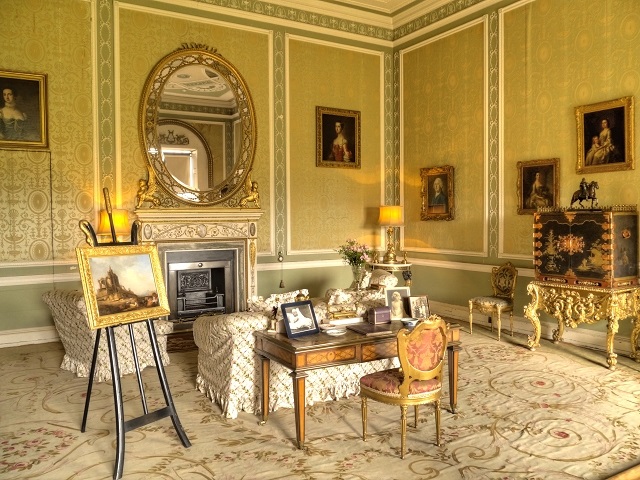
The interior is entered via the Marble Hall, a formal reception space on the south front with a chequered floor of black and white marble tiles and elaborate plasterwork. Leading from here is the Saloon, or Great Parlour, which features extensive wood panelling and a carved chimneypiece. Another principal ground-floor space is the Tapestry Room, which is hung with a set of three early 18th-century Mortlake tapestries depicting scenes from the Old Testament. These main reception rooms were designed for entertaining and to display the wealth and status of the owning Brownlow family.
Among the other significant interior spaces is the Great Staircase, a cantilevered structure with a decoratively carved balustrade that ascends through the heart of the house, its walls lined with family portraiture. The Library, remodelled in the early 19th century, contains bookcases designed by James Wyatt and houses a collection of over 6,000 volumes. The Chapel, which extends from the basement to the first floor, is a notable feature containing an exceptionally detailed limewood reredos attributed to the master carver Grinling Gibbons. A gallery on the first-floor level allowed the family to worship separately from the household staff, who occupied the pews below.
The first floor contains the principal bedroom suites, arranged for both family use and the accommodation of important guests. Notable among these is the Chinese Bedroom, featuring rare, hand-painted Chinese wallpaper from the 18th century, and the Windsor Bedroom, so-named after it was prepared for King Edward VIII during his relationship with Wallis Simpson. These opulent apartments contrast with the functional simplicity of the servants' quarters, located in the attic and basement levels. The ‘below stairs’ areas include the historic kitchens, scullery, and servants’ hall, which illustrate the operational side of the country house.
Surrounding the house are extensive formal gardens. The Italian Garden, a sunken parterre designed by Jeffry Wyatville in the early 19th century, contains formal flowerbeds, topiary, statuary, and a central fountain. It is overlooked by the Orangery, a delicate cast-iron and glass structure built in 1811 to house citrus trees and other exotic plants. Nearby, the walled kitchen garden historically supplied the house with fruit, vegetables, and cut flowers. To the east of the house lies the Dutch Garden, a later, late 19th-century addition with geometric parterres, formal ponds, and box hedging.
The wider estate consists of over 1,300 acres of landscaped parkland, which includes a herd of wild fallow deer that has inhabited the grounds for over three centuries. The park was laid out with formal avenues of trees, including a notable lime avenue, and clumps of woodland. The River Witham flows through the grounds, feeding a series of lakes and ponds, including the Mirror Pond. The landscape is dotted with architectural follies and features, such as a Boathouse, a Garden Temple, and the Bellmount Tower, a late 18th-century folly built on a hill to provide a focal point and viewing station. A network of paths offers a variety of walks through the pleasure grounds, woodland, and open parkland.
Getting There
Belton House is situated just outside Grantham in Lincolnshire, making it easily accessible by various means of transport. The nearest train station is Grantham, which is served by regular direct trains from London King’s Cross, Nottingham, and other major cities. From Grantham station, you can take a short taxi ride to the estate, typically costing around £10. For drivers, Belton House is conveniently located just off the A1, with free parking available for visitors. Coach services also stop in Grantham, and local buses connect the town to surrounding villages, though taxis are recommended for speed and ease. Once at Belton House, visitors can enjoy exploring the beautiful grounds and stunning interiors of this National Trust property.
Best Time to Visit
The best time to visit Belton House is during the spring and early summer months, from late March through June, when the gardens are in full bloom and the estate comes alive with vibrant colours and wildlife. This period offers pleasantly mild weather, ideal for leisurely strolls through the extensive parkland and formal gardens. While the house and grounds are open throughout the year, springtime showcases stunning displays of daffodils, bluebells, and blossoming trees, enhancing the charm of this historic country estate. For those seeking a quieter experience, visiting outside school holidays ensures a more tranquil atmosphere, allowing for a more immersive appreciation of the house’s grandeur and its picturesque surroundings.