


 Ireland Guide
 Scotland Guide
 Wales Guide
| Contents |
|---|

Introduction
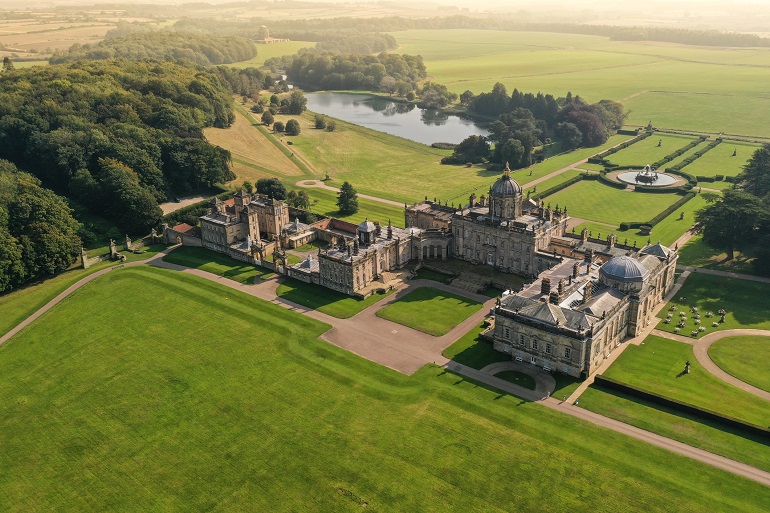
Castle Howard is a stately home located in North Yorkshire, approximately 15 miles north of York, nestled within the Howardian Hills Area of Outstanding Natural Beauty. Built over 300 years ago, it was commissioned by the 3rd Earl of Carlisle in 1699, designed by Sir John Vanbrugh and later Nicholas Hawksmoor, taking over 100 years to complete. Though not actually a castle, this magnificent example of English Baroque architecture has been home to the Carlisle branch of the Howard family for more than three centuries. Visitors can explore the impressive house with its world-renowned art collections and beautifully decorated interiors, as well as nearly 1,000 acres of landscaped parkland featuring temples, statues, lakes, fountains and woodland walks. The estate also offers family-friendly attractions including the Skelf Island Adventure Playground, along with shops, cafés and a garden centre. Castle Howard has gained additional fame as a filming location for productions including the television and film adaptations of "Brideshead Revisited" and more recently, "Bridgerton".
Interesting Facts about Castle Howard
- Castle Howard, located in North Yorkshire, England, has been the home of the Howard family for over 300 years.
- The construction of Castle Howard began in 1699 and took more than a century to complete.
- Designed by dramatist John Vanbrugh, it is one of the finest examples of Baroque architecture in Britain.
- The estate spans over 1,000 acres and includes formal gardens, lakes, fountains, and woodland walks.
- Much of Castle Howard was destroyed in a fire in 1940, but extensive restoration efforts have brought it back to life.
- The east wing of the house remains a shell due to the damage caused by the fire.
- Castle Howard served as a filming location for productions such as *Brideshead Revisited* and *Bridgerton*.
- The estate features notable landmarks such as the Temple of the Four Winds and a grand mausoleum.
- It houses an impressive collection of art, including paintings, sculptures, and tapestries collected over generations.
- Castle Howard is part of the Howardian Hills Area of Outstanding Natural Beauty.

History
The palace was designed by Sir John Vanbrugh (1664-1726) for Charles Howard (1669-1738), 3rd Earl of Carlisle, and constructed between 1699 and 1712.
Although this was Vanbrugh's first work, it surpasses many of his later works, except maybe Blenheim Palace. It was the first private residence in England to be surmounted by a dome. The grand landscaped gardens were laid in the 1750's by a team of 30 gardeners.
Upon its completion, the house still lacked a West Wing, which construction started only after Vanbrugh's death. Instead of being built in the same Baroque style as the rest of the house, the West Wing was designed in the Palladian style of the latter-half of the 18th century, and wasn't completed and fully decorated until the early 19th century. This asymetrical appearance has sometimes been criticised, although later alterations have attempted to reconcile the two styles.
In 1940, the interior of the house was badly damaged by a fire which swept from the South-East Wing to the Great Hall, destroying the dome and nearly twenty rooms. George Howard repaired the damages and rebuilt the dome in 1961-62.
In 1981, Castle Howard was chosen as scene of the TV drama Brideshead Revisited, produced by Granada Television.
Castle Howard has been opened to the public since 1952, and now attracts some 200,000 visitors annually. It is still the residence of the Howard family.
Description
The Grand Interior
Upon entering Castle Howard, visitors are immediately struck by the opulence of the state rooms. The Great Hall, with its soaring ceilings and ornate plasterwork, serves as a magnificent centrepiece. The dome above floods the space with natural light, illuminating the intricate marble floor below. The Antique Passage leads guests through a corridor lined with classical busts and sculptures, offering a taste of the artistic treasures that await.
The Long Gallery stretches an impressive 160 feet, its walls adorned with family portraits spanning generations of the Howard family. The crimson damask wall coverings provide a sumptuous backdrop for these historical treasures. Meanwhile, the Music Room showcases a collection of fine musical instruments, including a beautifully preserved harpsichord.
Throughout the house, exquisite furniture and priceless works of art by masters such as Rubens, Van Dyck, Gainsborough, and Reynolds adorn the walls. The Chinese Drawing Room houses an exceptional collection of Oriental ceramics and lacquerware, reflecting the 18th-century fascination with Eastern aesthetics. The Castle Howard Collection also includes remarkable antiquities, from Roman sculptures to Egyptian artefacts, each piece carefully curated to complement the magnificent surroundings.
The Formal Gardens
Stepping outside, one is greeted by meticulously landscaped formal gardens that extend in all directions. The South Parterre offers a classic formal garden with geometric patterns formed by neatly clipped box hedges and vibrant seasonal bedding plants. The iconic Atlas Fountain serves as a focal point, its jet of water soaring skyward from a basin supported by the mythological figure of Atlas bearing the weight of the celestial sphere. The intricate sculptural details of this magnificent fountain, created by John Thomas in the 1850s, reward close inspection.
From the South Parterre, terraced lawns descend gently towards the South Lake, offering ever-changing vistas across the water to the Temple of the Four Winds beyond. The careful placement of architectural elements within the landscape creates perfect picture postcard views at every turn, demonstrating the 18th-century mastery of landscape design.
The Walled Garden
The Walled Garden, a short stroll from the main house, is a horticultural delight spanning eight acres. This garden-within-a-garden features over 2,000 rose bushes representing both historic and modern varieties that fill the air with their heady scent from June through September. The central avenue, lined with lavender, creates a sensory experience as visitors brush past the aromatic plants.
This secluded space also includes a Potager Garden, showcasing a delightful mix of ornamental and edible plants arranged in decorative patterns. The Ornamental Vegetable Garden demonstrates the artistry of the estate's gardening team, with colourful chard, purple kale, and feathery fennel arranged in aesthetically pleasing combinations.
The glasshouses within the Walled Garden shelter more tender specimens, including exotic fruits and Mediterranean plants that would otherwise struggle in the Yorkshire climate. Espaliered fruit trees line the sun-warmed brick walls, their branches trained into elegant horizontal tiers that produce bountiful harvests of apples, pears, and stone fruits.
The Parkland and Woodland Walks
Beyond the formal gardens lies an expansive 1,000-acre parkland, offering breathtaking views of the Howardian Hills. This carefully designed landscape, influenced by the great Capability Brown, creates a seemingly natural yet artfully contrived setting for the house. Ancient oak trees, some over 300 years old, dot the rolling grasslands, providing shade for the estate's herd of fallow deer.
Visitors can explore tranquil woodland walks, including the ancient Ray Wood, which predates the castle itself. This woodland garden contains a remarkable collection of rhododendrons, camellias, and magnolias, many collected during plant-hunting expeditions to the Himalayas and Far East. In spring, the woodland floor is carpeted with bluebells, creating a magical atmosphere of shimmering blue beneath the emerging canopy.
The estate also boasts an impressive collection of champion trees—specimens that are the largest or oldest of their kind in Britain. These arboreal treasures include towering sequoias, rare Chinese paperbark maples, and ancient sweet chestnuts with gnarled, twisted trunks that speak of centuries of growth.
The Lakes and Waterways
Water features prominently in the Castle Howard landscape, with the South and North lakes providing reflective surfaces that mirror the architecture and surrounding trees. The South Lake, with its irregular shoreline and wooded islands, creates a naturalistic scene reminiscent of a Claude Lorrain painting. Elegant swans glide across the surface, while herons stand sentinel at the water's edge.
The cascade between the lakes creates a gentle symphony of falling water, drawing visitors along a path that reveals new vistas with each turn. Ornamental bridges span narrow sections of the lakes, their arches reflected perfectly in the still waters below on calm days.
Architectural Gems in the Landscape
Dotted throughout the grounds are architectural treasures that add to the estate's allure. The Temple of the Four Winds, designed by Vanbrugh as a garden pavilion, stands proudly at the eastern end of the garden. This perfectly proportioned classical temple offers panoramic views of the surrounding countryside and serves as a reminder of the 18th-century passion for classical antiquity.
The Mausoleum, an imposing domed structure set within the parkland, adds a touch of grandeur to the landscape. Designed by Nicholas Hawksmoor, this circular building with its colonnade of Doric columns was built to house the remains of the 3rd Earl of Carlisle and subsequent family members. Its scale and solemnity create a powerful presence within the landscape.
Other follies and eyecatchers, such as the newly restored Pyramid and various fortifications, provide intriguing focal points throughout the estate. The Pyramid, standing on a rise to the north of the house, serves as both a garden ornament and a family monument. The Four Faces, a curious stone monument with carved faces looking in four directions, adds an element of mystery to the woodland walks.
The New River Garden
The New River Garden represents a more contemporary addition to Castle Howard's horticultural offerings. This water garden features a series of interconnected pools and rills, with water flowing gently from one level to the next. Marginal plants such as iris, hostas, and gunnera create lush borders, while water lilies float serenely on the surface of the pools. Carefully placed sculptures add artistic interest among the verdant planting.
Seasonal Splendours
Each season brings its own distinct character to Castle Howard. Spring heralds an explosion of bulbs, with drifts of daffodils carpeting the slopes and woodland edges. Cherry trees burst into blossom, creating clouds of pink and white against the blue sky. Summer brings the rose garden to its fragrant peak, while the herbaceous borders overflow with colourful perennials.
Autumn transforms the landscape into a tapestry of gold, russet, and crimson as the ancient woodlands prepare for winter. The Japanese maples in Ray Wood provide particularly spectacular autumn colour. Even winter has its charms, with the clean architectural lines of the formal gardens revealed by a dusting of frost or snow, and the evergreen plantings providing structure and interest throughout the coldest months.
A Haven for Nature
Castle Howard is not only a feast for the eyes but also a haven for wildlife. The two lakes flanking the house provide habitats for various waterfowl, including great crested grebes that perform their elaborate courtship dances in spring. Kingfishers flash electric blue as they dart along the waterways, while dragonflies hover above the water's surface in summer.
The extensive woodlands and gardens support a diverse ecosystem. Ancient trees provide homes for woodpeckers, nuthatches, and treecreepers, while the meadow areas buzz with insect life, attracting butterflies such as peacocks, red admirals, and commas. Visitors may spot roe deer emerging cautiously from woodland edges at dawn and dusk, or glimpse a red kite soaring on thermals high above the estate.
The Sensory Experience
A visit to Castle Howard engages all the senses. Beyond the visual splendour, there's the scent of roses and lavender in the Walled Garden, the fragrance of lime blossom drifting from the avenue trees on summer evenings, and the earthy aroma of woodland paths after rain. The soundscape includes the gentle splash of fountains, the rustle of leaves in the breeze, and the melodious songs of blackbirds and thrushes echoing through the gardens.
Textural contrasts abound—from the smooth, cool stone of the balustrades to the rough bark of ancient oaks, from velvety moss carpets in the woodland to crisp gravel paths crunching underfoot. Each element contributes to the immersive experience that makes Castle Howard so much more than simply a beautiful view.
Getting There
To reach Castle Howard, a stunning stately home located 15 miles north-east of York, you have several options. By car, follow the A64, exiting at the Malton/Pickering roundabout if coming from the west, or continuing into Malton if coming from the east. Once in Malton, turn onto Castle Howard Road, just past the Talbot Hotel. For those without a car, a new direct bus service from York Memorial Gardens is available on Thursdays and Sundays during the summer months, offering a convenient and environmentally friendly option. Alternatively, you can use the regular line 81 bus service, which operates between York Station, Castle Howard, and Malton, though it does not run on Sundays. Taxis are also available from York, providing a direct but more expensive option.
Best Time to Visit
The best time to visit Castle Howard is during the spring and summer months when the gardens are in full bloom and the weather is generally pleasant. From March to November, the estate is open daily, offering visitors the chance to explore the stunning gardens, parkland, and the house itself. However, it's worth noting that the house is currently closed until mid-April for restoration work. If you prefer a festive atmosphere, visiting during the winter months can be enchanting, with Castle Howard's magical Christmas events, although some areas may be closed. Regardless of the season, pre-booking tickets is advisable to ensure entry, as this popular destination attracts many visitors throughout the year.