


 Ireland Guide
 Scotland Guide
 Wales Guide
| Contents |
|---|

Introduction
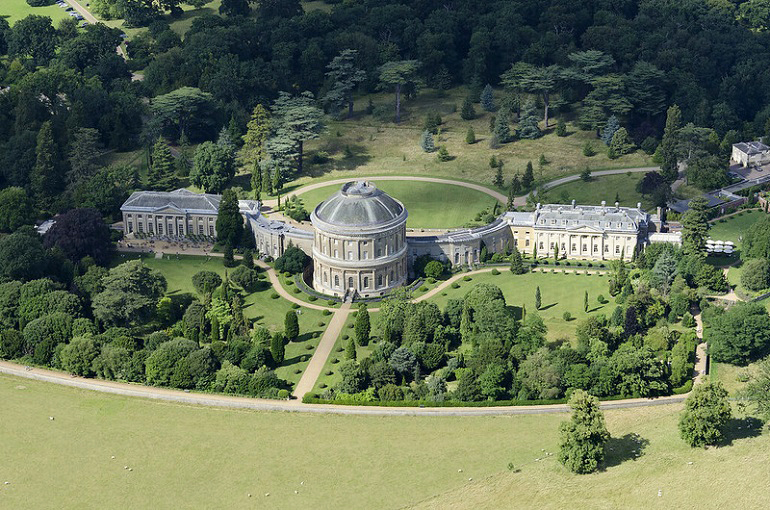
Ickworth House is a neoclassical country house situated near Horringer, on the outskirts of Bury St Edmunds. Designed by Italian architect Antonio Asprucci built between 1795 and 1829 for Frederick Hervey, 4th Earl of Bristol, the centrepiece is a monumental domed rotunda flanked by symmetrical wings. The house stands within an 1,800-acre estate managed by the National Trust, featuring one of Britain’s earliest Italianate gardens—complete with a walled garden, Victorian stumpery and herbaceous borders—and extensive parkland criss-crossed by walking and cycling routes. Visitors can explore richly furnished state rooms, a renowned silver and art collection, restored servants’ quarters and landscaped grounds open throughout the year.
Interesting Facts about Ickworth House
- Ickworth House features a striking neoclassical rotunda, inspired by Italian architecture and unique in the English countryside.
- The estate was the home of the Hervey family for over 500 years, with the house itself built between 1795 and 1829.
- The 4th Earl of Bristol, known as the Earl-Bishop, originally intended the house as a grand art gallery for treasures amassed during his extensive travels; most of the original collection was seized by Napoleon's forces.
- Ickworth's East Wing, once the private residence of the Hervey family, now operates as a luxury hotel leased from the National Trust.
- The Italianate gardens at Ickworth are amongst the earliest examples of their kind in England and feature a Victorian Stumpery and a Mediterranean Temple Garden.
- The main rotunda boasts an internationally renowned collection of art and Georgian silver, including works by artists such as Gainsborough, Hogarth, Reynolds, Titian, and Poussin.
- The estate covers over 1,800 acres of parkland, offering ancient woodlands, formal gardens, and miles of scenic walking and cycling trails.
- Ownership of Ickworth House transferred to the National Trust in 1956, when it was offered in lieu of death duties, ensuring its preservation for the public.
- For much of the 20th century, the West Wing was left unfinished and used as agricultural storage; it was only fully completed and restored in 2006.
- The servants’ basement at Ickworth has been restored, giving visitors a glimpse into 1930s domestic service life and the real stories of those who worked on the estate.
History
The estate first appeared in the Domesday Book of 1086 as a small settlement and came into the possession of the Hervey family through marriage in the 15th century. Throughout the following five hundred years, the Herveys played a significant role in its development, culminating in the construction of the current house by the eccentric 4th Earl of Bristol, also known as the Earl-Bishop, who began work on the property in 1795. Inspired by his extensive travels around Europe, he envisioned a grand Italianate residence that would serve as both an aristocratic home and a gallery for his lavish art collection.
The architectural design of Ickworth House is famous for its unique central rotunda, regarded as one of England's most distinctive country house features. This design, attributed to Italian architect Antonio Asprucci and built by Francis and Joseph Sandys, consists of a circular domed hall flanked by sweeping curved wings. The Rotunda was originally imagined as an art gallery, but most of the Earl-Bishop's collection was seized by Napoleonic troops before the house's completion. Construction continued under his son, Frederick Hervey, the 5th Earl of Bristol, who made the East Wing the family's living quarters while reserving the central rotunda for entertaining and display. The West Wing was completed for symmetry but mostly stood unused until the 21st century.
Ickworth’s gardens and parkland are as remarkable as the house itself. Originating as a deer park in the 13th century, the grounds were transformed over time into landscaped pleasure gardens and sweeping parkland to complement the grand house. The Hervey family’s vision included walled gardens, Italianate designs, and a focus on both beauty and utility. During the 20th century, the estate was touched by the events of the First World War before being given to the National Trust in 1956 in lieu of death duties. Today, Ickworth House and Gardens welcome the public, with the former East Wing now serving as a hotel, allowing visitors to appreciate this exceptional example of English heritage and landscape design.
Description
Architectural Grandeur
Rising like a monumental theatre set in the heart of a deer park, Ickworth’s central rotunda—some 32 metres in diameter—is the building’s defining feature. Its smooth, stucco-clad walls and lead-covered dome sit atop a broad plinth, punctuated by a portico of Ionic columns that give a measured sense of arrival. To either side, twin wings extend in gentle curves, framing the rotunda and cloaking it in a harmonious balance of classical form and pastoral serenity.
Within, the rotunda’s soaring domed ceiling bathes the principal rooms in soft, northern light. Each space has been arranged to celebrate the Earl-Bishop’s once-vast art collection, with galleries opening one into another. Scagliola columns and marble fireplaces punctuate drawing rooms, while the semi-circular library at the rear presents a white, vaulted expanse, its five floor-to-ceiling windows hung with vibrant green draperies that echo the hues of the landscape outside.
Interior Highlights
The ground floor unfurls around the rotunda in a sequence of elegantly proportioned rooms:
- The Entrance Hall: A grand circular chamber, its simple palette of white walls and black marble fireplace emphasising the rotunda’s pure geometry.
- Drawing Room and Dining Room: Twin salons flanking the stair hall, each richly furnished with Regency chairs and tables, their upholstery and woodwork underscoring the period’s restrained luxury.
- Rotunda Stair Hall: Behind the entrance hall, a wide stair ascends beneath the dome, offering glimpses of the upper galleries through slender balustrades.
- Semi-Circular Library: At the rotunda’s rear, this pale, lofty space feels almost ecclesiastical, its rustling silk curtains and polished floorboards lending a hushed intimacy ideal for contemplation.
Beneath the principal rooms, a restored servants’ basement reveals the household’s hidden world. Authentic 1930s kitchens, pantries and dormitories brim with original fittings and period props, inviting visitors to tread the flagstone floors once traversed by stewards and maids.

Italianate Gardens and Pleasure Grounds
Encircling the rotunda, the formal Italianate garden is among the earliest of its kind in England. Here, gravel parterres edged with clipped yew and topiary punctuate broad lawns, while statues and urns lend a sense of classical ritual to the plantings. Within this ordered space lies:
- The Temple Garden: A small enclosed court anchored by a limestone summerhouse, its raised beds awash with Mediterranean-style planting—lavender, rosemary and scented pelargoniums that summon an almost Tuscan lightness.
- Victorian Stumpery: A gentle grove of shaded hollows filled with gnarled tree-stump sculptures, ferns and mosses. This 19th-century novelty offers a woodland retreat of murmuring leaves and soft earth beneath towering oaks.
- Walled Kitchen Garden: Beyond the formal parterres, a Tudor-walled enclosure shelters espaliered fruit trees, herbaceous borders and neat vegetable plots—echoes of the estate’s working past.
Parkland and Pleasure Grounds
Spreading out from the house, 730 hectares of parkland invite rambling on waymarked trails. Ancient specimen trees—mighty oaks, graceful beeches and sculptural hornbeams—dot broad meadows, while quiet rides skirt serene lakes and hidden medieval church ruins. Whether on foot, bicycle or under the shade of cedars of Lebanon, the estate’s layered vistas unfold like a living painting in every season.
Visitor Experience
Ickworth presents a seamless blend of formal precision and rustic freedom. Indoors, rooms resonate with classical calm; below stairs, the bustle of country-house service comes alive. Outdoors, regal terraces merge into untrammelled parkland, offering moments of structured beauty and expansive solitude in equal measure. Thriving cafés, a gift and plant shop, and carefully restored spaces ensure that every visitor can savour the house’s unique fusion of art, architecture and landscape.
Ickworth House and Gardens is not merely a stately home but a timeless canvas on which the rigour of classical design meets the gentle lyricism of the Suffolk countryside. Whether studying its perfect circles or losing oneself among its ancient trees, every corner reveals a new scene in this grand country tableau.
Getting There
By train, the easiest route is to travel to Bury St Edmunds station, which is approximately five miles from Ickworth House and Gardens. From there, you can catch a local bus towards Horringer village or take a taxi for a short onward journey.
By bus, regular bus services such as the Number 14 and 15 run from Bury St Edmunds town centre, stopping in Horringer village—just a 15-minute walk to the main entrance.
By car, take the A14 to junction 42 for Westley and follow the A143 towards Horringer; the main entrance is well signposted—simply follow the brown tourist signs and avoid using the postcode for sat nav, as this can lead you astray. Parking is available on site with clear signage from the entrance drive.
Best Time to Visit
The best time to visit Ickworth House and Gardens is during late spring to early autumn, typically from May to September, when the estate’s beautifully landscaped gardens are in full bloom and the weather is most pleasant. During these months, visitors can enjoy vibrant displays of flowers, lush green lawns, and the striking Italianate garden design under mild temperatures and longer daylight hours. Seasonal events and open-air activities often take place in summer, adding to the lively atmosphere, while early autumn offers a stunning palette of changing foliage. Planning your visit during this period ensures you experience Ickworth at its most picturesque and welcoming.