


 Ireland Guide
 Scotland Guide
 Wales Guide
| Contents |
|---|

Introduction

The garden of Sissinghurst Castle is indubitably among the world's most famous 20th century gardens.
Sissinghurst Castle started as a stone manor house in the Middle Ages, replaced by a brick mansion by the Baker family (related by marriage to the Sackvilles of Knole) in 1480, and again by an Elizabethan house in 1560-70.
In the mid-18th century, the house served as a camp for French prisoners of war, and 2/3 of the buildings were subsequently destroyed. The Cornwallis family took possession of the estate in 1855, who used it as a farmhouse.
In 1930 the property was purchased by Vita Sackville-West (born in nearby Knole House), the woman responsible for the magnificent garden that can be seen today.
Vita and her husband, diplomat and writer, Harold Nicolson, created 10 separate gardens, each with a different feel, reflecting their divergence in style, from Vita's romanticism to Harold's classicism.
The gardens were first opened to the public in 1938, and were bequeathed to the National Trust in 1967, 5 years after Vita's death.
Interesting Facts about Sissinghurst
- The name "Sissinghurst" derives from the Saxon word "hurst," meaning an enclosed wood, and the site has been occupied since at least the Middle Ages.
- During the Seven Years' War (1756-1763), the Tudor buildings housed up to 3,000 French sailors as prisoners of war, who dubbed it "Château de Sissinghurst," giving rise to the "castle" name despite it never being an actual castle.
- Queen Elizabeth I was entertained at Sissinghurst in August 1573 by Sir Richard Baker, who had expanded the manor into a grand courtyard house surrounded by a 700-acre deer park.
- King Edward I is reputed to have stayed at the original moated manor house in 1305, making it a site with over 700 years of royal connections.
- In 2018, archaeologists uncovered an important collection of historical graffiti created by French prisoners beneath 20th-century plaster, providing a unique glimpse into the experiences of the 3,000 captives.
- Vita Sackville-West was so eager to begin gardening that she planted the noisette rose 'Madame Alfred Carrière' on the South Cottage even before the property deeds had been signed.
- The famous White Garden restricts plants to only white, green, grey, and silver colours, creating drama through different shapes, textures, and forms rather than colour.
- Harold Nicolson recorded in his diary that it was the discovery of the "nutwalk" (now the Nuttery) that convinced him and Vita to purchase Sissinghurst in April 1930.
- The property remained unsold for two years after being advertised in 1928 for £12,000, before Vita Sackville-West and Harold Nicolson finally purchased it.
- Vita Sackville-West climbed the 78 steps to the top of the tower daily to write in her study, where she penned 13 novels, poetry, short stories, and her regular column for The Observer.
- The garden rooms cover just 5 acres within the much larger 450-acre estate, yet contain distinct areas including the Purple Border, Cottage Garden, Rose Garden, and Herb Garden.
- By the 19th century, most of Sir Richard Baker's original Elizabethan mansion had been demolished, with the stone and brick being reused in buildings throughout the local area.
- The moat is the oldest surviving feature of the original manor house, with two of the three original arms still visible today, whilst the third became the Moat Walk.
- Vita Sackville-West cultivated approximately 200 varieties of roses over thirty years, transforming what she and Harold inherited as little more than "some oak and nut trees, a quince, and a single old rose".
- The garden attracts visitors from every continent and remains one of the most influential gardens in horticultural thought and practice, despite being created on a site that was described in 1752 as "a house in ten times greater ruins".
History
Sissinghurst Castle & Garden boasts a remarkable history spanning over eight centuries, beginning with its Saxon origins when "hurst" denoted an enclosed wood. The earliest recorded owner was Stephen de Saxinherst, mentioned in an 1180 charter, before the estate passed to the de Berhams by the late 13th century, who constructed a moated manor house that hosted Edward I in 1305. The property's Tudor transformation began in 1490 when the de Berhams sold to Thomas Baker of Cranbrook, a prosperous cloth producer. In the 1530s, Sir John Baker, one of Henry VIII's Privy Councillors, built the impressive brick gatehouse that survives today, whilst his daughter Cecily's 1554 marriage to Thomas Sackville, 1st Earl of Dorset, established the earliest connection between the Sackville family and Sissinghurst. Sir Richard Baker undertook a massive expansion in the 1560s, constructing the iconic Tower and creating a grand courtyard house surrounded by a 700-acre deer park, culminating in Queen Elizabeth I's three-day visit in August 1573.
Following the collapse of the Baker family fortunes after the Civil War (1642-1651), Sissinghurst entered a period of dramatic decline that would last nearly three centuries. By 1752, Horace Walpole described it as "a park in ruins and a house in ten times greater ruins". During the Seven Years' War (1756-1763), the government leased the property as a prisoner-of-war camp, housing up to 3,000 French seamen in conditions so brutal that other prisoners were threatened with transfer to Sissinghurst as punishment. It was during this dark chapter that the property acquired the name "Sissinghurst Castle," though it was never actually a castle, as French prisoners referred to it as "Château de Sissinghurst" in letters home. The historian Edward Gibbon, stationed there with the Hampshire militia, recorded "the inconceivable dirtiness of the season, the country and the spot". Around 1800, the Mann family purchased the estate and demolished most of Sir Richard's Elizabethan mansion, using the materials for local building projects, before it became a workhouse for the Cranbrook Union and later housed farm labourers.
Sissinghurst's renaissance began in 1930 when the poet Vita Sackville-West and her diplomat husband Harold Nicolson purchased the ruins for £12,375, inheriting little more than oak and nut trees, a quince, and a single old rose. Denied inheritance of her ancestral home Knole due to primogeniture, Sackville-West saw great significance in Sissinghurst's connection to her ancestor Thomas Sackville. The couple transformed the scattered Tudor buildings into an unconventional home—the gatehouse became their library or "Big Room," the Tower served as Vita's writing sanctuary, the Priest's House housed their sons Ben and Nigel, and the South Cottage contained their bedrooms. Over thirty years, they created what became one of England's most influential gardens, with Nicolson designing the layout whilst Sackville-West undertook the planting of some 200 rose varieties and countless other flowers and shrubs. The garden first opened to paying visitors for two days in 1938 at one shilling per head—leading Vita to affectionately call visitors "shillingses"—and the National Trust assumed control in 1967, ensuring this horticultural masterpiece's preservation for future generations.
Description
The Elizabethan Tower: Guardian and Observatory
The red-brick tower, rising majestically above the garden's intricate tapestry, serves as both focal point and lookout post. Its weathered Tudor bricks catch the light at different times of day, casting warm shadows across the courtyards below. From its upper windows, visitors gain a bird's-eye perspective of the garden's geometric precision—the way hedges carve out perfect rectangles, how paths intersect at precise angles, and how each garden room nestles into the greater whole like pieces of an elaborate puzzle.
The tower's base houses the entrance vestibule, where ancient stone floors worn smooth by centuries of footsteps lead visitors through a dramatic threshold. Here, the transition from everyday world to garden sanctuary begins, with glimpses of green lawns and purple blooms beckoning through the archway ahead.
The Tower Lawn and Purple Border: A Royal Welcome
Emerging through the arched tower vestibule, one steps onto the perfectly clipped lawn flanked by a rich purple border that serves as the garden's grand overture. Here, the planting scheme reaches crescendo with deep-hued salvias in velvety burgundy, towering lupins in shades from lavender to deep plum, and late-season asters that shimmer with purple-tinged petals.
Island clumps of alliums rise like purple globes on slender stems, their spherical heads catching morning dew and creating architectural punctuation points throughout the border. Verbena bonariensis weaves through the composition with its airy purple clouds, softening the edges whilst maintaining the regal colour palette.
Beneath the larger specimens, carpets of purple-leafed heuchera and burgundy-toned sedums provide ground-level interest, whilst the occasional silver-leafed plant—lamb's ear or artemisia—offers gentle relief from the saturated hues.

The Rose Garden and Rondel: Romance in Bloom
Beyond a pair of weathered brick walls lies the Rose Garden, where the curved Powys wall creates an intimate amphitheatre of scented blooms. This enclosure houses a carefully curated collection of old garden roses—damasks, gallicas, and albas—whose petals range from the palest blush to the deepest crimson. Here, 'Madame Isaac Pereire' sprawls with abandon, her raspberry-pink blooms releasing waves of intense fragrance, whilst the pure white 'Madame Hardy' provides cooling contrast with her perfectly quartered blooms and distinctive green eye.
Honeysuckles trained against the espaliered walls create vertical tapestries of cream and gold, their trumpet flowers attracting clouds of moths on summer evenings. The sweet perfume mingles with the roses' more complex fragrances, creating an almost intoxicating atmosphere during peak bloom.
At the garden's far end, a circular rondel of clipped yew provides formal counterpoint to the tumbling roses. This living sculpture, maintained with mathematical precision, offers visual respite and guides visitors through scented arches toward framed vistas of the gardens beyond. The yew's dark green provides a dramatic backdrop for the pale roses that scramble over nearby walls, creating a study in contrasts that exemplifies Sissinghurst's masterful use of structure and spontaneity.
Vita's White Garden: Moonlit Meditation
Perhaps the garden's most celebrated and copied space, the White Garden stands as a testament to the power of restraint and subtle variation. This monochromatic masterpiece demonstrates that limitation breeds creativity, with dozens of white-flowering plants creating a symphony in cream, ivory, and pure white.
The planting scheme unfolds in carefully orchestrated waves. White poppies with tissue-paper petals catch the morning light, whilst pale irises rise like elegant candles from sword-like foliage. Creamy peonies, heavy-headed and fragrant, provide moments of luxurious abundance, their ruffled blooms almost too perfect for nature.
The genius lies not just in the flowers but in the supporting cast of silver and grey foliage. Senecio cineraria spreads its felt-like leaves in pewter pools, whilst various artemisia species contribute feathery textures and aromatic qualities that release their herbal fragrance at the gentlest touch. Lamb's ear creates soft, tactile borders that invite stroking, whilst the architectural leaves of cardoon provide dramatic vertical elements.
At the garden's centre grows a single white rose—some say 'Iceberg', others 'White Pet'—whose pure blooms seem to glow against the surrounding silver foliage. Narrow brick paths bisect the beds in perfect geometry, their warm terra-cotta tones providing subtle contrast whilst inviting a slow, contemplative walk among the softly shimmering blooms.
The White Garden transforms throughout the day: cool and mysterious in early morning mist, brilliant and almost ethereal in midday sun, and ghost-like in the gathering dusk when pale flowers seem to emit their own gentle luminescence.
The Cottage (Sunset) Garden: A Blaze of Warmth
Enclosed by towering yew hedges that create a sense of intimate seclusion, the Cottage Garden blazes with the warm colours of sunset—golden yellows, burnished oranges, and rich crimsons that seem to capture and hold the day's dying light. This is Sissinghurst's answer to a cottage garden, though executed with far more sophistication than its humble inspiration might suggest.
Verbascum bombyciferum rises like golden candelabras on woolly grey stems, their tall spires creating vertical drama amongst lower plantings. The South African Moraea huttonii contributes delicate yellow butterfly flowers that seem to hover on invisible stems, whilst bronze fennel provides a backdrop of feathery, copper-toned foliage that catches every breeze.
Petrorhagia saxifraga, sometimes called tunic flower, creates clouds of tiny pink blooms that soften the stronger colours, whilst various crocosmias thrust up their gladiolus-like leaves and produce arching sprays of flame-coloured flowers. The planting includes hot-coloured dahlias, golden rudbeckias, and nasturtiums that scramble and tumble with cottage-garden abandon whilst maintaining sophisticated colour harmony.
The warmth of this garden room creates a marked contrast with the cool white of its neighbouring spaces, demonstrating how Vita Sackville-West and Harold Nicolson used temperature as well as colour to create emotional journeys through their garden rooms.
The Lime Walk and Herb Garden: Ceremonial and Sensual
A formal avenue of pleached limes creates one of Sissinghurst's most theatrical approaches. These trees, trained and clipped to form a living corridor, provide dappled shade and architectural grandeur whilst framing views of the gardens beyond. In spring, their fresh green leaves create a tunnel of lime-coloured light; in autumn, they turn butter-yellow before falling to carpet the path beneath.
This ceremonial avenue leads to the Herb Garden, where the transition from formality to informality demonstrates another aspect of Sissinghurst's genius. Here, beneath clipped hornbeam archways that echo the lime walk's geometry, Mediterranean herbs spill and sprawl with aromatic abandon.
Lavender forms great billowing mounds of silver-blue, their flower spikes creating a symphony of purple that hums with visiting bees throughout summer. Rosemary bushes, some reaching considerable size and age, contribute their needle-like foliage and small blue flowers, whilst various thymes create carpets of tiny leaves that release intense fragrance when trodden upon.
The Herb Garden includes both culinary and ornamental herbs: sage in silver-grey and purple forms, bronze-leafed fennel towering above all else, and self-sowing borage with its cucumber-scented blue stars. Here, the clipped formality of the hornbeam arches dissolves into informality, with herbs allowed to seed themselves in gravel paths and between paving stones, creating the kind of happy accidents that make gardens feel lived-in rather than merely designed.
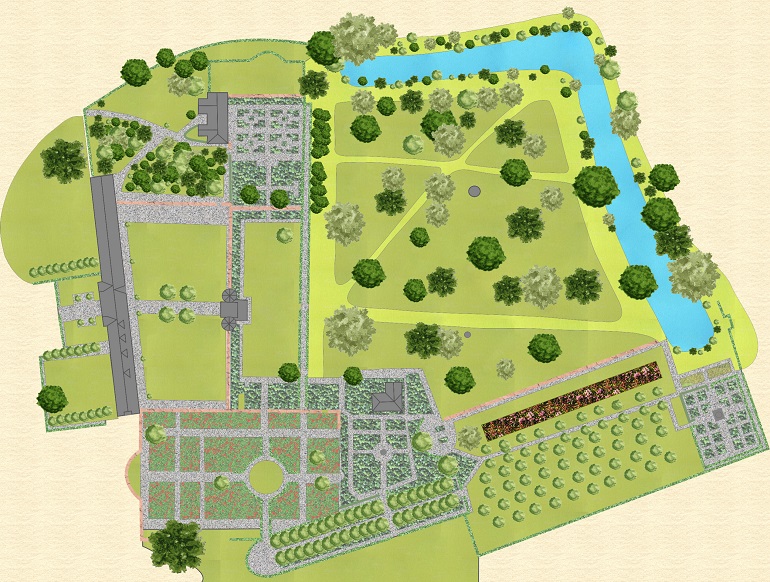
The Delos Garden: Mediterranean Dreams
Inspired by Vita Sackville-West's travels to the Greek island of Delos, this sun-baked garden room sits beyond the Moat Walk like a Mediterranean mirage transported to the English countryside. Created to house plants that revel in heat and drought, it presents a completely different aesthetic from Sissinghurst's lusher gardens.
The planting palette draws from the Mediterranean garrigue: great spurge (Euphorbia characias) creates architectural statements with its blue-green foliage and lime-yellow flower heads, whilst various lavenders contribute their silver foliage and purple spikes. Rosemary grows in sculptural mounds, its needle leaves glinting in bright sunlight, and cistus species provide papery flowers in white and pink that seem almost too delicate for their harsh growing conditions.
The hardscaping echoes Mediterranean landscapes: gravel paths wind between sun-bleached rocks and weathered stone, creating a sense of ancient ruined gardens. Self-sowing plants like nigella and calendula pop up in unexpected places, their bright colours seeming all the more intense against the predominantly silver and grey foliage.
This garden demonstrates Sissinghurst's international influences whilst proving that English gardens need not be exclusively green and leafy. The bright yellows and silvers echo the Greek isles whilst the scents—resinous, herbal, and warming—transport visitors to hillsides overlooking the Aegean.
Yew Walk and Azalea Bank: Dark and Light
The Yew Walk presents one of Sissinghurst's most dramatic contrasts: a long, narrow corridor flanked by towering yews that have grown together overhead to form a living tunnel. This dark passage, cool even on the hottest summer days, creates a sense of mystery and anticipation. The filtered light that penetrates the dense canopy creates ever-changing patterns on the path below, whilst the resinous scent of ancient yew provides an almost cathedral-like atmosphere.
This somber passage leads dramatically to the vibrant Azalea Bank, where the contrast could hardly be more striking. Here, in soil specially prepared for acid-loving plants, rhododendrons and azaleas erupt each spring in waves of pink, purple, orange, and white blooms. The display begins in early spring with small alpine rhododendrons, builds through the azalea season, and concludes with larger rhododendron species that provide architectural presence throughout the year.
The Azalea Bank demonstrates sophisticated woodland gardening, with careful attention paid to providing the right growing conditions whilst creating naturalistic drifts of colour. Beneath the flowering shrubs, carpets of spring bulbs—bluebells, wood anemones, and wild garlic—create additional layers of interest, whilst the scent of damp earth mingles with the resinous perfume of yew from the adjoining walk.
The Orchard, Moat Walk and Estate Views
The Moat Walk provides one of Sissinghurst's most contemplative experiences, skirting a still rectangular pool that perfectly reflects the towering hedges and sky above. This water feature, thought to be a remnant of the original Tudor house's defensive moat, creates liquid tranquility and serves as a mirror for the surrounding garden architecture.
The reflections double the visual impact of plantings and structures, whilst the still water provides habitat for dragonflies, water beetles, and occasional visiting herons. Along the walk's edges, moisture-loving plants thrive: astilbes with their feathery plumes, hostas contributing architectural foliage, and various ferns that appreciate the humid microclimate.
Adjacent to the Moat Walk, the Orchard opens onto wider estate views and provides a transition from intensive garden to agricultural landscape. Here, heritage fruit trees grow in neat rows—apples, pears, plums, and cherries that provide blossom in spring, fruit in autumn, and architectural interest throughout winter. Beneath the trees, managed meadow areas burst with wild flowers: ox-eye daisies, field scabious, and various native orchids create natural tapestries that complement rather than compete with the more formal garden rooms.
The Orchard demonstrates Sissinghurst's connection to its agricultural heritage whilst providing breathing space and longer views that prevent the intensive garden rooms from feeling claustrophobic.
Getting There
By train, take a direct service from London Charing Cross, Victoria, or London Bridge to Staplehurst station in Kent, which takes approximately 50-59 minutes, then pre-book a taxi for the remaining 5-mile journey to the garden.
By coach, catch the Arriva service 5 from Maidstone to Hawkhurst (which passes Staplehurst station) and alight at Sissinghurst village, from where it's a 1¼-mile walk past the church following the footpath signposted to Sissinghurst Castle.
By car, Sissinghurst Castle Garden is located 2 miles north-east of Cranbrook and 1 mile east of Sissinghurst village on Biddenden Road, off the A262 - follow the National Trust brown signs and look out for black signs before the turning, with on-site parking available for visitors.
Best Time to Visit
To truly capture the essence of Sissinghurst Castle Garden, the prime time for a visit is from late spring through to early autumn. May and June are particularly spectacular, offering the famously romantic and abundant floral displays that Vita Sackville-West envisioned. During this period, the world-renowned White Garden is at its peak, with a stunning succession of white and grey foliage, while the Rose Garden is a breathtaking riot of colour and scent. As summer progresses, the South Cottage Garden bursts into a vibrant tapestry of hot colours, with reds, oranges, and yellows creating a dazzling display that continues well into September. An early autumn visit also has its own charm, with the low light casting a magical glow over the mellowing colours and structural beauty of the yew hedges. To avoid the biggest crowds, consider a weekday visit.