


 Ireland Guide
 Scotland Guide
 Wales Guide
| Contents |
|---|

Introduction
Ancestral home of the Throckmorton family since 1409, Coughton Court is one of the best example of Tudor stately home in England, with a remarkable collections of furniture, porcelain and family portraits.
The present stately home was built in 1530. The gardens are a late addition from 1991 and grew to become some of the finest in England. There is a bog garden, vegetable garden, orchard and a riverside walk, but what has made Coughton Court's reputation is its walled garden and its rose labyrinth.
The Throckmortons were partly involved in the Gunpowder Plot of 1605, in which a group of Catholic extremists led by Guy Fawkes attempted to kill King James I, his family, and most of the Anglican aristocracy by blowing up the Houses of Parliament during the State Opening. The plot was discovered only hours before the planned execution.
Visitors can learn more about the details the Gunpowder Plot and its association with the Throckmortons at the exhibition at Coughton Court.
Still unhappy of the Anglican dominance in the 19th century, the Throckmortons became leaders in Catholic emancipation, which aimed at reducing and removing many of the restrictions on Roman Catholics.
Interesting Facts about Coughton Court
- Twenty-one generations of the Throckmorton family have lived at Coughton Court since 1409, when they inherited part of the estate by marriage.
- The house's sixteenth-century priest's hole was only rediscovered in the Tower Room in 1858, and when fully opened in 1910, it still contained a rope ladder, a small tapestry, bedding, and a folding leather altar.
- Katherine Vaux, who married Sir George Throckmorton in the early sixteenth century, had an extraordinary 19 children and 112 grandchildren.
- Seven out of the thirteen Gunpowder Plot conspirators were either Throckmorton descendants or married to members of the Throckmorton family.
- The magnificent Tudor gatehouse was built from stones taken from Bordesley Abbey and Evesham Abbey after the Dissolution of the Monasteries Act in 1536.
- When Coughton Court was handed over to the National Trust in 1946, the family negotiated a 300-year lease for themselves—the longest in National Trust history.
- Katherine Vaux was the aunt of Katherine Parr, Henry VIII's sixth and final wife.
- Parliamentary soldiers burnt down the east wing of the house in 1651 during the English Civil War, along with many of the Throckmorton family papers.
- The Tudor mansion was once surrounded by a moat, with bridge access to the separate kitchen range.
- The priest hole consists of two secret spaces, one above the other, designed so that if anyone discovered the first empty compartment, they were unlikely to find the second compartment below where the priest would be hiding.
- Sir George Throckmorton was imprisoned for his vocal opposition to King Henry VIII's marriage to Anne Boleyn.
- The house is a Grade I listed building and one of the most architecturally ambitious structures to survive in England from the early 16th century.
- The courtyard was originally enclosed on all four sides until 1780, when the east range opposite the gatehouse was demolished.
- The house has recently undergone a £3.3 million large-scale building conservation project that continued until 2025.
- Coughton Court contains two carved alabaster slabs from the 15th century—one showing the Nativity and another depicting the head of St John the Baptist—which were likely hidden during the Reformation.
History
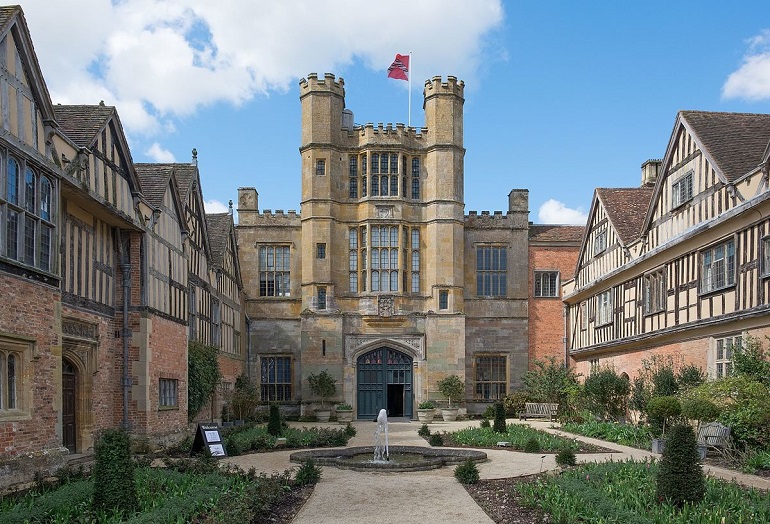
Coughton Court stands as one of England's most enduring family homes, having been owned by the Throckmorton family for over six centuries since 1409. The estate was acquired through marriage to the De Spinney family by John de Throckmorton, Under Treasurer of England to Henry VI. Evidence suggests a house has occupied this site since the 14th century, though the present building was begun in the 15th century. Twenty-one generations of Throckmortons have called Coughton home, making it one of the longest continuous family ownerships in English history. The magnificent Tudor gatehouse, the building's most striking feature, was constructed around 1536 using stones salvaged from Bordesley Abbey and Evesham Abbey following the Dissolution of the Monasteries. Sir George Throckmorton dedicated this impressive battlemented gatehouse to King Henry VIII, though he would later fall from favour due to his opposition to the King's divorce from Catherine of Aragon and his stance against the English Reformation.

The house's Catholic heritage profoundly shaped its tumultuous history throughout the centuries of religious persecution in England. As devout Catholics, the Throckmortons faced considerable hardship, including heavy fines for recusancy (refusing to attend Anglican church services) which restricted their ability to undertake major rebuilding work. Coughton Court contains priest holes, secret chambers used to hide Catholic clergy during periods when practising the faith was illegal. The family became entangled in two major conspiracies: the Throckmorton Plot of 1583 to murder Queen Elizabeth I, and more significantly, the Gunpowder Plot of 1605. During the latter, some of the conspirators rode directly to Coughton after the plot's discovery, and Sir Everard Digby's wife was staying at the house along with Jesuit priests. Remarkably, the Throckmortons managed to escape with their lives and retain their property despite these dangerous associations.
The Civil War brought further trials as the Royalist-supporting Throckmortons saw their home captured and plundered by Parliamentary forces. In 1688, an angry Protestant mob destroyed the Catholic chapel in the east wing, which was never rebuilt. Following the Roman Catholic Relief Act of 1829, the family's fortunes improved dramatically, allowing them to undertake extensive building works and remodel portions of the house. Today, Coughton Court houses an extraordinary collection of Catholic treasures, including a cope believed to have been embroidered by Catherine of Aragon and the chemise reputedly worn by Mary, Queen of Scots to her execution. The estate was transferred to the National Trust in 1946 under a remarkable 300-year hereditary lease, allowing the Throckmorton family to continue living in their ancestral home whilst opening it to the public.
Description
Coughton Court presents as a striking Tudor mansion, a formidable statement in grey stone whose crenellated gatehouse and half-timbered courtyard proclaim its architectural pedigree the moment you arrive. The double-storey Gatehouse, flanked by imposing hexagonal turrets, is a masterpiece of Tudor design, adorned with intricate oriel windows that catch the light. It leads into a tranquil, three-sided courtyard framed by the contrasting black-and-white Elizabethan timbering of the domestic wings. Beyond the architectural core, broad, neatly clipped lawns extend across gently rolling parkland, punctuated by ancient, venerable trees and the glimpsed, shimmering ribbons of the River Arrow.
The Formal Gardens
The formal gardens unfold in a sequence of discoveries and ordered elegance. A celebrated rose labyrinth, fashioned with tall, clipped yew pillars and classical wooden obelisks, is an immersive experience of scent and colour. It is home to over 200 varieties of climbing, shrub, and rambling roses whose fragrances drift through the warm air. On the main lawn, sunken circular parterres provide intimate, sheltered spaces for repose, while long, deep herbaceous borders burst with seasonal blooms in carefully orchestrated colour palettes. Gravel paths meander through these vibrant beds, leading the eye past riots of buddleias, clematis, and rambling roses that are artfully draped over classic wrought-iron arches and pergolas.
The Walled Gardens
Walled within sturdy brick and weathered stone, the knot and kitchen gardens offer a delightful blend of symmetry and productivity. Intricate box hedges create geometric patterns that encircle tinkling fountains, while nearby beds of aromatic herbs like lavender and rosemary give way to neat allotments of vegetables and flowers destined for the house’s arrangements. A short walk away, a specially created bog garden thrives on moisture, its collection of lush, exotic foliage, ferns, and giant gunnera creating a primeval atmosphere. Its tranquil pond, rich with aquatic plants, serves as a haven for wildlife.
Woodland and Lakeside Walks
Alongside the house, a network of woodland walks winds beneath mature canopies of oak and beech. In spring, these woods are transformed by carpets of native bluebells. At any time of year, patient observers may spot kingfishers darting like jewels along the riverbank or herons stalking silently through the reeds. A serene lake perfectly reflects the mansion’s latticed windows and the distant spire of the parish church, inviting quiet contemplation from a timber summerhouse perched at its edge.
Inside the Mansion
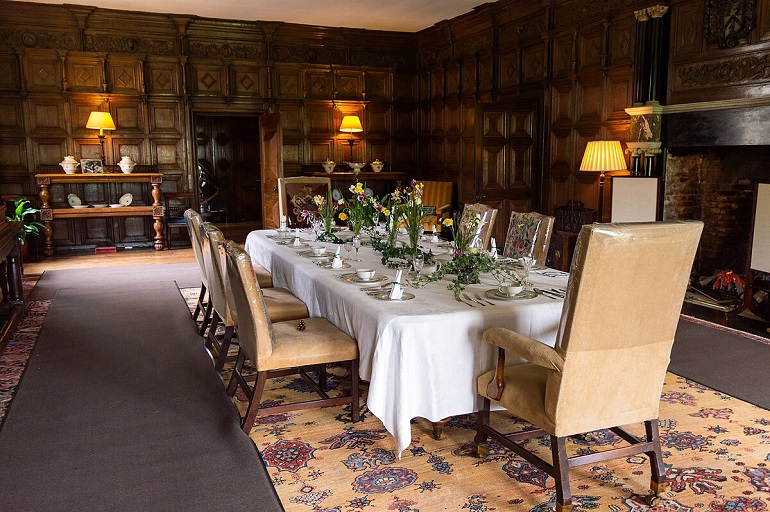
Inside, the house is an atmospheric interplay of light, shadow, and timber. The Front Hall, ingeniously converted from the original gate passage, now dazzles with a magnificent fan-vaulted plaster ceiling and stone-effect walls that lend it a sense of grandeur. Beyond, a series of interconnected state rooms reveals fine Jacobean panelling, deep-set mullioned windows that frame garden views, and richly polished oak floors that gleam with age. The Dining Room is particularly notable for its display of family silver and porcelain, set as if for a grand dinner. In the Saloon, fine furniture and intricate tapestries create a formal yet welcoming space.
Portraits of the Throckmorton family line the main staircase walls, their poised gazes guiding the eye upward through generations of ancestors. The upper chambers are furnished with sumptuous brocades, elaborately carved four-poster beds, and gleaming porcelain vignettes, evoking an atmosphere of lived-in, aristocratic grace. Throughout the interiors, discrete glimpses of secretive chambers and hidden passages—remnants of a clandestine past—add an air of compelling mystery. Soft daylight filters through leaded window panes, casting shifting patterns on tapestries and heraldic carpets, animating the silent rooms.
Getting There
Coughton Court, located on the A435 in Warwickshire, can be reached by several transport methods.
By train, the nearest station is Redditch, approximately 6 miles away, from which you'll need to continue by bus or taxi to reach the historic house.
By coach, Coughton Court is conveniently served by the Stagecoach No. X19 bus route, which runs hourly between Stratford-upon-Avon and Redditch, with a bus stop directly opposite the Court. The journey takes roughly 35 minutes from Stratford-upon-Avon and 20 minutes from Redditch. Additionally, the Diamond No. 247 service operates from Evesham, though less frequently.
By car, the Court is easily accessible via the A435, situated 2 miles north of Alcester, with the main entrance drive located directly off this major road. Follow the brown tourist signs to find the car entrance, and use postcode B49 5JA for satellite navigation.
Best Time to Visit
The optimal time to visit Coughton Court is during the late spring and summer months, from May through to July. During this period, the estate’s celebrated gardens are at their most spectacular, with the award-winning rose labyrinth reaching its peak in late June and July. The weather is typically warm and sunny, ideal for strolling through the grounds and appreciating the vibrant herbaceous borders. It is advisable to check the opening times on the National Trust website before your visit, as the house is open from Wednesday to Sunday and subject to occasional closures for private events. Bear in mind that the property is undergoing significant refurbishment until 2026, which may affect some areas.