


 Ireland Guide
 Scotland Guide
 Wales Guide
| Contents |
|---|

Introduction
Lavenham is a picturesque medieval village located in the county of Suffolk, England, approximately five miles northeast of Sudbury. Renowned as one of England's finest examples of a medieval settlement, the village boasts over 300 listed timber-framed buildings dating primarily from the 15th century, which have been remarkably preserved due to the area's economic decline following the collapse of its prosperous wool trade. During the Tudor period, Lavenham was among the wealthiest towns in England, ranking as the fourteenth richest by 1524, with its fame built on the production and export of high-quality blue broadcloth that was traded as far afield as Russia and Egypt. Today, with a population of approximately 1,925 residents as of the 2021 census, the village serves as a living museum of medieval architecture, featuring notable landmarks including the impressive Guildhall of Corpus Christi (built in 1529), the towering Church of St Peter and St Paul with its 141-foot spire, and the iconic crooked timber-framed houses that line its narrow streets and market square, making it a popular destination for visitors seeking to experience authentic medieval English heritage.
Interesting Facts about Lavenham
- Lavenham possesses more than 320 listed buildings, including the village’s red telephone box.
- In the 16th century it ranked as the 14th-wealthiest town in England, paying more tax than the far larger cities of York and Lincoln.
- The village’s prosperity was built on its famed “Lavenham blue” broadcloth, a luxury woollen cloth exported across Europe and as far as Russia.
- St Peter and St Paul’s parish church sports a 138-foot tower, reputedly the tallest church tower of any village in Britain.
- Jane Taylor, author of the beloved nursery rhyme “Twinkle, Twinkle, Little Star”, once lived and wrote in Lavenham.
- John Lennon and Yoko Ono chose the snow-covered Market Place as the setting for their 1969 avant-garde film Apotheosis.
- In modern times the village buried its overhead electric cables to maintain the uninterrupted Tudor streetscape.
- Lavenham’s timber-framed houses doubled as Godric’s Hollow in Harry Potter and the Deathly Hallows, adding wizarding fame to its medieval charm.
- The timber-framed Guildhall of Corpus Christi, completed around 1520, now serves as a museum telling the story of the wool trade and village life.
- During the Second World War, nearby RAF Lavenham hosted the USAAF; its first station commander, Beirne Lay Jr., later co-wrote the classic film Twelve O’Clock High.
History
Early Origins and Saxon Roots
The settlement of Lavenham can trace its beginnings to the early Saxon period, when two thegns, Ulwin (or Wulwine) and another local landholder, controlled estates recorded in the Domesday Book of 1086. These Saxon halls, referred to as Overhall and Netherhall, were seized after the Norman Conquest and granted to Aubrey de Vere I, ancestor of the Earls of Oxford. Under the de Vere family’s stewardship, a vineyard was planted, and the manorial village gradually evolved into a marketplace after Henry III granted its market charter in 1257. This charter and the establishment of the wool trade attracted merchant clothiers to organise production in the surrounding countryside, setting the stage for Lavenham’s medieval prosperity.
The Medieval Wool Boom
During the 14th and 15th centuries, Lavenham rose to prominence as one of England’s wealthiest towns, thanks to its production of “Lavenham Blue” broadcloth. Encouraged by Edward III’s policies supporting English weaving, the town’s cloth exports reached as far as Russia. By 1524, Lavenham was the 14th richest settlement in the country, outpacing even much larger cities like York and Lincoln in tax contributions. Evidence of this affluence remains visible in the grand timber-framed houses lining the High Street, the 141-foot tower of St Peter and St Paul’s Church (completed in 1525), and the Guildhall of Corpus Christi (built in 1529) where the local wool guild once met.
Decline and Preservation
The late 16th century saw Lavenham’s fortunes wane as cheaper and lighter cloth production in Colchester and imports from the Continent undercut its market. However, this economic downturn inadvertently preserved the town’s medieval character: without funds for major redevelopment, its timber-framed buildings, narrow lanes and historic marketplace remain largely unchanged. Today, Lavenham is celebrated as England’s best-preserved medieval village, with over 300 listed structures. Visitors can still experience its medieval layout, explore the Guildhall museum, admire the ornate church interior, and appreciate the village’s unique architectural heritage.
Main Attractions
Historic Streets and Timber-Framed Buildings
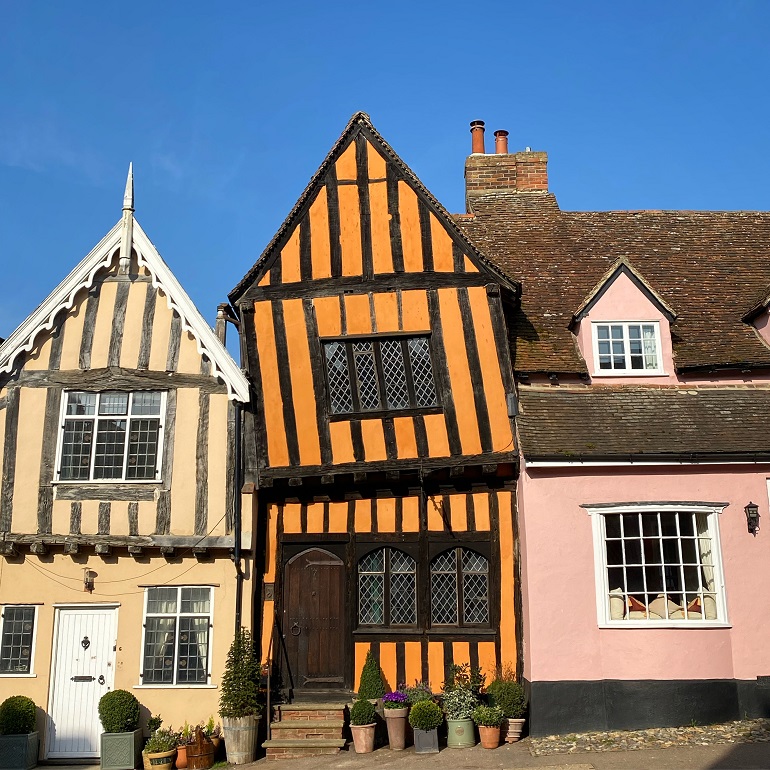
Lavenham is renowned for its remarkably well-preserved medieval streetscape, featuring over 300 listed timber-framed buildings that predominantly date from the late 15th and early 16th centuries. A walk through the village, particularly along High Street, Water Street, and Lady Street, reveals the architectural heritage of its prosperous past. Among these structures, the Crooked House on High Street stands out as an iconic dwelling, famed for its pronounced lean. It is one of the most photographed buildings in the country and is popularly associated with the nursery rhyme “There was a Crooked Man”.

The Church of St Peter and St Paul
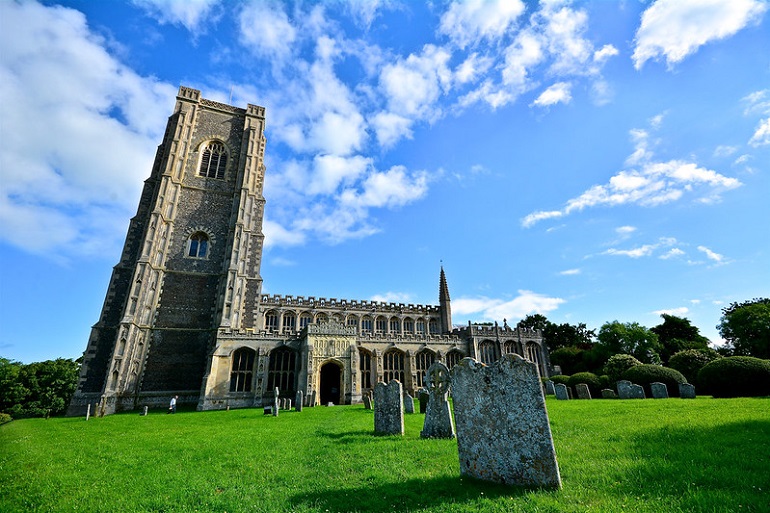
The Church of St Peter and St Paul is considered one of Suffolk's most significant parish churches and a prime example of Perpendicular Gothic architecture. Constructed mainly between 1485 and 1525 with wealth from the medieval wool trade, its impressive 141-foot tower dominates the local skyline. Inside, visitors can observe intricate woodwork, a rare late-medieval font cover, and finely carved misericords. The church is typically open to visitors daily with free entry, though donations towards its upkeep are encouraged.
Lavenham Market Place
The Market Place has long been the heart of village life and continues to serve as a community hub. It hosts a popular farmers’ market on the fourth Sunday of each month, where visitors can purchase fresh local produce, artisan foods, and various regional crafts. This historic square is framed by important buildings, including the stone Market Cross and several ancient guildhalls that testify to Lavenham's commercial history.
Guided and Self-Guided Walks
Visitors can explore Lavenham's history and architecture through organised walking tours, which are available from the Swan Hotel. These tours typically run on Wednesdays, with additional walks scheduled for weekends between April and October, covering local folklore and historical details. For those preferring to explore at their own pace, several self-guided routes are available. A notable option is the Lavenham Woodland Walk, a 2.8-mile trail that begins at the Guildhall, passes the parish church, and follows a section of a disused railway line through the surrounding countryside.
Local Food and Drink
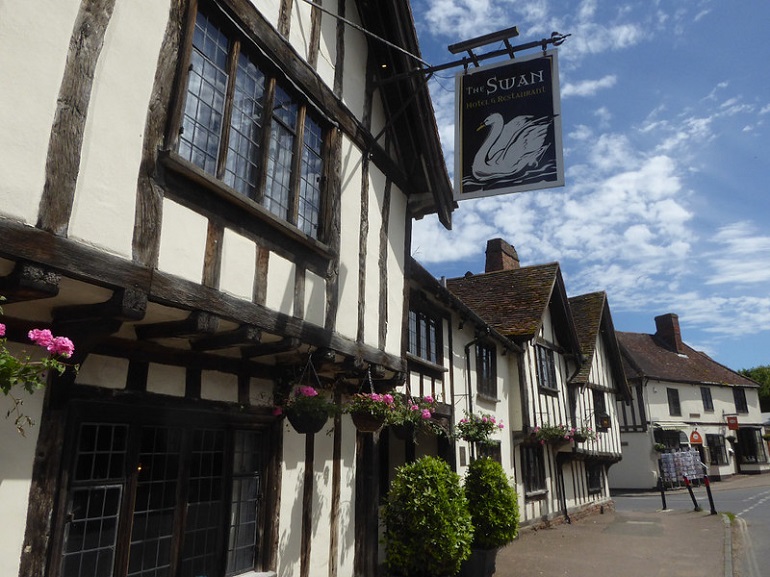
Lavenham offers a variety of dining experiences within its historic settings. The village is home to several medieval pubs, traditional tea rooms, and restaurants. Notable establishments include The Swan at Lavenham, which is popular for afternoon tea, as well as The Greyhound and The Great House, both known for their food. For lighter refreshments, cafes such as the Lavenham Blue Vintage Tearooms in the Market Place and The Nook on Church Street provide locally made cakes, scones, and other treats.
Art Galleries and Independent Shops
The village supports a vibrant community of artists and independent retailers. Along Merchants’ Row and other historic streets, numerous boutique shops sell a range of goods, including antiques, local crafts, textiles, and art. Lavenham also has several art galleries and hosts occasional pop-up exhibitions that showcase the work of local artists and craftspeople, making it a destination for those interested in unique, locally-made products.
Lavenham Falconry
Situated in wildflower meadows near the village, Lavenham Falconry provides hands-on experiences with birds of prey. Visitors can participate in sessions that involve handling and flying various birds. In addition to falconry, the centre offers other outdoor activities, such as archery and survival skills workshops, providing a different kind of attraction away from the village's historical centre.
Top Museums
Little Hall Museum
Little Hall stands as Lavenham's most intimate and engaging museum experience, occupying one of the village's oldest timber-framed buildings on the Market Place. Built in the 1390s for the Causton family of clothiers, this late 14th-century hall house perfectly mirrors the changing fortunes of Lavenham itself.
The museum's seven rooms tell a compelling story of architectural evolution and human habitation. Originally constructed as a traditional hall house with a central hearth open to the rafters, the building underwent significant modifications during Tudor times when a fireplace and upper floor were added, and all windows were glazed. By the 17th century, declining wool trade fortunes led to the house being divided into small cottages housing six families.
The building's transformation into a museum began in the 1920s when the Gayer-Anderson twin brothers, both soldiers with distinguished military careers and passionate collectors, rescued Little Hall from decay. Robert Gayer-Anderson, who became an Egyptologist of such distinction that King Farouk of Egypt granted him the honorary title of 'Pasha', filled the house with an eclectic collection of art objects, antiques, pictures, books, china, and decorative art gathered during their extensive travels.
Visitors can explore treasures including exotic Persian panels in the study and the spectacular upstairs chamber dominated by its striking crown-post supporting the roof timbers. The museum retains the intimate atmosphere of a family home from the mid-20th century, with many of the brothers' personal possessions remaining exactly as they left them. A bronze replica of the famous Gayer-Anderson cat from the British Museum, representing the Egyptian goddess Bastet, provides a tangible connection to Robert's Egyptological work.
The museum's beautiful gardens combine a knot garden planted along Tudor lines with a traditional English walled garden, offering visitors a peaceful retreat that reflects the domestic life of centuries past.
Lavenham Guildhall
The Guildhall of Corpus Christi, managed by the National Trust, represents one of England's finest timber-framed buildings and serves as the village's premier historical attraction. Built around 1530 by the Guild of Corpus Christi, this magnificent structure was funded by the extraordinary wealth generated from Lavenham's famous blue cloth trade.
The building's remarkable history encompasses multiple incarnations that reflect the changing needs of the community. Originally constructed as a religious meeting place for wealthy Catholic merchants, the Guildhall later served as a bridewell (prison) from 1689, then as a workhouse from 1787. During the Second World War, it provided social facilities for American troops stationed at nearby RAF Lavenham and functioned as a British Restaurant.
The museum's interpretation presents a journey through more than five centuries of history, told through the experiences of people who lived and worked within its walls. Visitors encounter compelling stories including that of young Anne Baker, imprisoned at age eight and later sentenced to seven years' transportation to Australia for being 'an incorrigible rogue'. The exhibits also feature the intriguing medicinal recipes of Widow Snell, who ran the 18th-century workhouse and created treatments that included adding twenty live woodlice to cough mixture.
The building houses displays on the evolution from prosperous cloth trade to workhouse operations, alongside memorabilia from Lavenham railway station, which served the Long Melford–Bury St Edmunds branch line until 1961. Visitors can explore the Courtyard Garden with its beds of dye plants, including woad used to create Lavenham's famous blue cloth since medieval times.
The museum's 'Lavenham in the 16th Century' exhibition, created by local volunteers, celebrates the 500-year anniversary of St Peter and St Paul's Church completion whilst examining how the village's dramatic change in fortune left behind an incredible legacy of more than 300 listed buildings.
War Heritage and Memorial Sites
Although not formal museums, Lavenham's wartime heritage provides additional historical context through various memorial sites commemorating the village's Second World War connections. The former RAF Lavenham (Station 137) operated from March 1944 through August 1945, serving as home to the 487th Bombardment Group of the US Army Air Force.
Memorial plaques in the Market Square and within St Peter and St Paul Church honour the 233 American servicemen who lost their lives whilst stationed at Lavenham. These memorials, whilst not museums in the traditional sense, serve as important historical markers connecting visitors to the village's wartime experiences and the international relationships forged during this period.
Local Cuisine
Eateries housed in centuries-old, timber-framed buildings offer everything from classic pub fare to fine dining. Visitors can indulge in time-honoured British traditions such as a classic afternoon tea complete with warm scones and clotted cream, or a hearty Sunday lunch featuring roast beef with all the trimmings, including a fluffy Yorkshire pudding. Many establishments pride themselves on farm-to-table dining, showcasing the best of Suffolk's produce. Local specialities to look out for include dishes made with famed Suffolk pork, freshly caught lemon sole, and seasonal game like pheasant breast. For a more casual meal, you can't go wrong with traditional fish and chips from a local inn, often enjoyed with a locally brewed ale or cider.
Getting There
By train, the most convenient route to Lavenham is to take Greater Anglia services from London Liverpool Street to either Sudbury or Marks Tey (approximately 50-54 minutes), then connect to the local 753 bus service which runs to Lavenham village centre. Alternatively, trains run from London to Colchester, followed by a connection to Sudbury, with the final leg completed by bus. By coach, National Express operates services from London Victoria Coach Station to nearby interchange points, though multiple connections are required including local bus services to reach Lavenham itself. The most straightforward coach option involves travelling to Sudbury or Bury St Edmunds, then taking the 753 bus service operated by Hedingham and Chambers. By car, Lavenham is easily accessible via the M11 motorway, situated approximately 77 miles from London with a driving time of around 1 hour 42 minutes. The village offers free roadside parking throughout the town centre, as well as several car parks including facilities with electric charging points at locations such as The Cock Horse Inn and Lavenham Gas Works.