


 Ireland Guide
 Scotland Guide
 Wales Guide
| Contents |
|---|
Introduction
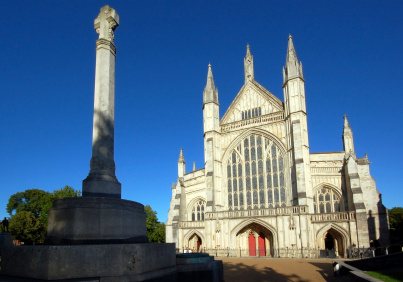
Winchester (pop. 127,000) is the attractive county town of Hampshire and one time capital of England. Founded by the Romans as Venta Belgarum, Winchester served as the seat of Anglo-Saxon kings and remained England's capital until the Norman Conquest, when power shifted to London. Winchester Cathedral, founded in the 7th century, is one of the longest and historically most important medieval cathedrals in Europe. It houses the mortal remains of numerous English monarchs and literary figures, including Jane Austen. Winchester College, one of England's oldest and most prestigious public schools founded in 1382, claims "the longest unbroken history of any school in England".
The city maintains its educational heritage whilst offering visitors a wealth of attractions including the Great Hall with its legendary Round Table, the ruins of Wolvesey Castle, and charming medieval streets lined with independent shops and traditional pubs. Located in the South Downs National Park, Winchester provides an ideal base for exploring the Hampshire countryside whilst being easily accessible from London, making it a perfect destination for those seeking to experience England's rich historical tapestry.
Interesting Facts about Winchester
- Winchester was the first capital of England and remained an extremely important city until the Norman conquest.
- Winchester Cathedral is one of the largest cathedrals in Europe, boasting the greatest length of any Gothic cathedral in Europe at 556 feet.
- Winchester College, founded in 1394 by William of Wykeham, proudly holds the longest continuous history of any school in England.
- The city's old mill is the country's oldest working watermill, steeped in over a thousand years of history.
- Jane Austen spent the last few weeks of her life in Winchester and is buried in Winchester Cathedral.
- In March 2016, Winchester was named 'The Best Place to Live' by the Sunday Times.
- Winchester hosts one of the UK's largest farmers' markets on the last Sunday of every month, featuring over 100 different stalls.
- Winchester became home to the first public library in the UK in 1850.
- The first settlers in Winchester arrived during the Iron Age, over 2000 years ago.
- Winchester's Great Hall is considered one of the finest surviving great halls of the 13th century.
- Academy Award winner Colin Firth is from Winchester and was educated at Montgomery of Alamein School (now Kings' School).
- Winchester holds the annual 'Hat Fair' in July, which is the UK's longest running festival for street theatre, running since 1974.
- The beautiful countryside between Winchester and Newbury inspired Richard Adams' best-selling book Watership Down.
- King Alfred the Great rebuilt Winchester with streets laid out in a grid pattern to provide better defence against the Vikings.
- In the 13th century, Winchester contained one of the most important Jewish communities in England, commemorated today in the street name Jewry.
History
Winchester was settled since the Iron Age. The Romans founded the city as Venta Belgarum (named after the Belgic tribes that occupied the region), which went to become the fifth largest city in Roman Britain.
Winchester acted as the capital of Wessex since 590, but really got a kickstart when the episcopal see of Wessex was moved there from Dorchester in 670.
In 827, King Alfred the Great kept Winchester as the capital of the newly unified England, which it remained until soon after the Norman conquest, two and a half centuries later (note that William the Conqueror was crowned both in London and in Winchester).
It was the monks of Winchester that William I commissioned in 1086 to write his famous Domesday Book (sometimes called the 'Book of Winchester'), a survey listing the owners of all lands and properties in England.
A fire ravaged the city in 1141, and it fell behind London in importance. That didn't prevent Bishop William of Wykeham (1320-1404) to establish Winchester College in 1382 and to start the construction of the present cathedral in 1394.
Not much happened in Winchester afterwards, except that the city was the starting point of the "Pilgrims' Way" leading to the shrine of Thomas Becket in Canterbury. Novelist Jane Austen died in Winchester in 1817 and was interred in the cathedral.

|
|
|
Main Attractions
Winchester Cathedral
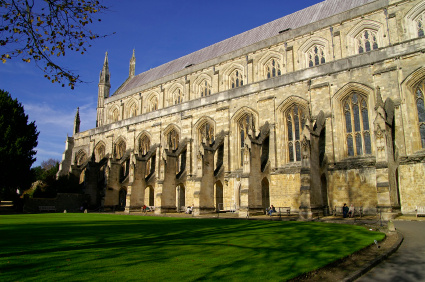
Winchester Cathedral was first built by King Cenwalh in 642 CE and was the largest church in the country. It was replaced in 1070 by a 164-metre long Romanesque structure. In 1107, just 14 years after its completion, the central tower collapse due to marshy grounds.
Restoration work took place from the 13th to 15th century, including the transformation of the nave into the Gothic style by William of Wykeham.
The cathedral saw the coronations of Edward the Confessor (1043), of Matilda of Flanders as queen consort (1068), of Henry the Young King and his queen, Marguerite (1172) and the second coronation of Richard I of England (1194), as well as the marriages of Edward the Confessor and Edith (1045), King Henry IV and Joanna of Navarre (1403) and finally Queen Mary I and King Philip II of Spain (1554).
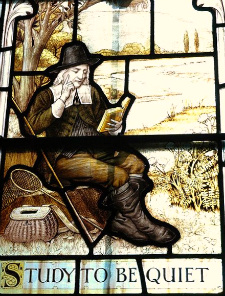
King William II (son of William the Conqueror), Izaac Walton and Jane Austen are all buried within the precincts.
Winchester College
Founded in 1382 by William of Wykeham to educate "seventy poor and needy scholars", Winchester College was the first exclusive public school (see Eton) in Britain, and now one of the most prestigious.
On weekdays between April and September, there are guided tours starting from Porter's Lodge in College Street. Tours start at 10:45 am, 12 noon, 2:15 pm and 3:30 pm.
Also in College Street are Jane Austen's house (at No 8), where she moved 6 months before succumbing to Addison's Disease, and Kings Gate, one of the city's 13th-century gateway.
Wolvesey Castle (Old Bishop's Palace)
Built around 1100 as a residence for the Bishops of Winchester, Wolvesey Castle was fortified during the war between Queen Matilda and King Stephen (1135-48).
Queen Mary of England and Philip II of Spain had their weding breakfast here in 1554. The castle was torn down in 1680 and the stones used to built a new Baroque-style bishop's palace.
Hospital of St Cross
1.5km south of the College down Kingsgate, then St Cross Road, the hospital was founded . in 1132 by Henry of Blois, grandson of William the Conqueror. It was extended in 1446 by Cardinal Beaufort, who created a second order of almsmen, the `Noble Order of Poverty´.
As its name ("St Cross") indicate, its purpose was not only to treat the ill and feed the poor, but also to give hospitality to the crusaders on their way to the Holy Land. It is still home to 25 brothers nowadays, who will be happy to serve the needy a small portion of bread and beer.
Great Hall
Situated at the crossing of Romsey Road and Upper High Street, the Great Hall is all that remains of Winchester Castle. The castle claims Saxon origins, but the hall that can be seen today is that of the castle built by Henry III in 1222-36, and destroyed by Oliver Cromwell.
The Great Hall first served as a royal residence, the as legal and administrative building. Sir Walter Raleigh was tried and sentenced to death here in 1603. The hall was used again as a court of justice from 1938 to 1974.
Tourists come to see the so-called Round Table of King Arthur (5.5m of diametre). It is of course not the real one, but an imitation made for King Edward I (1272-1307).
River Itchen and Its Walks
The River Itchen flows through Winchester, creating scenic walking paths that offer both urban and rural views throughout the city. Designated as a Site of Special Scientific Interest, the river supports diverse wildlife including otters and water voles, making it an important ecological corridor. Walking routes extend alongside the ancient city walls and past numerous historic sites, providing an excellent way to explore Winchester's heritage whilst enjoying natural surroundings. The river walks connect many of the city's attractions, offering visitors a pleasant means of transportation between sites whilst experiencing the landscape that has shaped Winchester's development for over a millennium.
Abbey Gardens and Abbey House
Abbey Gardens provide a peaceful public space located next to the King Alfred statue and situated on the site of the medieval Nunnaminster, also known as St Mary's Abbey. The gardens feature formal flower beds, a rose garden, children's play area, and the specially designed Soroptimist Garden of the Senses complete with a sundial. Abbey House, an elegant Georgian building constructed in 1751, stands within the gardens and serves as the Mayor's official residence. The combination of historic significance and contemporary recreational facilities makes this an ideal spot for relaxation whilst exploring Winchester's city centre.
King Alfred the Great Statue
The bronze statue of King Alfred the Great stands prominently at the eastern end of the High Street, having been unveiled in 1901 to commemorate this significant historical figure. King Alfred, the former ruler of Wessex, played a crucial role in English history, and the statue serves as a focal point for understanding Winchester's importance as an ancient capital. The statue's location makes it easily accessible to visitors exploring the city centre, whilst its historical significance provides context for Winchester's role in the formation of England as a unified kingdom.
St Catherine's Hill
St Catherine's Hill presents visitors with an ancient earthwork topped by a fascinating turf maze and commanding panoramic views over Winchester. The hill offers spectacular vistas of the city and the Itchen valley, making it a popular destination for photography and quiet contemplation. Walking routes from the city centre provide access to this elevated site, where the combination of archaeological interest and natural beauty creates a memorable experience. The turf maze adds an element of mystery and historical intrigue, representing traditions that stretch back centuries.
Queen Eleanor's Garden
Queen Eleanor's Garden offers visitors a carefully recreated medieval garden experience located alongside The Great Hall. The garden has been designed to reflect the period style and plant varieties that would have been familiar to Queen Eleanor of Provence during her time. This small but authentic space provides insight into medieval horticulture and garden design, demonstrating how outdoor spaces were used and enjoyed by medieval nobility. The garden's proximity to The Great Hall creates a comprehensive medieval experience for visitors interested in this period of English history.
Marwell Zoo
Located just outside Winchester's city centre, Marwell Zoo houses over 1,200 animals representing 135 species from around the world. The wildlife park has gained recognition for its conservation work and features themed animal areas designed to educate visitors about wildlife preservation. The zoo's family-friendly approach makes it suitable for visitors of all ages, whilst its commitment to conservation provides educational opportunities about global wildlife challenges. The park's location outside the city centre offers a different perspective on the Winchester area whilst maintaining easy accessibility for day trips.
Winchester Science Centre & Planetarium
The Winchester Science Centre & Planetarium, situated just outside the city centre, provides an interactive science and astronomy experience designed particularly for families. The centre features hands-on exhibits that encourage learning through exploration and experimentation, whilst the planetarium offers immersive astronomy experiences. This modern attraction complements Winchester's historic sites by providing contemporary educational entertainment, making it an excellent addition to any visit that includes younger family members or those with interests in science and technology.
Top Museums
Winchester City Museum
Situated in the heart of the historic city centre, the Winchester City Museum tells the story of England’s ancient capital. The museum spans three floors:
- Roman and Iron Age Origins: Explore the city’s beginnings as the Roman settlement Venta Belgarum, with displays of local mosaics, jewellery, and everyday objects.
- Anglo-Saxon and Medieval Winchester: Marvel at period artefacts, models showing the city’s growth, and fascinating medieval sculptures and coins.
- Victorian to Modern Times: The highlight is a remarkable scale model of Victorian Winchester, complemented by interactive exhibits and displays related to local figures such as Jane Austen.
Hands-on activities abound, allowing visitors to handle genuine archaeological finds or dress up as Romans and Saxons. The museum offers a vivid, family-friendly journey through over two millennia of Winchester’s history.
Westgate Museum
Housed in one of Winchester’s last remaining medieval gates, Westgate Museum is an atmospheric small site overlooking the city. The gateway itself, dating chiefly from the 12th to 14th centuries, has a storied past as the old western entrance to Winchester and even served as a debtor’s prison for 150 years.
- Exhibitions: Discover displays on the city’s medieval defences, including an extraordinary collection of pre-imperial weights and measures and a beautifully painted ceiling commissioned for Mary Tudor’s marriage in 1554.
- Interactive Experiences: Try on replica Tudor costumes, don a coat of armour, and make brass rubbings to take home.
A climb to the rooftop rewards visitors with spectacular views across the city, making the museum as much an experience as a lesson in history.
The Great Hall
This iconic medieval building is famed for its soaring arches and the legendary Round Table, long associated with King Arthur. Once the heart of Winchester Castle, The Great Hall immerses visitors in centuries of royal intrigue. As you explore its historic stone halls and serene Tudor gardens, you retrace the footsteps of kings, queens, and legendary heroes.
Winchester’s Military Museums
Located mainly in the Peninsula Barracks, Winchester is home to six military museums, each with its own focus:
The Rifleman’s Museum
A journey through the story of the rifle regiments, with uniforms, weapons, and personal stories.
The Gurkha Museum
Commemorates the history and bravery of the Gurkhas, including displays of traditional weaponry and uniforms.
HorsePower, The Museum of The King’s Royal Hussars
Highlights the history of cavalry, battle strategies, and heroic deeds.
Royal Hampshire Regiment Museum
Chronicles the history of the regiment from 1702 to 1992.
Adjutant General’s Corps Museum
Details the vital support role of this corps in the British Army.
Royal Logistic Corps Museum
Showcases how the army has been moved and supplied throughout history.
These museums offer extensive collections of medals, paintings, uniforms, artefacts, and films, bringing to life over 300 years of military history.
Winchester Science Centre & Planetarium
Ideal for families, the Winchester Science Centre is a modern, interactive museum focused on science and discovery. Spread across two floors, the centre features:
- Hands-on Exhibits: Explore the world of physics, biology, engineering, and space through engaging, interactive displays.
- Planetarium: The highlight is the impressive planetarium, the largest in the UK, offering immersive shows about the universe and our place in it.
Regular live science demonstrations and family-friendly activities make learning lively and fun.
The Arc – Galleries and Arts
Housed in the centre of Winchester, The Arc hosts a rotating programme of contemporary art exhibitions in The Gallery, as well as the more intimate City Space gallery. Exhibits span painting, sculpture, photography, and digital art, often with a focus on local artists and community heritage.
878 AD
A unique immersive attraction, 878 AD blends living history with actual artefacts and interactive technology to tell the story of King Alfred’s Winchester and the pivotal moments in the nation’s early history. Particularly appealing for families and school groups, it offers a fresh, innovative way to experience the past.
Beyond the City
Jane Austen’s House, Chawton
A short drive from Winchester, this charming cottage and museum celebrates the beloved author’s life, works, and inspirations, offering a tranquil garden and evocative household displays.
Local Cuisine
Winchester's culinary scene is deeply rooted in the bountiful produce of the Hampshire countryside. As you explore the city's eateries, from historic pubs to contemporary restaurants, you'll find menus celebrating local flavours. A must-try is the locally grown watercress, so integral to the area that it has its own festival and a steam train line named after it. The clear chalk streams of the Rivers Test and Itchen provide fresh trout, a true local delicacy. The region is also renowned for its high-quality meats, giving rise to traditional dishes like Hampshire Haslet, a simple pork loaf. For a taste of something more modern, seek out the inventive Winchester Roll, a unique sushi creation that substitutes seaweed with a locally grown wasabi leaf. The city's vibrant farmers' market, one of the largest in the country, offers an excellent opportunity to sample these specialities alongside award-winning local cheeses and English sparkling wines.
Getting There & Around
By train, there are regular direct services from London Waterloo taking approximately one hour, with additional direct connections from Oxford, Bournemouth, and Birmingham. The railway station is conveniently located just a 10-minute walk from the city centre.
By coach, National Express operates regular services from London Victoria Coach Station and Heathrow Airport, with coaches arriving at St Catherine's Park and Ride.
By car, Winchester is well-connected via the M3 motorway, which provides a quick route from London, and is also accessible via the A34.