


 Ireland Guide
 Scotland Guide
 Wales Guide
| Contents |
|---|
Introduction
Northampton (pop. 249,000) is the county town of Northamptonshire and serves as the administrative centre of West Northamptonshire, a unitary authority created in 2021. Northampton ranks among the largest settlements in the United Kingdom that has not achieved city status, following Reading and Dudley. The town boasts a rich history spanning nearly a millennium, from its Bronze Age origins through its significance as a medieval royal residence where Parliament once convened at Northampton Castle. Historically renowned as the heart of England's shoe and leather manufacturing industry since the Middle Ages, Northampton today combines its industrial heritage with modern amenities, featuring attractions such as 78 Derngate (the only house in England designed by Charles Rennie Mackintosh), the Royal & Derngate theatre complex, and numerous historic buildings including All Saints' Church and the medieval Church of the Holy Sepulchre.
Interesting Facts about Northampton
- Northampton is home to the tallest lift testing tower in the country, standing at an impressive 127.5 metres (418 feet) tall.
- The town was once the capital of England, serving as a crucial political centre during medieval times.
- Thirty-two Parliaments were held at the historic Northampton Castle, making it one of the most politically significant locations in medieval England.
- The Church of the Holy Sepulchre in Northampton is one of only four remaining round churches in England, built around 1100.
- During the First World War, Northampton's shoemakers supplied over two-thirds of the 70 million pairs of footwear required by the armed forces.
- The Great Fire of Northampton in 1675 destroyed much of the historic town, leading to extensive rebuilding that shaped its current appearance.
- Thomas Becket was famously tried at Northampton Castle in 1164, adding to the castle's significant historical importance.
- Northampton is one of the largest towns in England, with a population of 249,093 recorded in the 2021 census.
- The National Lift Tower is affectionately nicknamed both the "Northampton Lighthouse" and the "Cobblers' Needle" by locals.
- Comedian Alan Carr grew up in Northampton, and his father Graham Carr was both a player and manager for Northampton Town football club.
- Entertainer Des O'Connor was born in Northampton and briefly played professional football for the local club during the Second World War.
- The house at 78 Derngate represents Charles Rennie Mackintosh's only major domestic architectural work outside Scotland.
- Despite four attempts in 1992, 2000, 2002, and 2022, Northampton has unsuccessfully applied for city status each time.
- The Gunpowder Plot was hatched in Northamptonshire at Ashby St Ledgers, making the county central to one of England's most famous conspiracies.
- The world's first radar station was built at nearby Daventry, marking a significant technological milestone for the region.
History
Northampton's history goes back to Roman times, but didn't really develop as a significant town until the 11th century, when the Normans built town walls (razed in the 17th century) and a castle (also razed by Charles II, it was located where the railway station now stands).
In 13th century, it also had the largest Jewish population (centered around Gold Street), before 300 of them were executed in 1277 for clipping the King's coin.
In 1460, as the Wars of the Roses was raging, Henry VI was captured by the Yorkist at the the decisive Battle of Northampton.
The town burnt to the ground in 1675 and was re-built as a spacious and well-planned town. In the 18th century Northampton became a major centre of shoemaking and other leather-related goods. The prosperity of the town was greatly aided by demand for footwear caused by the Napoleonic Wars at the turn of the 19th century.
In 1801, Northampton was still a small town of barely 7,000 inhabitants. Its connection to the Grand Union Canal in 1815 and the coming of the Railways in the 1830s accelerated the town's growth, and in 1861, its population had boomed to 33,000.
Main Attractions
Northampton Guildhall
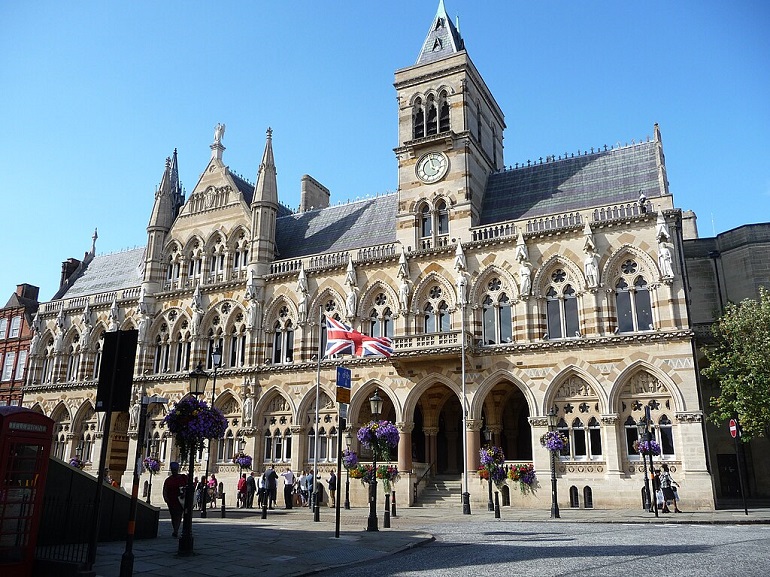
The prize for the nicest façade in town would go to the Guildhall. Its name and architectural style mistakenly hint at a medieval origin. However, this superb Neo-gothic edifice is actually Victorian. It was constructed between 1861 and 1864, and extended in the 1990's, the building features a highly decorated façade with statues of English monarchs and figures from local history. Originally built as a court room, it now houses the Northampton Borough Council. Inside, the Great Hall is noted for its ornate ceilings and large stained-glass windows that depict key events in the town's past. While it functions as a municipal building, its historic interiors are often open for public viewing and for events such as heritage open days.
The Holy Sepulchre
The Church of the Holy Sepulchre, founded in 1100 by Earl of Northampton, Simon de Senlis, who had just returned from the first crusade. It is the largest and best preserved of the country's only four round churches. Its distinctive round nave was built in the early 12th century by the first Earl of Northampton, Simon de Senlis, and is believed to have been inspired by the original Church of the Holy Sepulchre in Jerusalem. The church has been expanded over the centuries but retains its Norman core. As an active Anglican parish church, access is generally available during services and special open days.
St Peter's Church
The heavily buttressed St Peter's Church is the second oldest edifice in town, constructed in 1150, and restored in the 19th century. It is one of the most architecturally interesting Norman edifice in England. William Smith (1769-1839), the "Father of English Geology", is buried here.
Royal & Derngate Theatre
The Royal & Derngate is the principal performing arts venue in Northampton, comprising two distinct auditoriums within one complex. The Royal Theatre is an ornate Grade II listed Victorian theatre designed by renowned architect C.J. Phipps, which typically stages plays and smaller-scale productions. The Derngate is a larger, more modern multi-purpose concert hall that hosts West End musicals, comedy shows, live music, and orchestral concerts. The venue's diverse programming makes it a significant cultural hub for the town and the wider region.
Delapré Abbey
Set within 500 acres of public parkland, Delapré Abbey is a restored historic house with origins as a 12th-century Cluniac nunnery. Following the Dissolution of the Monasteries, it was converted into a private residence and has undergone significant architectural changes over the centuries. After an extensive restoration project, the Abbey now operates as a heritage attraction, offering insight into its varied history. Visitors can explore the main house, the walled garden, and the surrounding park, which includes a lake and woodland walks. The site also features a café and hosts a regular programme of events and exhibitions.
Abington Park
Abington Park is Northampton's oldest and most popular public park, located on the former grounds of a medieval village. Its landscape features two lakes, mature trees, and formal flower beds. The park is home to an aviary, a bandstand that hosts concerts in the summer, and the ruins of the original parish church. It serves as a central recreational space for the town, with facilities for sports, a café, and a popular children's playground.
The Racecourse
Known locally as The Racecourse, this expansive public park occupies the site of the former Northampton Racecourse, which closed in 1904. Its history is reflected in its vast, open green spaces and circular layout. Located close to the town centre, the park is a major venue for recreation, with numerous football pitches, tennis courts, and children's play areas. It is also the primary location for large-scale town events, including funfairs, circuses, and the annual Northampton Balloon Festival.
Northampton & Lamport Railway
The Northampton & Lamport Railway is a volunteer-run heritage railway that operates on a section of the former Northampton to Market Harborough line. Visitors can take train rides on restored steam and diesel locomotives from Pitsford and Brampton station. The line runs through the scenic Northamptonshire countryside, offering a nostalgic travel experience. The railway also hosts special events throughout the year, including themed weekends and dining services, making it popular with families and railway enthusiasts.
National Lift Tower
A prominent feature of Northampton's skyline, the National Lift Tower is a 127.5-metre (418 ft) concrete structure originally built for testing new lift technologies. Opened in 1982, it was the only lift-testing tower in the UK and one of only two in Europe. After its primary function ceased, the Grade II listed brutalist tower was repurposed and is now used for abseiling and as a research and development facility. While it is not generally open for public tours, it is a well-known local landmark and can be seen from miles around.
Pinnacle Climbing Centre
Located within the decommissioned St. Benedict's Church, the Pinnacle Climbing Centre offers an indoor rock climbing experience in a unique setting. The centre has utilised the height and space of the former church to install over 200 climbing routes on walls up to 12.5 metres high, as well as extensive bouldering areas. It caters to all abilities, from first-time climbers to experienced mountaineers, and provides equipment hire, introductory courses, and private tuition.
Around Northampton
Althorp House, the childhood home of Diana, Princess of Wales, is located six miles northwest of Northampton. There are several other stately homes around Northampton, such as Castle Ashby Gardens, Coton Manor, and Kelmarsh Hall and Gardens.
Two rare Saxon churches survive in the periphery of Northampton. The first one is All Saints' Church in Brixworth, 9 km (6 miles) to the north. It dates from the 7th century, and is the third oldest surviving Saxon-era church after St Martin's in Canterbury and St Peter's in Bradwell, Essex. It is the largest and least altered English church from the Anglo-Saxon period, and possibly the biggest 7th century building north of the Alps.
The other church is All Saints in Earls Barton, 11 km (7 miles) to the east of the city. Rebuilt in 970 CE after its predecessor was razed by Danish raids, it is considered as one of the finest examples of late Anglo-Saxon architecture. The style carries clear Roman influence, for examples in the doors and windows. The tower's arcading design reminds of timber framing patterns used in older wooden churches. The upper section of the bell tower has arched five-light windows with baluster shaft mullions found nowhere else in English architecture.
Icarus Falconry provides hands-on experiences with a variety of birds of prey. Rather than being a traditional zoo or bird display centre, the attraction focuses on small-group and individual sessions where visitors can handle and fly birds under the supervision of expert falconers. The experiences range from taster sessions with owls to full-day hawk walks and falconry courses. All visits must be pre-booked, allowing for a personal and educational encounter with the birds.
Created around a former drinking water reservoir, Sywell Country Park offers a range of outdoor activities in a countryside setting. A 2.5-mile trail runs around the edge of the reservoir, popular with walkers, cyclists, and runners. The park is a notable location for birdwatching, with several hides overlooking the water, and fishing is also permitted. For families, a large adventure playground with a water feature provides a key attraction. A small museum housed in the reservoir's former pump house details the history of the site.
Top Museums
Northampton Museum and Art Gallery
Situated in the heart of the town, Northampton Museum and Art Gallery stands as a cultural landmark. It houses an impressive array of collections, notably an extensive and world-renowned shoe collection, comprising over 15,000 pairs, making it one of the largest of its kind globally. The galleries also showcase fine and decorative art, local history exhibits, and archaeological finds. Temporary exhibitions frequently refresh the offering, ensuring there is always something new for visitors. The museum also features a café, shop, and a selling gallery, making it a central hub for the town's artistic and historical life.
78 Derngate
78 Derngate is a meticulously restored historic house celebrated for its striking interiors designed by the famed Scottish architect and designer Charles Rennie Mackintosh. Commissioned by local businessman Wenman Joseph Bassett-Lowke, the house offers a rare opportunity to experience Mackintosh’s distinctive modernist style outside of Scotland. Visitors can explore both the preserved rooms and frequent exhibitions dedicated to contemporary craft and art, enriching the experience further.
Abington Park Museum
Located in the picturesque surroundings of Abington Park, this museum provides an engaging overview of Northampton’s past. Its exhibits feature displays on local history, costumes, leathercraft, and the Northamptonshire Regiment. The venue is as much prized for its setting—a historic manor house surrounded by calm parkland—as it is for its rich core collections, making it a serene yet informative destination.
Local Cuisine
Northampton is particularly renowned for 'Ock and Dough, a hearty suet pastry dish traditionally filled with meat at one end and jam at the other, which was historically favoured by farm labourers who needed a substantial portable meal. Local specialities include Earls Barton Leek Pie, a Shrove Tuesday tradition where the entire village participates in preparing massive leek pies served at local pubs, and Cattern Cakes, sweet treats historically enjoyed by lace-makers on St Catherine's Day. The town also boasts Jeyes's Northamptonshire Sauce, a condiment revived in recent years to rival Worcestershire sauce, and is home to the breakfast cereal giant Weetabix, which has been produced in nearby Burton Latimer since 1932. Beyond these regional treasures, Northampton's dining landscape features everything from award-winning Indian restaurants and Mediterranean eateries to traditional British pubs serving excellent Sunday roasts, making it a delightful destination for food enthusiasts exploring the East Midlands.
Getting There & Around
By train, direct services run frequently from London Euston, taking just 55 minutes on the fastest services, with West Midlands Trains and Avanti West Coast operating regular departures throughout the day. Direct trains also connect from Birmingham New Street in around an hour.
By coach, National Express and FlixBus provide comfortable services from London, with journeys taking approximately one hour and 25 minutes from central London stops including Victoria Coach Station, Marble Arch, and Golders Green.
By car, Northampton benefits from excellent road connections, situated just over an hour's drive from London via the M1 motorway, with the A14, A5, M40, and M6 providing convenient access from other parts of the country.