


 Ireland Guide
 Scotland Guide
 Wales Guide
| Contents |
|---|
Introduction
Sheltered in the eastern flank of the Penwith Peninsula, facing Mount's Bay, Penzance (pop. 21,000) is the last town at the southwesternmost corner of England before Land's End. The name Penzance is derived from the Cornish pen sans, meaning "holy headland".
The town has been a busy port for centuries. It was granted various Royal Charters from 1512 onwards and incorporated in 1615. The Spanish fleet bombarded in the medieval city in the 16th century, and most buildings nowadays date from the Georgian and Regency era. It is now one of Britain's busiest fishing port.
Like nearby St Ives, Penzance has attracted artists since the late 19th century. Some of the finest example of the Newlyn School, including such painters as Stanhope Forbes, Walter Langley and Lamorna Birch, are displayed at Penlee House.
The town's compact centre offers a mix of 18th- and 19th-century architecture, independent shops and basic services. The climate is among the mildest in mainland Britain, encouraging sub-tropical planting in public gardens such as Morrab. Notable points of interest within walking distance include the 1930s Jubilee Pool, one of the UK’s few surviving Art Deco sea-water lidos, and views across the bay to tidal St Michael’s Mount.
Interesting Facts about Penzance
- Penzance derives its name from the Cornish "pen sans," which means "holy headland," referring to a chapel that stood over a thousand years ago on the headland west of the harbour.
- The town is the most westerly major town in Cornwall, situated approximately 64 miles west-southwest of Plymouth and 255 miles west-southwest of London.
- The remarkable Egyptian House in Chapel Street was built in 1836 during the national craze for Egyptology and is modelled on the Temple of Hat-hor at Dendra in Egypt.
- Sir Humphry Davy, the famous chemist who invented the miner's safety lamp, was born in Penzance and his statue stands proudly at the top of Market Jew Street.
- Gilbert and Sullivan chose Penzance as the setting for their comic opera "The Pirates of Penzance" because, by 1879, it had become such a peaceful resort town that the idea of pirates seemed amusingly absurd.
- The Dolphin Inn is believed to be the first place in Britain where tobacco was smoked, when it accommodated Sir John Hawkins who brought tobacco to England in 1564.
- The Admiral Benbow public house was home to a real 19th-century smuggling gang and allegedly inspired the "Admiral Benbow Inn" in Robert Louis Stevenson's "Treasure Island".
- Penzance hosts the unique Golowan Festival and Mazey Day celebrations each June, a revived pagan Celtic festival celebrating midsummer with bonfires and colourful parades of giants.
- The Morrab Library, established in 1818, is one of the few remaining independent libraries in the UK, housing 40,000 books in a beautiful Georgian house.
- The town boasts the Jubilee Pool, one of the oldest surviving Art Deco swimming baths in the country, which opened in 1935 as an open-air seawater pool.
- Penzance serves as the departure point for ferries to the Isles of Scilly and was once home to a helicopter service connecting the mainland to the islands.
- The news of Lord Nelson's death at the Battle of Trafalgar was first announced in Britain at the Union Hotel in Chapel Street in 1805.
- Penzance received its first royal charter from King Henry VIII in 1512 for its harbour and was incorporated as a borough by King James I in 1614.
- Maria Branwell, mother of the famous Brontë sisters Charlotte, Emily, and Anne, once lived in Chapel Street, with a plaque marking her former home.
- The nearby Iron Age village of Chysauster, just outside Penzance, was inhabited by the Dumnonii tribe from 100 BCE to 400 CE and features remarkably preserved courtyard dwellings.
History
Penzance's origins stretch back over a millennium to its beginnings as a small fishing settlement on Cornwall's rugged western coast. The town's name derives from the ancient Cornish "Pen Sans," meaning "Holy Headland," referring to the sacred site where a chapel dedicated to St Anthony stood over 1,000 years ago on the headland west of the present harbour. The first written historical reference to Penzance as a town appears in the manorial records of 1322, describing it as a place to land fish, whilst the earliest mention of the name "Pensans" dates to the Assize Roll of 1284. The settlement's importance grew steadily through the medieval period, receiving its first charter in 1332 which granted the right to hold a weekly market and an annual seven-day fair. By 1404, King Henry IV had granted Penzance a royal market, and the town was permitted two weekly markets and three annual fairs, establishing its role as a vital commercial centre for the far west of Cornwall.
The Tudor and Stuart periods marked Penzance's transformation from a medieval market town into a significant Cornish borough, though not without considerable tribulation. King Henry VIII recognised the port's growing importance in 1512 by granting the townspeople the right to collect harbour dues—a privilege that provided crucial revenue for the community. The town's most defining moment came on 9th May 1614 when King James I granted Penzance a Charter of Incorporation, officially establishing it as a borough with extensive privileges including independence from County Courts, the right to impose fines, operate a civil court, and maintain a prison. However, Penzance's prosperity was repeatedly interrupted by conflict; the town suffered a devastating Spanish raid on 23rd July 1595 led by Don Carlos de Amesquita, who ransacked Mount's Bay before English forces could respond. During the English Civil War, the staunchly Royalist town was plundered by Parliamentary soldiers in 1646 and again in 1648 following a failed uprising. Despite these setbacks, King Charles II confirmed the town's charter in 1663 and designated Penzance as a coinage town where tin was weighed and taxed, reflecting its continued commercial significance.
The Georgian and Victorian eras witnessed Penzance's golden age of prosperity and architectural development, transforming it into both a thriving commercial hub and a fashionable seaside resort. The town's population grew from 2,248 in 1801 to reach its 19th-century peak of 3,843 residents by 1861. Major civic improvements began in the 1830s with the introduction of gas street lighting in 1830, followed by the construction of several landmark buildings that remain central to Penzance's character today. The eccentric Egyptian House was erected in Chapel Street in 1830, whilst the old Market House was demolished in 1836 and replaced by W. Harris of Bristol's design, completed in 1838 at the top of Market Jew Street. St Mary's Church, now a prominent feature of the Penzance skyline, was completed in 1836, with a Roman Catholic church following in 1843. The town's maritime infrastructure also expanded significantly during this period: the pier was extended in 1812, and John Matthews established the South West's first dry dock in 1814. The first section of the Promenade—Cornwall's only seafront promenade—was constructed in 1844, cementing Penzance's reputation as an elegant resort destination that attracted fashionable Victorian society seeking the clean air and therapeutic benefits of Mount's Bay.
Main Attractions
Morrab Gardens
Situated in Penzance's town centre, Morrab Gardens represents one of Cornwall's finest subtropical garden spaces, taking advantage of the region's mild maritime climate to cultivate an impressive collection of Mediterranean and exotic plants. The gardens feature a beautifully preserved Victorian bandstand that occasionally hosts musical performances, an ornate fountain, and several commemorative memorials that reflect the town's history. These tranquil gardens provide an essential green sanctuary within the urban environment, offering benches and shaded areas where visitors can rest whilst exploring the diverse plant collections.
The Egyptian House
The most eye-catching building in town is the ostentatious Egyptian House in Chapel Street. Built in 1835 to house a geological museum, it represents one of Cornwall's most architecturally distinctive buildings. This remarkable building features an elaborate Egyptian-style façade that was inspired by the contemporary fascination with ancient Egyptian culture following Napoleon's campaigns and archaeological discoveries in Egypt. The building's unique design elements include hieroglyphic-inspired decorative features and a striking frontage that makes it one of the most photographed buildings in Penzance.
Chapel Street
Chapel Street ranks amongst Penzance's most historically significant thoroughfares, lined with well-preserved Georgian and Regency buildings that showcase the town's architectural heritage from its prosperous maritime past. The street houses several notable landmarks, including the famous Egyptian House with its distinctive façade, and the historic Union Hotel, which holds the distinction of being where news of Nelson's victory at the Battle of Trafalgar was first announced to the British public. Today, the street combines historical preservation with modern commerce, featuring independent shops, art galleries, and cafés that maintain the area's character whilst serving contemporary visitors.
Jubilee Pool
Jubilee Pool stands as the largest sea water lido in the UK, built in 1935 and renowned for its striking Art Deco architecture. This exceptional facility offers visitors both a sea-temperature swimming pool that fills naturally with filtered seawater and a separate geothermal heated pool, making it accessible for swimming throughout much of the year. The complex includes comprehensive changing facilities, a café serving refreshments, and deckchair hire for those wishing to relax poolside. The pool operates seasonally, so visitors should verify opening times before travelling.
Penzance Promenade
The Penzance Promenade extends for over a mile along the town's historic seafront, providing spectacular views across Mount's Bay that encompass the iconic St Michael's Mount. This well-maintained pathway connects the town centre with the neighbouring fishing village of Newlyn and serves as both a practical route and a scenic attraction. Throughout its length, the promenade features various artworks and sculptures that reflect the area's maritime heritage, alongside several well-equipped play areas for children. The route accommodates walkers, cyclists, and wheelchair users, making it accessible to visitors with varying mobility needs.
Tremenheere Sculpture Gardens
Located on Penzance's outskirts, Tremenheere Sculpture Gardens combine contemporary art with subtropical horticulture, featuring works by internationally recognised artists set amongst carefully planned exotic plantings. The gardens offer commanding views across Mount's Bay whilst visitors explore the various sculpture installations that change periodically as part of ongoing exhibitions. The site includes an on-site shop selling local crafts and art pieces, along with a café serving refreshments. The gardens operate seasonally with admission charges, and visitors should confirm opening times before travelling.
St. Mary's Church
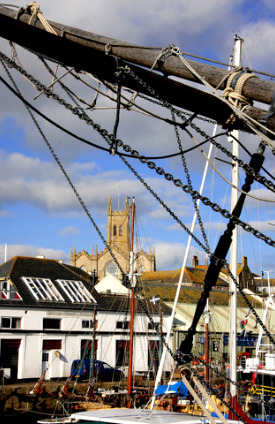
St. Mary's Church occupies a prominent position near Penzance harbour, serving both as an active place of worship and a significant historical landmark that offers elevated views over the town and surrounding coastline. The church building reflects various architectural periods and contains historical features that document the town's development over centuries. The churchyard and surrounding area provide a peaceful retreat from the busier commercial areas of the town centre.
Long Rock Beach
Long Rock Beach stretches eastward from Penzance railway station, providing a substantial expanse of sandy coastline suitable for various recreational activities including swimming, walking, and dog exercise. The beach offers excellent views of St Michael's Mount across the bay, making it a popular location for photography and peaceful contemplation. The wide sandy area accommodates families and provides ample space even during busier periods, whilst the relatively sheltered position within Mount's Bay often results in calmer conditions than more exposed Cornish beaches.
Battery Rocks
Battery Rocks provide a natural rocky swimming and sunbathing area adjacent to Jubilee Pool, offering an alternative to formal beach environments for those seeking a more rugged coastal experience. These granite formations create natural pools and sheltered areas popular with local swimmers and visitors looking for dramatic coastal scenery. The rocks provide an excellent vantage point for viewing the bay and are particularly popular during sunset hours.
Around Penzance
Minack Theatre
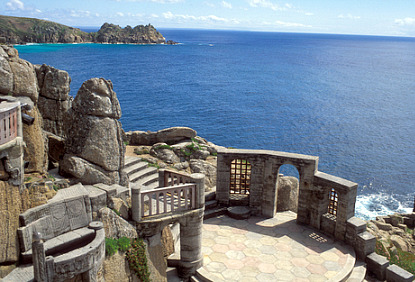
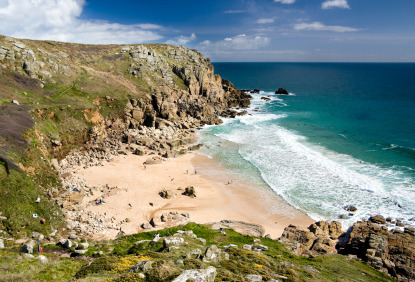
The Minack Theatre, 4 miles (6.5 km) south-east of Land's End at Porthcurno, ranks as one of the world's most dramatically situated performance venues, carved directly into the granite cliffs overlooking the Atlantic Ocean. It was designed in 1932 as a stage for Shakespeare's The Tempest. Plays are still performed every summer. The full season from June to September features 17 plays. Even when performances are not scheduled, the theatre offers guided visits that allow exploration of the remarkable venue and its stunning coastal setting.
St Michael's Mount
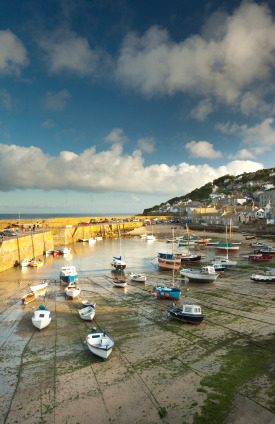
A stay in Penzance would not be complete without a visit to the dramatically set St Michael's Mount, a few kilometres east of town. The fishing villages of Newlyn and Mousehole, in the opposite direction, are also worth a stop for their quaint charm.
Land's End
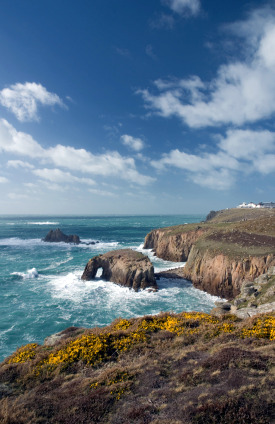
Provided you have your own wheels, a trip to Land's End should also be on top of your list. Besides being able to say that you have been to the extreme south-westerly point of the British mainland, Land's End is usually the scene of spectacular raging waves of the Atlantic Ocean crashing on the craggy promontory.
Lanyon Quoit
Dolmen enthusiasts will head for Lanyon Quoit, 4 miles north-east of Penzance. It is located along the small country linking the villages of Madron and Morvah.
Chysauster Ancient Village
Chysauster Ancient Village, located a short drive from Penzance, preserves the remains of an Iron Age settlement that provides insight into prehistoric life in Cornwall. This English Heritage site features the stone foundations of ancient houses arranged in a distinctive pattern that archaeologists believe dates from approximately 100 BCE to 300 CE. The site includes interpretive information explaining the archaeological significance of the remains and the daily life of the Celtic inhabitants who once lived here.
Top Museums
Penlee House Gallery & Museum
Located in a Victorian mansion amidst lush gardens, Penlee House specialises in the art and local history of West Cornwall. It is home to a superb collection of paintings, especially by the renowned Newlyn School, and explores the lives of artists inspired by the area’s unique light and landscape.
In addition to its artistic treasures, Penlee House displays fascinating archaeological finds, ceramics, and exhibits capturing Cornish social history, from prehistoric settlement through to the mining and fishing industries. The setting is serene, and the Orangery Café offers a relaxing spot for refreshments after your visit.
The Exchange
A former telephone exchange transformed into a modern art gallery, The Exchange is recognised by its striking glass façade. It focuses on contemporary visual arts, hosting exhibitions by leading and emerging artists, as well as community collaborations. The gallery regularly offers events, workshops, and unique short-duration shows, providing a dynamic cultural hub for visitors and locals.
Newlyn Art Gallery
Situated just outside Penzance, Newlyn Art Gallery is an essential stop for lovers of contemporary art. The venue displays the work of regional, national, and international artists and often features experimental and collaborative practices. With an ethos of accessibility and innovation, it’s an inspiring centre for creative exploration.
PK Porthcurno (Porthcurno Telegraph Museum)
A short drive from Penzance, Porthcurno was once the heart of international communications. PK Porthcurno tells the story of global telegraphy, set on the site where undersea cables first connected Britain to the wider world in the 19th century.
The museum brings the history and science of communication to life, detailing both Victorian innovation and modern fibre optics. Visitors can explore underground tunnels, interactive exhibits, and original equipment that helped change the way the world communicates.
Geevor Tin Mine
This fascinating site near St Just, not far from Penzance, immerses visitors in Cornwall’s mining history. Once a working tin mine, Geevor now offers guided tours of its surface and underground workings. Exhibits cover the region’s extraordinary industrial history, showcasing the experiences, challenges, and technology that shaped a vital local industry.
Levant Mine and Beam Engine
Overlooking the dramatic coastline, Levant is home to Cornwall’s oldest working steam beam engine, which has been restored to working order. The site reveals the legacy of Cornish mining, offering tunnels, engine houses, and spectacular sea views, providing a powerful sense of the area’s past.
Art Galleries and Additional Cultural Destinations
Cornwall Contemporary & Lighthouse Gallery
Both located in Penzance and known for exhibiting contemporary works by local and international artists.
Redwing
A not-for-profit space in Market Jew Street, championing artists outside the mainstream and blending art with music and affordable studios.
Local Cuisine
Penzance's proximity to Newlyn, one of the UK's largest fishing ports, ensures an abundance of supremely fresh seafood including scallops, crab claws, pollock, and over 53 different species of fish landed daily. Local specialities include the iconic Cornish pasty filled with beef, potatoes, swede, and onions, which can be found at authentic bakeries throughout the town. Visitors shouldn't miss trying golden saffron cake, creamy clotted cream teas, and the famous Newlyn crab, often served simply dressed in its shell. For the adventurous, stargazy pie—a traditional dish featuring pilchards with their heads poking through the pastry crust—represents one of Cornwall's most unique culinary traditions, though it's typically only available during special occasions in nearby Mousehole. The historic Chapel Street area serves as the town's foodie hub, where traditional pubs steeped in maritime history offer everything from fresh fish and chips to sophisticated fine dining experiences.
Getting There & Around
St Ives is located 450km southwest of London, and is the last train station before Land's End. The fastest way to get there is to fly to Newquay first, then catch a train.
By train, direct services operate from London Paddington, taking approximately 5 hours and passing through major stations including Reading, Taunton, and Exeter, with Great Western Railway providing the main service.
By coach, National Express and FlixBus offer regular services, primarily departing from London Victoria Coach Station with journey times of around 8-10 hours, providing a more budget-friendly option with direct routes available.
By car, the route is remarkably straightforward - simply follow the M4 or M5 motorway towards Exeter, then join the A30 which leads directly to Penzance as a mostly dual carriageway, with alternative scenic routes available via the A39 Atlantic Highway from North Devon or the A38 through Plymouth from South Devon.