


 Ireland Guide
 Scotland Guide
 Wales Guide
| Contents |
|---|

Introduction
Wimpole Hall is a seventeenth-century country house set within a 3,000-acre National Trust estate in the civil parish of Wimpole, Cambridhire, approximately nine miles southwest of Cambridge. Constructed from 1640 and successively remodelled by architects including James Gibbs, Henry Flitcroft and Sir John Soane, the house stands at the heart of parkland originally laid out by designers such as Charles Bridgeman, Lancelot “Capability” Brown and Humphry Repton. The estate encompasses formal gardens, a working Home Farm with rare breeds and miles of public walking trails, and is open daily to visitors.
Interesting Facts about Wimpole Hall
- Wimpole Hall is the largest country house in Cambridgeshire, originally begun in 1640 and remodelled by famous architects including James Gibbs and John Soane.
- The estate's grounds have been home to humans for over 2,000 years, with archaeological evidence of Iron Age settlements and mentions in the Domesday Book of 1086.
- Queen Victoria and Prince Albert paid a visit to Wimpole Hall on 27 October 1843, attending a dinner and a ball before touring the estate farm the following morning.
- The last private owners were Captain George Bambridge and his wife Elsie, the daughter of Rudyard Kipling, who restored the house with royalties from her father's books.
- Wimpole Hall is now owned by the National Trust, following a bequest from Elsie Bambridge in 1976, ensuring its preservation for future generations.
- The estate features the remarkable Wimpole’s Folly, a Gothic tower purposely built as a decorative ruin in 1768 and recently restored by the National Trust.
- Wimpole's library holds over 10,000 books, representing collections built up by the various families who owned the house since the 1700s.
- The formal gardens and wider landscape were shaped by renowned designers, including "Capability" Brown and Charles Bridgeman, while the Dutch Garden was recreated in 1980 from a 19th-century design.
- The estate's Home Farm, established in the late 18th century, is a working rare breeds farm and a popular attraction for families today.
- Wimpole Hall holds the national collection of walnut trees and boasts a vast, productive walled garden supplying its own restaurant with fruit and vegetables.

History
The estate is listed in the Domesday Book and, from the early 15th century, was the seat of the Chicheley family. Sir Thomas Chicheley, a notable royalist and politician, commenced the construction of the grand mansion around 1640, a process interrupted by the English Civil War. Over subsequent centuries, the property passed through the hands of several prominent families by marriage and inheritance, including the Cutlers, Robartes, Holles, Harleys, and the Earls of Hardwicke. Each left their imprint on the house, gardens, and wider estate, creating the sprawling property visitors see today.
Architecturally, Wimpole Hall reflects the influences of a succession of celebrated designers. The original 17th-century house was reshaped and enlarged under James Gibbs, who added the library and remodelled the chapel in the early 18th century. Henry Flitcroft oversaw later modifications, while Sir John Soane, famed for his neoclassical style, transformed the Yellow Drawing Room and constructed a bath house in the late 18th century. The interior is a grand mixture of Baroque and Georgian decoration, with painted schemes by Sir James Thornhill. Notable features include the elaborate Long Gallery, a chapel with trompe-l'œil murals, and extensive pleasure grounds. The estate's 3,000 acres are dotted with ornamental gardens, a parterre restored in modern times, ancient woodland, and the impressive Wimpole’s Folly.
The estate’s fortunes fluctuated with changing times. Queen Victoria and Prince Albert stayed here in 1843, signifying its high social standing. The estate later became associated with Captain George and Mrs Elsie Bambridge, daughter of Rudyard Kipling, who purchased Wimpole in 1942. Using royalties from her father’s literary legacy, Elsie restored both house and gardens while weathering the challenges of war and post-war upkeep. On her death in 1976, Wimpole Hall was bequeathed to the National Trust, which continues the work of conservation and public engagement. Today, visitors can explore lavish historic rooms, extensive parkland, a working farm, and a walled garden, all echoing centuries of British heritage.
Description
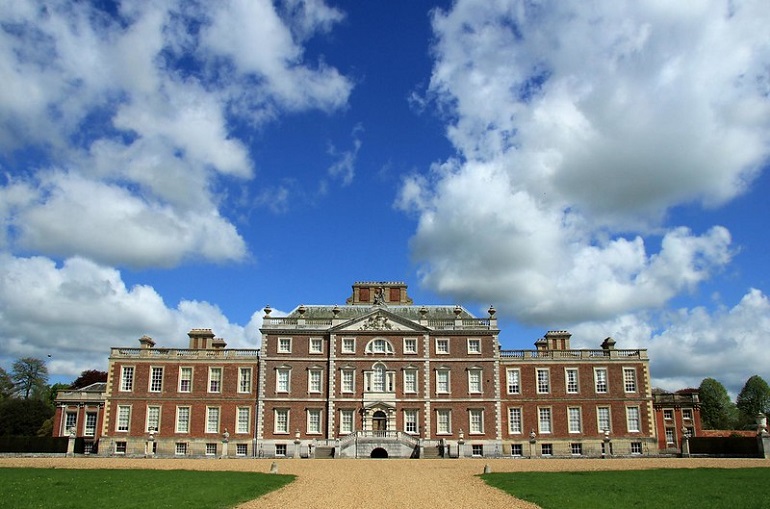
Dominating its gently rolling Cambridgeshire parkland, Wimpole Hall presents aning façade of pale ashlar punctuated by rows of tall sash windows and by twin pavilions. Its architectural language is predominantly Georgian – a composed symmetry broken only by Soane’s later additions, most notably the unusual key-hole plan of the Yellow Drawing Room. Interior and exterior here unite to conjure a country house of refined elegance, domestic intimacy and unexpected theatrical flourishes.
The Grand Approach and Exterior
On arrival, the central block rises with calm authority, its Portland-stone portico and balustraded roofline echoing Palladian ideals. To one side stands Sanderson Miller’s Gothic Tower folly, a carefully contrived ruin whose crenellations and blank windows peek through woodland glades. Across the lawns, lakes and carriage drives laid out by Capability Brown draw the eye to distant vistas and the sinuous contours of country beyond.
Main Reception Rooms
Passing through the understated entrance hall, visitors encounter a suite of rooms that blend grand formality with homely warmth. The Grand Salon’s high ceilings, delicate plaster cornices and crystal-paneled doors evoke eighteenth-century splendour, yet the arrangement of gilded chairs and richly upholstered sofas creates an inviting, lived-in ambience. Opposite, the South Drawing Room contrasts pale Grecian draperies with feminine touches – Chintz armchairs, fine porcelain vases and conversation pieces arranged for intimate gatherings.
Soane’s Yellow Drawing Room
Behind discreet doors lies Soane’s showpiece. Carved from three adjoining chambers, its key-hole layout opens into a semicircular apse, all lined in buttery yellow damask. Gilded mirrors and a central skylight flood the space with soft daylight, illuminating finely modelled cornices and the curved mahogany tables that nestle against the walls. This room epitomises Soane’s gift for spatial drama and light interplay.
The Library and Dome
At the heart of the house, the library presents a more contemplative calm. Tall bookcases rise beneath a spectacular central dome capped by a clear lantern. Its plaster ceiling – stamped with ornamental rosettes – and the soft glow from above create a serene retreat for perusing leather-bound volumes.
The Baroque Chapel and Bath Chamber
Tucked away is a trompe-l’œil chapel, richly painted with faux architectural details by Thornhill. The illusion of depth and soaring arches transports visitors into an almost theatrical sacred space. Equally theatrical, the Roman-inspired bath chamber descends via a curved staircase to an oval plunge pool lined in white marble. This intimate spa evokes the private rituals of bygone owners.
Below-Stairs Corridor
A passage into the servant’s world reveals low ceilings, flagstone floors and discreet niches once used for lamps and chamber pots. Atmospheric and shadowed, it offers a glimpse of the choreography required to maintain a house of this stature.
Gardens and Surroundings
Although not about travel logistics, one must note the experience of stepping beyond the thresholds. The formal parterre, with its lattice of clipped yew and seasonal bedding, gives way to lush herbaceous borders. A Chinese Bridge spans a hidden canal, while the walled kitchen garden bursts with vegetables, fruit and flowers. In spring, pillars of daffodils and drifts of alliums light the lawns. The wider parkland unfolds in sweeping vistas, punctuated by specimen trees, serene lakes and the lone silhouette of the Gothic Tower.
Getting There
By train, the nearest railway station to Wimpole Hall is Cambridge, from which you can take a taxi or local bus to the estate.
By coach, national services run to Cambridge and nearby towns such as Royston and St Neots, offering connections to local buses or taxis for the final stretch.
By car, Wimpole Hall is conveniently located just off the A603, a short drive from Cambridge and easily accessible via the M11 or A1, with clear signposting guiding visitors to the property.
Best Time to Visit
The best time to visit Wimpole Hall is during late spring and early summer, when the gardens are in full bloom, the parkland is lush and green, and the estate hosts a variety of outdoor events and activities. From May to June, visitors can enjoy pleasant weather ideal for exploring the majestic landscaped grounds, the historic mansion, and family-friendly attractions such as the farm and walking trails. Weekdays typically offer a more tranquil atmosphere compared to weekends, making for a more relaxed and immersive experience.