


 Ireland Guide
 Scotland Guide
 Wales Guide
| Contents |
|---|
Introduction
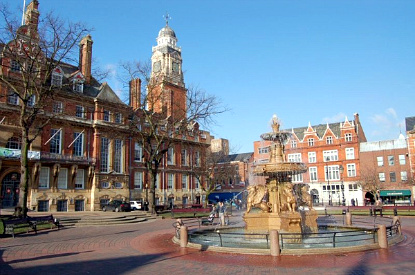
Leicester (pronounced Lester; pop. 375,000; urban 560,000) is one of England's most multicultural city. In fact it has the highest percentage (37%) of non caucasians of any city in the UK, including 30% of South Asians and 3% of Afro-Caribeans (mostly Ugandans).
Leicester was badly damaged by German bombings during WWII, but is now redefining itself as a vibrant and modern city, where mosques, Hindu, Jain and Sikh temples are giving it a new appearance.
The Indian and Pakistani community is concentrated along Belgrave Road and Melton Road. Try to visit Leicester during one of its two great Hindu festivals. Diwali , the Festival of Light, is held in October or November and attracts some 20,000 onlookers. Also in October, Navrati (festival dedicated to goddess Ambaji) is celebrated during nine days. The Afro-Caribbean community also has its own festival, second only after Notting Hill's carnival, during the first week of August.
Interesting Facts about Leicester
- Leicester hosts the largest Diwali celebrations outside of India, with as many as 35,000 people turning out to witness the lights being switched on in Belgrave Road.
- Leicester is the birthplace of modern tourism, as Thomas Cook organised the world's first package tour from Leicester to Loughborough in July 1841 for a temperance meeting.
- Leicester is one of England's oldest cities with a history stretching back at least 2,000 years, appearing in the Domesday Book as "Ledecestre".
- King Richard III's skeletal remains were discovered under a Leicester car park in 2012, on the site of the former Choir of Greyfriars Church where he was hastily buried after the Battle of Bosworth Field in 1485.
- BBC Radio Leicester was Britain's first mainland local radio station when it began broadcasting in November 1967.
- The modern English language spoken by over 1 billion people worldwide originated in Leicester, first developed as a way for Anglo-Saxons and Vikings to communicate with each other.
- Leicester's River Soar used to be pink due to waste from the city's thriving textile industry, which in the 1930s made Leicester the second richest city in Europe.
- Leicester is home to the world's largest crisp factory, operated by Walkers, whose Beaumont Leys plant produces Britain's biggest grocery brand.
- Leicester boasts Europe's largest outdoor covered market, located south of the city centre's iconic Clock Tower and open six days a week with over 300 stalls.
- Leicester lost its legal city status in the 1200s due to power struggles between the aristocracy and the church, and didn't regain it until 1919.
- The National Space Centre in Leicester is Britain's largest space-dedicated visitor attraction, welcoming around 250,000 visitors annually and featuring the UK's largest domed planetarium.
- Leicester City FC's unlikely Premier League triumph in the 2015-16 season has been hailed as the ultimate example of what can be achieved with team spirit and self-belief.
- Leicester was Britain's first 'Environment City', with the 'greening' of the city receiving special praise at the 1992 Earth Summit in Rio.
- Walkie-talkies were developed during the Second World War by Leicester-born Donald L. Hings.
- Despite its name, Red Leicester cheese doesn't actually come from Leicester but originates from a farm near Hinckley and was originally called 'Leicestershire Cheese'.
History
Leicester was founded in 50 CE as the Roman trading and military settlement of Ratae Coritanorum, upon the Fosse Way (main road running between present-day Exter to Lincoln).
It is believed that the name Leicester is derived from Ligore Caster, meaning "castle on the (River) Legro, from the former name of the River Soar that flows through the city.
Resetlled by the Saxons after Roman times, Leicester was taken by the Danish Vikings and became one of the five boroughs of the Danelaw. Although Leicester was at both the status of 'city' and 'diocese', by the 11th century it had lost both of them and was not to recover them until the 20th century.
In 1265, Simon de Montfort, Earl of Leicester, forced King Henry III to hold the first parliament of England at the now ruined Leicester Castle.
Leicester turned into a major industrial city after the construction in the 1790s of the Grand Union Canal between London and Birmingham. This was further accentuated with the coming of railway in 1832. The city's main industries are hosiery, footwear and engineering, but all declined sharply after WWII.
Leicester is also famous for two 'unusual' citizens. The first one was Daniel Lambert (1770-1809), who reached the record weight of 333kg, making him the heaviest man of his time. The second was Joseph Merrick (1862-1890), the 'Elephant Man', who suffered from an extremely rare genetic disorder known as neurofibromatosis, expressed by a grotesque deformity. Joseph spent much of his life in as a circus attraction. The biographical book Elephant Man: A Study in Human Dignity by Sir Frederick Treves was made into an for Academy Awards winning movie in 1980 starring Anthony Hopkins.
Main Attractions
National Space Centre
The National Space Centre is a key attraction for science and astronomy, located just outside the city centre. Its most prominent feature is the 42-metre high Rocket Tower, which houses the Blue Streak and Thor Able rockets. Inside, visitors can explore six interactive galleries covering topics from the planets to the wider cosmos. The centre also features the UK's largest planetarium, the Sir Patrick Moore Planetarium, which presents immersive shows. A variety of real space artefacts are on display, including spacecraft and meteorites, offering an educational experience for all ages.
Leicester Cathedral

With a history spanning over 900 years, Leicester Cathedral stands in the heart of the city's old town. Originally a parish church dedicated to St Martin, it was elevated to cathedral status in 1927. The building showcases a mix of architectural styles, largely due to a significant Victorian restoration by architect Raphael Brandon. Its primary point of interest is the tomb of King Richard III, whose remains were discovered nearby in 2012 and reinterred within the cathedral in 2015. The cathedral is an active place of worship and welcomes visitors to attend services or explore its historic interior and stained glass windows.
King Richard III Visitor Centre
Located directly opposite the cathedral, the King Richard III Visitor Centre is built over the car park where the king's remains were unearthed. The centre provides an immersive exhibition that details the life, death, and subsequent discovery of the last Plantagenet king. Through interactive displays and storytelling, it covers the Wars of the Roses, Richard's rise to power, and the archaeological investigation that led to his finding. The centrepiece of the visitor experience is a glass floor that allows visitors to view the exact site where the king’s skeleton was found in its grave.
Jain Temple
The Jain Temple in Leicester, known as the Jain Centre, is situated on Oxford Street and is recognised as the first fully consecrated Jain temple in the Western world. Established in a former Congregational Chapel, the temple was completed in 1988 and features an exterior clad in white marble imported from India. Its interior is noted for its intricate carvings, including 44 sandstone pillars, a traditional temple dome, ornate ceilings, marble floors, and mirrored walls. The centre accommodates all Jain sects under one roof and serves not only as a place of worship but also as a cultural hub with a museum, library, auditorium, and dining hall. The Jain Temple remains an important part of Leicester’s diverse community, welcoming visitors and providing insight into Jain religious practices and values such as non-violence and respect for all living beings
Bradgate Park
Bradgate Park is an 830-acre public park located northwest of Leicester, known for its dramatic and wild landscape. Historically a medieval deer park, it is still home to herds of red and fallow deer that roam freely. The park contains the ruins of Bradgate House, a brick-built country house from the early 16th century and the childhood home of Lady Jane Grey. The landscape is characterised by rugged rock outcroppings, ancient oak trees, and the River Lin, which flows through the lower part of the park. It is a popular destination for walking, with landmarks like the Old John Tower folly providing panoramic views.
Abbey Park
Situated to the north of the city centre, Abbey Park is a large Victorian park divided by the River Soar. The western side features the ruins of the 12th-century Leicester Abbey and the remaining walls of the 17th-century Cavendish House. The eastern side of the park is more formal, with ornamental gardens, a large boating lake, a miniature railway for children, and facilities for tennis and bowling. The park is a significant green space for the city, hosting major annual events such as the Bonfire Night display.
Leicester Market
Leicester Market is one of the oldest and largest outdoor covered markets in Europe, with a history stretching back over 700 years. Located in the city centre, it offers a vibrant shopping experience with a diverse range of goods. Stalls sell fresh fruit, vegetables, meat, and fish, alongside fabrics, clothing, and jewellery. A modern indoor Food Hall, opened in 2014, complements the traditional outdoor market. The market remains a central hub of activity and a key part of Leicester's cultural and commercial life.
Church of St Mary de Castro
The Church of St Mary de Castro, meaning 'St Mary of the Castle', is a Grade I listed church founded in 1107. Located within the former bailey of Leicester Castle, it served as the castle's chapel and is one of the city's oldest churches. Its architecture displays a mix of Norman, Early English, and Perpendicular Gothic elements, with a distinctive tall, slender spire. The church has significant historical connections; it is believed to be where Geoffrey Chaucer married his wife and where a young King Henry VI was knighted in 1426.
Haymarket Memorial Clock Tower
The Haymarket Memorial Clock Tower is a prominent landmark situated at a busy intersection in Leicester's city centre. Erected in 1868, the 70-foot Victorian Gothic tower was designed by local architect Joseph Goddard. It serves as a monument to four notable benefactors of the city, whose statues are placed in niches around the structure. These figures are Simon de Montfort, William Wyggeston, Sir Thomas White, and Alderman Gabriel Newton. The clock tower remains a popular meeting point and a key architectural feature of the city.
Grand Union Canal
The Leicester Line of the Grand Union Canal passes through the city, providing a scenic route for walking and cycling along its towpaths. This stretch of waterway offers varied landscapes, from the urban setting near the city centre to greener areas towards the city's outskirts. It connects several local landmarks, including Abbey Park and the area near the King Power Stadium. The canal system was historically important for transporting goods during the Industrial Revolution and is now primarily used for leisure, with narrowboats frequently seen navigating the waters.
Golden Mile
The Golden Mile is the name given to a stretch of Belgrave Road, which is famous for being a hub of South Asian culture and commerce. The road is lined with a high concentration of Indian jewellery shops, traditional clothing boutiques selling saris, and restaurants offering authentic regional cuisine. It is the focal point of Leicester's Diwali celebrations, which are considered among the largest outside of India. During the festival of lights, the area is decorated with thousands of lights, attracting large crowds for the switch-on ceremony and related events.
Curve Theatre
The Curve is a modern performing arts venue in Leicester's cultural quarter, known for its distinctive glass-fronted, curved architecture designed by Rafael Viñoly. A key feature of its design is the absence of a traditional backstage, allowing the public to view the production and preparation areas through the glass facade. The theatre produces its own shows, including major musicals and plays, and also hosts touring productions, dance, and comedy. It has a strong commitment to community engagement and talent development within the region.
Foxton Locks
Located a short distance south of Leicester near Market Harborough, Foxton Locks is a major attraction on the Grand Union Canal. It comprises two "staircase" flights of five locks each, which together form the longest and steepest flight of such locks in the UK. This impressive piece of 19th-century engineering is a popular destination for visitors who come to watch narrowboats navigate the ten locks. The site includes waterside pubs, cafés, and towpaths for walking, offering a pleasant day out in the countryside.
Victoria Park
Victoria Park is a large expanse of open parkland situated to the south of the city centre, adjacent to the University of Leicester. The park provides space for various sports, including football, rugby, and tennis, and has a popular skate park. It is also a key venue for major city events such as the Leicester Caribbean Carnival and Leicester Pride. Two significant landmarks are located within the park: the Arch of Remembrance, a war memorial designed by Sir Edwin Lutyens, and De Montfort Hall, one of the city's primary concert and entertainment venues.
Top Museums
Leicester Museum & Art Gallery
Leicester’s original museum, located on historic New Walk, is a world of discovery spanning art, natural history, world cultures, and local stories. The galleries include:
- Dinosaurs Gallery: Home to the 15-metre Rutland Dinosaur and Barrow Kipper, as well as a diverse collection of prehistoric fossils and minerals.
- Ancient Egypt: Features the East Midlands' most significant Egyptian collection—including mummies, figurines, and artefacts that reveal Ancient Egyptian beliefs about life and death.
- Leicester Stories Gallery: A permanent exhibition celebrating Leicester’s achievements and challenges over the past seventy years, with personal stories and community artefacts.
- German Expressionism: Renowned collection of German Expressionist art, among the finest in the UK.
- Victorian and Contemporary Art Galleries: Exhibiting classic and modern works, including Picasso Ceramics from the Attenborough Collection.
- Changing Exhibitions: Frequently hosts touring national exhibitions and special displays celebrating everything from local sport to global art movements.
National Space Centre
An award-winning attraction dedicated to the exploration of space. Interactive galleries, hands-on exhibits, and immersive experiences guide visitors through the history and future of space travel. Standing out is the iconic Rocket Tower, home to real rockets and space vehicles, making it a must-see for families and science enthusiasts alike.
Leicester Guildhall
One of the finest preserved timber-framed halls in the country, the Guildhall boasts over 600 years of history:
- Medieval Architecture: Constructed in the late 14th century, this building is known for its medieval features and atmospheric interiors.
- Historic Uses: Once a town hall, courtroom, and even a police station, it is now a museum housing the Medieval Leicester Galleries.
- Cultural Venue: Hosts theatre, comedy, and ghost tours—Leicester Guildhall’s reputation as the city’s most haunted building is well-earned.
Abbey Pumping Station
Leicester's science and technology museum, housed in a grand Victorian building originally built to pump sewage. Highlights include:
- Beam Engines: Four enormous, restored steam-powered engines are on display.
- Industrial Heritage: Exhibits showcase Leicester’s technological, industrial, and scientific evolution, with hands-on activities for all ages.
- Special Events: From vintage vehicles to steam days, the museum brings history to life through a varied event programme.
Newarke Houses Museum
Formed from two historic houses, this museum explores the social history of Leicester through:
- Toy Collection: Toys from Tudor times to the present.
- Regimental Gallery: Honour the Royal Leicestershire Regiment’s story.
- WWI Trench and 1950s Street: Explore a recreated wartime trench and step into a recreated mid-century Leicester street scene.
Jewry Wall: A Real Roman Experience
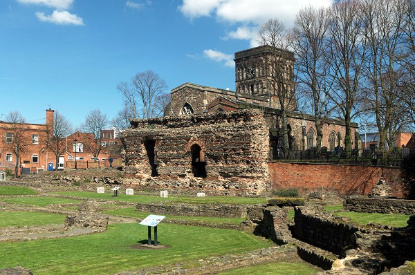
Reopened from July 2025 following major redevelopment, the Jewry Wall museum stands beside one of Britain’s tallest surviving Roman ruins. Visitors will be able to:
- Roman Bathhouse Ruins: Witness striking remains of a public Roman bath complex.
- Artefacts and Exhibits: Discover mosaics, pottery, and artefacts illuminating Roman life in Ratae Corieltauvorum (Roman Leicester).
- Immersive Displays: State-of-the-art interpretation will bring ancient history vividly to life for all ages.
Belgrave Hall
An elegant 18th-century house set amidst peaceful gardens. Visitors can:
- Heritage Interiors: Explore finely restored rooms reflecting Leicester’s Georgian and Victorian eras.
- Tranquil Gardens: Stroll through charming gardens that have been a local sanctuary for centuries.
- Events: Experience open days and festivals, notably the Belgrave Food & Garden Festival.
Local Cuisine
Leicester's culinary landscape brilliantly reflects the city's multicultural heritage, making it a fascinating destination for food enthusiasts. The city holds the distinction of being a former UK Curry Capital and currently boasts the second highest number of Indian restaurants per capita in the world outside India, with over 234 establishments serving everything from authentic Gujarati vegetarian cuisine and chaats (savoury Indian snacks) to rich Punjabi curries and delicate southern Indian dosas. Beyond its renowned curry houses concentrated along the famous Golden Mile on Belgrave Road, Leicester celebrates its broader Leicestershire heritage with iconic local specialities including Red Leicester cheese, the world-famous Melton Mowbray pork pie, and Stilton cheese. The city's diverse population, representing over 50 countries, has created an extraordinary global food scene where you can sample Korean rice bowls, authentic sushi, African cuisine, and even Uyghur dishes, whilst traditional British fare remains strong with excellent gastropubs and the home of Walkers crisps. Leicester's commitment to culinary excellence is exemplified by award-winning establishments like the Michelin-starred John's House, which showcases farm-to-table dining using locally sourced Leicestershire ingredients.
Getting There & Around
Leicester is located between Nottingham to the North, Northampton to the South, Birmingham to the West, and Peterborough to the East. The M1, M69, A46 and A47 motorways all pass through by Leicester.
By train, Leicester is excellently connected to the national rail network, with frequent direct services from London St Pancras International taking approximately 1 hour 11 minutes, whilst East Midlands Railway and CrossCountry operate regular services from major cities including Birmingham, Nottingham, Sheffield, Derby, and Lincoln.
By coach, National Express provides comfortable services from across the UK, with coaches arriving at Leicester's St Margaret's Bus Station in the city centre - journeys from London Victoria Coach Station take around 2-3 hours.
By car, Leicester benefits from its position just off the M1 motorway, with junctions 21 and 22 providing direct access to the city centre, whilst the M69 and M6 offer convenient routes from Birmingham, Wales, and the south-west.