


 Ireland Guide
 Scotland Guide
 Wales Guide
| Contents |
|---|

Introduction
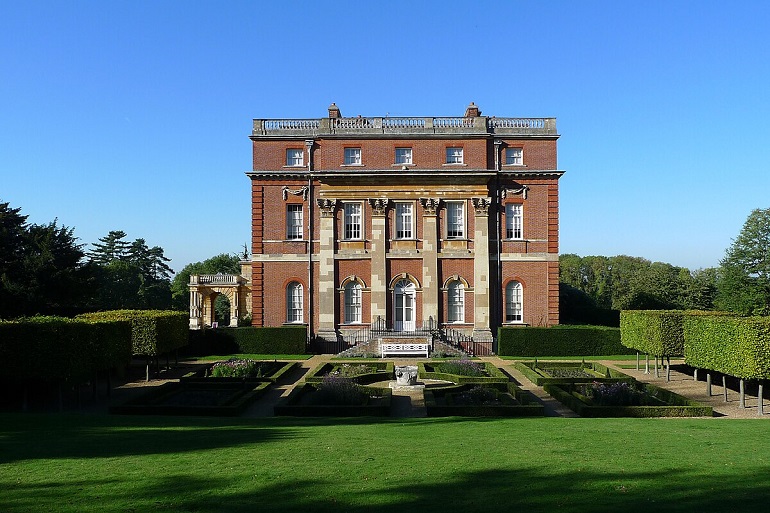
Clandon Park has been the home of the Onslow family since 1641. Thomas, 2nd Baron Onslow commissioned Venetian architect Giacomo Leoni to built the present red-brick and marble manor in 1731.
Clandon is renowned for its collection of 18th-century furniture, carpets, needlework, (Chinese, Meissen and Sevres) porcelain, acquired in the 1920s by the connoisseur Mrs David Gubbay. The manor also prides itslef on its Italian comedy figures and Mortlake tapestries.
But the most impressive of all is the grand Marble Hall, built on two-storeys, and considered as one of the best example of 18th-century interior. The chimney pieces were sculpted by the celebrated Italo-Swiss stuccoists, Michael Rysbrack.
The Maori House beside the sunken Dutch garden may seem a bit out of place. It was brought back from New Zealand in 1892 by Lord Onslow (then Governor of New Zealand) after the house was half-buried in lava and ashes following the eruption of Mount Tarawera 6 years earlier.
Interesting Facts about Clandon Park
- Clandon Park is one of England's most complete examples of a Palladian mansion, designed by Venetian architect Giacomo Leoni in the 1730s for the Onslow family.
- The estate was once part-owned by the crusading Knights Templar before being sold to the Onslow family in 1641 on the eve of civil war in England.
- Three members of the Onslow family achieved the unique distinction of becoming Speaker of the House of Commons over the centuries, with their portraits hanging in the aptly named Speakers' Parlour.
- During the First World War, Clandon Park was transformed into an auxiliary military hospital with over 100 beds, admitting 5,059 patients and carrying out 747 operations between 1914 and 1919.
- The house contains Hinemihi, a Māori meeting house brought back from New Zealand in 1892, making it one of only four such structures outside New Zealand.
- Archaeologists discovered 55-million-year-old sharks' teeth during excavations in the basement, revealing that Clandon Park was once at the bottom of a prehistoric lake populated by sharks and other fish.
- The devastating fire in April 2015 left the Grade I listed mansion "essentially a shell," destroying thousands of historic artefacts in what was described as a national tragedy.
- The parkland was landscaped by renowned garden designer Lancelot 'Capability' Brown between 1776 and 1781, who transformed part of a disused canal into an ornamental lake.
- An Elizabethan cast iron fireback from around 1600, made for Queen Elizabeth I's favourite Charles Blount, 8th Baron Mountjoy, was discovered in an outbuilding at Clandon.
- Post-fire excavations uncovered 16th or 17th-century underfloor drains, providing the first physical evidence of the Jacobean home that stood on the site before the current mansion.
- The house was investigated for paranormal activity in 1895 by John Crichton-Stuart, 3rd Marquess of Bute, and Ada Goodrich Freer on behalf of the Society for Psychical Research.
History
Clandon Park's Medieval Origins and the Onslow Dynasty
Clandon Park boasts a remarkable heritage stretching back centuries, with the estate once partially owned by the crusading Knights Templar before being sold to the Onslow family in 1641 on the eve of England's civil war. The purchase was made by Sir Richard Onslow, MP for Surrey in the Long Parliament, who acquired both the estate and its existing Elizabethan house from Sir Richard Weston of nearby Sutton Place. The Onslow family proved to be a politically influential dynasty, with three family members serving as Speakers of the House of Commons, including the renowned Arthur Onslow. The estate remained a hunting lodge initially, but by the time of Richard's purchase, it had developed into an impressive house at the centre of a large deer park and farm. The family's political prominence and growing wealth would soon demand a grander architectural statement befitting their status.
The Palladian Masterpiece of the 1730s
The Clandon Park that visitors recognise today began to take shape in the 1720s when Thomas Onslow, 2nd Baron Onslow, commissioned the demolition of the existing family mansion to make way for a fashionable new house. Built between approximately 1730-33, the new residence was designed by the Italian architect Giacomo Leoni, who had arrived in England aged 28 and had previously worked on Lyme Park in Cheshire. The resulting Grade I listed building represents a superb example of early 18th-century Palladian architecture, constructed of red brick with stone dressings in a rectangular design. The interiors, completed in the 1740s by continental sculptors and plasterers, featured the spectacular two-storey Marble Hall with marble chimney pieces by Flemish sculptor Michael Rysbrack and rococo plasterwork ceilings by Italian-Swiss artists Giuseppe Artari and Bagutti. The estate's landscape was later transformed by Lancelot 'Capability' Brown between 1776-81, who replaced the formal French gardens with his signature naturalistic parkland and converted part of a disused canal into an ornamental lake.
From Military Hospital to Tragic Fire
During the First World War, the Onslow family converted Clandon Park into a military hospital, treating wounded soldiers from 1917 onwards. The hospital admitted 5,059 patients and performed 747 operations before closing in May 1919, even caring for victims of the deadly Spanish flu pandemic. Those soldiers who died from their injuries were buried in the cemetery of the nearby Church of St Peter and St Paul in West Clandon, including Belgian, British, Canadian, and Australian servicemen. The house and gardens were generously donated to the National Trust in 1956, though the surrounding parkland remained in private ownership with the Onslow family. Tragically, on 29th April 2015, a devastating fire caused by an electrical fault in the basement swept through the building, destroying all but one room—the Speakers' Parlour. The blaze reduced one of England's finest Palladian mansions to a shell, prompting ongoing debates about restoration versus the National Trust's preferred "laid-bare" approach, which would preserve the fire-damaged structure as a unique historical record.

Description
Architectural Setting & Estate Context
The House & Immediate Grounds
Clandon House sits with poise at the heart of gently undulating lawns, its red-brick façades softened by stone quoins and pediments. The building presents a perfect study in 18th-century Palladian proportions, with wide sash windows arranged in rhythmic bays across its three-storey elevation. A central portico, supported by slender Ionic columns, establishes the entrance's classical dignity whilst creating harmonious symmetry across the entire façade.
The house commands extensive views across its immediate parkland, where carefully maintained lawns sweep away towards distant tree lines. Ancient cedar and oak specimens punctuate these open spaces, their placement revealing the hand of landscape design whilst appearing entirely natural. Stone balustrades and ornamental urns mark formal terraces, whilst elegant stone steps descend from the main entrance to the surrounding gardens.
The Wider Estate
Beyond the immediate grounds, the wider estate stretches into Capability Brown's sweeping parkland, where fragmented glimpses of distant woodlands and scattered specimen trees hint at the estate's former grandeur. Rolling pastures extend towards the Surrey Hills, creating a sense of endless countryside despite the estate's proximity to London. Ancient field boundaries marked by hedgerows and veteran trees speak to centuries of careful stewardship, whilst glimpses of Georgian farm buildings and estate cottages remind visitors of the working landscape that once supported this grand establishment.
Formal Gardens & Designed Landscape
The South Parterre
Flanking the south front lies a meticulously maintained parterre, its crisp box-edged compartments arranged in geometric patterns that complement the house's classical symmetry. Each compartment is filled with carefully chosen seasonal blooms—spring bulbs giving way to summer perennials and autumn colour—whilst the design's formal structure remains constant throughout the year.
The parterre is centred on a classical stone capital, a fragment from some ancient building that serves as both sculpture and historical curiosity. Gravel pathways, raked to perfection, wind between neat herbaceous borders where lavender, roses and traditional English garden plants provide fragrance and colour whilst maintaining the overall formality of the design.
The Grotto & Water Features
A short stroll from the main gardens leads to the Grotto, a charming rustic retreat built from local flint and nestled beneath a carefully planted bank of native shrubs and ferns. This picturesque folly captures the 18th-century taste for romantic landscape features, its cool interior providing welcome shade on warm summer days.
Nearby, a series of small water features includes a circular pond that reflects the sky and surrounding plantings, whilst gentle rills carry water between different garden compartments. These water elements, though modest in scale, provide important focal points and add the soothing sound of moving water to the garden experience.
The Dutch Garden
A gentle rise beyond the grotto reveals the serene Dutch Garden, a sunken lawn enclosed by towering yew hedges that create a sense of complete privacy and enclosure. This formal garden room follows traditional Dutch principles, with its central pool reflecting the sky above whilst perfectly clipped hedge walls provide a backdrop of the deepest green.
Stone benches positioned at regular intervals invite contemplation, whilst narrow gravel paths allow visitors to walk the garden's perimeter. The contrast between the dark yew hedging and the bright central lawn creates a dramatic effect, particularly when morning or evening light illuminates the space.
Woodland Gardens & Walks
Beyond the formal gardens, a network of woodland paths winds through naturalistic plantings of rhododendrons, azaleas and specimen trees. These less formal areas provide seasonal interest, from spring bluebell carpets to autumn leaf colour, whilst maintaining views back towards the house and formal gardens.
Ancient trees, including magnificent specimens of cedar, oak and beech, create a cathedral-like atmosphere along these paths. Carefully placed benches offer opportunities to rest and contemplate the changing views, whilst interpretive plantings demonstrate historical garden styles and plant introductions.
Unique Features & Cultural Treasures
Hinemihi: The Māori Meeting House
To the east lawn stands Hinemihi, an authentic Māori meeting house that creates one of England's most unexpected cultural encounters. This remarkable structure, with its vibrant carved timbers depicting ancestral figures and traditional patterns, stands beneath a traditional thatched roof that weathers beautifully in the English climate.
The meeting house's interior reveals intricate woodcarving that tells stories of Māori culture and history, whilst its positioning on the Clandon lawn creates a fascinating dialogue between Polynesian and European architectural traditions. Regular cultural events and educational programmes help visitors understand the significance of this extraordinary survival.
Classical Architectural Details
Throughout the house and gardens, exceptional architectural details reward careful observation. Door cases feature carved pediments and classical orders, whilst window surrounds demonstrate the finest Georgian stonework. Internal features include elaborate ceiling roses, carved wooden chimneypieces, and decorative ironwork that exemplifies 18th-century craftsmanship.
The house's roofline is punctuated by classical urns and decorative chimneys, whilst lead rainwater goods bear dates and monograms that speak to the building's history. Even service areas reveal high-quality workmanship, with brick arches, stone flags and traditional building techniques evident throughout.
Parkland & Landscape Context
Capability Brown's Legacy
Though the wider park remains privately managed, glimpses between mature trees reveal the enduring influence of Capability Brown's original 18th-century design. Gently sloping grassland creates the illusion of endless countryside, whilst clusters of venerable oaks and cedars provide vertical interest and seasonal variation.
The landscape's apparent naturalness conceals sophisticated design principles, with carefully positioned tree clumps framing views and creating a sense of discovery as visitors move through the grounds. Brown's characteristic serpentine drives once wound through this landscape, though modern access arrangements have necessarily altered these historical circulation patterns.
Archaeological & Historical Features
Scattered throughout the parkland, classical elements hint at the estate's layered history. A Grade II listed wrought-iron gate, probably dating from the mid-18th century, demonstrates exceptional metalwork whilst providing glimpses into areas not normally accessible to visitors.
In the distance, a Georgian folly crowns a gentle rise, its purpose now largely forgotten but its romantic silhouette still contributing to carefully composed views from the house. Archaeological evidence suggests earlier settlement on the site, whilst field boundaries and ancient trees speak to centuries of continuous occupation and landscape management.
Wildlife & Natural Heritage
The estate's parkland and gardens support diverse wildlife, from ancient trees that provide habitat for numerous bird species to formal ponds that attract waterfowl and amphibians. Traditional management practices, including extensive grassland and mixed woodland, create conditions that benefit both wildlife and landscape aesthetics.
Seasonal highlights include spring wildflower displays in less formal areas, whilst autumn brings spectacular leaf colour from the estate's magnificent specimen trees. The gardens' formal structure provides year-round interest, but it is the seasonal rhythms of the wider landscape that connect Clandon most powerfully to its Surrey setting.
Getting There
By train, visitors can travel to Clandon Station on the London Waterloo to Guildford mainline, operated by South Western Railway, with the station located approximately one mile from Clandon Park requiring a 15-20 minute walk along the A247.
By coach, several bus services including the 463, 479, and 25 connect the area to Guildford and surrounding towns, with the nearest stop at Church, West Clandon just a six-minute walk from the property.
By car, drivers should leave the A3 southbound at the junction signposted for Ockham, Ripley, and Send, then follow signs to West Clandon where free parking is available on-site, with the postcode GU4 7RQ for satellite navigation.
Best Time to Visit
The optimal time to visit Clandon Park is during the spring and summer months, from April to September, when the gardens are in full bloom and the weather is typically more favourable for exploring the grounds. During this period, you can fully appreciate the seasonal planting in the Dutch garden and the developing wildflower meadow. It is also when the house, currently undergoing a major restoration project following a fire, offers specific open days allowing visitors a unique insight into the conservation and architectural work in progress. Visiting on one of these open days provides a chance to see the building's raw structure and learn about the ambitious project to bring it back to life, an experience not available at other times of the year. It's advisable to check the National Trust website for the specific open days and tour schedules before planning your trip, as access to the main house is limited.