England Guide  |
|---|
|
| | English Regions |
|---|
|
| | Top English Cities |
|---|
|
| | Top National Parks |
|---|
|
| | Europe Guide |
|---|
|
| | Travel Tools |
|---|
|
| | UK & Ireland Guide |
|---|
|
|
|
|
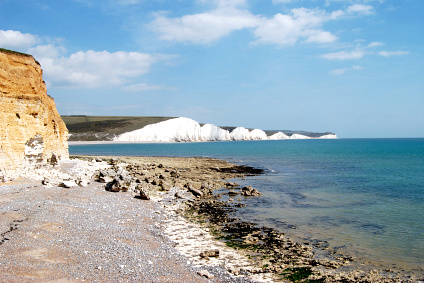 Seven Sisters Cliffs near Eastbourne, Sussex. Seven Sisters Cliffs near Eastbourne, Sussex.
Introduction to South-East England
South East England offers a remarkable blend of historical significance and natural beauty that makes it a compelling destination for visitors. This ancient region boasts a rich historical tapestry dating back to prehistoric times, with the Ridgeway along the Chilterns and Marlborough Downs being Britain's oldest road.
The region is home to numerous UNESCO World Heritage Sites, including Blenheim Palace, a masterpiece of Baroque architecture and the birthplace of Sir Winston Churchill. Canterbury Cathedral, St Augustine's Abbey and St Martin's Church collectively received UNESCO World Heritage status in 1988.
Historical Attractions
South East England features an impressive array of historical attractions:
- Over 50 castles, including Windsor Castle, Dover Castle, and Leeds Castle
- Historic houses such as Penshurst Place, described as "the grandest and most perfectly preserved example of a fortified manor house in all England"
- Tudor mansions at Knole House and Parham House
- Homes of famous historical figures like Churchill's Chartwell and the Duke of Wellington's Stratfield Saye
Natural Landscape
The natural landscape is equally captivating with:
- More than 400 miles of coastline featuring the iconic White Cliffs of Dover and 26 Blue-flag award-winning beaches
- Two national parks (the New Forest and the South Downs)
- Eight designated Areas of Outstanding Natural Beauty
- Over 140 vineyards spread across the region
The South East boasts vibrant cities each with unique character, from Oxford's "dreaming spires" to maritime Portsmouth and bohemian Brighton. With approximately 1,900 hours of sunshine annually, it ranks among the warmest regions in the UK.
For garden enthusiasts, the region offers Penshurst Place gardens (dating to the 14th century), considered the oldest in the country, as well as early 18th-century landscape gardens at Rousham and Painshill.
With its blend of royal heritage, literary connections, film locations, and diverse attractions ranging from historic sites to natural wonders, South East England provides visitors with an authentic glimpse into England's past while offering modern amenities and experiences.
Attractions
|
Clickable Tourist Map of Southeast England
Note that dots, castle icons and national parks are not clickable on the mobile version. Please use the desktop version for optimal navigation.
Across counties
| South Downs National Park |
|---|
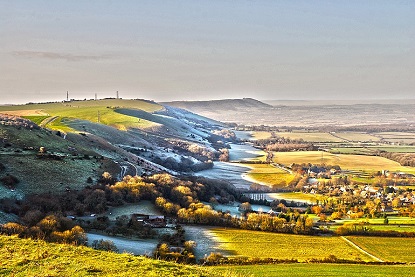
 The South Downs National Park offers visitors an exceptional opportunity to experience England's largest expanse of chalk downland, featuring rolling hills, ancient grasslands, and diverse wildlife habitats that support over 40 species of butterflies and numerous rare birds including skylarks and yellowhammers. The park's 1,600 square kilometres encompass pristine chalk cliffs, flower-rich meadows filled with orchids and other native wildflowers, and well-maintained footpaths including sections of the South Downs Way that provide excellent walking opportunities with panoramic views across the English Channel and surrounding countryside. The unique chalk geology creates distinctive landscapes and supports specialised plant communities that have developed over thousands of years, making it an ideal destination for nature enthusiasts, hikers, and anyone seeking to experience traditional English downland scenery whilst observing wildlife in their natural habitats. |
Berkshire
| Windsor & Eton |
|---|

 Windsor Castle is the world's oldest occupied castle and working royal residence. Visitors can tour the State Apartments and St George's Chapel, and witness the Changing of the Guard ceremony. The town is also home to the prestigious Eton College, founded in 1440, whose historic buildings and famous former pupils have shaped British history for centuries. Beyond the royal and educational heritage, visitors can enjoy riverside walks along the Thames, browse the cobbled streets of Windsor's town centre, and experience the unique atmosphere of a place where royal tradition continues to this day, making it a fascinating destination for anyone interested in British monarchy, architecture, and centuries of living history. |
Buckinghamshire
| Stowe House & Gardens |
|---|

Stowe House & Gardens represents one of Britain's most significant achievements in landscape design, created by legendary figures including Charles Bridgeman, William Kent, and Capability Brown during the 18th century. The estate showcases the evolution of English garden design from formal baroque layouts to the naturalistic landscape movement that would influence gardens worldwide. Visitors can explore over 40 temples and monuments scattered across 250 acres of carefully crafted scenery, including the Temple of British Worthies, the Palladian Bridge, and the Gothic Temple, each telling stories of political allegory and classical ideals. The neoclassical mansion itself, with its Egyptian Hall and floating marble staircase, reflects three centuries of architectural ambition by the powerful Temple-Grenville family. Having served as a tourist attraction for over 300 years, Stowe offers an unparalleled opportunity to experience the grandeur of Georgian England whilst walking through landscapes that trained many of Britain's most celebrated garden designers. |
| Waddesdon Manor |
|---|

Waddesdon Manor represents one of the finest examples of French Renaissance chùteau architecture in Britain, built by Baron Ferdinand de Rothschild in the 1870s as a spectacular weekend retreat for entertaining distinguished guests including royalty and political figures. The manor houses an extraordinary collection of 18th-century French decorative arts, including furniture once owned by Marie Antoinette and Louis XV, alongside masterpieces by Gainsborough and Reynolds, making it a treasure trove for art enthusiasts. Beyond its opulent interiors, the estate features meticulously designed Victorian gardens with over 50,000 seasonal bedding plants, an ornate aviary housing rare exotic birds, and the renowned Rothschild Wine Cellars where visitors can explore the family's prestigious wine heritage. The property offers a unique glimpse into the lavish lifestyle of one of Europe's most influential banking dynasties, whilst its innovative features for the era—including early electric lighting and central heating—demonstrate the Rothschilds' embrace of modern technology alongside their passion for historical craftsmanship. |
| Claydon House |
|---|

 Claydon House offers visitors the chance to experience some of England's most remarkable 18th-century interiors, featuring extraordinary wood carvings and decorative work by master craftsman Luke Lightfoot that remain virtually unparalleled in their intricacy and artistry. The house has served as the ancestral home of the Verney family for over 400 years, providing a fascinating glimpse into English aristocratic life through the centuries, whilst its connection to Florence Nightingale adds particular interest—the pioneering nurse regularly stayed here with her sister Parthenope, and the house contains one of the largest collections of Nightingale correspondence. Built as an ambitious display of 18th-century grandeur to rival neighbouring great houses, today's structure represents only a third of the original mansion, yet what remains showcases sumptuous rococo and chinoiserie styling alongside compelling stories of both triumph and financial ruin that shaped one of England's most enduring family estates. |
East Sussex
| Brighton |
|---|

Brighton offers visitors a distinctive blend of Regency grandeur and vibrant seaside culture, centred around the extraordinary Royal Pavilion with its exotic Indian and Chinese architectural influences commissioned by King George IV. The city's famous Victorian pier stretches into the English Channel, providing traditional seaside entertainment alongside the historic Lanes, a maze of narrow streets filled with independent shops, cafés, and restaurants that reflect Brighton's bohemian character. As Britain's unofficial gay capital, the city celebrates diversity through its annual Pride festival and year-round inclusive atmosphere, whilst its thriving arts scene, from street art to live music venues, continues to attract creative communities and festival-goers who contribute to its reputation as one of England's most culturally dynamic coastal destinations. |
| Bodiam Castle |
|---|
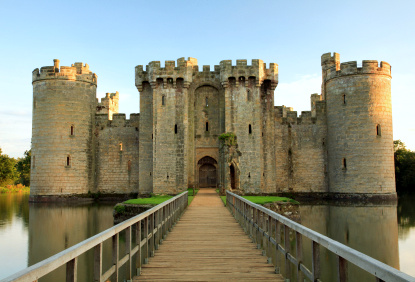
Bodiam Castle stands as one of Britain's most perfectly preserved 14th-century moated fortresses, offering visitors a remarkable glimpse into medieval life and architecture. Built in 1385 by Sir Edward Dalyngrigge, a knight of Edward III, this quadrangular castle represents the pinnacle of late medieval design, combining formidable defensive features with elegant domestic quarters. The castle's most distinctive feature is its complete water-filled moat, fed by natural springs, which reflects the imposing stone walls and towers to create one of England's most photogenic medieval monuments. Visitors can explore the castle's unique features including spiral staircases leading to tower tops with panoramic countryside views, the original iron-clad oak portcullis (considered one of the oldest in England), and the atmospheric ruins of the great hall where medieval feasts once took place. The castle's strategic positioning near the River Rother and its innovative architectural elements, such as the protective barbican gatehouse and sophisticated defensive systems, demonstrate the military engineering expertise of the era whilst serving as a symbol of prestige and power that attracted high society guests throughout the medieval period. |
| Hastings |
|---|

 Hastings offers visitors the chance to walk through one of England's most pivotal historical moments, as the site of the famous 1066 battle that changed the course of English history forever. The town combines this rich Norman heritage with a thriving fishing tradition that continues today, where visitors can watch boats being hauled up the beach in the same manner used for centuries. The medieval Old Town features narrow cobbled streets, ancient churches, and atmospheric caves once used by smugglers, whilst the clifftop castle ruins provide dramatic views across the English Channel. Beyond its historical significance, Hastings maintains an authentic seaside character with its working fishing fleet, traditional net shops, and vibrant arts scene, offering a genuine English coastal experience away from more commercialised resort towns. |
Hampshire
| Highclere Castle |
|---|

 Made famous as the filming location for Downton Abbey, Highclere Castle offers visitors a remarkable journey through over 1,200 years of English history, from its Anglo-Saxon origins as a bishop's residence to its transformation into the magnificent Victorian castle designed by Sir Charles Barry, architect of the Houses of Parliament. The estate combines architectural grandeur with fascinating historical connections, including its role as the family seat of the Earls of Carnarvon, whose 5th Earl famously sponsored the discovery of Tutankhamun's tomb in 1922. Today, guests can explore the opulent state rooms, browse the extensive library, and visit the unique Egyptian Exhibition housed in the castle's cellars, whilst the surrounding parkland, designed by renowned landscape architect Capability Brown, provides a stunning backdrop with its collection of 18th-century follies and carefully curated gardens. |
| Beaulieu Palace House |
|---|
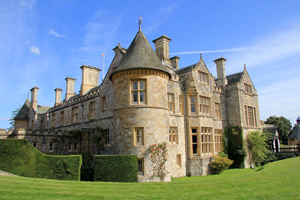
 Beaulieu Palace House and National Motor Museum offers a unique combination of living history and automotive heritage that spans over eight centuries. The Palace House, originally built as the 13th-century gatehouse to Beaulieu Abbey and transformed into a family residence following the Dissolution of the Monasteries in 1538, remains home to the Montagu family whilst showcasing Victorian Gothic architecture and period furnishings that tell the story of English aristocratic life. The National Motor Museum, founded in 1952 by the 3rd Baron Montagu as a tribute to his father—a British motoring pioneer—houses over 280 vehicles that chronicle the complete evolution of British motoring from its earliest days to modern Formula 1 racing, including iconic cars from film and television alongside land speed record breakers. This remarkable pairing allows visitors to experience both the grandeur of a lived-in stately home and the engineering brilliance that shaped Britain's automotive industry, making it a singular destination where family heritage and national motoring history converge in one comprehensive experience. |
| Winchester |
|---|

Winchester offers visitors a remarkable concentration of English heritage centred around its magnificent cathedral, one of Europe's longest medieval buildings, which houses the tomb of Jane Austen and features stunning Norman architecture. The city served as the ancient capital of Wessex and later England, with the Great Hall being the sole surviving remnant of Winchester Castle, famous for displaying what legend claims to be King Arthur's Round Table. The historic high street leads through centuries of well-preserved architecture, from medieval churches to Georgian townhouses, whilst the nearby ruins of Wolvesey Castle provide glimpses into the power of medieval bishops. Winchester College, founded in 1382, remains one of England's most prestigious schools and offers guided tours of its historic buildings, whilst the city's compact medieval street layout makes it particularly rewarding for walking tours that reveal layers of Roman, Saxon, and Norman history at every turn. |
| Portsmouth |
|---|

Portsmouth offers visitors an unparalleled glimpse into Britain's naval heritage through its historic dockyard, home to iconic warships including HMS Victory, Nelson's flagship from the Battle of Trafalgar, and the Tudor warship Mary Rose, which was raised from the seabed after 437 years. The city's maritime legacy extends beyond these famous vessels to include the National Museum of the Royal Navy and the opportunity to explore HMS Warrior, Britain's first iron-hulled warship. Beyond its naval attractions, Portsmouth features the distinctive Spinnaker Tower offering panoramic views across the Solent, whilst the historic Old Portsmouth district provides charming cobbled streets and traditional pubs alongside remnants of the medieval city walls. |
| New Forest National Park |
|---|
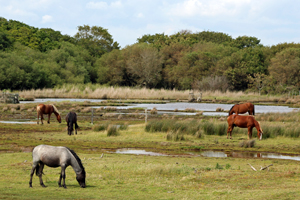
 The New Forest National Park offers a unique blend of ancient woodland, heathland, and traditional commoning practices that have remained largely unchanged for nearly a thousand years. Established by William the Conqueror in 1079 as a royal hunting ground, the forest retains its medieval character through the annual Drift, where Commoners still exercise their historic rights to graze ponies and cattle freely across the landscape. Visitors can explore over 150 square miles of diverse habitats, from ancient oak and beech woodlands to expansive heathlands dotted with gorse and heather, whilst encountering the famous New Forest ponies that roam freely throughout the area. The park's network of walking and cycling trails leads to picturesque villages with traditional thatched cottages, historic pubs, and local museums that showcase the area's fascinating heritage of forest law and rural traditions. Wildlife enthusiasts can spot deer, rare birds, and seasonal displays of wildflowers. |
Kent
| Canterbury ※
|
|---|

Ccentred around its magnificent Gothic cathedral where Archbishop Thomas Becket was murdered in 1170, Canterbury is a UNESCO World Heritage Site preserving over 1,400 years of history, from Roman foundations to medieval streets that inspired Geoffrey Chaucer's famous Canterbury Tales, whilst the cathedral's stunning architecture and ancient manuscripts provide an exceptional window into England's ecclesiastical past. Beyond its religious importance, the city combines Roman ruins, Norman castles, and well-preserved medieval buildings with modern attractions, creating an authentic historical experience that spans from guided cathedral tours to interactive exhibitions exploring the stories of pilgrims who have walked these streets for centuries. |
| Knole House |
|---|

Knole House stands as one of England's largest and most impressive country houses, featuring an extraordinary collection of 17th-century furniture, textiles, and paintings that remain largely unchanged since the early 1600s. The house showcases remarkable architectural evolution across several centuries, from its origins as a medieval archbishop's palace to its transformation into a grand aristocratic residence. Highlights include the spectacular Great Hall and the ornate galleries filled with original tapestries and royal portraits. The house gained additional cultural significance through its association with writer Vita Sackville-West, who immortalised it in literature, whilst the surrounding deer park offers glimpses of ancient parkland that has remained virtually untouched for over 400 years. |
| Leeds Castle |
|---|

Leeds Castle served as home to six medieval English queens and was transformed by Henry VIII into a magnificent royal palace, giving it an exceptional place in English royal history. Today, visitors can explore beautifully furnished interiors that reflect centuries of royal occupation, wander through 500 acres of parkland and formal gardens, and enjoy attractions ranging from falconry displays and a challenging maze with underground grotto to adventure golf and Britain's only dog collar museum. The castle's position on two islands connected by bridges creates a distinctive and picturesque setting that sets it apart from other historic sites, whilst its year-round programme of activities and events ensures there's something to engage visitors of all ages and interests. |
| Chartwell House |
|---|

Chartwell House offers visitors an intimate glimpse into the private world of Sir Winston Churchill, preserved exactly as it was during his forty-year residence from 1922 to 1965. The Victorian country house contains Churchill's personal study where he composed many of his famous speeches and wrote his books, alongside rooms filled with gifts from world leaders, family photographs, and personal mementos that reveal the domestic life behind the public figure. The property features Churchill's painting studio housing the largest collection of his artwork, complete with unfinished canvases and art supplies still laid out as he left them. The extensive gardens showcase Churchill's hands-on approach to landscape design, including the lakes he created himself, the walled kitchen garden he helped build, and Lady Churchill's formal rose garden, all set against sweeping views across the Kent Weald that originally convinced Churchill to purchase the property. |
| Dover |
|---|

 Set dramatically over the town's iconic White Cliffs, Dover provide breathtaking views across the English Channel, whilst Dover Castle stands as one of Europe's most impressive medieval fortresses, complete with its Norman Great Tower and the fascinating Secret Wartime Tunnels that served as the headquarters for the Dunkirk evacuation during World War II. The area reveals layers of British history from Roman times—including one of the few remaining Roman lighthouses in the world—through to its crucial role as a defensive stronghold against Napoleon and Hitler. Beyond the castle walls, visitors can explore the Bronze Age boat at Dover Museum, discover the world's first electric lighthouse at South Foreland, and walk the coastal paths where centuries of maritime history unfold, making Dover a compelling destination that brings together spectacular clifftop scenery with some of the most significant military and maritime heritage sites in Britain. |
| Hever Castle |
|---|

Hever Castle was the childhood home of Anne Boleyn, Henry VIII's second wife and mother of Elizabeth I. The 13th-century double-moated castle houses an exceptional collection of Tudor portraits, fine furniture, tapestries, and Anne Boleyn's personal prayer books bearing her own inscriptions and signature. Beyond its historical significance, the castle features award-winning gardens spanning 125 acres, including formal Italian gardens with classical statuary, a quintessential English rose garden with over 4,000 roses, and two challenging mazes - a traditional yew maze and an interactive water maze. The extensive grounds also include woodland walks, a boating lake, adventure playgrounds, and miniature model houses, whilst the castle's restoration by American millionaire William Waldorf Astor in the early 20th century created the Tudor village and luxurious interiors that visitors enjoy today. |
| Penshurst Place & Gardens |
|---|

Penshurst Place is a medieval castle with a remarkably preserved 14th-century Great Hall, one of the finest examples of medieval domestic architecture in the country. This historic house has remained in the same family for over 460 years, creating an unbroken link to England's past that few properties can match. The Sidney family's continuous residence has maintained the building's original character whilst accumulating centuries of fascinating stories, including connections to the famous Elizabethan poet Sir Philip Sidney. The formal gardens, some dating back 700 years, showcase evolving horticultural styles and provide a peaceful setting that complements the house's medieval grandeur. Together, the house and gardens present a living piece of English heritage where visitors can experience how the nobility lived across different historical periods. |
| Royal Tunbridge Wells |
|---|

Royal Tunbridge Wells gained prominence as a spa town in the 17th century when the chalybeate springs were discovered, attracting royalty and aristocrats seeking the supposed health benefits of the iron-rich waters. The elegant Georgian architecture of The Pantiles, a colonnaded walkway lined with independent shops, cafés, and galleries, remains the town's centrepiece and offers a glimpse into its fashionable past. Visitors can explore the historic Chalybeate Spring where it all began, wander through Calverley Grounds with its formal gardens and bandstand, or visit the impressive Tunbridge Wells Museum and Art Gallery housed in a Victorian civic building. The town's royal connections are evident throughout, having been granted its "Royal" prefix by King Edward VII, whilst the surrounding countryside offers additional attractions including the medieval ruins of Bayham Old Abbey and several National Trust properties within easy reach. |
| Sissinghurst Castle Garden |
|---|

Sissinghurst Castle Garden represents one of the most influential examples of 20th-century garden design, created from the ruins of an Elizabethan mansion by the renowned writer Vita Sackville-West and diplomat Harold Nicolson in the 1930s. The couple pioneered the revolutionary "garden rooms" concept, transforming a neglected farmstead into a series of themed outdoor spaces including the world-famous White Garden, which has inspired countless gardens worldwide. Visitors can explore the Grade I listed gardens whilst discovering their literary heritage—climbing the 16th-century tower to see Vita's preserved writing room where she penned her novels and poetry, and wandering through spaces that once hosted Britain's leading writers and artists. The gardens showcase an internationally respected collection of plants, particularly old garden roses, arranged within Harold's carefully planned axial design that opens onto intimate enclosed spaces, each with distinct planting schemes from vibrant cottage garden colours to the serene monochrome elegance of the White Garden. |
Other attractions
 Rochester Castle
Walmer Castle & Gardens
Oxfordshire
| Oxford |
|---|

Oxford offers visitors a remarkable concentration of medieval and Renaissance architecture through its 38 historic colleges, many dating back over 700 years. The University of Oxford, established in the 12th century, provides the backbone for the city's appeal with its iconic "dreaming spires," quadrangles, and the world-famous Bodleian Library. Tourists can explore college halls where countless notable figures studied, from Lewis Carroll to Stephen Hawking, whilst the city's compact centre allows easy walking between landmarks such as the Radcliffe Camera, Christ Church Cathedral, and the covered market. The blend of functioning academic life with public access creates an authentic atmosphere where visitors witness centuries-old traditions still in practice, complemented by excellent museums including the Ashmolean and the Museum of Natural History. |
| Blenheim Palace ※
|
|---|

Blenheim Palace stands as one of England's finest examples of Baroque architecture, built in the early 18th century as a gift to the Duke of Marlborough following his decisive victory at the Battle of Blenheim. The palace serves as the birthplace of Sir Winston Churchill and houses an impressive collection of tapestries, paintings, and period furniture that chronicle centuries of British aristocratic life. Visitors can explore the magnificent State Rooms designed by Sir John Vanbrugh, wander through capability Brown's landscaped parkland spanning over 2,000 acres, and discover the palace's role in shaping British military and political history. The estate offers a comprehensive glimpse into English heritage, from its formal gardens and lake to the Churchill Exhibition, making it a significant cultural and historical destination that represents the grandeur of Britain's past whilst remaining actively connected to the present day. |
| Chastleton House |
|---|

Chastleton House represents one of England's finest examples of Jacobean architecture, remarkably preserved in its original 17th-century state with authentic furnishings, tapestries, and decorative schemes that have remained largely untouched for over 400 years. Built between 1607 and 1612, the house offers visitors a rare glimpse into the domestic life of a gentry family across the centuries, complete with its original plasterwork, oak panelling, and period furniture that tell the story of the Jones family who called it home for generations. The property's connection to the English Civil War adds historical intrigue, whilst its famous topiary garden and the Middle Gallery—one of the longest rooms of its kind in England—showcase the craftsmanship and grandeur of the early Stuart period, making it a particularly authentic experience for those interested in England's architectural and social heritage. |
Surrey
| Clandon Park |
|---|

Clandon Park offers a striking example of Palladian architecture, with its grand Marble Hall, ornate plasterwork and period interiors reflecting the wealth and taste of the Onslow family who built it in the 1720s. Visitors can witness a live conservation project following the devastating 2015 fire, gaining unusual behind-the-scenes access to the painstaking restoration of historic rooms and collections. The grounds also shelter Hinemihi o te Ao Katoa, a 19th-century MÄori meeting house that adds a rare cross-cultural dimension, while formal gardens and woodland walks provide a pleasant contrast to the mansion’s classical symmetry. |
| RHS Wisley Gardens |
|---|

As the flagship garden of the Royal Horticultural Society, this destination offers a unique insight into the past, present, and future of British gardening. Originally established as an experimental garden in the 19th century, it is now home to one of the world's largest and most diverse plant collections. Visitors can explore numerous distinct garden areas, from the historic Glasshouse containing plants from around the globe to the modern RHS Hilltop, a centre for gardening science. The original Edwardian Laboratory, once the heart of the society's research, now provides a glimpse into the institution's heritage, making a visit an experience in both horticultural excellence and scientific discovery. |
West Sussex
| Arundel |
|---|

Arundel Castle offers visitors the rare opportunity to explore nearly 1,000 years of continuous family ownership, having served as the ancestral home of the Dukes of Norfolk since the 11th century. The castle showcases remarkable architectural evolution from its original Norman keep and medieval gatehouse to its lavishly restored Victorian state rooms, which house an exceptional collection of paintings by masters including Van Dyck, Gainsborough, and Canaletto. Beyond its artistic treasures, the castle provides fascinating insights into English history through personal possessions of Mary, Queen of Scots, furniture specially commissioned for Queen Victoria's 1846 visit, and the atmospheric 14th-century Fitzalan Chapel that serves as the private mausoleum for the Dukes of Norfolk. The extensive gardens, spanning 40 acres with tropical glasshouses, formal English gardens, and a unique stumpery, complement the castle experience whilst offering spectacular views across the South Downs and River Arun valley. |
| Petworth House |
|---|

Petworth House combines artistic treasures and historic grandeur, featuring one of Britain's finest art collections with masterpieces by Turner, Van Dyck, Reynolds, and Gainsborough displayed throughout its magnificent 17th-century baroque interiors. The Grade I listed mansion, built to rival European palaces, showcases exquisite wood carvings by Grinling Gibbons and grand state rooms that reflect over 900 years of continuous family ownership. Set within a stunning 700-acre deer park landscaped by 'Capability' Brown, the house provides a complete heritage experience where visitors can explore both the opulent living spaces and the historic servants' quarters, whilst enjoying the tranquil parkland populated by herds of fallow deer. |
| Chichester |
|---|

Chichester offers visitors a rich tapestry of Roman heritage and medieval architecture, anchored by its magnificent Norman cathedral with its distinctive detached bell tower and contemporary Chagall window. The city's well-preserved Roman walls encircle a compact historic centre where the ornate Market Cross stands as a focal point amongst Georgian townhouses and traditional shops. Cultural attractions include the renowned Festival Theatre, which hosts acclaimed productions, and the Pallant House Gallery with its impressive collection of modern British art. The nearby Goodwood Estate adds further appeal with its motor racing circuit, sculpture park, and stately home, while the surrounding South Downs provide scenic walking opportunities just minutes from the city centre. |
Other attractions
Bignor Roman Villa
|


 Ireland Guide
 Scotland Guide
 Wales Guide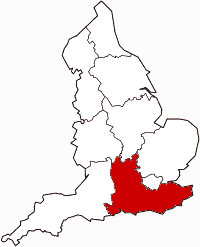

 The South Downs National Park offers visitors an exceptional opportunity to experience England's largest expanse of chalk downland, featuring rolling hills, ancient grasslands, and diverse wildlife habitats that support over 40 species of butterflies and numerous rare birds including skylarks and yellowhammers. The park's 1,600 square kilometres encompass pristine chalk cliffs, flower-rich meadows filled with orchids and other native wildflowers, and well-maintained footpaths including sections of the South Downs Way that provide excellent walking opportunities with panoramic views across the English Channel and surrounding countryside. The unique chalk geology creates distinctive landscapes and supports specialised plant communities that have developed over thousands of years, making it an ideal destination for nature enthusiasts, hikers, and anyone seeking to experience traditional English downland scenery whilst observing wildlife in their natural habitats.


 The New Forest National Park offers a unique blend of ancient woodland, heathland, and traditional commoning practices that have remained largely unchanged for nearly a thousand years. Established by William the Conqueror in 1079 as a royal hunting ground, the forest retains its medieval character through the annual Drift, where Commoners still exercise their historic rights to graze ponies and cattle freely across the landscape. Visitors can explore over 150 square miles of diverse habitats, from ancient oak and beech woodlands to expansive heathlands dotted with gorse and heather, whilst encountering the famous New Forest ponies that roam freely throughout the area. The park's network of walking and cycling trails leads to picturesque villages with traditional thatched cottages, historic pubs, and local museums that showcase the area's fascinating heritage of forest law and rural traditions. Wildlife enthusiasts can spot deer, rare birds, and seasonal displays of wildflowers.


 : Local interest
 : Moderately interesting
 : Outstanding place
 : Must-see in the country
 : Top cities in Europe