


 Ireland Guide
 Scotland Guide
 Wales Guide
| Contents |
|---|
Introduction
Perched on the northern edge of Hampstead Heath, Kenwood House is a tranquil neoclassical gem famed for Robert Adam’s exquisite interiors and the Iveagh Bequest—highlighted by a radiant Rembrandt self-portrait and superb works by Gainsborough and Reynolds. Explore the gilded library, step out to rolling lawns, woodland paths and a reflective lake with sweeping views over London, then linger at the café or picnic beneath ancient trees. With free entry, family-friendly trails and seasonal events, Kenwood blends art, architecture and countryside in one effortless half-day escape—ideal to pair with a Heath ramble and a stroll through Hampstead village.
Interesting Facts about Kenwood House
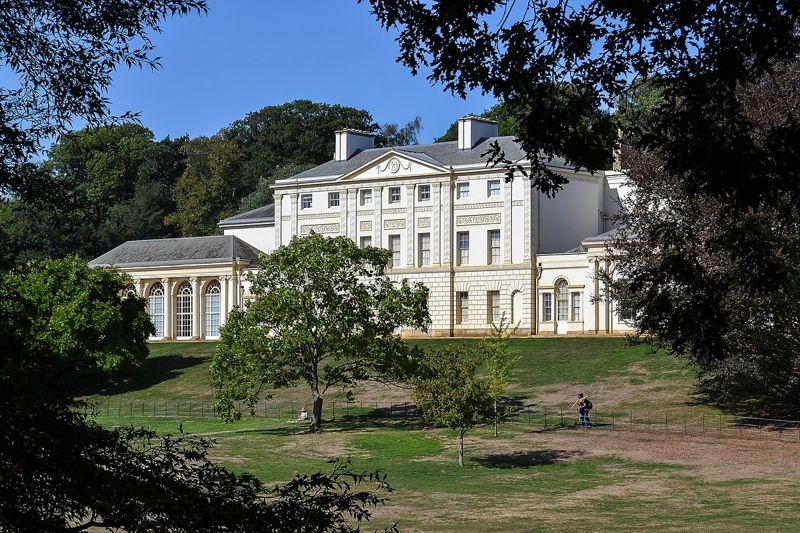
- Kenwood House crowns the northern edge of Hampstead Heath, a neoclassical villa remodelled by Robert Adam between 1764 and 1779 for William Murray, later the 1st Earl of Mansfield.
- Its celebrated Adam Library, famed for serene symmetry and pastel ornament, is considered one of Adam’s finest surviving interiors in Britain.
- The house holds the Iveagh Bequest, an exceptional art collection featuring Old Masters including Rembrandt and Vermeer, gifted to the nation by Edward Guinness, 1st Earl of Iveagh.
- The estate’s story begins in 1616 when John Bill, King James I’s printer, bought the land and raised an early brick house later transformed behind the Georgian façade.
- Dido Elizabeth Belle, the mixed-race great-niece of Lord Mansfield, was brought up at Kenwood in the late 18th century, a rare and revealing presence in an aristocratic British household.
- Lord Mansfield, a towering legal figure and Lord Chief Justice, shaped English common law while making Kenwood his country retreat just beyond the city.
- The north front’s Ionic portico and balanced wings give Kenwood its iconic silhouette above rolling lawns that sweep down towards tranquil water and woodland.
- Part of the grounds opened to the public in the 1920s, and today the house is cared for as a free-to-enter cultural gem amidst Hampstead Heath.
- The mansion’s setting has proved cinematic, with its classical lines and landscaped grounds appearing as a refined backdrop in modern film.
- Concerts and seasonal events have long animated the estate, pairing fine art and architecture with music in a quintessential London green setting.
History
Kenwood House occupies a site that has been inhabited since the early 17th century, when John Bill, King James I's printer, purchased the estate in 1616 and constructed the first brick house on the land originally known as Caen Wood. The substantial property, which boasted 24 hearths recorded in the 1665 Hearth Tax assessment, passed through several hands over the decades, including Brook Bridges who acquired it for £3,400 in 1690 and significantly modified the structure around 1700. The estate continued to change ownership throughout the early 18th century, belonging to various notable figures including the Duke of Argyll in 1712, the Earl of Islay who added the famous Kenwood Lime Avenue in 1726, and the 3rd Earl of Bute who constructed the Orangery in 1746 as a greenhouse for his exotic plants.
The house's transformation into the neoclassical masterpiece we see today began in 1754 when William Murray, later the 1st Earl of Mansfield and Lord Chief Justice, purchased the property. Between 1764 and 1779, Murray commissioned the celebrated Scottish architect Robert Adam to completely remodel the house, giving him complete creative freedom as Adam later claimed that Lord Mansfield "gave full scope to my ideas". Adam's revolutionary alterations included the addition of a magnificent full-height giant pedimented portico on the north front in 1764, the creation of the world-renowned library or 'Great Room' between 1767-1769 (considered one of the finest English 18th-century interiors anywhere), and the modernisation of existing spaces including the entrance hall, Great Stairs, and various social rooms decorated in his signature pale pink, blue, and white colour scheme. The house served as a country retreat for Lord Mansfield, his wife Elizabeth, and their adopted family members including their niece Anne Murray and great-nieces Elizabeth Murray and Dido Elizabeth Belle, the latter being the mixed-race daughter of Mansfield's nephew and an enslaved African woman who was raised as a free gentlewoman at Kenwood.
Following the 1st Earl of Mansfield's death in 1793, the property passed to his nephew David Murray, the 2nd Earl, who commissioned extensions including new dining facilities and service wings, and crucially had the main Hampstead-Highgate road diverted between 1793-1796 to create the current secluded setting. The house remained with the Mansfield family until 1922, when the 6th Earl sold much of the estate to prevent development, with the land opening to the public in 1925 when King George V officially inaugurated the public access. The property's preservation as a cultural institution was secured when Edward Cecil Guinness, 1st Earl of Iveagh and heir to the Guinness brewing fortune, purchased Kenwood House and the remaining grounds for £107,900 in 1925, subsequently bequeathing both the neoclassical villa and his internationally important collection of Old Master paintings—including masterpieces by Rembrandt, Vermeer, Gainsborough, Reynolds, and Turner—to the British nation upon his death in 1927. Today, the house operates as a free public gallery managed by English Heritage, showcasing the Iveagh Bequest collection within Adam's exquisite interiors whilst standing in 74 acres of landscaped grounds that afford spectacular views towards the City of London.
Description
Architectural Splendour and External Features
The approach to Kenwood House reveals its architectural magnificence gradually, as Robert Adam intended. The villa's distinctive white stucco exterior, originally made from innovative 'Liardet's cement', creates a striking contrast against the natural greenery surrounding it. The north front presents visitors with an imposing colonnaded portico supported by four Ionic columns, creating a dramatic entrance that speaks of grandeur and refinement. This impressive façade draws the eye upward to the triangular pediment above, decorated with classical motifs that herald the sophisticated interior beyond.
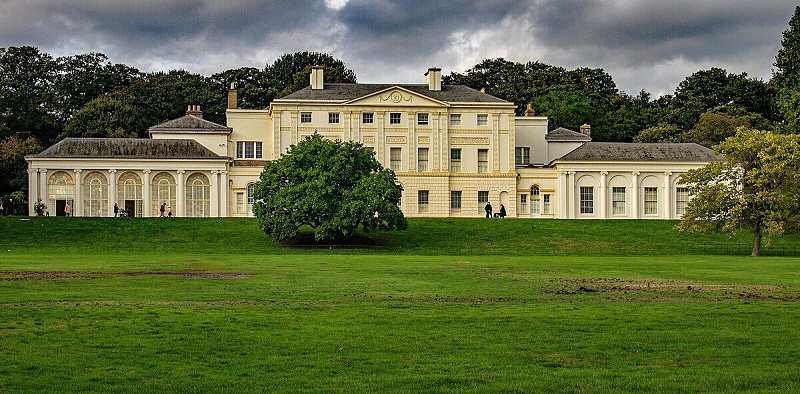
The south elevation is perhaps even more spectacular, offering sweeping panoramic views across the Heath toward London. Here, Adam demonstrated his architectural genius by creating perfect symmetry through the addition of the Library on the east side, which exactly balances the existing Orangery on the west. This ingenious solution created a harmonious façade whilst providing the grand entertaining space that the villa's aristocratic owners required. The south terrace, with its elegant balustrade, provides the perfect vantage point from which to appreciate both the house's classical proportions and the carefully composed landscape that flows away from it.
The later additions by George Saunders in the 1790s, including the north-east and north-west wings that house the Dining Room and Music Room respectively, were executed in contrasting white Suffolk brick. This material choice was both practical and aesthetic, distinguishing the newer work from Adam's original stucco whilst maintaining the overall harmony of the composition. The service wing, cleverly concealed behind the dining room wing, demonstrates the period's sophisticated understanding of both functionality and visual appeal.
The Magnificent Interiors
Stepping through the entrance door, visitors immediately encounter the refined elegance that characterises every aspect of Kenwood's interior. The Entrance Hall, though modest in scale, serves as an elegant introduction to Adam's decorative genius. Originally designed to double as a dining room, this space showcases Adam's integrated approach to interior design, with its carefully coordinated colour palette of soft pastels creating a sense of unity throughout the house. The ceiling, decorated with original paintings by the Venetian artist Antonio Zucchi, features delicate classical motifs executed in blues, pinks, and whites that set the tone for the entire house.
The Great Stairs, recently restored to their original blue balustrade (replacing an inappropriate 20th-century black), provide a graceful ascent to the upper floor. The restoration work has revealed Adam's original vision, with walls now returned to their intended pale blue rather than the later turquoise, and the intricate plasterwork once again gleaming in its original colours. Every detail, from the carved handrail to the decorated risers, speaks of Adam's attention to creating a unified artistic vision.
The antechamber, or entrance to the Library, has been meticulously restored to its original delicate lead white and pale green colour scheme. The once-marbled columns now stand white as Adam intended, creating a subtle transition space that prepares visitors for the Library's spectacular interior. Original Adam-designed furniture, including window seats and long stools, has been painstakingly tracked down and returned to their original positions, completing the authentic 18th-century atmosphere.
The Great Library: Adam's Masterpiece
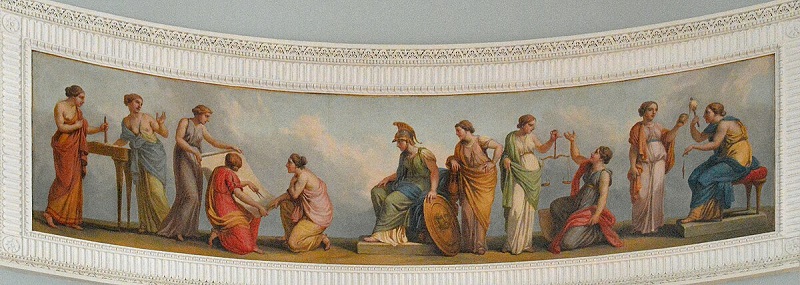
The Great Library stands as one of Robert Adam's finest surviving interiors, a room of such breathtaking beauty that it continues to inspire awe more than two centuries after its completion. This spectacular space, with its soaring barrel-vaulted ceiling, represents the pinnacle of neoclassical interior design. The ceiling's intricate plasterwork, executed in a rainbow of pastel shades—soft blues, delicate pinks, gentle greens, and warm creams—creates an effect that is both grand and intimately beautiful.
The room's proportions are perfectly calculated to create a sense of harmony and repose. Tall windows on the south side flood the space with natural light, whilst the colour scheme changes subtly throughout the day, creating an ever-shifting canvas of beauty. The original decorative ceiling paintings by Antonio Zucchi remain in pristine condition, their classical scenes and mythological figures providing intellectual stimulus for the room's 18th-century occupants.
Adam designed built-in bookcases that integrate seamlessly with the room's decorative scheme, their pale wood tones complementing the overall palette. The marble fireplace, with its exquisite carved details, serves as a focal point whilst providing practical warmth during London's cooler months. Original Adam-designed furniture, including specially commissioned library chairs and tables, has been returned to create an authentic atmosphere where visitors can imagine the room's original function as both library and principal entertaining space.
Additional Reception Rooms
The Music Room, added in the 1790s, provides insight into the domestic life of the Georgian aristocracy. This intimate space, with its carefully proportioned windows and elegant fireplace, was designed for the informal entertainment that formed such an important part of upper-class social life. Period instruments, including a chamber organ, suggest the musical performances that would have delighted guests on numerous occasions.
The Dining Room, also part of Saunders' additions, demonstrates the evolving needs of the Georgian household. With its practical layout and proximity to the service areas, this space shows how even grand houses needed to balance formality with functionality. The room's decoration, whilst not by Adam, maintains the house's overall sense of refined elegance.
Lady Mansfield's dressing room offers a glimpse into the private world of 18th-century domestic life. This intimate space, with its delicate decorative details and carefully chosen furnishings, shows how even the most private areas of grand houses were designed with beauty and comfort in mind.
The Iveagh Bequest: A World-Class Art Collection
Kenwood's role as a public art gallery began with Lord Iveagh's magnificent bequest of 63 paintings, creating one of the finest collections of Old Master and British paintings ever given to the nation. The collection is displayed throughout the house's reception rooms, creating an atmosphere where great art enhances domestic architecture and vice versa.
The collection's crown jewel is Rembrandt's late masterpiece, Self-Portrait with Two Circles (c. 1665), a work of profound psychological depth that ranks among the artist's finest achievements. The painting's mysterious circles and the artist's penetrating gaze create an intimate encounter that few museum settings could match. Displayed in domestic surroundings, this masterpiece takes on additional layers of meaning, becoming part of the lived experience of the house.
Johannes Vermeer's The Guitar Player (c. 1672) represents one of only around 34 known works by this master of light and domestic intimacy. The painting's exquisite detail and luminous quality exemplify Vermeer's genius, whilst its domestic subject matter perfectly complements Kenwood's residential setting. The work's preservation and presentation allow visitors to appreciate subtleties of technique that would be impossible in a more crowded museum environment.
The collection's British portraits form the largest group, featuring masterpieces by Thomas Gainsborough, Sir Joshua Reynolds, and George Romney. Gainsborough's Mary, Countess Howe exemplifies his mastery of both portraiture and landscape, whilst his full-length portraits demonstrate the elegant sophistication of Georgian society. Reynolds' seventeen works in the collection span his entire career, showing the development of Britain's most influential portrait painter. Romney's portraits, including his famous depictions of Emma Hamilton such as The Spinstress, capture the era's fascination with beauty and sentiment.
The Dutch and Flemish Old Masters include works by Anthony van Dyck, Frans Hals, and other giants of European art. These paintings, predominantly from the 17th century, demonstrate the highest achievements of European painting traditions. The intimate setting allows visitors to study brushwork, colour relationships, and artistic techniques in ways that larger institutions cannot provide.
French Rococo paintings round out the collection, representing the elegant sophistication of 18th-century European taste. These works, whilst fewer in number, provide important context for understanding the international artistic currents that influenced British collecting practices.
The Suffolk Collection and Other Treasures
Beyond the Iveagh Bequest, Kenwood houses the remarkable Suffolk Collection, a series of royal and family portraits spanning the 16th to 19th centuries. These works, many depicting members of the Howard family and various courtiers, provide fascinating insights into the evolution of British portraiture. The collection includes internationally important works by William Larkin, whose distinctive style captures the elaborate costumes and formal poses of Jacobean court life.
The house also displays three distinct collections of miniatures, jewellery, and shoe buckles that reveal the exquisite craftsmanship of Georgian artists. These small, portable treasures demonstrate the period's appreciation for intimate works of art and personal adornment. The miniatures, in particular, show the extraordinary skill required to create detailed portraits on such a small scale, whilst the jewellery and buckles illustrate the elaborate decorative arts that accompanied Georgian fashion.
The Designed Landscape: Repton's Masterpiece
The 112 acres of parkland surrounding Kenwood House represent one of Humphry Repton's finest landscape achievements. Commissioned in 1793 by the 2nd Earl of Mansfield, Repton's design transformed the villa's surroundings into a masterpiece of naturalistic landscape gardening that perfectly complements Adam's architectural work.
Repton's genius lay in his ability to create apparently natural landscapes that were actually carefully composed artistic statements. His design for Kenwood included the strategic moving of Hampstead Lane further from the house, allowing for the creation of sweeping carriage drives that provide dramatic approaches to the villa. These curving drives, still visible today, create a sense of anticipation as the house gradually reveals itself through carefully framed vistas.
The landscape's centrepiece is the magnificent sweep of lawn that flows away from the south front toward the lake. This carefully graded slope, dotted with specimen trees, creates a living painting that changes with the seasons and weather conditions. Repton's skill in creating this "borrowed landscape" effect makes the villa appear to command a vast estate stretching toward London, when in reality the property's boundaries are much more modest.
The lake itself, crossed by a charming wooden bridge, provides both a picturesque focal point and a practical solution to the site's natural drainage. Its serpentine shape and carefully designed banks create multiple vantage points for appreciating reflections and wildlife, whilst the surrounding plantings provide habitat for various species of waterfowl and other creatures.
Woodland Walks and Garden Features
The estate's ancient woodlands, remnants of the medieval Forest of Middlesex, provide a fascinating contrast to Repton's more formal landscape interventions. These areas, with their towering oaks, beeches, and hornbeams, some hundreds of years old, create a sense of timeless continuity that grounds the 18th-century villa in its natural setting. Woodland paths wind through these areas, offering peaceful retreats and opportunities to observe wildlife in their natural habitat.
The spring display at Kenwood is particularly spectacular, with thousands of daffodils, snowdrops, and crocuses carpeting the ground beneath the ancient trees. These naturalised bulbs, planted over many decades, create vast drifts of colour that complement the emerging green of new leaves. Later in the year, bluebells and wild garlic add their own contributions to this natural garden.
Scattered throughout the landscape are significant sculptures by major 20th-century artists, including works by Barbara Hepworth and Henry Moore. These pieces, carefully sited to complement both the natural and designed landscape, add contemporary artistic interest whilst respecting the historical character of the estate. The sculptures create focal points for walks and provide opportunities for contemplating the relationship between art and nature.
Hidden Treasures and Architectural Curiosities
Behind the main café, visitors can discover one of Kenwood's most intriguing features: a curious brick-walled cold bath, a remnant of Hampstead's 18th-century role as a fashionable health spa. This octagonal structure, built into the hillside, provides a fascinating glimpse into Georgian attitudes toward health and hygiene, when cold water bathing was considered both fashionable and beneficial.
The Dairy, designed by George Saunders in 1794-6 for Louisa, 2nd Countess of Mansfield, represents a charming example of Georgian romanticism. This complex of buildings includes a small octagonal tearoom where the Countess would entertain her friends in pastoral surroundings, a 'Dairy House' for the resident dairymaid, and practical areas including a scullery and ice-house. Recently renovated, the Dairy now serves as a nature interpretation centre, providing insights into the Heath's wildlife and ecology.
The old Orangery, dating from the 1740s and built by Lord Bute, demonstrates the Georgian fascination with exotic plants and garden buildings. This elegant structure, with its tall south-facing windows and classical proportions, would have housed tender plants during winter months whilst providing an additional entertaining space during warmer weather.
Contemporary Amenities and Visitor Experience
The former service wing has been thoughtfully converted into the Brew House Café, which offers a range of refreshments in surroundings that maintain the house's historical character. The café's location allows visitors to rest and reflect on their experience whilst remaining within the estate's enchanting atmosphere. The menu features both traditional British fare and contemporary options, catering to diverse tastes whilst maintaining quality standards appropriate to the setting.
The well-stocked shop, also housed within the converted service areas, offers an extensive range of books, gifts, and souvenirs that allow visitors to take something of Kenwood's magic home with them. The selection includes detailed guides to the house and collection, art books, and locally made crafts that reflect the estate's character and history.
Throughout the year, Kenwood hosts a variety of exhibitions, concerts, and special events that bring the house and grounds to life. These programmes, carefully designed to complement rather than overwhelm the historic setting, provide additional reasons to return and explore different aspects of this remarkable place. From chamber music concerts in the Library to outdoor theatre performances on the lawns, these events maintain Kenwood's tradition as a place of cultural enrichment.
The estate's commitment to conservation and education ensures that future generations will be able to enjoy this remarkable place. Ongoing restoration work, guided by the latest historical research and conservation techniques, continues to reveal new aspects of Adam's and Repton's genius whilst preserving their achievements for posterity.
Getting There
Kenwood House sits on the northern edge of Hampstead Heath; the simplest route is to take the Northern line to either Archway or Golders Green, then hop on the 210 bus which stops by the Kenwood House entrance on Hampstead Lane/Compton Avenue for a short final walk. From Archway, the 210 runs frequently and brings you up the hill to the gates, saving you the steepest part on foot. If you prefer a scenic approach, take the Overground to Hampstead Heath or Gospel Oak and stroll across the Heath to the house in around 25–30 minutes, enjoying wide views en route. Buses 210 and local services serve stops marked “Kenwood House” or “Compton Avenue/Kenwood House,” making wayfinding straightforward once you’re in Hampstead or Highgate.
Best Time to Visit
The best time to visit Kenwood House is on a clear weekday morning in late spring or early autumn, when the rooms are calmer, the light flatters Robert Adam’s interiors, and the gardens are at their loveliest with rhododendrons in May and rich foliage come September. Summer weekends can be very busy, especially if there are events on the Heath, so arriving early helps you enjoy the art collection and library in peace. Winter brings quieter galleries and crisp walks, though shorter daylight hours mean planning for an earlier finish. Whenever you go, pair the visit with a stroll on Hampstead Heath for wide city views and a relaxed, scenic finish.