


 Ireland Guide
 Scotland Guide
 Wales Guide
| Contents |
|---|
Introduction
Ham House is a rare survivor of 17th-century splendour on a tranquil bend of the Thames at Richmond, a National Trust gem famed for its near-intact Stuart interiors, scented formal gardens and riverside calm. Step into richly panelled rooms hung with Old Masters, gleaming Dutch cabinets and shimmering textiles; admire the Green Closet and dramatic Painted Staircase; then wander past clipped yews, the Cherry Garden and historic orangery before pausing in the café. Reached by riverside walk from Richmond or via Hammerton’s Ferry from Twickenham, it blends heritage with bucolic charm—ideal for a half-day escape with photo-worthy corners and seasonal events.
Interesting Facts about Ham House
- Ham House is a rare, richly preserved Stuart mansion on the Thames, begun in 1610 for Sir Thomas Vavasour, Knight Marshal to King James I.
- King Charles I granted the lease to his boyhood companion William Murray in 1626, helping launch its rise as a courtly power-house.
- Elizabeth Murray, later Duchess of Lauderdale, expanded and refashioned Ham House after the Restoration, creating opulent state rooms and fashionable interiors of the highest calibre.
- The house retains outstanding 17th-century furniture, tapestries and decorative arts, including work associated with cabinetmaker Gerrit Jensen and gilded leather hangings.
- Its plan evolved from an original H-shape, later infilled on the garden front in the 1670s to almost double the house’s size and grandeur.
- The Great Staircase (1638–39) was designed as a ceremonial route to state apartments, with exuberant carved martial trophies and fantastical creatures.
- Ham House is Grade I listed, with gardens listed Grade II*, reflecting its exceptional national significance and survival of Stuart-era character.
- The gardens feature 17th-century design elements, including a cherry parterre, kitchen garden and wilderness areas framed by high brick walls.
- John Evelyn praised Ham in 1678 as “inferior to few of the best villas in Italy,” signalling its European-inspired luxury in Restoration England.
- Discreet royalist symbolism abounds, with “Vivat Rex” and a bust of Charles I added after the Restoration to proclaim loyal affiliations.
- Elizabeth Murray skilfully navigated Civil War politics, cultivating Cromwell while aiding royalist networks, then reshaping the house under Charles II.
- The property passed to the National Trust in the 20th century and is today one of London’s most atmospheric survivals of Stuart taste and life.
- Early sash windows and classical garden-front elevations reveal cutting-edge continental influences embraced by the Lauderdales.
- The Long Gallery and intimate Green Closet reflect elite Stuart collecting culture, echoing innovations seen in royal palaces like Whitehall.
- Its atmospheric rooms and intact setting have made Ham House a popular filming location and a touchstone for understanding 17th-century England.
History
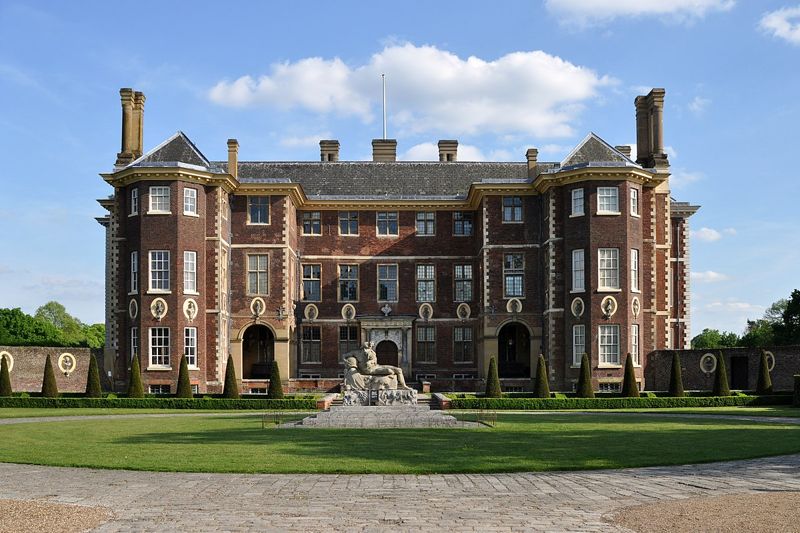
Ham House, a magnificent Stuart mansion set in formal gardens on the banks of the River Thames in Ham, south of Richmond, has stood as one of London's most remarkable historical treasures since its completion in 1610. Originally built by Sir Thomas Vavasour, an Elizabethan courtier and Knight Marshal to James I, the house was constructed in an H-plan layout consisting of nine bays and three storeys. The Thames-side location was ideal for Vavasour's court role, allowing him to move seamlessly between the palaces at Richmond, Hampton Court, London and Windsor. After Vavasour's death in 1620, the house was granted to John Ramsay, 1st Earl of Holderness, until his death in 1626, when it was leased and later purchased by William Murray. Murray, born around 1600, had grown up with the future King Charles I and held the rather unenviable position of the King's whipping boy, receiving beatings otherwise meant for the future monarch due to any royal misbehaviour. Charles didn't forget this loyalty, appointing Murray as Gentleman of the Bedchamber and granting him both the lease to Ham House and the title of Lord Dysart.
The house achieved its greatest period of prominence under the remarkable Elizabeth Murray, William's eldest daughter, who inherited the estate in 1655 upon her father's death during his exile following the English Civil War. Unusually well-educated and capable of running a vast household, Elizabeth was thoroughly connected at court and had eleven children with her first husband Lionel Tollemache, though only five survived to adulthood. During the tumultuous Civil War period, whilst her father William fought for the Royalist cause, Catherine Murray and young Elizabeth remained at Ham House to protect it from confiscation by Parliament. Elizabeth proved herself a cunning political operator, maintaining good relations with Oliver Cromwell during his rule as Lord Protector to keep control of Ham during the Interregnum, whilst secretly supporting efforts to restore the Stuarts to the throne, carrying secret letters to the continent and sharing recipes for invisible ink with her collaborators. Following the Restoration in 1660, Elizabeth's loyalty was rewarded, and after her first husband's death in 1669, she married John Maitland, 1st Earl (later Duke) of Lauderdale in 1672, becoming the Duchess of Lauderdale. The Lauderdales held important roles at Charles II's court, with the Duke being a member of the notorious Cabal ministry and holder of major positions in Scotland, whilst the Duchess exercised significant social and political influence.
Under Elizabeth's ambitious vision, Ham House was transformed into what John Evelyn described in 1678 as being "inferior to few of the best villas in Italy the House furnished like a great Prince's". The house was almost doubled in size with private apartments for the Duke and Duchess, as well as princely accommodation suites for visitors, furnished to the highest standards of courtly taste and decorated with "a lavishness which transcended even what was fitting to their exalted rank". The Lauderdales accumulated notable collections of paintings, tapestries and furniture, and redesigned the gardens and grounds to reflect their exalted status. The front of the house still proclaims its royal loyalty with a bust of King Charles I and "Vivat Rex" (Long Live the King) carved on the front door, these overt displays being post-Restoration additions from around the 1670s. Following the 9th Earl of Dysart's death in 1935, Ham House passed to a second cousin, Sir Lionel Tollemache, who with his son Cecil gave the house to the National Trust in 1948. Today, this atmospheric mansion remains virtually unchanged for 400 years and is internationally recognised for its superb collection of textiles, furniture and art which have remained in the house for centuries, representing one of the most complete survivals of 17th-century life in England.
Description
The House: A Masterpiece of Stuart Architecture and Decoration
The house presents an imposing yet inviting façade of deep red brick, its architectural integrity maintained for over four centuries. As you cross the threshold, the immediate impression is one of entering a world preserved in amber – every detail speaks of wealth, sophistication, and an era when ostentation was not merely acceptable but expected.
The Great Hall: Gateway to Grandeur
The Great Hall serves as your introduction to Ham House's extraordinary interiors. Dating from the original 1610 construction, this room immediately captivates with its distinctive black-and-white marble chequerboard floor, believed to be original to the building. The pattern creates a mesmerising optical effect that draws the eye upward to Joseph Kinsman's elaborate plasterwork ceiling from the 1630s. This master craftsman, who also worked on Whitehall Palace for King Charles I, created a composition of extraordinary complexity, with deep beams enclosing rectangles bursting with individually crafted fruit and flowers, punctuated by hemispherical rosettes at the intersections – a feature that may be unique in English interior decoration.
The room's oak staircase, dating from the 1630s, is a work of art in itself, adorned with carved trophies of arms that showcase the military prowess and noble lineage of the house's owners. By the early 18th century, the hall had been dramatically enhanced by opening the ceiling to create a connection with the Round Gallery above, allowing light to cascade down through a balustraded opening. This modification creates a theatrical vertical space where guests gathering in the Round Gallery could peer down at dancing couples below, adding layers of social interaction to the architectural experience.
The walls display a carefully curated selection of family portraits spanning centuries, including Sir Joshua Reynolds' portrait of Charlotte Walpole, Countess of Dysart, exhibited at the Royal Academy in 1775, and works by John Constable, who was commissioned as a family friend to create copies of earlier family portraits, demonstrating the continuity of artistic patronage that characterised the house's history.
The Marble Dining Room: A Study in Evolving Luxury
The Marble Dining Room exemplifies Ham House's unique ability to document changing fashions in interior decoration across centuries. Since 1675, the walls have been adorned with leather panels, though visitors today can observe two distinct decorative schemes that tell the story of evolving taste and technology.
The original 1675 design featured brightly coloured Flemish leather panels depicting fruits and flowers – tulips, roses, and other botanical motifs – interspersed with birds and butterflies, all set against a white background. These panels were embossed and partially gilded, creating a sumptuous visual feast that complemented the room's original black and white marble floor, from which the room derives its name. This leather decoration was considered ideal for dining rooms, as it did not absorb food odours like fabric tapestries would.
In 1756, the 4th Earl of Dysart modernised the room by removing the marble floor and replacing it with an exquisite marquetry floor of tropical hardwoods – a testament to 18th-century craftsmanship and the global trade connections that supplied such exotic materials. Simultaneously, he commissioned John Hutton of London to create new leather wall hangings featuring an embossed diaper rosette pattern surrounded by four leaves. The brown sections visible today were originally gold, achieved through the technique of varnishing silver leaf with yellow lacquer, creating a lustrous surface that would have shimmered in candlelight.
The North Drawing Room: A Treasury of Decorative Arts
After dinner, guests would retire to the North Drawing Room for conversation and entertainment, entering a space that represents the pinnacle of 17th-century decorative arts. Joseph Kinsman's plasterwork ceiling continues his masterful work from the Great Hall, with deep beams creating rectangles filled with individually crafted botanical motifs, while unusual hemispherical rosettes mark the intersections – a detail that may be unique to Ham House.
The room's crown jewel is the extraordinary ivory cabinet, a piece so remarkable that it was quickly moved to the prestigious Queen's Bedchamber after its acquisition. This large oak and cedar cabinet is veneered in rippled ivory panels both inside and out, creating a surface that seems to glow with inner light. When opened, it reveals fourteen drawers, with an inner door concealing additional small drawers, secret compartments, and hidden storage spaces. The cabinet may have originated in the Northern Netherlands, inspired by furniture inlaid with ivory brought back from Dutch Brazil in 1644, demonstrating the global connections that influenced English decorative arts.
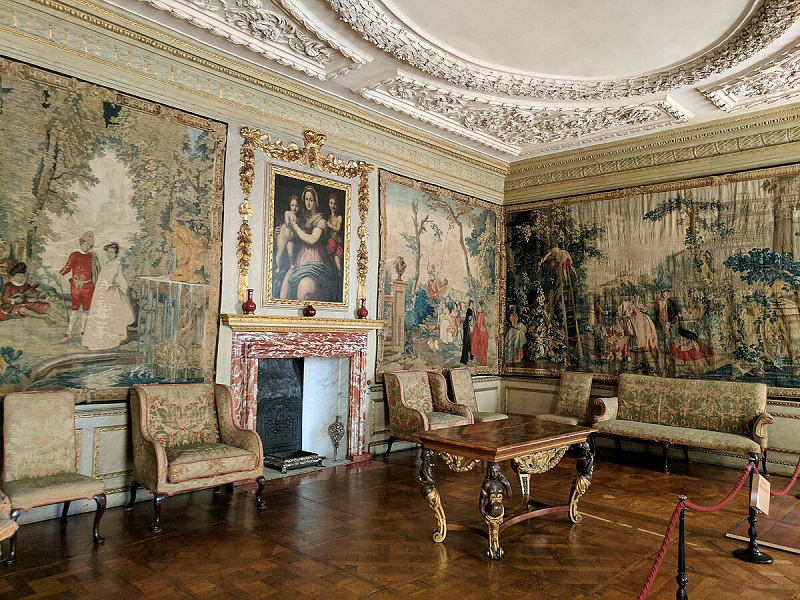
The room is further enhanced by a vibrant set of tapestries depicting the seasons, woven in Lambeth between 1699 and 1719 by Stephen de May, an ex-Mortlake weaver working to Mortlake designs. These tapestries, originally commissioned by the 1st Lord Shelburne and later acquired by the 4th Earl of Dysart, incorporate gold thread and depict seasonal activities such as milking for April, ploughing and sowing for September, and wine-making for October. Beyond their decorative function, these tapestries served the practical purpose of providing warmth in draughty rooms while serving as status symbols due to their considerable expense.
The Withdrawing Room: Theatre of Social Interaction
Following dinner in the Marble Dining Room, guests would move to the Withdrawing Room for entertainment and refined conversation. This space also served as an antechamber to the adjacent bedchamber, creating a carefully orchestrated sequence of social spaces that reflected 17th-century protocols of hospitality and privacy.
The room's most spectacular feature is the Antwerp cabinet (c. 1650-1675), a masterpiece of theatrical furniture design. Its somewhat austere ebonised pine exterior, decorated with red tortoiseshell, gives no hint of the ornate interior that awaits. When the two doors are opened, they reveal multiple shallow drawers flanking an architectural centrepiece that opens to unveil a theatrical set framed by golden pillars and mirrors. This cabinet is embellished with ivory, pietra paesina (naturally patterned limestone), and gilt bronze and brass, creating a miniature stage set that would have delighted and amazed 17th-century guests.
The Duke's and Duchess's Apartments: Private Luxury
The private apartments showcase the ultimate in 17th-century luxury, with each room designed to impress and overwhelm visitors with displays of wealth and taste. The Duke's Apartment and Duchess's Apartment feature silk damask wall hangings in rich colours, magnificent state beds with elaborate hanging systems, and private closets designed for quiet contemplation or intimate meetings.
These rooms contain some of Ham House's most precious objects, including a rare Chinese teapot, one of the earliest examples known and said to have been used by the Duchess herself. The apartments demonstrate the careful balance between public display and private comfort that characterised aristocratic living in the Stuart period.
The Long Gallery: A Promenade of Portraits
Spanning the entire length of the house, the Long Gallery serves multiple functions as exercise space, art display area, and social promenade. This room exemplifies the 17th-century concept of the gallery as a space for rainy-day exercise and art appreciation, lined with portraits that chronicle generations of family history. The gallery's tall windows provide stunning views over the restored gardens, creating a visual connection between the interior luxury and the formal landscape beyond.
The Library: A Scholar's Sanctuary
The Library remains a testament to the intellectual pursuits of Ham House's owners, retaining many of its original volumes and creating an atmosphere of scholarly contemplation. The room demonstrates that Ham House was not merely a showplace but also a centre of learning and intellectual discourse, reflecting the Renaissance ideal of the complete gentleman or lady who combined aesthetic refinement with scholarly achievement.

Below Stairs: The Engine of Luxury
The basement levels reveal the complex infrastructure required to maintain aristocratic life, including the scullery, larders, wine cellars, original 17th-century still-house, and bakehouse. These spaces provide crucial context for understanding how the luxury above stairs was made possible, offering insights into the lives of the numerous servants whose labour sustained the household's elegant lifestyle.
The Gardens: A Formal Paradise Restored
Ham House's gardens are as integral to the visitor experience as the house itself, representing one of the most complete restorations of 17th-century garden design in England. The National Trust's restoration work, begun in 1975, has recreated these spaces based on original plans and archaeological evidence, offering visitors an authentic glimpse into Stuart-era garden design and philosophy.
The Cherry Garden: Geometric Perfection
The Cherry Garden represents the epitome of 17th-century formal garden design, though archaeological investigations in the 1980s revealed that no formal garden originally existed on this side of the house. The National Trust's decision to maintain this later addition demonstrates how gardens evolve and how different periods' interpretations of formality can coexist successfully.
The garden consists of geometric box-hedged compartments filled with lavender, creating a parterre of extraordinary precision and sensory appeal. Original 17th-century statues of Bacchus stand as focal points within the geometric layout, while pleached tree avenues provide vertical structure and seasonal interest. The combination of textures – the fine clipping of box hedges, the silvery foliage of lavender, and the architectural lines of pleached trees – creates a study in restraint that demonstrates the "less is more" principle that characterises the best formal garden design.
The Cherry Garden is particularly spectacular during lavender's flowering season, when the geometric beds are filled with purple spikes that attract clouds of butterflies and bees, adding movement and life to the precise architectural framework. The fragrance is intoxicating, creating a truly multisensory experience that would have delighted 17th-century visitors as much as it does contemporary ones.
The Kitchen Garden: Productivity Meets Beauty
Occupying the south-west corner of the garden, the Kitchen Garden represents a masterful blend of utilitarian function and aesthetic appeal. This space has been restored based on original 17th-century plans and is maintained using organic principles, producing heritage varieties of fruits, vegetables, and herbs that supply the on-site Orangery Café.
The garden is laid out in a precise grid pattern, with corners often marked by topiaried variegated hollies and paths lined with aromatic plants such as lavender and teucrium. During summer months, the garden becomes a riot of colour, predominantly featuring orange and purple hues from plants like Hemerocallis (day lilies), Calendula (pot marigolds), dahlias, lavender, Agastache (hummingbird mint), and various salvias. This colour scheme, whether intentional or serendipitous, creates a striking visual impact that is amplified by the warm orange-red brick of the surrounding walls.
The kitchen garden buzzes with wildlife throughout the growing season, particularly bumblebees and butterflies including Red Admirals, Large Whites, and various skipper species. This abundance of pollinators not only ensures productive crops but also creates a dynamic, living landscape that changes throughout the day as different insects visit the flowers.
Fresh produce and cut flowers from the garden are regularly displayed in the house's historic Kitchen and Still House, creating tangible connections between the working garden and the domestic life of the house. On summer Wednesdays, harvest volunteers stock a cart outside the shop with vegetables and cut flowers available by donation, allowing visitors to take home a tangible piece of Ham House's continuing agricultural tradition.
The Wilderness: Structured Nature
The Wilderness exemplifies the 17th-century aristocratic concept of contained nature, demonstrating the owners' power to impose order on the natural world through careful design and maintenance. Despite its name, this is not a wild garden but rather a highly structured space designed for quiet contemplation and reflection, embodying the biblical concept of wilderness as a place for spiritual retreat.
The space is divided by mown lawn paths that create a criss-cross pattern between tight architectural hornbeam hedges, which screen woodland plantings and historic borders from view. This creates a sense of mystery and discovery as visitors navigate the maze-like paths, never quite certain what lies around the next corner.
The hornbeam hedges are clipped into precise geometric shapes, including tunnels and formal walks that create outdoor rooms of varying sizes and characters. In places, the dappled shade created by the hedging provides ideal conditions for specialist plantings, including drifts of early spring hellebore and pulmonaria – the latter grown for its medicinal properties by the original Duke and Duchess of Lauderdale.
Scattered throughout the Wilderness are small wooden summerhouses built in authentic 17th-century style. These structures serve as focal points and rest stops, providing shelter from weather while offering carefully framed views of the surrounding plantings. The summerhouses demonstrate the period's love of architectural incident in garden design, creating destinations that encourage leisurely exploration and contemplation.
The Plats: Formal Lawns as Living Architecture
The eight formal lawns known as The Plats provide breathing space within the garden's complex design, their geometric precision serving as a counterpoint to the more densely planted areas. These vast square lawns are bordered by gravel paths and filled with seasonal accents including wildflowers, crocuses, tulips, and muscari, creating subtle seasonal variations within the formal framework.
The Plats demonstrate the 17th-century love of symmetry and geometric perfection, their scale and precision creating an almost architectural quality that complements the house's formal façade. During different seasons, these spaces take on varying characters – from the fresh green of spring grass dotted with early bulbs to the more complex textures of summer wildflower meadows.
The Orangery: Historic Architecture Meets Modern Hospitality
The Orangery, dating from around the 1670s, represents one of the earliest examples of this building type in England. Built in Dutch classical style with cross-bar windows featuring small diamond-shaped panes, the structure consists of a main building with a smaller cottage added later at the west end.
While not ideal for plant cultivation due to its small windows and limited light penetration, the Orangery housed the Lauderdales' extensive collection of citrus trees during winter months. Today, it serves as an atmospheric café where visitors can enjoy refreshments while overlooking the Kitchen Garden, creating a perfect synthesis of historical architecture and contemporary hospitality.
The café sources ingredients from the Kitchen Garden when possible, offering seasonal menus that reflect the garden's productive cycles. Both indoor and outdoor seating allow visitors to appreciate the building's historic character while enjoying views across the restored gardens to the Thames beyond.
The Riverside Setting: Thames-side Tranquillity
Ham House's location on the banks of the River Thames adds another dimension to the visitor experience. The river frontage provides spectacular views back towards the house, particularly from the towpath that runs along the Thames. The exotic calls of green parakeets, which have colonised the ancient trees in the garden, add an unexpected tropical soundtrack to this thoroughly English scene.
The riverside setting also provides context for understanding Ham House's historical importance as a country retreat easily accessible from London by river, the primary transport route of the 17th century. The Thames connection explains how the house could maintain such close links with court culture while enjoying the tranquillity of a rural setting.
Walking along the river path offers opportunities to appreciate the house's architectural composition from different angles, revealing how the building was designed to present an impressive face to both land and water approaches. The reflection of the house in the Thames during calm weather creates particularly magical moments, doubling the visual impact of this remarkable survivor from England's golden age of country house architecture.
This comprehensive restoration and preservation effort has created a visitor experience that is both educational and deeply atmospheric, offering insights into 17th-century life that simply cannot be found elsewhere. Ham House stands as a testament to the vision of its creators and the dedication of its conservators, providing a uniquely complete picture of aristocratic life during one of English history's most fascinating periods.
Getting There
Ham House sits on the south bank of the Thames between Richmond and Kingston; the simplest route is to take the District line or London Overground to Richmond, then either walk the pleasant 1.5-mile Thames Path to the house or hop on the 371 bus from Richmond Station to Ham Street for a short stroll along signed avenues to the entrance. Alternatively, South Western Railway trains to St Margarets or Richmond place you within walking distance, with St Margarets about a 20–25 minute walk via the river towpath and Richmond linked by well-surfaced paths and local buses and taxis. The 65 bus toward Kingston also stops near Sandpits Road by Ham Polo Ground, about a 10–15 minute walk through historic avenues to the house, while cyclists can follow NCN4 along the A307 and use racks by visitor reception. For a charming seasonal approach, Hammerton’s Ferry shuttles foot passengers and bikes across the Thames from the Twickenham side by Marble Hill House directly to Ham House’s riverside path, offering a scenic arrival when operating.
Best Time to Visit
The best time to visit Ham House is late spring to early autumn, when the formal gardens are in full flourish and daylight lasts long enough to pair the house with a leisurely Thames-side stroll. Mornings on weekdays are typically quieter, giving a calmer look at the Cherry Garden topiary and the Kitchen Garden before any lunchtime rush. Summer brings the most colour and warmest weather, but early autumn offers golden foliage and harvest interest without peak-season crowds. In winter, the grounds remain atmospheric, though house opening hours can be shorter and some access more limited, so checking current timings before you go is wise.