


 Ireland Guide
 Scotland Guide
 Wales Guide
| Contents |
|---|
Introduction
Set within elegant 18th-century gardens in west London, Chiswick House is a Palladian masterpiece created by the 3rd Earl of Burlington with William Kent, offering a serene escape of sculpture-lined avenues, ornamental water, and one of Britain’s oldest camellia collections. The villa’s harmonious proportions, classical interiors, and pioneering landscape design shaped Georgian taste, while today the free-to-wander grounds, seasonal house openings, family-friendly trails, and a welcoming café make it ideal for a leisurely morning or unhurried afternoon. Easily reached from central London, it blends art, architecture, and greenery into a quietly dazzling visit.
Interesting Facts about Chiswick House
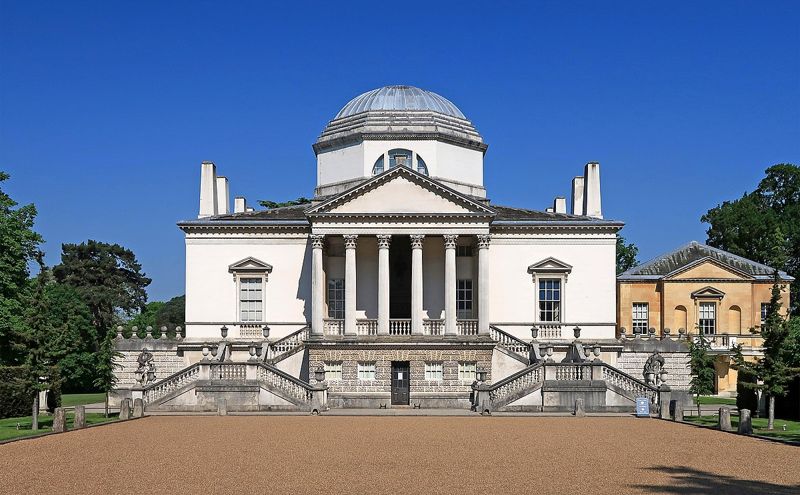
- Chiswick House is a Neo-Palladian villa designed by Richard Boyle, 3rd Earl of Burlington, and completed in 1729 as a manifesto for classical architecture in West London.
- The octagonal domed Saloon at its heart reflects Palladian planning inspired by ancient Roman bath complexes and centrally planned villas like the Villa Capra.
- William Kent shaped the surrounding grounds into one of the earliest English landscape gardens, pioneering a ‘natural’ style with vistas, sculptures, and ornamental buildings.
- The estate spans about 26.33 hectares (65 acres), blending formal avenues with softened landscapes, lakes, and classical features.
- After Burlington’s death, the house passed to the Cavendish family and became a Whig social hub frequented by Georgiana, Duchess of Devonshire.
- Charles James Fox died at Chiswick House in 1806, and Prime Minister George Canning died there in 1827, marking its place in political history.
- In the late 19th century it was converted into the Chiswick Asylum, reflecting a dramatic shift from aristocratic villa to institutional use.
- Sold to Middlesex County Council in 1929, part of the site even served as a fire station before mid-20th-century restorations.
- A V-2 rocket during the Second World War damaged one of the villa’s wings, both of which were later demolished in 1956.
- Today Chiswick House is Grade I listed and stewarded as one of the most significant 18th-century houses and gardens in Britain.
- The plan’s mix of octagonal, circular, and rectangular rooms around the Saloon was revolutionary in English domestic architecture at the time.
- The gardens’ patte d’oie, or ‘goose foot’, of radiating avenues terminated in ornamental buildings helped shape the evolution of the English landscape garden.
- Interiors contrast with the austere exterior, featuring rich decorative schemes, classical orders, and refined details on the piano nobile.
- English Heritage oversees the site, presenting both the villa and the restored 18th-century gardens for public enjoyment.
- The estate’s design dialogue with Inigo Jones and Palladio makes it a touchstone for the revival and adaptation of classical ideals in Georgian Britain.
History
Chiswick House's origins trace back to 1682, when Richard Boyle, 1st Earl of Burlington, purchased the estate which featured a Jacobean house built around 1610 surrounding a courtyard. The original house served as an occasional country residence whilst the family's primary home remained Burlington House on Piccadilly. Following a fire in 1725, the 3rd Earl of Burlington, Richard Boyle (1694-1753), commissioned the construction of his revolutionary neo-Palladian villa between 1726 and 1729, designed largely by Burlington himself after his architectural education gained through Grand Tours of Italy and study of Andrea Palladio's works. The villa was conceived as a 'temple of the arts', where Burlington could display his precious art collections and entertain selected friends, though critics noted its unusual proportions - Lord Hervey famously described it as too small to live in but too large to hang on a watch chain.
The architectural significance of Chiswick House cannot be overstated, as it represents one of the earliest and finest examples of neo-Palladian style in England, pre-dating widespread neoclassicism by several years. Burlington's design synthesised features from Palladio's drawings, Inigo Jones's work, and ancient Roman architecture, particularly inspired by the Baths of Diocletian in Rome. The villa's complex layout features a square main building with an imposing six-column portico, crowned by an octagonal dome lighting the central Saloon, with rooms of varying shapes - octagonal, rectangular, and circular - arranged around this central space. The interiors were decorated by William Kent, Burlington's protégé, who contributed furniture designs and painted ceilings in rooms such as the Blue Velvet Room and Red Velvet Room, though recent scholarship suggests some masonic symbolism may be present in the decoration.
Following Burlington's death in 1753, the estate passed to his son-in-law, the 4th Duke of Devonshire, beginning the Cavendish family's long association with the property. The 5th Duke demolished the original Jacobean house in 1788 and commissioned John White to add two three-storey wings to accommodate the political entertaining of the celebrated Georgiana, Duchess of Devonshire, a prominent Whig hostess where figures like Charles James Fox died in 1806. The 6th Duke, known as the 'Bachelor Duke', used Chiswick extensively for grand entertaining, including hosting Tsar Nicholas I of Russia in 1844, and maintained an exotic menagerie on the grounds. From 1892 to 1929, the house served as Chiswick House Asylum, operated by the Tuke brothers as a humane private mental health facility for wealthy patients, before being sold to Middlesex County Council. After suffering wartime damage and deterioration, English Heritage restored the property in the 1950s, demolishing the 18th-century wings and recreating lost Georgian features, with management now overseen by the Chiswick House and Gardens Trust established in 2005.
Description
The Villa's Architectural Splendour
The villa's exterior strikes an immediate impression of classical purity and restraint. Six Corinthian columns support an elegant portico that frames the main entrance, whilst tall sash windows march across the façade in perfect symmetry. Above, an octagonal drum crowned by a shallow dome provides the building's crowning glory, its proportions calculated to perfection. The stonework, rendered in pale Bath stone, catches and reflects light throughout the day, creating subtle shadows that emphasise the building's sculptural qualities.
Stone urns and balustrades punctuate the roofline, adding delicate ornamental flourishes that never overwhelm the composition's essential simplicity. The villa's compact footprint belies the spatial drama within—every external element has been carefully considered to create an harmonious whole that speaks to the refined aesthetic sensibilities of its creators.
Interior Grandeur and Spatial Drama
The Central Saloon
At the heart of the villa lies the spectacular central Saloon, a circular room that soars upward into the octagonal dome. Natural light filters down from above through carefully positioned windows, creating an almost celestial atmosphere that changes throughout the day. The room's proportions are masterfully judged—tall enough to inspire awe, yet intimate enough for conversation. Gilded detailing catches the light, whilst rich marble surfaces provide visual weight and gravitas.
The Saloon serves as the pivot around which all other rooms revolve, creating a sense of anticipation as visitors move through doorways that offer tantalising glimpses of the treasures beyond. Each opening frames a carefully composed view, whether of sumptuous interiors or perfectly aligned garden vistas.
The Blue Velvet Room
Perhaps the most intimate and richly appointed space within the villa, the Blue Velvet Room functions as a perfect 15-foot cube—a geometric perfection that speaks to both mathematical harmony and esoteric symbolism. The walls are swathed in hand-woven blue silk velvet of extraordinary depth and lustre, creating an atmosphere of scholarly contemplation and quiet luxury.
The room's pièce de résistance is William Kent's magnificent painted ceiling, where the personification of Architecture presides over three cherubic attendants who grasp the tools of the trade—T-squares, set-squares, and plumb lines. Architecture herself holds dividers and contemplates a temple plan, whilst all four figures rest upon a fallen column beneath a canopy of golden stars. The symbolism extends deeper still, with subtle references that reward careful observation: rats and snakes hidden within the decorative scheme, and one cherub holding a finger to his lips in a gesture of silence reminiscent of Harpocrates, the Egyptian god of secrecy.
The room originally housed Lord Burlington's extensive collection of architectural drawings and plans, with a magnificent mahogany table by William Kent serving as the centrepiece for scholarly discussion and contemplation. The proportions—exactly 10 biblical cubits in each direction—suggest deeper symbolic meanings that continue to intrigue visitors and scholars alike.
The Red Velvet Room
A theatrical counterpoint to the Blue Velvet Room, this space blazes with crimson silk velvet wall hangings that create a backdrop of princely magnificence. The room was designed specifically to showcase Lord Burlington's finest paintings, with the rich red providing an ideal foil for gilded frames and Old Master canvases.
Kent's ceiling painting here presents an allegory of the Arts, with Mercury—messenger of the gods—hovering above a classical arch whilst directing Abundance towards the three visual arts below. Architecture appears as a bare-chested woman with set-square and cherub assistant holding a Roman temple plan; Sculpture is represented by a fallen bust of Inigo Jones; and Painting by a woman unveiling a self-portrait of Kent himself. Around the edges, painted panels incorporate musical instruments and portrait roundels of gods and goddesses—Jupiter, Venus, Saturn, Mars, Diana, and Apollo—each with their appropriate zodiacal signs.
The room's symbolism operates on multiple levels. The traditional interpretation celebrates the harmony of the arts under divine guidance, but alternative readings suggest masonic symbolism, with the red drape being removed to reveal hidden knowledge, and the architectural implements serving as emblems of moral and spiritual construction.
The Green Velvet Room and Gallery
These interconnected spaces continue the villa's theme of colour-coordinated magnificence. The Green Velvet Room provides a more restful atmosphere, its sage-toned walls offering respite from the intensity of the red and blue chambers. The adjacent Gallery stretches along the garden front, its tall windows framing views of the landscape whilst providing ideal conditions for displaying paintings.
Furniture throughout these rooms bears William Kent's distinctive touch—mahogany chairs with gilt detailing, marble-topped tables with sculptural supports, and pieces incorporating his signature scallop shell motif. Every item was designed specifically for these rooms, creating an unparalleled harmony between architecture, decoration, and furnishing.
The Revolutionary Gardens
The English Landscape Movement
The gardens surrounding Chiswick House represent nothing less than a revolution in landscape design—the birthplace of the English Landscape Movement that would influence garden-making across Europe and beyond. Rather than the geometric formality that had previously dominated grand estates, these grounds flow with naturalistic grace, creating the illusion of an idealised countryside whilst maintaining sophisticated artistic control.
Water Features and Reflective Elements
Water plays a central role in the garden's composition, both as a design element and a source of tranquil atmosphere. The serpentine lake stretches elegantly across the middle distance, its curving banks planted with reeds and marginal vegetation that soften the transition between water and land. An classical stone bridge spans the water at its narrowest point, its reflection creating perfect symmetry on still days.
The cascade provides gentle movement and sound, water tumbling over carefully arranged stones in a naturalistic display that nonetheless reveals the hand of the designer. Smaller pools and water features are discovered throughout the grounds, each offering moments of contemplation and reflection—both literal and metaphorical.
The Exedra and Classical Features
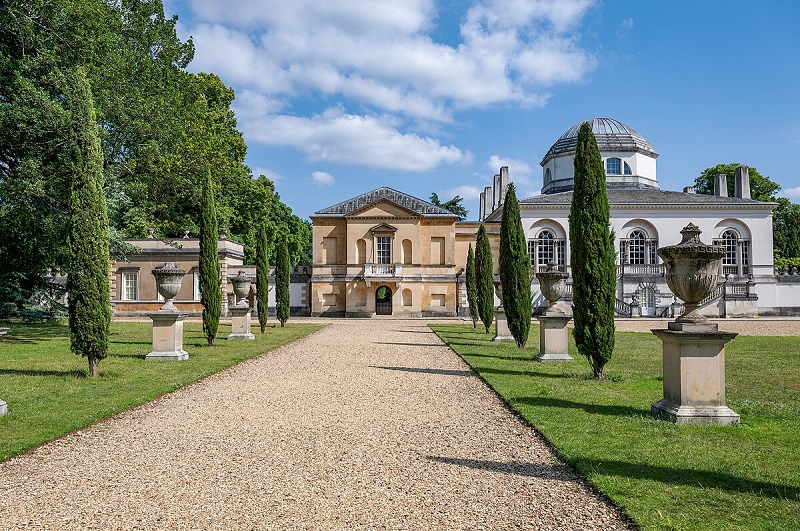
One of the garden's most striking features is the great exedra—a semicircular lawn framed by towering cypress trees, classical urns, and precisely clipped yew hedging. This theatrical space creates a dark, sculptural backdrop against which marble statuary appears to glow with inner light. The effect is both dramatic and serene, offering visitors a sense of stepping into a classical landscape painting.
Scattered throughout the grounds, carefully sited classical buildings provide focal points and destinations for garden wanderers. A temple-like pavilion crowns a gentle rise, its columns and pediment framing views back towards the house. An obelisk marks another important axis, whilst classical gateways and archways frame vistas and create transitions between different garden rooms.
Woodland and Naturalistic Planting
The garden's genius lies in its ability to feel both natural and composed. Woodland edges are carefully managed to appear wild whilst concealing the sophisticated planning behind their apparent randomness. Ancient cedars and other specimen trees provide vertical drama and seasonal interest, their placement calculated to create the perfect interplay of light and shadow.
Seasonal plantings ensure year-round interest: spring brings clouds of blossom and emerging foliage; summer sees herbaceous borders at their peak whilst dappled shade provides cooling relief; autumn transforms the canopy into a tapestry of gold and amber; winter reveals the garden's underlying structure, with evergreens and architectural features taking centre stage.
The Italian Garden and Formal Elements
Closer to the house, more formal garden rooms provide counterpoint to the naturalistic landscape beyond. The Italian Garden presents geometric patterns of clipped box and seasonal bedding, its precise geometry echoing the villa's classical proportions. Gravel paths create crisp edges and clear circulation routes, whilst carefully chosen plants provide colour and fragrance without compromising the formal design.
The Kitchen Garden and Productive Areas
Beyond the ornamental grounds lie the kitchen garden and productive areas, where functional beauty takes precedence. Espaliered fruit trees line warm walls, their trained branches creating living architecture. Herb gardens perfume the air with Mediterranean scents, whilst vegetable plots demonstrate the marriage of utility and beauty that characterises the best English kitchen gardens.
The Conservatory and Camellia Collection
Architectural Achievement
The Grade I-listed conservatory stretches for an impressive 300 feet along the garden's edge, its elegant glazed structure representing one of England's finest examples of early horticultural architecture. The building's proportions are perfectly judged—tall enough to accommodate mature trees yet intimate enough to feel welcoming rather than industrial.
The Camellia Collection
Within this glass sanctuary lives one of the world's most significant collections of heritage camellias—possibly the oldest collection under glass in the Western world. Thirty-two heritage varieties create a spectacular display from late winter through early spring, their blooms ranging from pure white through delicate pink to deep crimson.
The collection includes several varieties of extraordinary rarity and historical significance. Most famous is the Middlemist's Red, one of the rarest camellias in the world, its deep red blooms a testament to centuries of careful cultivation. Many of these plants have been growing in the conservatory for over 200 years, their gnarled trunks and spreading canopies telling stories of generations of dedicated gardeners.
The display reaches its crescendo in February and March, when the conservatory fills with colour and fragrance. Visitors can appreciate not only the visual spectacle but also the extraordinary horticultural achievement of maintaining such ancient specimens in perfect health. Each plant represents a living link to the estate's gardening heritage and the wider story of plant collecting and cultivation.
Seasonal Highlights and Botanical Interest
Beyond the famous camellias, the conservatory houses a constantly changing display of exotic and tender plants. Seasonal arrangements ensure year-round interest, with spring bulbs giving way to summer exotics and autumn displays of fruits and berries. The microclimate within the glasshouse allows for the cultivation of plants from Mediterranean and subtropical regions, creating a diverse botanical collection that delights enthusiasts and casual visitors alike.
The Contemporary Café and Modern Amenities
Architectural Integration
The award-winning café pavilion represents a masterclass in contemporary design that respects its historic setting without resorting to pastiche. The low-lying, light-filled structure nestles discretely within the landscape, its clean lines and extensive glazing creating a modern counterpoint to the classical villa whilst never competing for attention.
The building's orientation maximises views across the parkland whilst providing shelter from prevailing winds. Large sliding doors open completely in fine weather, blurring the boundaries between interior and exterior and creating a seamless connection with the gardens beyond.
Culinary Excellence and Hospitality
The café offers a carefully curated menu that celebrates seasonal British produce alongside international influences. Morning coffee and pastries give way to light lunches featuring locally sourced ingredients, whilst afternoon tea provides the perfect accompaniment to a leisurely garden visit. The wine and beer selection focuses on English producers, continuing the theme of celebrating British excellence whilst acknowledging international influences.
The generous terrace provides outdoor dining opportunities throughout the warmer months, with comfortable seating arranged to take advantage of the finest garden views. Parasols and heating elements ensure comfort across the seasons, whilst the covered areas provide all-weather dining options.
Photographic Opportunities and Artistic Inspiration
Light and Composition
Chiswick House offers exceptional photographic opportunities throughout the day and across all seasons. Early morning light rakes across the villa's façade, creating dramatic shadows and emphasising architectural details. The golden hour before sunset transforms the landscape into a romantic composition of light and shade, with the lake providing perfect reflections of sky and surrounding trees.
The classical buildings and statuary throughout the grounds offer endless compositional opportunities, whether as isolated focal points or elements within larger landscape views. The careful positioning of these features ensures that photographs capture not just individual objects but the relationships between them—the very essence of the garden's design philosophy.
Seasonal Transformations
Each season brings its own photographic rewards. Spring sees the gardens emerging from winter dormancy, with fresh green growth providing a vibrant counterpoint to the classical stonework. The camellia display in the conservatory offers spectacular close-up opportunities, with individual blooms worthy of detailed study.
Summer brings the gardens to full maturity, with herbaceous borders at their peak and the lake fringed with lush vegetation. The long days provide extended opportunities for photography, whilst the dappled shade beneath mature trees creates intimate, contemplative compositions.
Autumn transforms the landscape with warm tones and dramatic skies, whilst winter reveals the garden's underlying structure with particular clarity. The bare branches of deciduous trees create intricate patterns against the sky, whilst evergreens and architectural features take centre stage.
Accessibility and Visitor Experience
Physical Access and Inclusion
The gardens are designed to accommodate visitors of all abilities, with level paths and gentle gradients ensuring that most areas remain accessible. The main circulation routes utilise hard surfaces or well-maintained gravel paths, whilst secondary paths may require more careful navigation. The villa itself presents some challenges, with staircases providing access to the principal first-floor rooms, though ground-floor areas and the conservatory remain easily accessible.
Staff members are knowledgeable and helpful, able to advise on current access arrangements and suggest alternative routes for visitors with mobility challenges. The estate's commitment to inclusion extends beyond physical access to encompass interpretive materials and guided tours that cater to different learning styles and interests.
Educational Opportunities and Interpretation
Chiswick House serves as an exceptional educational resource, offering insights into architecture, garden design, art history, and social history. Self-guided tours allow visitors to explore at their own pace, whilst expert-led tours provide deeper insights into the estate's significance and hidden details.
The villa's rooms are carefully interpreted with information panels that explain the historical context, artistic significance, and symbolic meanings without overwhelming the visitor experience. The garden interpretation focuses on design principles, plant identification, and seasonal highlights, encouraging visitors to look more closely at their surroundings.
Events and Special Occasions
Throughout the year, Chiswick House hosts a carefully curated programme of events that complement its historic character whilst bringing new audiences to the estate. Classical concerts take advantage of the villa's exceptional acoustics, whilst garden lectures and workshops share expertise with enthusiastic gardeners and designers.
The annual Camellia Festival celebrates the conservatory's magnificent collection, providing expert talks, specialised tours, and opportunities to purchase rare varieties. Summer evening events take advantage of the extended daylight and warm weather, with outdoor dining and entertainment creating memorable experiences against the backdrop of the illuminated villa.
The Complete Experience
A Journey Through Time and Space
Visiting Chiswick House represents far more than a simple tourist attraction—it offers a complete sensory and intellectual experience that engages visitors on multiple levels. The carefully orchestrated journey from arrival through gardens to villa and back again creates a narrative that unfolds gradually, rewarding attention and contemplation.
The estate's genius lies in its ability to feel both grand and intimate, sophisticated and welcoming. Whether seeking architectural inspiration, gardening knowledge, artistic enlightenment, or simply a peaceful retreat from urban pressures, visitors find their expectations exceeded by the depth and quality of what awaits them.
Lasting Impressions
Long after leaving, visitors carry with them impressions of perfect proportions, carefully composed views, and the seamless integration of architecture and landscape. The estate's influence extends far beyond its boundaries, having inspired generations of architects, garden designers, and artists who recognised in Chiswick House a benchmark of aesthetic achievement.
For contemporary visitors, the estate offers both historical insight and contemporary relevance. Its lessons in design, sustainability, and the relationship between built and natural environments speak directly to current concerns whilst demonstrating the enduring value of beauty, craftsmanship, and thoughtful planning.
In a world increasingly dominated by the rushed and the temporary, Chiswick House stands as a testament to the power of patience, vision, and attention to detail. It represents not just a historic house and garden, but a philosophy of life that values contemplation, beauty, and the careful nurturing of excellence across generations.
Getting There
Chiswick House sits just west of the Hogarth Roundabout in W4 and is easy to reach by public transport: take the District line to Turnham Green or Gunnersbury, then walk about 20–25 minutes or hop on a local bus towards the Hogarth Roundabout/Edensor Road for the garden gates on Burlington Lane or the Alexandra Avenue/Cavendish School stops near the park perimeter. South Western Railway trains from Waterloo stop at Chiswick station; from there it’s around a 20–25 minute walk or a short E3 bus ride to Cavendish School for the nearest entrance to the grounds. Several buses serve the area, including the E3, 190 and 272, which place you within a few minutes’ walk of the house and formal gardens. If cycling, follow local routes towards Hogarth Lane and Burlington Lane; there are entrances along the perimeter adjoining the roundabout and Burlington Lane near the cricket pavilion.
Best Time to Visit
The sweet spot is late April to early May, when the famous wisteria cloaks the garden walls in lilac and the grounds feel at their most romantic, though it’s also the busiest period and early mornings are wisest for photos and calm. Spring and early summer bring blossom, longer daylight, and outdoor events, while summer weekends can be lively with festivals and families. Autumn offers rich colour and quieter paths, perfect for peaceful walks, and crisp winter days are serene if you’re mainly after landscapes and birdlife. The gardens are open daily from early to dusk year-round, but the House typically operates a seasonal schedule, so check dates if you want to go inside.