


 Ireland Guide
 Scotland Guide
 Wales Guide
| Contents |
|---|
Introduction
Hadrian's Wall, stretching 84 miles across northern England from Wallsend to Bowness-on-Solway, was constructed by Roman Emperor Hadrian in 122 CE to defend the northern frontier of Roman Britain against Scottish tribes. Housesteads Fort, known to the Romans as Vercovicium, stands as one of the most complete and well-preserved Roman forts along the Wall, located in Northumberland National Park. The fort housed approximately 800 auxiliary troops and features remarkably intact remains including barracks, granaries, a hospital, and latrines, alongside commanding views across the Northumberland countryside. Today, both the Wall and Housesteads Fort form part of a UNESCO World Heritage Site, managed by English Heritage, offering visitors the opportunity to explore Roman military architecture, walk along reconstructed sections of the Wall, and experience one of Britain's most significant archaeological landscapes through a network of footpaths and visitor centres.
Interesting Facts about Hadrian's Wall and Housesteads Fort
Hadrian's Wall
- Hadrian's Wall stretches for 73 miles (117.5 kilometres) across northern England from Wallsend on the River Tyne in the east to Bowness on the Solway Firth in the west.
- The wall was built by approximately 15,000 Roman soldiers from three legions - the Legio II Augusta, Legio VI Victrix, and Legio XX Valeria Victrix - and took around six years to complete starting in 122 CE.
- Originally planned to be 10 Roman feet wide, the wall's width was reduced to between 6 and 8 Roman feet (about 1.8 to 2.4 metres) after two years of construction.
- The wall featured a milecastle (small fort) every Roman mile with gates and towers that could hold about 30 soldiers, plus two turrets between each milecastle for observation.
- Soldiers from Syria were amongst those stationed along Hadrian's Wall, demonstrating the diverse origins of Roman troops defending Britain's northern frontier.
- The wall may have originally been covered in plaster and whitewashed, creating a shining surface that would have been visible for miles around as a symbol of Roman power.
- Hadrian's Wall was designated a UNESCO World Heritage Site in 1987 and is now part of the Frontiers of the Roman Empire collection.
- The wall wasn't officially attributed to Emperor Hadrian until 1840, despite being built on his orders nearly 1,700 years earlier.
- The wall does not follow the modern border between England and Scotland, as these nations didn't exist when it was constructed in 122 CE.
Housesteads Fort
- Housesteads Roman Fort, originally known as Vercovicium, is the most complete example of a Roman fort in Britain and one of the best-known from the entire Roman Empire.
- Built around 124 CE, just two years after Hadrian's Wall construction began, the fort could house approximately 800 to 1,000 troops and remained in use until the 4th century.
- Unlike most other early forts along the wall, Housesteads does not straddle the wall and therefore does not project into barbarian territory.
- The fort had no running water supply and was entirely dependent upon rainwater collection, evidenced by a series of large stone-lined cisterns around the periphery of the defences.
- Housesteads features one of the best-preserved stone latrines in Roman Britain, along with exceptional cisterns and water channels.
- A substantial civilian settlement (vicus) existed outside the fort's south gate, including the so-called "Murder House" where two skeletons were found beneath a newly-laid floor during excavation.
- The fort was built over the demolished Turret 36B, which had been constructed as part of the original wall before the decision was made to add forts to the defensive system.
- A ruined 17th-century farmhouse called Housesteads was built incorporating parts of the Roman fort ruins, and its former occupants were notorious horse thieves and cattle rustlers who used the ancient structures to store stolen animals.
- The fort was garrisoned by various units over the centuries, including Cohors I Tungrorum (a Tungrian cohort), a Frisian cavalry unit called Cuneus Frisiorum, and detachments from Legio II Augusta.
- Housesteads was one of five Roman forts purchased and excavated by John Clayton of Chesters in the 19th century, making it one of the earliest examples of archaeological conservation in Britain.
History
Hadrian’s Wall was commissioned by Emperor Hadrian in 122 CE to mark the north-western frontier of Roman Britannia and to control movement across the province’s wild northern border. Stretching 80 Roman miles (117 km) from Wallsend on the River Tyne in the east to Bowness-on-Solway in the west, it comprised a stone curtain wall initially planned at 10 Roman feet (3 m) wide and at least 12 ft (3.7 m) high in the eastern sector, with a turf rampart of 20 Roman feet (6 m) wide in the west, both fronted by a deep ditch where geography allowed. Construction took around six years and involved three Roman legions (Legio II Augusta, VI Victrix and XX Valeria Victrix) totalling some 15,000 soldiers, along with auxiliary units and naval detachments, who performed all aspects of building work, from surveying to masonry and carpentry.
Before completion, the original plan was significantly revised. Fourteen forts were added to the wall line at roughly 11 km intervals, each intended to straddle the wall with double-portal gates for rapid troop movement. A great earthwork known as the Vallum—a wide, flat-bottomed ditch flanked by mounds—was constructed to the south of the wall to demarcate a controlled military zone and further delay invaders. The curtain wall itself was narrowed in places from 10 to as little as 6 Roman feet (1.8 m) to suit terrain and manpower constraints. Milecastles (small fortlets) at one-mile intervals and turrets every third of a mile provided observation points and limited garrison accommodation, creating a chain of fortified positions that remained garrisoned for nearly 300 years.
Housesteads Roman Fort (Latin Vercovicium) was built in stone around 124 CE, just two years after the wall’s construction began, and is often described as the “grandest station” on the Wall. Perched on the tip of a Whin Sill crag, it covered five acres and was designed for a cohort of approximately 800 infantry, later augmented by frumentarii cavalry and detachments from Legio II Augusta. Uniquely, Housesteads lacked a running water supply and relied on rainwater collected in large stone-lined cisterns; it also boasts one of the best-preserved stone latrines in Roman Britain. A substantial civilian settlement (vicus) grew immediately south of the fort, where stone foundations—including the so-called “Murder House” where two skeletons were discovered—offer evidence of traders, craftsmen and soldiers’ families living alongside the garrison. The fort was repaired and rebuilt several times, notably in the late 3rd/early 4th century when interval towers, a vast horreum (granary) and new barracks were added. After abandonment c. 400 CE, the site later formed part of an 18th-century farm before preservation by John Clayton and, ultimately, by the National Trust and English Heritage for public access.
Description
Hadrian's Wall: The Great Barrier Across Northern England
Hadrian's Wall stands as one of Britain's most magnificent ancient monuments, a testament to Roman engineering prowess that continues to captivate visitors nearly two millennia after its construction. This extraordinary fortification stretches an impressive 73 miles across the dramatic Northumberland landscape, creating an unbroken line from Wallsend in the east to Bowness on the Solway Firth in the west. The wall's journey across the countryside is nothing short of spectacular, as it twists and snakes along dramatic crags and escarpments, following the natural contours of the land with remarkable precision.
The wall's physical presence is immediately striking to any visitor. The stone sections, which form the majority of the surviving structure, measure approximately 8 feet wide and at least 12 feet high, creating an imposing barrier that would have dominated the landscape in Roman times. What makes the wall particularly captivating is how it follows the natural contours of the landscape, utilising the dramatic Whin Sill escarpment to maximum defensive effect. Archaeological evidence suggests that the original structure may have been covered in plaster and whitewashed, which would have created a shining surface visible for miles around, making it an even more impressive sight than the weathered stone we see today.
The wall's defensive capabilities were enhanced by additional earthworks that remain visible today. In front of the wall runs a substantial ditch, measuring 6 metres wide and 3 metres deep, which would have presented a formidable obstacle to any approaching force. This ditch, combined with the wall itself, created a defensive system that was both psychologically intimidating and practically effective. The wall is punctuated at regular intervals by milecastles - fortified gateways that appear every Roman mile along its length, each serving as a checkpoint and garrison point. Between these substantial structures, visitors can discover two observation towers (turrets) in each mile-long section, creating a comprehensive surveillance network that allowed Roman forces to monitor the frontier effectively.
| Hadrian's Wall Path ※ |
|---|

 Hadrian’s Wall Path Hadrian’s Wall Path |
The Landscape Setting and Visual Impact
Perhaps the wall's most breathtaking quality lies in how it commands the landscape through which it passes. From many vantage points along its length, visitors can see the ancient barrier stretching off into the distance, creating dramatic views that showcase both the monument's impressive scale and the wild, rolling countryside it traverses. The contrast between the precisely built stonework and the natural crags and escarpments it follows creates some of Britain's most photogenic archaeological scenery, where human engineering and natural beauty combine in perfect harmony.
The wall's route takes it through some of Northumberland's most spectacular terrain, including steep valleys, windswept moors, and rocky outcrops that provide constantly changing perspectives. During different seasons, the wall presents entirely different moods - from the fresh greens of spring when wildflowers bloom along its length, to the golden hues of autumn when the surrounding landscape takes on a warm, amber glow. Winter visits offer their own rewards, with the wall often dusted with snow, creating a stark and beautiful contrast against the grey stone.
The preservation of the landscape around the wall means that visitors can experience something approaching the original setting. The absence of modern development in many sections helps maintain the site's authentic atmosphere, allowing visitors to imagine how Roman soldiers might have viewed this frontier. The wall's elevated position on ridges and escarpments provides panoramic views across the surrounding valleys, offering glimpses of distant hills and forests that stretch to the horizon.
Housesteads Fort: The Crown Jewel of Roman Britain
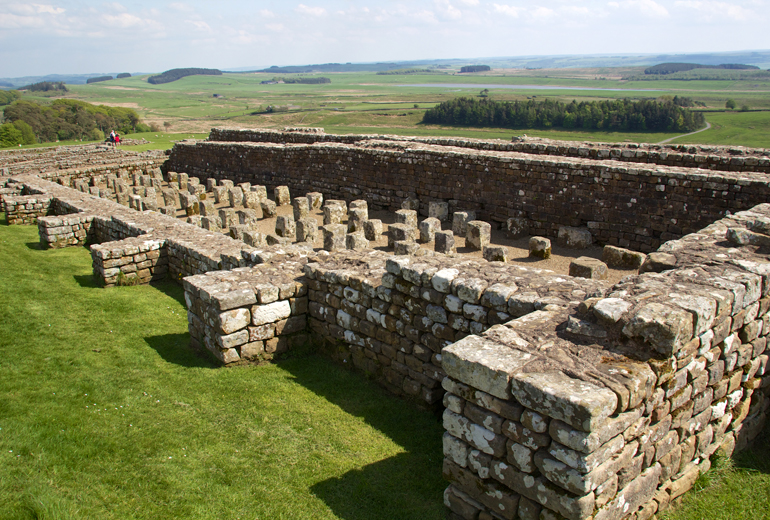
Housesteads Fort represents the pinnacle of Roman military architecture in Britain, standing as Britain's most complete Roman fort in a position of extraordinary natural drama. The fort is dramatically positioned on the Whin Sill escarpment with panoramic views across the surrounding valleys, creating one of the most impressive archaeological sites in the country. This substantial installation covers 5 acres and measures 367 feet by 610 feet, making it not only one of the largest but also one of the most impressive archaeological sites along the entire length of Hadrian's Wall.
The fort's commanding position was clearly chosen for both strategic and practical reasons. From its elevated location, Roman commanders could survey vast stretches of the surrounding countryside, monitoring approaches from the north while maintaining communication with other installations along the wall. The site's natural defences, provided by the steep escarpment on which it sits, would have made it virtually impregnable when combined with the fort's substantial man-made fortifications.
Architectural Features and Defensive Systems
What immediately strikes visitors approaching Housesteads is the fort's unusual eastward orientation and its four imposing gates, each designed to control access to this vital military installation. Each gate features the standard twin portal design that was characteristic of Roman military architecture, with the west gate being one of the best-preserved gateways on Hadrian's Wall. These gates would have been heavily defended, with guard chambers and upper storeys that allowed soldiers to control entry and exit while providing elevated positions for observation and defence.
The fort's perimeter defences remain remarkably well-preserved, with the complete line of curtain wall and interval towers still visible, allowing visitors to trace the entire perimeter of this ancient stronghold. The fort wall, originally backed by an earth rampart, may have stood 4.2 metres high up to the wall-walk, creating an impressive defensive barrier that visitors can still appreciate today. Additional interval towers were added in later periods as the fort's defences were strengthened and modified, and these architectural additions remain visible throughout the site, telling the story of the fort's evolution over time.
The defensive system was completed by a series of ditches and earthworks that surrounded the fort on its more vulnerable sides. These outer defences, while less well-preserved than the stone walls, can still be traced in the landscape and would have provided additional protection against attack. The combination of natural and artificial defences made Housesteads one of the most secure positions along the entire frontier.
Interior Layout and Building Remains
Within the fort walls, visitors can explore the remains of all the main buildings found in a typical auxiliary fort, providing a comprehensive picture of Roman military life. The layout follows the standard Roman pattern, with buildings arranged around a central headquarters complex and connected by a network of streets that divided the fort into distinct functional areas.
The barrack blocks where soldiers once lived are among the most evocative remains, with their distinctive long, narrow buildings divided into individual rooms for each contubernium (eight-man squad). These buildings would have housed the fort's garrison of approximately 800 men, providing not just sleeping quarters but also space for equipment storage and daily activities. The remains show clear evidence of the hierarchical nature of Roman military life, with different quarters for officers and ordinary soldiers.
The hospital complex represents one of the most sophisticated medical facilities of its time, with specialized rooms for different types of treatment and recovery. The building's layout reveals the Romans' advanced understanding of medical practice, with separate areas for surgery, convalescence, and storage of medical supplies. This facility would have served not only the fort's garrison but also the surrounding civilian population.
The Commander's House stands out with its distinctive layout, reflecting the status and responsibilities of the fort's commanding officer. This substantial building would have served both as a private residence and as an official headquarters, with rooms for entertaining visiting dignitaries and conducting official business. The remains show evidence of hypocaust heating systems and other luxury features that would have made life more comfortable for the fort's senior officers.
The granaries showcase the fort's logistical capabilities and represent some of the best-preserved examples of Roman military architecture. These buildings, with their raised floors and sophisticated ventilation systems, were designed to keep grain dry and free from pests. The granary remains are particularly impressive, with their well-preserved structure offering insights into the fort's self-sufficiency and the complex supply systems that kept the frontier garrisons fed and equipped.
Perhaps the most famous feature of Housesteads is its latrines - described as the oldest working toilets you'll ever see. These facilities represent a remarkable example of Roman engineering, with their sophisticated drainage systems and communal design. The site also features the best preserved latrines, cisterns and water channels of any Roman fort in Britain, demonstrating the Romans' advanced understanding of sanitation and public health.
The Civilian Settlement and Broader Community
Beyond the fort's walls, visitors can explore the remains of the civilian settlement (vicus) outside the south and east gates, which provides a fascinating glimpse into the broader community that developed around the military installation. This settlement would have housed the families of soldiers, merchants, craftsmen, and others who provided services to the garrison. The remains include shops, taverns, temples, and houses that show how a thriving community developed in the shadow of the fort.
The civilian settlement reveals the complex relationship between the military and civilian populations on the frontier. While the fort provided security and economic opportunities, the civilian community provided essential services and goods that the military could not produce for itself. This symbiotic relationship created a unique frontier culture that blended Roman and native British elements.
Archaeological excavations in the settlement have revealed evidence of metalworking, pottery production, and other crafts that supported both the military and civilian populations. The remains of temples and shrines show how different religious traditions coexisted in this frontier community, with Roman gods worshipped alongside local deities.
Panoramic Views and Natural Setting
The fort's position offers stunning panoramic views across the Northumberland countryside that are among the finest in northern England. From the fort's elevated position, visitors can see for miles in all directions, taking in a landscape that has changed remarkably little since Roman times. The views encompass rolling hills, deep valleys, scattered farmsteads, and distant forests that stretch to the horizon, creating a sense of the vast scale of the frontier that the Romans were attempting to control.
Behind the north wall of the fort, there's a particularly good stretch of Hadrian's Wall that visitors can walk along, offering excellent views of the wall stretching off into the distance. This section provides one of the best opportunities to appreciate the wall's construction and to understand how it would have appeared to Roman soldiers on patrol. The wall here follows the dramatic contours of the Whin Sill, creating a series of spectacular viewpoints that showcase both the monument and the surrounding landscape.
The changing light throughout the day creates different moods and atmospheres at Housesteads. Early morning visits often provide the clearest views, with mist rising from the valleys below and the first light illuminating the ancient stones. Evening visits can be equally rewarding, with the setting sun casting long shadows across the ruins and highlighting the texture of the weathered stonework.
The Museum Collection and Archaeological Discoveries
The on-site museum houses a fascinating collection of Roman finds that bring the site to life and provide context for the visible remains. Visitors can see Roman altars, dedication stones, jewellery, tools and weapons - all excavated from the fort itself and the surrounding area. These artifacts tell the story of daily life on the frontier, from the religious beliefs of the garrison to the practical tools they used in their daily work.
The centrepiece of the collection is an impressive winged statue called Victory, described as a wonderful example of classical sculpture found in the landscape around the fort. This statue, along with other sculptural fragments, demonstrates the high level of artistic achievement that the Romans brought to even the most remote corners of their empire. The collection also includes inscribed stones that provide valuable information about the units stationed at the fort and the individuals who served there.
Other notable artifacts include military equipment such as armor fragments, weapons, and horse harness fittings that illustrate the fort's role as a cavalry base. Personal items such as jewelry, coins, and household objects provide insights into the daily lives of both soldiers and civilians who lived at Housesteads. The museum's displays are regularly updated as new discoveries are made, ensuring that there is always something new to see.
The Natural Landscape and Seasonal Changes
Rather than formal gardens, Housesteads Fort is set within the dramatic natural landscape of Northumberland National Park, where the archaeological remains blend seamlessly with the surrounding countryside. The site sits atop the Whin Sill plateau, surrounded by rolling hills and valleys that stretch to the horizon in all directions. This wild, open countryside provides a magnificent backdrop to the archaeological remains, with the fort appearing to emerge naturally from the rocky escarpment on which it stands.
The landscape around the fort is characterized by a mosaic of different habitats, from the short grassland on the exposed ridges to the deeper soils in the valleys where trees and shrubs can establish themselves. This diversity of habitats supports a rich variety of wildlife, including birds of prey that can often be seen soaring above the fort, and wildflowers that bloom in profusion during the spring and summer months.
The absence of modern development in the immediate vicinity helps maintain the site's authentic atmosphere, allowing visitors to appreciate how the fort might have appeared in its original setting. The landscape management by English Heritage and the National Trust ensures that the views from the fort remain unspoiled, preserving the sense of remoteness and wildness that would have characterized this frontier region in Roman times.
The landscape around the fort changes dramatically with the seasons, ensuring that each visit offers a different visual experience. Spring brings fresh greens and wildflowers, with the surrounding countryside coming alive after the winter months. Summer provides the longest days and the clearest views, with the opportunity to explore the site in warm sunshine. Autumn offers golden hues as the bracken and grasses turn color, creating a warm and mellow atmosphere. Winter visits can be particularly atmospheric, with the possibility of snow highlighting the ancient stones and creating dramatic contrasts in the landscape.
The interplay between the ancient monument and the natural landscape creates a unique sense of place that makes Housesteads one of Britain's most memorable archaeological sites. The fort's position on the escarpment means that it is always seen in the context of the wider landscape, creating a powerful sense of the scale and ambition of the Roman frontier system. Whether viewed from a distance as part of the wall's journey across the countryside, or explored in detail as a complex archaeological site, Housesteads provides an unforgettable encounter with Britain's Roman past set within one of the country's most beautiful landscapes.
Getting There & Around
Getting to Hadrian's Wall and Housesteads Fort is straightforward using a combination of rail and bus services. The most convenient approach is to travel by train to either Newcastle or Carlisle, both well-connected cities with excellent rail links from across Britain. From there, take the local Tyne Valley railway line to either Haltwhistle station (7 miles west of Housesteads) or Hexham station (11 miles east). The seasonal AD122 Hadrian's Wall Country Bus provides the perfect connection, running between these stations and stopping directly at key sites including Housesteads Fort, Vindolanda, and other Roman attractions along the wall. This dedicated service operates from Easter through October and makes exploring the wall without a car remarkably easy, allowing visitors to hop on and off at different sites for linear walks. For those travelling by car, the A69 road runs parallel to Hadrian's Wall between Newcastle and Carlisle, providing excellent access to the various car parks along the route. The combination of Britain's rail network and the specialist AD122 bus service means that even the most remote sections of this UNESCO World Heritage Site remain accessible to visitors using public transport.
Best Time to Visit
The best time to visit Hadrian's Wall and Housesteads Fort is between May and October, when the weather is most favourable for exploring these remarkable Roman ruins. Late May through June and late August to September offer the optimal conditions, providing comfortable daytime temperatures, extended daylight hours, and relatively dry weather whilst avoiding the peak summer crowds of July and August. During these months, you'll benefit from warmer temperatures averaging around 18°C, up to 16 hours of daylight around the summer solstice, and drier soil conditions that make walking the ancient paths more pleasant. Spring visits in April and May offer the added charm of wildflowers and lambing season, though you should be prepared for occasional heavy rainfall. Whilst it's possible to visit year-round, the winter months from November to March see many accommodation providers and some historical sites close, with shorter daylight hours and unpredictable weather making exploration more challenging. Summer remains the busiest period, particularly during school holidays, so booking accommodation well in advance is essential if you're planning to visit during peak season.