


| Contents |
|---|

Introduction
Vicenza (pop. 110,000) sits at the foot of the Berici Hills, approximately 60 kilometres west of Venice and 200 kilometres east of Milan. Vicenza is renowned worldwide for its exceptional Renaissance architecture, particularly the works of Andrea Palladio, the 16th-century architect whose innovative designs fundamentally influenced Western architecture. The city centre, designated a UNESCO World Heritage Site in 1994, features numerous Palladian buildings including the iconic Basilica Palladiana, Teatro Olimpico, and Villa Rotonda. Beyond its architectural treasures, Vicenza is an important economic centre, known for its gold jewellery production, textiles, and engineering industries, whilst also serving as a gateway to the Veneto's wine regions and the nearby Dolomites.
Interesting Facts about Vicenza
- Vicenza is known as the "City of Palladio" and has been a UNESCO World Heritage Site since 1994, recognised for its remarkable collection of 23 Palladian monuments.
- About one-fifth of Italy's gold and jewellery is manufactured in Vicenza, earning it the nickname "City of Gold".
- Federico Faggin, the co-inventor of the microprocessor, was born in Vicenza, highlighting the city's contribution to modern technology.
- Despite being a medium-sized city with around 115,000 inhabitants, Vicenza is Italy's third-largest industrial centre measured by the value of its exports.
- The Torre Bissara, one of Italy's tallest clock towers, plays a special melody twice daily at the unusual times of 11:53 AM and 5:53 PM.
- Vicenza was the most damaged city in the Veneto region during World War II due to Allied bombings.
- The city boasts two sets of defensive walls—medieval walls from the 13th century and later Venetian walls.
- The Teatro Olimpico in Vicenza is the world's oldest enclosed theatre, completed in 1585 as Andrea Palladio's final masterpiece.
- Villa La Rotonda, one of Palladio's most famous creations, sits outside the city and exemplifies perfect Renaissance architectural proportions.
- Founded in the 2nd century BCE, Vicenza prospered under Venetian rule from the early 15th to the end of the 18th century.
- The city straddles the River Bacchiglione at the northern base of Monte Berico, approximately 60 kilometres west of Venice.
- Vicenza's wealth stems not only from its historical gold trade but also from thriving textile and steel industries that employ tens of thousands of people.
History
Vicenza boasts a remarkable history spanning over two millennia, beginning with its ancient foundations by the Italic Euganei tribe and subsequently the Paleo-Veneti tribe in the 3rd and 2nd centuries BCE. The Romans recognised the city's strategic importance as they allied with the Paleo-Veneti against Celtic tribes in north-western Italy, and in 157 BCE established it as a de facto Roman centre named Vicetia or Vincentia, meaning "victorious". The settlement received full Roman citizenship in 49 BCE when its citizens were inscribed into the Roman tribe Romilia. As an important waystation on the crucial road between Mediolanum (Milan) and Aquileia near Trieste, Roman Vicenza flourished through agriculture, brickworks, marble quarrying, and wool production. Though overshadowed by neighbouring Patavium (Padua), the city's Roman heritage endures today in three bridges across the Bacchiglione and Retrone rivers and isolated arches of a Roman aqueduct outside the Porta Santa Croce.
The medieval period brought turbulent times as various barbarian groups including Heruls, Vandals, Visigoths, and Huns repeatedly devastated the area during the Western Roman Empire's decline. Following brief recovery under Ostrogothic and Byzantine rule, Vicenza became an important Lombard and later Frankish centre before suffering complete destruction by Magyar raiders in 899. The city's renaissance began in 1001 when Emperor Otto III placed it under episcopal rule, allowing communal organisation to develop and separate from church authority. Vicenza actively participated in the Veronese League and most notably the Lombard League (1164-1167) against Emperor Frederick I Barbarossa, with its podestà Ezzelino II il Balbo serving as league captain. However, internal factions between the Vivaresi (Ghibellines) and Maltraversi (Guelphs), combined with renewed rivalries with Padua and other cities, led to periods of tyrannical rule, particularly under Ezzelino III from Bassano who drove out the Guelphs in 1230.
The city's most transformative period began in 1404 when Vicenza came under Venetian rule, a dominion that would last until the end of the 18th century. During this era, particularly in the 16th century, Vicenza achieved its greatest cultural significance through the revolutionary architectural work of Andrea Palladio (1508-1580). Palladio's detailed study of classical Roman architecture gave the city its unique appearance and established the Palladian style that would profoundly influence European and North American architecture. His masterworks include the Basilica Palladiana (1549-1614), the Loggia del Capitanio (1571), and the Teatro Olimpico (1580-85), his final work completed by Vincenzo Scamozzi. The city's remarkable Palladian heritage, combined with the scattered villas throughout the Veneto region, earned Vicenza UNESCO World Heritage status as the "City of Vicenza and the Palladian Villas of the Veneto". This architectural legacy represents what UNESCO describes as "a unique artistic achievement" and "unique survival of a total humanist concept based on a living interpretation of antiquity".
Main Attractions
Piazza dei Signori
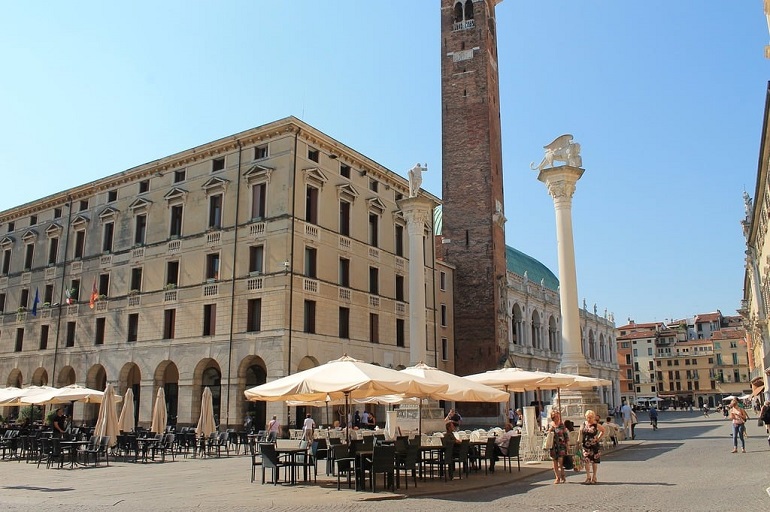
As the historic heart and principal public square of Vicenza, Piazza dei Signori functions as the city's civic and social centre. The piazza is framed by monumental works of Renaissance architecture, most notably the commanding Basilica Palladiana and the adjacent Loggia del Capitaniato, both designed by Andrea Palladio. The square is a lively hub of activity, hosting regular outdoor markets on Tuesday and Thursday mornings where locals and visitors can browse fresh produce and other goods. Throughout the year, it also serves as a venue for various seasonal festivals and public events, maintaining its historical role as Vicenza's main gathering place.
Basilica Palladiana
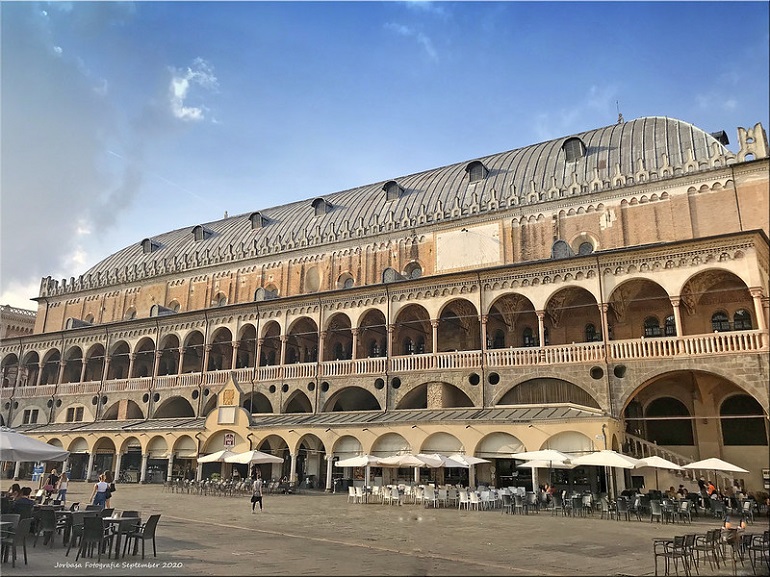
A UNESCO World Heritage Site, the Basilica Palladiana is not a religious building but a historic public hall and courthouse, given its distinctive form by the Renaissance architect Andrea Palladio. Its most recognisable feature is the two-tiered outer loggia, constructed from white marble, which envelops the pre-existing medieval structure. This innovative design, with its repeating sequence of arches and columns known as the Serlian window, is considered a masterpiece of Renaissance design. During certain seasons, the public can access the rooftop terrace, which houses a café and offers panoramic views across the city's terracotta roofs and the surrounding landscape.
Torre Bissara
Standing adjacent to the Basilica Palladiana, the Torre Bissara is a prominent medieval clock tower that, at 82 metres, is one of Vicenza's tallest structures. Its origins date back to the 12th century, pre-dating the Renaissance redevelopment of the square. When Palladio redesigned the basilica, he incorporated the existing tower into his overall plan for the piazza. While the tower itself is not open for public entry, its clock face and commanding height make it a key focal point of the Piazza dei Signori and a defining feature of the city's skyline.
Teatro Olimpico
The Teatro Olimpico is the oldest surviving indoor theatre of the Renaissance era and is considered one of Andrea Palladio's final and most influential works. Commissioned in 1580, it was completed after his death by his pupil, Vincenzo Scamozzi. The theatre's most remarkable feature is its permanent and illusionistic stage set, which depicts the seven streets of ancient Thebes in forced perspective, creating a remarkable and convincing illusion of depth. This original wooden scenery remains perfectly preserved, offering visitors a unique glimpse into the theatrical world of the 16th century.
Santa Corona Church
This 13th-century Gothic church was originally constructed to house a sacred relic: a thorn believed to be from Christ's crown of thorns. The church holds significant artistic and historical value, containing several notable Renaissance masterpieces. Among its most prized works of art is Giovanni Bellini's magnificent painting, "The Baptism of Christ," located at the Garzadori altar. Santa Corona also has a direct connection to Andrea Palladio, who was buried here in 1580, making the church his final resting place.
Monte Berico and Sanctuary
Overlooking Vicenza from the south, Monte Berico is a hill offering expansive panoramic views of the city and the distant mountains. At its summit stands the Sanctuary of the Madonna di Monte Berico, a significant pilgrimage site comprising two churches, one Gothic and one Baroque. The sanctuary is home to a celebrated altarpiece, "The Supper of Saint Gregory the Great" by Paolo Veronese. The approach to the sanctuary is via Viale X Giugno, a scenic, tree-lined avenue that features a series of arches and shrines, creating a monumental pathway to the summit.
Parco Querini
Situated at the edge of the historic centre, Parco Querini is a large public park that provides a spacious green retreat from the city streets. The park is characterised by its vast open lawns, shaded walking paths that meander through groves of trees, and a central pond. It is home to a variety of animals, including chickens and peacocks that roam freely across the grounds. At the park's centre, on a small island within the pond, stands a small neoclassical temple, adding a classical point of interest to the natural landscape.
Salvi Gardens (Giardini Salvi)
Located near the city's train station and at the western end of Corso Palladio, the Giardini Salvi are small, formal public gardens offering a tranquil space for relaxation. The gardens are notable for the Loggia Valmarana, a 16th-century Palladian-style structure that stands beside a small waterway. Although often attributed to Andrea Palladio himself, it is now generally believed to have been designed by one of his close students. The loggia's elegant arches provide a picturesque architectural element within the garden's peaceful setting.
Corso Andrea Palladio
Corso Andrea Palladio is the main thoroughfare that runs through the heart of Vicenza's historic centre. This elegant, largely pedestrianised street is lined with a succession of Renaissance palaces, many designed by or attributed to Palladio and his followers, showcasing the city's architectural wealth. Today, the ground floors of these historic buildings are occupied by a variety of shops, cafés, and restaurants, making it the primary commercial and social artery of the city. It provides direct access to many of Vicenza's major attractions, including the Piazza dei Signori and the Teatro Olimpico.
Vicenza Cathedral (Cattedrale di Santa Maria Annunciata)
The city's main religious building, Vicenza Cathedral, has a history stretching back to the early medieval period, though its current form is largely the result of later reconstructions. Andrea Palladio contributed to its design, creating the distinctive dome and designing several of the side chapels. The building suffered extensive damage from bombing during the Second World War, but its original Gothic façade survived. The rest of the structure has been carefully reconstructed, and the interior contains various chapels and artworks by local artists from different periods.
Top Museums
Civico Museo di Palazzo Chiericati
Housed since 1855 in Palladio’s early masterpiece (1550), Palazzo Chiericati combines elegant Renaissance architecture with a distinguished art collection. Its frescoed loggias and imposing façades enclose galleries showcasing Vicentine art from the 15th to 18th centuries, including works by local masters such as Alessandro Maganza and Alessandro dal Borro. The museum’s layout highlights Palladio’s harmonious proportions while guiding visitors through the evolution of regional artistic styles.
Museo Naturalistico-Archeologico
Situated in the former Dominican convent of Santa Corona, this museum explores Vicenza’s natural environment and ancient past. Exhibits range from fossils of the nearby Berici Hills to archaeological finds spanning the prehistoric era through the Lombard period. Interactive displays and reconstructed habitats immerse visitors in the region’s geological and cultural development, revealing how landscape and human activity have intertwined over millennia.
Museo del Risorgimento e della Resistenza
Set within Villa Guiccioli on Colletta Ambellicopoli, this museum chronicles Vicenza’s role in Italy’s unification and subsequent struggles for freedom. Period rooms preserve 19th-century décor, while displays of weapons, uniforms and personal documents recount the lives of patriots and partisans. The surrounding park offers a contemplative setting, linking the museum’s moral and cultural narratives to the broader landscape of Veneto’s civic identity.
Gallerie di Palazzo Thiene
An exemplar of Renaissance architecture initiated by Giulio Romano and completed by Palladio (1542–58), Palazzo Thiene dazzles with its richly decorated interiors and frescoes. Recent restoration has reopened its grand halls to host rotating exhibitions of classic and contemporary art. Visitors can admire the opulent stuccowork and fresco cycles that attest to Vicenza’s aristocratic culture in the 16th century.
Basilica Palladiana
Although not strictly a museum, the Basilica Palladiana—Palladio’s 16th-century loggia encasing the medieval Palazzo della Ragione—frequently hosts art exhibitions and cultural events. Its iconic two-tiered Serliana arcade, clad in green copper, frames the city’s central square. Inside, the vaulted Sala dei Contratti houses temporary shows that dialogue with the building’s architectural grandeur, making the basilica both monument and exhibition space.
Chiesa di Santa Corona
Founded in 1270 to shelter a fragment of the Crown of Thorns, this Gothic church displays an extraordinary assembly of sacred art. Works include Lorenzo Lotto’s radiant altarpieces, Paolo Veronese’s dramatic canvases and the ornate marble tomb of Federico da Montefeltro by Francesco di Giorgio Martini. The church’s soaring vaults and luminous stained-glass windows create an atmosphere of devotional splendour.
Museo Diocesano
Established in 2005 within the Palazzo Vescovile, the Diocesan Museum preserves ecclesiastical treasures transferred from Vicentine churches. Illuminated manuscripts, precious liturgical vestments and Renaissance bronzes are arranged chronologically, offering insight into the region’s religious and artistic patronage. The upstairs courtyard provides views over Vicenza’s rooftops, linking the sacred collections to the living city below.
Palladio Museum
Housed in the Palazzo Barbaran da Porto—Palladio’s own design dating to 1569—this museum examines the life, works and enduring influence of Andrea Palladio. Interactive displays, architectural models and multimedia installations trace his principles of symmetry and classical harmony, demonstrating how his villas and civic buildings shaped Western architectural thought for centuries.
Gallerie d’Italia – Palazzo Leoni Montanari
Occupying an 18th-century Baroque palace, these galleries offer two distinct collections: Russian icons and European Baroque art. The former features rare devotional panels from the 15th to 19th centuries, while the latter includes exuberant paintings and decorative arts by Italian and Flemish masters. Sumptuous period rooms, with frescoed ceilings and carved marble staircases, provide a lavish backdrop for art that bridges East and West.
Museo del Gioiello
Vicenza’s centuries-old jewellery tradition finds a dedicated home in the Museo del Gioiello, located in a Renaissance palace on Piazza dei Signori. Exhibits range from 16th-century goldsmiths’ workshops to contemporary design studios, illustrating the technological innovations and artistic craftsmanship that underpin the city’s international reputation as a “City of Gold.” Interactive showcases reveal techniques from enamelling to gem-setting, inviting visitors to appreciate the craft’s minute intricacies.
Local Cuisine
Vicenza's cuisine reflects the rich culinary traditions of the Veneto region, blending influences from the city's historical connections to Venice with hearty local ingredients. The undisputed star of local dining is baccalà alla vicentina, a beloved dish of stockfish slowly simmered in milk with onions, anchovies, and olive oil, traditionally served alongside creamy polenta. Pasta lovers should seek out bigoli con l'arna, thick hand-made spaghetti-like noodles served with a rich duck ragù that's been perfected over centuries. The region's prized Soprèssa Vicentina, a PDO-protected cured sausage with a distinctive sweet and garlicky flavour, makes for an excellent antipasto, often paired with local Asiago cheese. Other regional treasures include gnocchi con la fioretta, delicate dumplings made with a soft milk derivative rather than potatoes, and torresani allo spiedo, tender young pigeons roasted on the spit—a delicacy that's been prepared in the province for over 500 years. Seasonal specialities such as risotto con bruscandoli (featuring wild hop shoots) and dishes incorporating the local broccoli fiolari showcase the area's commitment to fresh, locally-sourced ingredients that have sustained Vicentine families for generations.
Shopping
Corso Andrea Palladio runs for about 700 metres through the historic centre, lined with both international brands and independent boutiques beneath Renaissance arcades. Mornings bring the weekly “mercato” in Piazza dei Signori, where traders offer clothing, homeware and local produce until around 12.30 pm. Every second Sunday of the month (September–July), Campo Marzo hosts “Non ho l’età,” a collectibles and vintage market of antiques, furniture and vinyl records. For contemporary retail, the Centro Commerciale Palladio mall houses over 80 shops—from fashion chains like Zara and H&M to an Emisfero hypermarket—plus ten eateries and a cinema. Vicenza is also renowned for its goldsmith district: more than 800 companies in the province craft Italian-made jewellery, and the Museo del Gioiello in the Palladian Basilica showcases this heritage.
Nature in and around Vicenza
Vicenza and its surroundings offer a variety of easily accessible natural attractions. Within the city limits, the Oasi della Valletta del Silenzio provides a tranquil green space beside Palladio’s Villa La Rotonda, while the banks of the River Bacchiglione are lined with riverside trails and parks. A short drive south leads to Lake Fimon, a peaceful lake set among rolling hills popular for birdwatching and gentle walks. To the south-west lie the gently undulating Colli Berici, where marked paths wind through vineyards, woodland clearings and limestone outcrops such as the scenic Lumignano rock face. For higher-altitude scenery, the northernmost stretch of the province encompasses part of the Parco Naturale Regionale della Lessinia, featuring karst plateaux, wooded valleys and spectacular formations like the Ponte di Veja. Together, these sites offer visitors a rich palette of landscapes within easy reach of Vicenza’s historic centre.
Getting There & Around
By train, Vicenza is excellently connected to major Italian cities with frequent services, including direct trains from Venice taking approximately 45 minutes and regular connections from Milan, Rome, and other destinations via Trenitalia's regional and high-speed services. By coach, budget-friendly options are available through operators like FlixBus, connecting Vicenza to cities across Italy and Europe, whilst airport shuttle services provide convenient links from Venice Marco Polo and Verona airports. By car, Vicenza is easily accessible via the A4 Autostrada, with the journey from Venice taking around an hour along a straightforward route westbound towards Milan, where you can exit at either Vicenza Est or Vicenza Ovest depending on your destination within the city.
Best Time to Visit
The ideal time to visit Vicenza is during the spring and autumn months, from April to June and September to October. During these periods, the weather is pleasantly mild and sunny, perfect for exploring the city's Palladian architecture and strolling through its charming streets without the intense summer heat. Visitor numbers are also lower than in the peak months of July and August, allowing for a more relaxed experience. While summer offers warm weather, it can be uncomfortably hot and humid, with larger crowds. Winter is generally cold and can be damp, though it provides a quieter, more local atmosphere. For those interested in cultural events, late spring and early autumn often host various festivals and exhibitions, adding another layer to your visit.