


| Contents |
|---|
Introduction
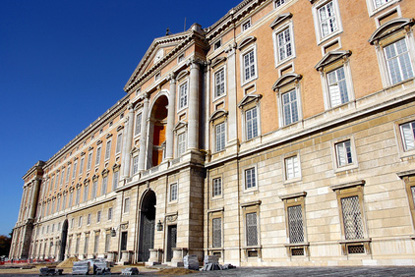
The Royal Palace of Caserta is a magnificent 18th-century palace that rivals Versailles in grandeur. Commissioned by Charles VII of Naples in 1752, it boasts 1,200 rooms, 1,742 windows, and covers a staggering 47,000 square metres, making it the largest royal residence in the world by volume. The palace's 120-hectare park features a stunning 3.3km-long canal with fountains and cascades, supplied by the ingenious Carolino Aqueduct. The park's layout nods to ancient Roman hydraulic engineering, blending classical influences with Baroque and Neoclassical design. The complex also includes the first example of an English Garden in Italy, commissioned by Queen Maria Carolina in 1786, showcasing over 200 botanical species. Film enthusiasts might recognise the palace's grand entrance hall from appearances in Star Wars and Mission Impossible.
Interesting Facts about the Royal Palace of Caserta
- The Royal Palace of Caserta is the largest royal residence in the world by volume, spanning 47,000 square metres with over 1,200 rooms and 34 staircases.
- Designed to rival Versailles, its Baroque gardens stretch 120 hectares and feature cascading fountains, an English Garden, and the Carolino Aqueduct.
- The palace’s English Garden, commissioned by Queen Maria Carolina, was one of Europe’s first landscape gardens and houses rare botanical species from around the world.
- Its Grand Staircase includes twin marble staircases adorned with lion statues, leading to opulent state apartments and a lavishly frescoed Throne Room.
- The site served as the filming location for Star Wars and Mission Impossible, with its iconic entrance hall doubling as galactic settings.
- In 1945, the palace hosted the signing of the unconditional surrender of German forces in Italy during World War II.
- UNESCO designated the palace and its gardens a World Heritage Site in 1997, recognising its Baroque grandeur and Enlightenment-era urban planning.
- The complex includes a theatre modelled after Naples’ Teatro San Carlo and a unique silk factory village reflecting Enlightenment social reforms.
- Over 200 botanical species thrive in the English Garden, designed by British horticulturist John Andrew Graefer in the 1780s.
- The palace’s 3 km-long garden canal features monumental fountains depicting mythological scenes, rivalling those of Peterhof Palace in Russia.
History
The Royal Palace of Caserta, a magnificent architectural masterpiece, was commissioned by Charles of Bourbon in 1752 to establish a new capital away from vulnerable Naples. Designed by architect Luigi Vanvitelli, this colossal palace was intended to rival Versailles and serve as both a royal residence and administrative centre. When Charles first saw Vanvitelli's grand design, he was overwhelmed with emotion, though ironically, he never spent a night there, as he abdicated in 1759 to become King of Spain.
The palace itself is a triumph of Italian Baroque architecture, boasting 1,200 rooms across five floors, including two dozen state apartments, a theatre, and a vast library. As the largest royal residence in the world by volume, covering over 47,000 square metres, the complex was designed to function as a self-contained city, housing everything from a university to military high commands. The construction continued under Charles's son Ferdinand IV, though economic constraints meant that some of Vanvitelli's original plans, including a pair of frontal wings similar to Bernini's colonnades at St. Peter's Square, were never realised.
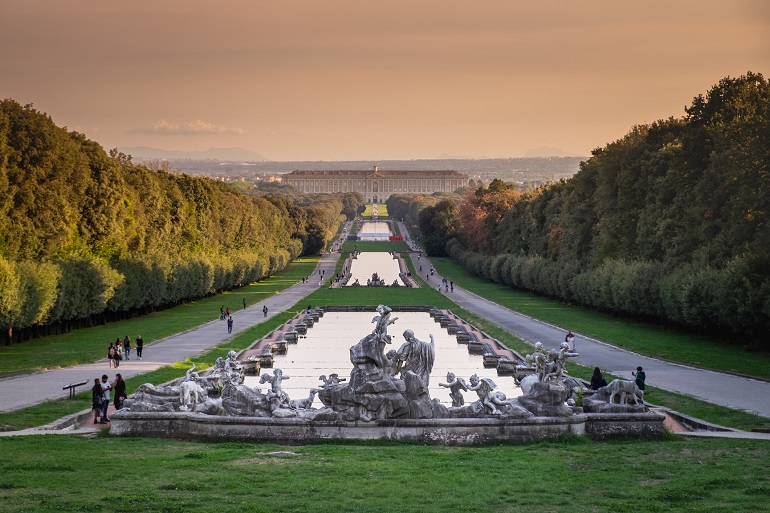
The spectacular park, stretching across 120 hectares, was begun in 1753 and draws inspiration from Versailles whilst maintaining its own distinct character. The gardens feature a remarkable 3.3-kilometre canal of fountains and basins, culminating in a dramatic waterfall, all fed by the innovative Carolino Aqueduct. In 1786, the eastern section was transformed into the English Garden, commissioned by Queen Maria Carolina and representing Italy's first informal garden. This pioneering landscape design incorporated hundreds of rare and precious plants from around the world, many of which still flourish today.
Description
The Royal Palace of Caserta stands as Europe's largest royal residence constructed in the 18th century, a masterpiece that rivals Versailles in its grandeur and architectural brilliance. This UNESCO World Heritage Site represents the pinnacle of Baroque design and royal ambition, stretching across a vast complex that showcases the finest Italian craftsmanship and artistic achievement.
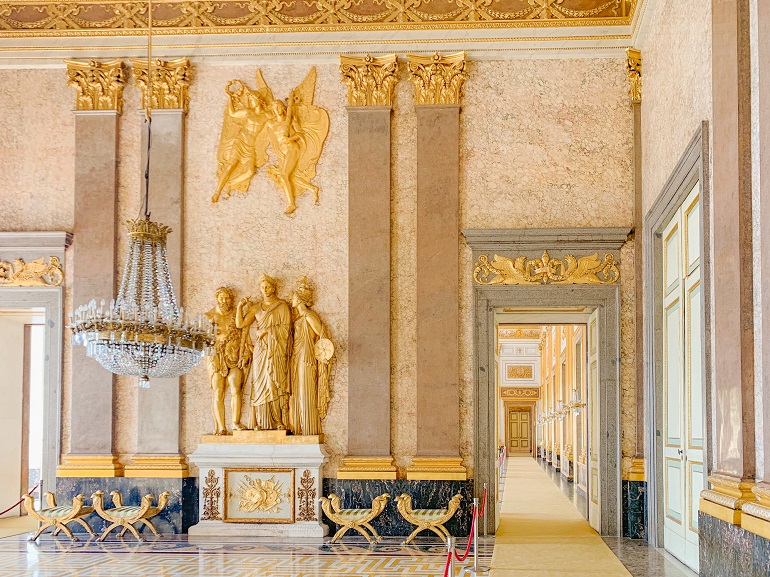
The magnificent Grand Staircase serves as the palace's crowning architectural achievement, featuring 116 steps crafted from exquisite Trapani marble. This masterpiece represents a perfect synthesis of classical rigour and Baroque theatricality, with its design becoming the inspiration for grand staircases worldwide. The staircase reveals itself gradually as visitors ascend, with two parallel staircases culminating in a temple-like structure adorned with arches and columns. At its summit, a 42-metre-high dome, ingeniously designed with a hidden second dome suspended by wooden tie rods, originally concealed an invisible orchestra. The space is further enhanced by enormous statues of Merit, Royal Majesty, and Truth, while two marble lions guard the upper gallery, symbolising power and majesty.

The octagonal Upper Vestibule serves as the palace's architectural heart, marking the intersection of the building's central arms. This space creates a mesmerising visual experience through its dynamic arrangement of vaults, arches, columns, and pillars, all culminating in the spiral motif of the central dome. The vestibule's design masterfully connects the palace's major sections, serving as a transitional space between the Grand Staircase, the Palatine Chapel, and the museum galleries.
Completed in 1845, the Throne Room stands as one of the palace's most impressive chambers. This majestic space extends 40 metres in length, featuring 28 fluted twin Corinthian columns that line its walls. The room's crowning glory is its ceiling, adorned with a magnificent fresco titled "The Laying of the First Stone of the Royal Palace of Caserta," painted by Gennaro Maldarelli in 1844. The room's grandeur is further enhanced by its Empire-style décor and served as the primary venue for receiving distinguished visitors and hosting important state functions.

The Royal Court Theatre represents a remarkable achievement in 18th-century theatrical architecture. Designed as a smaller version of Naples' Teatro di San Carlo, it features an innovative horseshoe shape that provides superior acoustics and visibility. This intimate performance space, the only room completed entirely under Vanvitelli's supervision, served as the sovereign's private theatre for exclusive productions of Neapolitan performances.
Park & Garden
The park spans an impressive 120 hectares, extending 3.3 kilometres from the palace. Designed by Luigi Vanvitelli, it masterfully combines Italian Renaissance garden traditions with French-inspired solutions popularized at Versailles. The park's most distinctive feature is its innovative "Telescope Effect," creating an optical illusion through a perfectly straight avenue that appears to extend infinitely. The water features are supplied by the remarkable Carolino Aqueduct, which feeds the numerous pools and fountains throughout the grounds.
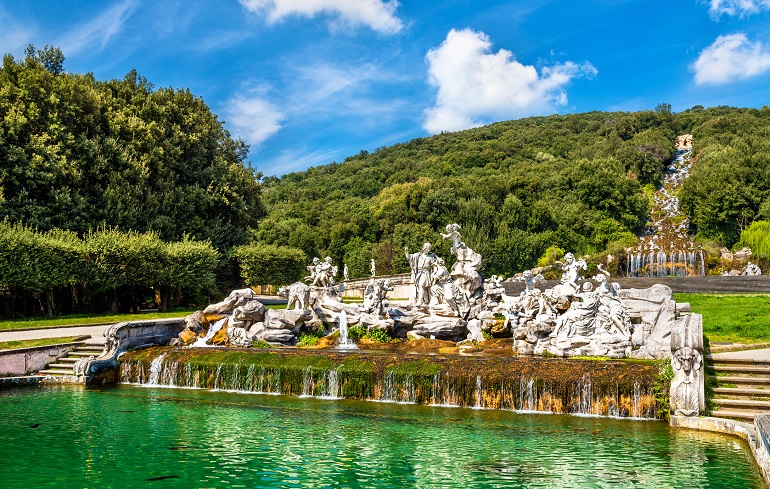
The park's water features represent some of the finest examples of Baroque fountain design in Europe. Five magnificent fountains line the central alleyway, each telling stories from Roman mythology through intricate sculptural compositions. The Fountain of Diana and Actaeon dramatically depicts the myth of the hunter's transformation, while the massive Fountain of Aeolus spans 80 metres and features 28 statues. The Fountain of Ceres celebrates agricultural abundance with its depiction of the goddess surrounded by nymphs, tritons, and dolphins. Each fountain contributes to a carefully choreographed sequence of water displays that culminates in the great waterfall.
The English Garden, created in 1786, represents Italy's first informal garden and covers 24 hectares. Commissioned by Queen Maria Carolina and designed by Carlo Vanvitelli and John Andrew Graefer, this romantic landscape features carefully crafted hills, meadows, and waterways. The garden incorporates artificial ruins and archaeological statues, drawing inspiration from the contemporary discoveries at Herculaneum and Pompeii. Its collection of exotic plants, housed in orangeries and greenhouses, demonstrates the Bourbon dynasty's keen interest in botany and horticultural innovation.
The waterfall serves as the culmination of the park's water system, with water cascading 82 metres from Mount Briano's summit to the Fountain of Diana and Actaeon. Seven ramps flank each side of the waterfall, leading to a panoramic lookout point adjacent to the San Silvestro Wood. Though Vanvitelli originally planned to construct a coffee house at this location, the site instead features a rustic cave pavilion known as the Torrione, adding to the romantic atmosphere of the upper gardens.
Getting There
The Royal Palace of Caserta, located at Piazza Carlo di Borbone in Caserta, Italy, is easily accessible from Naples, situated about 30 km away. The most convenient way to reach the palace is by train from Napoli Centrale station to Caserta station, with frequent services running every 30-45 minutes and a journey time of approximately 40 minutes. From Caserta station, the palace is a mere 5-minute walk away. For those arriving by car, take the A1 motorway and exit at Caserta Nord, or the A30 motorway and exit at Caserta Sud, then follow signs to Caserta. Once at the palace, visitors can explore the extensive 3-kilometre park either on foot or via the electric shuttle service, which costs €2.50 for a return ticket and stops at various fountains throughout the grounds. The palace offers two main entrances: Piazza Carlo di Borbone, which provides priority access for people with disabilities, and Corso Giannone, which allows direct access to the Royal Park and permits bicycle entry. Bicycle rental is available within the park for those who prefer cycling, though bikes are not permitted in the English Garden section.
Best Time to Visit
The best time to visit the Royal Palace of Caserta is during the spring and early autumn months, when the weather is pleasant and crowds are relatively smaller compared to the peak summer season. It is advisable to arrive early in the morning, around 8:30 am, to avoid the heat and crowds, especially during summer. Starting your visit with the gardens is recommended, as they offer a cooler and more serene environment in the morning. If you arrive later, consider beginning with the palace and then moving to the gardens. Weekdays, excluding Tuesdays when the palace is closed, are generally less busy than weekends, making them ideal for a more peaceful visit. Additionally, visiting in the late afternoon can also be beneficial, as the palace remains open until 7:30 pm, allowing for a more relaxed exploration of its grand halls and gardens.