


| Contents |
|---|

Introduction
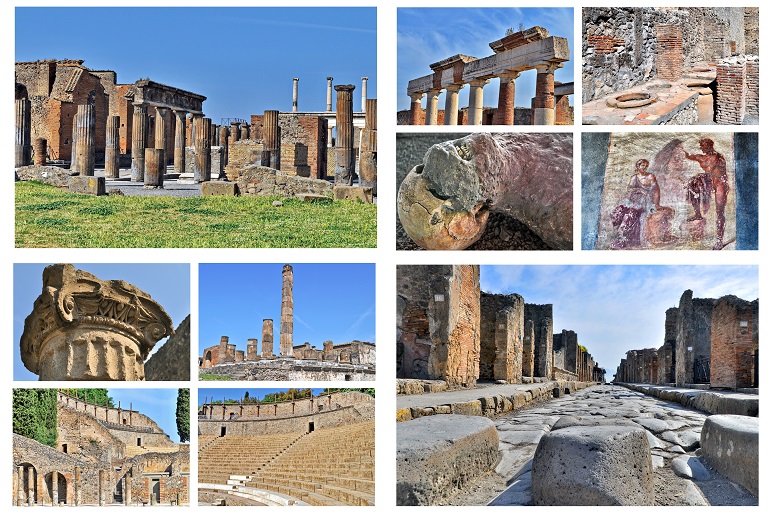
The ancient Roman city of Pompeii, situated near modern-day Naples in Italy, stands as one of the world's most remarkable archaeological sites, preserved by the catastrophic eruption of Mount Vesuvius in 79 CE. This once-thriving port city was buried under 6 metres of volcanic ash and pumice, effectively freezing it in time and providing an unparalleled window into daily life in the Roman Empire. Today, visitors can explore over 44 hectares of excavated ruins, including well-preserved homes, shops, temples, public baths, and a magnificent amphitheatre that could seat 20,000 spectators. The site offers extraordinary glimpses of Roman architecture, art, and engineering, with vivid frescoes and detailed mosaics still adorning many buildings. The plaster casts of victims, created by archaeologists who filled the voids left by decomposed bodies in the ash, serve as poignant reminders of the human tragedy that occurred here.
Interesting Facts about Pompeii
- Pompeii was buried under 4-6 metres of volcanic ash during Mount Vesuvius' catastrophic eruption in 79 CE, preserving entire buildings and everyday objects.
- The city featured ancient Roman "fast food" establishments called thermopolia, where citizens purchased hot meals from street counters.
- Archaeologists discovered perfectly preserved 2,000-year-old loaves of bread in bakery ovens, still bearing bakers' stamps.
- Pompeiians enjoyed remarkably healthy teeth due to fluoride-rich water from Vesuvius, with dental studies showing minimal decay.
- The world's oldest surviving Roman amphitheatre, built in 70 BCE, still stands in Pompeii's ruins.
- Over 150 ancient graffiti messages were preserved on walls, including insults, love notes and political campaign slogans.
- Giuseppe Fiorelli pioneered plaster casting in 1863 to capture victims' final poses by filling body-shaped voids in hardened ash.
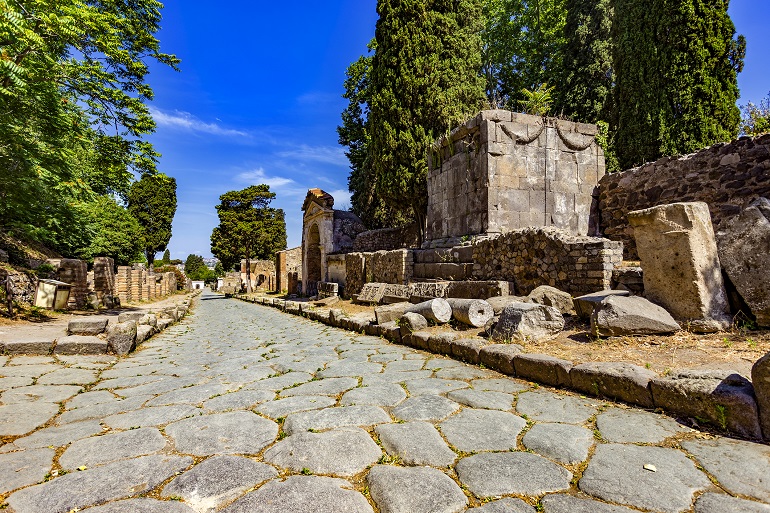
- Pompeii's streets featured raised stepping stones to keep pedestrians dry while allowing chariot wheels to pass through gaps.
- An unusual prevailing wind direction during the eruption blew deadly ash directly towards Pompeii rather than away from it.
- The site remained undiscovered for nearly 1,700 years until accidental rediscovery by canal diggers in 1748.

History
Pompeii, situated near modern-day Naples in Italy's Campania region, was first established by the Oscans in the 8th century BCE. The settlement quickly grew in importance due to its strategic location near the Sarno River, which facilitated maritime trade. The Greeks arrived around 740 BCE, introducing their culture and building the significant Doric Temple in what would later become the Triangular Forum.
The city underwent several transformations under different rulers. The Etruscans controlled the area from the 6th century BCE, during which time they constructed a primitive forum and the Temple of Apollo. After the Battle of Cumae in 474 BCE, the Greeks regained control, followed by the Samnites who conquered the region in the 5th century BCE. Pompeii later became part of the Roman orbit, though it maintained its autonomy until 89 BCE when it was conquered by Sulla and declared a Roman colony.
Under Roman rule, Pompeii flourished as a wealthy commercial centre, exporting wine and olive oil throughout the Mediterranean. The city saw significant architectural development, with the construction of impressive public buildings including the Forum, the Temple of Jupiter, the Large Theatre, and the Stabian Baths. However, this prosperity was abruptly halted when Mount Vesuvius erupted in 79 CE, burying the entire city under volcanic ash and preserving it for over 1,500 years until its rediscovery in 1599.
Description
Main Public Buildings
Around the Forum
The Forum of Pompeii served as the pulsating heart of the ancient city, representing the pinnacle of Roman urban design and civic life. This grand central plaza, dating back to the 6th century BCE, underwent multiple expansions and renovations throughout its history, reaching its architectural zenith during the reign of Emperor Augustus with the addition of its defining colonnaded portico. The space functioned as a vibrant hub for political gatherings, legal proceedings, and commercial activities, with the Basilica serving as the city's courthouse. Religious life flourished here as well, evidenced by the temples dedicated to Jupiter, Apollo, and the Imperial Cult that flanked the square. Archaeological investigations have revealed an unexpectedly dynamic history of redesigning and changes, with numerous traces of dismantled, moved, and subsequently placed sculptures and fountains, suggesting a constantly evolving public space.
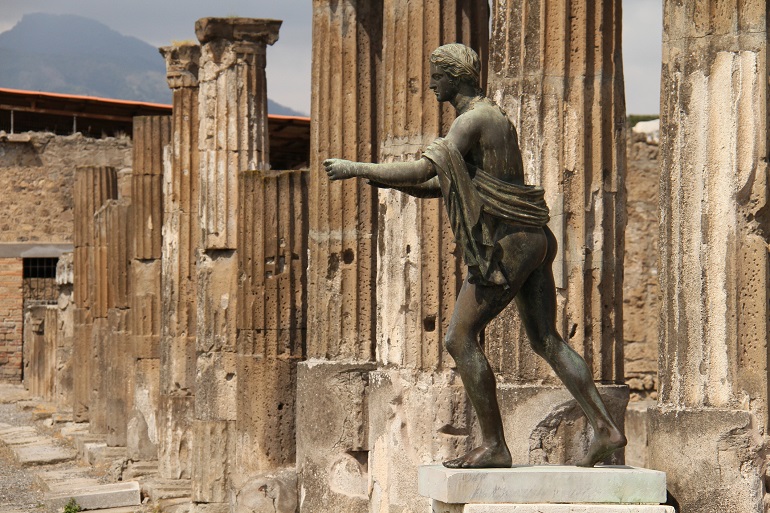
The Temple of Apollo, dating to around 120 BCE, represents one of Pompeii's most important religious buildings. Located in the forum and facing the northern side of town, it features 48 Ionic columns surrounding a high podium. The temple underwent reconstruction after the 62 CE earthquake, with its columns being updated from tuff to stucco with Corinthian capitals painted in vibrant yellows, reds, and dark blues. A white marble altar stands in front of the steps, while a sundial-bearing Ionic column sits to the side.
The Temple of Jupiter, also known as the Capitolium or Temple of the Capitoline Triad, stands majestically at the north end of Pompeii's forum. Built in 150 BCE, it became Pompeii's main temple after the Roman conquest. The temple housed statues of Jupiter, Juno, and Minerva in its cella, which only priests could enter. Below the main hall was a chamber used for storing sacrificial offerings and the city's treasury. The temple suffered significant damage in the 62 CE earthquake and was still awaiting restoration when Vesuvius erupted in 79 CE.
The Basilica of Pompeii stands as one of the oldest and most handsome public structures in the Italic world. Built at the end of the 2nd century BCE, this impressive building served multiple purposes as a court, political rally site, and general meeting place. The rectangular space measures 55 x 24 metres, divided by colonnades into a nave and two aisles, with a raised podium for judges. Its First Style decorations and Oscan graffiti testify to its great antiquity.
The Forum Granaries, located on the western side of the Forum, feature eight openings separated by brick pillars. Built after the 62 CE earthquake, this structure originally served as a fruit and vegetable market. Today, it houses over 9,000 archaeological artifacts, including terracotta pottery, cooking implements, and amphorae used for transporting oil, wine, and fish sauces across the Mediterranean. The building also displays marble tables, fountain basins, and several casts of eruption victims.
The Macellum: This grand marketplace served as Pompeii's main commercial center. Located near the Forum, it featured three entrances and was constructed around 130-120 BCE. The building included a distinctive dodecagonal central space supported by twelve columns, used primarily for fish sales, as evidenced by discovered fish bones and scales. The southern entrance is notable for its remarkable checkerboard-patterned wall, considered one of the finest examples of Roman construction in Pompeii.
The Great Palestra, constructed during the Augustan period in the early 1st century CE, served as an impressive gymnasium and sports complex. This expansive site features open-air courtyards adorned with beautifully preserved mosaics depicting athletic activities. The facility was primarily used for physical and intellectual training of upper-class youth, offering spaces for various activities including wrestling, boxing, and general exercise.
The Stabian Baths, located at the intersection of Via Stabiana and Via dell'Abbondanza, represent the largest public bath complex in Pompeii. Built after 130/120 BCE, these baths underwent three major renovations throughout Pompeii's history. The complex spans approximately 3,300 square metres and features separate sections for men and women. The men's section includes a large palaestra with a swimming pool, garden nymphaea, and various bathing rooms including a frigidarium, tepidarium, and caldarium. Recent excavations in 2021 and 2023 revealed two round rooms identified as ancient saunas, though these have since been reburied.
Around the Amphitheatre
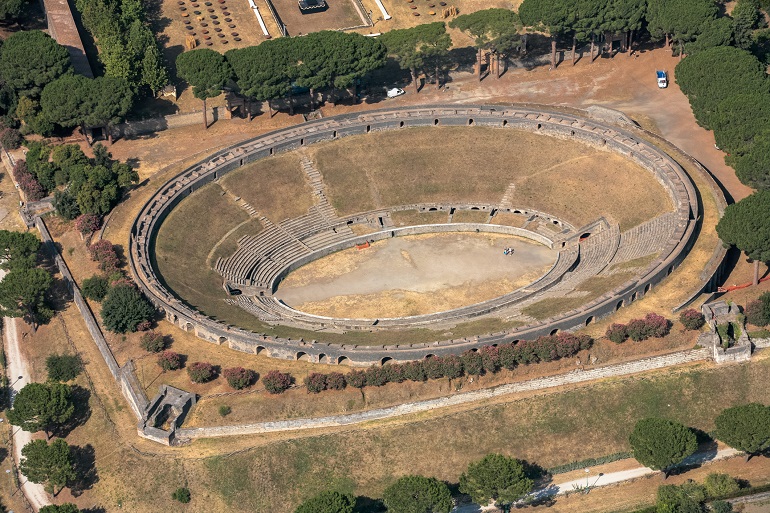
The Amphitheatre of Pompeii stands as Italy's oldest surviving permanent arena, commissioned by magistrates C. Quintus Valgus and M. Porcius in 80 BCE. This magnificent structure could accommodate up to 20,000 spectators and featured sophisticated design elements, including three distinct seating sectors: the ima cavea for aristocrats, and the media and summa cavea for other citizens. The building was equipped with a velarium, a massive canopy that protected spectators from the sun, supported by articulated beams inserted into stone rings. The amphitheatre gained additional historical significance in 59 CE when it became the site of a notorious riot between Pompeians and Nucerians, leading Emperor Nero to temporarily close the venue. The structure's remarkable preservation allows visitors to imagine the excitement of gladiatorial contests and public spectacles that once animated this grand arena.
The Forum Boarium, situated near the eastern edge of the city just inside the Porta Urbulana (also known as Porta di Sarno), was initially misidentified by excavators in 1755 due to the discovery of large bovine bones. Recent archaeological work has revealed that at least part of this area actually contained an ancient vineyard, demonstrating the diverse agricultural activities within the city walls.
The Praedia di Giulia Felice (Estate of Julia Felix) is one of Pompeii's largest properties, occupying an entire block. First excavated between 1754-57 and later re-excavated in 1952-53, this luxurious residential-commercial complex features three separate gardens, elegant baths, and spectacular Fourth-Style frescoes. The walls display scenes of everyday Pompeian life, and the summer triclinium overlooks gardens with pools and waterfalls. The property was clearly designed for wealthy clientele, featuring private water supply and both indoor and outdoor seating areas.
The Necropoli di Porta Nocera, located in the southeastern periphery of Pompeii, is the city's largest and most important burial ground. Established after the Roman colonization of Pompeii in 80 BCE, it contains well-preserved funerary structures and inscriptions spanning 160 years until the city's destruction. The necropolis provides valuable insights into Roman burial customs and social structures, including evidence of how slaves and young children were commemorated.
The Necropoli di Fondo Pacifico is situated near the amphitheatre and represents one of Pompeii's major burial grounds. However, the available search results don't provide detailed information about this particular necropolis's specific features or characteristics.
In other quarters
The Teatro Grande (Great Theatre), constructed in the 2nd century BCE, stands as a magnificent example of Roman theatrical architecture. This horseshoe-shaped theater cleverly utilizes the natural hillside slope for its cavea (seating area). The theater could accommodate approximately 5,000 spectators and featured three distinct seating zones, including four marble-clad steps near the orchestra reserved for musicians and city elite. During the Augustan age, the theater underwent significant renovations, including the addition of a retractable canopy to protect spectators from the elements.
The Temple of Asclepius, dating from the 2nd century BCE, sits at the intersection of Via del Tempio di Iside and Via Stabiana. The temple features a narrow design with a portico at the entrance, a tufa altar decorated with cushion scrolls, and a mixture of Doric and Ionic elements. A columned podium is accessed by steps, and at the rear, a cella contains a pedestal where the statue of Asclepius, the God of Medicine, was discovered.
The Triangular Forum, situated at the highest point of Pompeii, derives its name from its distinctive geometric shape. Built in the 2nd century BCE, this impressive space features a monumental entrance with six Ionic columns and a surrounding colonnade of 95 Doric columns. The forum contains several fascinating elements, including a mysterious tomb-like structure thought to be a monument to Pompeii's founder, three tuff stone altars from the pre-Roman era, and a well flanked by Doric columns. A semi-circular tuff stone seat offers spectacular views over the Gulf of Naples.
The Lupanar, Pompeii's official brothel, was strategically located near the Forum and Stabian Baths on Via dell'Abbondanza. This two-story structure contained ten small rooms with stone beds, five on each floor. The building features explicit frescoes advertising various services, and approximately 120 examples of graffiti remain on its walls. The establishment was managed by a "leno" who purchased enslaved women primarily from the East, with services costing between 2 to 16 asses (with one as equal to about half a sesterce).
The Forum Baths, while smaller than the Stabian Baths, are considered the most elegant of Pompeii's thermae. Built in the years following 80 BCE, they feature separate sections for men and women with individual entrances. The men's section includes an apodyterium (changing room), frigidarium (cold bath), tepidarium (warm bath), and calidarium (hot bath). The rooms are elegantly embellished, particularly the apodyterium-tepidarium with its elaborate stucco relief vault and bronze brazier for heating. Archaeological evidence suggests these baths were open in the evenings, as indicated by the discovery of over 500 lamps in the men's entrance.
The Necropolis of the Herculaneum Gate, accessed through the Porta Ercolano, represents one of Pompeii's most significant burial grounds. The gate itself, featuring three barrel arches, was constructed by the Sullans after their conquest of Pompeii in 80 BCE, though the access point had existed since the 3rd century BCE. The gate marks the beginning of the Roman road that connected Pompeii to Herculaneum and served as a busy regional route linking the city to Naples and, via the Via Domitiana, to Rome.
Individual Houses
Around the Forum
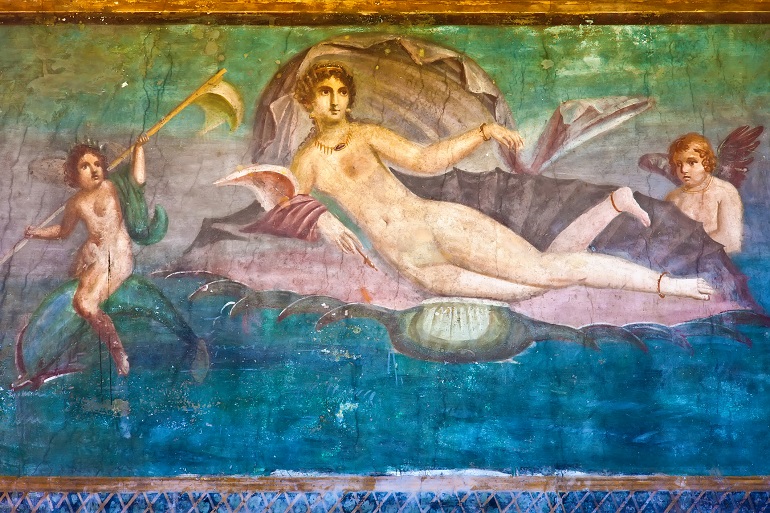
The Casa di Trittolemo, situated in front of the Basilica and adjacent to the Sanctuary of Apollo, was a lavish house featuring two atriums and two peristyles. The house is particularly notable for its exquisite Fourth Style frescoes, including scenes of amorini engaged in various activities and the celebrated fresco of Triptolemus, from which the house derives its name. The hero is depicted receiving a basket of wheat from Persephone. A second remarkable fresco shows Venus arriving from the sea on a Triton's back, depicting the mythological founding of Pompeii.
The Casa della Regina Carolina, partially excavated in the early 19th century, takes its name from Queen Caroline Bonaparte Murat, who supported its excavation. The house was first investigated by the Bourbons in the 18th century, with further excavations occurring in 1809, 1812, 1818, 1826, and 1839. Recent archaeological work has revealed evidence of earlier Samnite or Republican domestic structures beneath the 79 CE stratum.
The Casa dalle Pareti Rosse (House of the Red Walls) has recently been restored and reopened to the public in 2017. This house is currently accessible to visitors with opening hours from 9:15 to 16:20, with the last entry at 16:00.
Around the Teatro Grande
The Casa dei Ceii, built in the late 2nd century BCE during the Samnite period, showcases remarkable architectural evolution. The house underwent significant renovation in the early 1st century when it belonged to Lucius Ceius Secundus, who served as aedile in 76 CE and duovir in 78 CE. The renovation included the addition of third-style wall paintings throughout the interior. When Vesuvius erupted in 79 CE, the house was still undergoing modernization work, including the construction of an upper floor, though it remained inhabited as evidenced by the discovery of everyday objects.
The House of Menander dominates insula I.10 in Pompeii's southern quarter. This high-status townhouse spans nearly 20,000 square feet and features marble columns and red and yellow wall paintings across all four styles. Originally built in the third century BCE as a basic atrium house, it was later enhanced with a Hellenized peristyle garden. The house's peristyle is particularly impressive, featuring 23 columns connected by a pluteus decorated with paintings of birds and animals.
The House of the Cryptoporticus features a unique underground corridor decorated with frescoes of Satyrs and Maenads, along with scenes from the Trojan War. The house includes a private bath complex, a rarity in Pompeii, with four rooms featuring rich stucco decoration. Archaeological evidence suggests extensive trade connections, with amphoras from Italy, Libya, Tunisia, Greece, and Turkey found in the cryptoporticus, which was used as a cellar.
Around the Amphitheatre & the Palestra Grande
The House of Venus in the Shell, discovered between 1933-1935 and 1951-1953, was constructed in the 1st century BCE. The house's focal point is its peristyle garden, around which various frescoed rooms are arranged. Its most spectacular feature is a large fresco depicting Venus lying in a shell, accompanied by two cherubs. The lower portion shows an exotic garden with plants and animals, while the upper section is divided into three panels featuring a drinking fountain with birds, a statue of Mars, and the central Venus figure. The goddess is portrayed nude, adorned only with a tiara and jewelry. This residence belonged to the prominent Satrii family during Pompeii's final years.
The House of the Ship Europa, located in the southeastern part of the city, is notable for its distinctive north wall peristyle decoration depicting a ship named Europa. This image is believed to be allegorical, representing the goddess Europa's mythical abduction by Jupiter disguised as a bull. The house's most remarkable feature is its expansive garden, which was used to cultivate a variety of produce including beans, onions, cabbage, and grapes for wine production. The garden also contained exotic fruit trees such as cherries and apricots, introduced from the Far East, as well as lemon trees used for their antibacterial properties.
The Casa del Larario Fiorito represents the merger of two independent units sharing similar floor plans, with the residential section facing Via di Nocera to the west and a spacious garden to the east. The house features well-preserved original wall paintings, particularly the Fourth Pompeian style decorations in the grand hall (oecus) overlooking the garden, with mythological scenes set within yellow ochre panels. The house's namesake comes from its exquisite lararium (domestic shrine) located in a small cubiculum, adorned with flying cupids and scattered flowers. The hortus (garden) area features a large masonry triclinium set upon a cocciopesto floor with marble inserts.
The Caupona di Sotericus began as a modest house with a covered atrium and rear garden before being converted into a commercial space during the Imperial period. The building is particularly remarkable for its eight preserved grey tuf blocks, which formed pillars with recessed half-columns that once framed openings on the first floor. These blocks retain their original decorated plasters, providing rare evidence of upper-floor architectural ornamentation in Pompeii.
The House of Octavius Quartio, located along the Via dell'Abbondanza, boasts the largest garden in Pompeii. The house features a magnificent atrium surrounded by bedchambers, with an impluvium bordered by a masonry flower bed. Its most striking feature is the expansive garden, which has been restored with historically accurate plantings. The property was identified as belonging to Octavius Quartio through a bronze seal discovered during excavations.
The Villa of the Mysteries represents one of Pompeii's most enigmatic and fascinating structures, combining residential luxury with religious significance. Built in the 2nd century BCE, this magnificent villa served dual purposes as both a place of business and a sacred space. Its most remarkable feature is the series of well-preserved frescoes depicting what appears to be initiation rites of the Dionysian mystery cult, painted in vibrant colours that have endured for two millennia. The villa also functioned as a working vineyard, with evidence of wine production facilities demonstrating its role in the local economy. The structure's sophisticated architecture, with its central peristyle and carefully planned rooms, exemplifies the finest aspects of Roman architectural design.

The House of the Tragic Poet, known for the Sacrifice of Iphigenia fresco, represents one of Pompeii's most significant artistic treasures. This remarkable Fourth Style fresco, now preserved in the Naples Archaeological Museum, depicts the dramatic moment of Iphigenia's sacrifice, showcasing the sophisticated artistic achievements of Pompeian painters.
The Casa degli Archi (House of the Arches) was excavated in 1954. The house features distinctive architectural elements, including black panels with decorative elements such as vases, circles, and palm motifs.
The Casa di Giulio Polibio stands as one of Pompeii's largest private residences, occupying nearly an entire insula. Built on the ancient city ramparts, this expansive dwelling featured multiple floors on terraces that descended toward the sea. The house was partially excavated in 1912 and fully unearthed between 1964 and 1978. Its last owner was likely C. Julius Polybius, whose name appears on numerous electoral inscriptions on the façade.
The Garden of the Fugitives provides perhaps the most emotionally powerful experience in Pompeii, preserving a tragic moment frozen in time. This former vineyard, spanning approximately 1,500 square meters, contains the haunting plaster casts of thirteen victims who sought escape during the eruption's final moments. These casts, created by pouring liquid chalk into the cavities left by decomposed bodies in the volcanic ash, capture extraordinarily detailed impressions of the victims' final positions and expressions. The victims, discovered in 1961, were found above a 3.5-meter layer of pumice, indicating they perished in the lethal pyroclastic flow while attempting to flee through the nearby Nocera Gate. The garden underwent careful restoration in 2011, with the casts placed over a thin layer of ash to commemorate the tragic events of 79 CE.
In the Northwest Quarter
Casa delle Nozze d'Argento (House of the Silver Wedding): This elegant Roman house, excavated in 1893, was named to commemorate the silver wedding anniversary of Italy's King Umberto I and Queen Margherita of Savoy. Built around 300 BCE during the Samnite period, it underwent renovations in the early 1st century CE. The house features one of Pompeii's largest atria, supported by four magnificent Corinthian columns. Two gardens enhance the property: the main garden includes a central pool and triclinium, while the second features a bath-house, outdoor swimming pool, and kitchen area. The living room boasts impressive decorative elements, including mosaic flooring, painted walls, and a barrel-vaulted ceiling supported by octagonal columns decorated to imitate porphyry.
Casa del Principe di Napoli (House of the Prince of Naples): This Roman townhouse earned its name when the Prince and Princess of Naples attended its ceremonial excavation in 1898. The house is particularly valuable to archaeologists because it features Fourth Style Pompeian paintings from a single period, making it unique among Pompeii's houses. The structure includes a Tuscan atrium with a central impluvium, and the rear portion contains richly decorated rooms surrounding a portico and central garden.
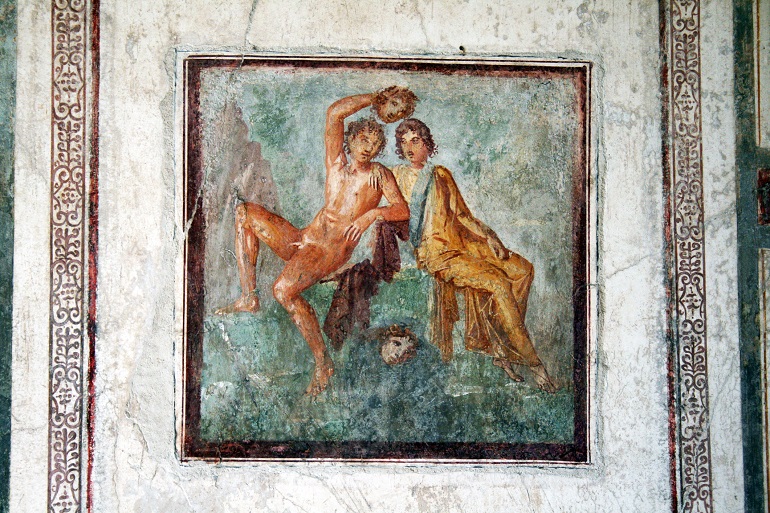
House of the Dioscuri:ne of Pompeii's largest and most beautifully decorated houses, it derives its name from paintings of the Dioscuri (Castor and Pollux) in the entrance vestibule. The house reached its current form during the Augustan period through the merger of three separate houses. It features a Corinthian-style atrium, and its peristyle contains fourth-style frescos depicting architecture and still lifes, believed to be created by the same artist who decorated the House of the Vettii.
The House of Caecilius Iucundus offers fascinating insights into the life of a Roman banker. Excavated in 1875, this double atrium house yielded an extraordinary archive of 153 wax tablets documenting business transactions. The south house served a representative function with reception rooms and a peristyle garden, while the north house contained practical spaces like the kitchen and stables. The house's tablinum featured some of Pompeii's finest wall paintings, though many are now housed in Naples' National Museum.
The House of the Faun, constructed in the 2nd century BCE, stands as the largest and most elaborate residential complex in Pompeii. This grand Hellenistic palace showcases exceptional craftsmanship and quality materials, even among the noble houses of Pompeii. Though damaged in the 62 CE earthquake, it was rebuilt and remained in use until the 79 CE eruption. The house represents one of the most luxurious aristocratic residences from the Roman Republic period.
The House of the Vettii, reopened to tourists in January 2023 after twenty years of restoration, is one of Pompeii's largest and most impressive domus. Named after its owners, two successful freedmen named Aulus Vettius Conviva and Aulus Vettius Restitutus, the house spans the entire southern section of block 15. The residence features twelve mythological scenes spread across four cubicula and one triclinium, with remarkably preserved wall frescoes completed after the 62 CE earthquake.
The House of the Small Fountain derives its name from its remarkable fountain-nymphaeum, a fashionable feature added in the 1st century CE. The house combines architectural elements spanning Pompeii's history, with rooms opening onto a central atrium. Its distinctive sloped roof channeled rainwater into a central impluvium and cistern below. The fountain takes the form of a miniature arch with a triangular roof, decorated with intricate mosaics and sculptures, while the peristyle garden features rich frescoes depicting landscapes and maritime scenes.

The House of the Surgeon, one of Pompeii's most famous houses, was first excavated in 1771 and named after the ancient surgical instruments discovered within. Built in the early 2nd century BCE, this modest yet sturdy residence features an opus quadratum ashlar façade in Sarno stone and an atrium courtyard. Though lacking ornate external decorations, its elite status is evident through its four-sided atrium and exclusive vestibulum.
Getting There
The most convenient way to reach Pompeii is by taking the Circumvesuviana train from Naples Centrale Station to Pompei Scavi - Villa dei Misteri station, with trains departing every 30 minutes and the journey taking approximately 35-40 minutes. Upon arrival, there are three main entrances to the archaeological site: two in the southwest near the train station (Porta Marina Superiore and Porta Marina Inferiore at Piazza Esedra), and one at Piazza Anfiteatro in the east. For those wishing to combine their visit with Mount Vesuvius, EAV public buses depart regularly from Piazza Anfiteatro, with the journey taking about 55 minutes and tickets costing €3.10 one way. Alternatively, visitors can drive to Pompeii, which takes roughly 30 minutes from Naples, with paid parking available near the site entrances, though navigating Italian roads can be challenging.
Best Time to Visit
The best time to visit Pompeii is during the shoulder seasons of spring (April to May) and early autumn (September to October). These months offer a delightful balance of mild temperatures, ranging from 21°C to 28°C, and fewer crowds compared to the peak summer season. Spring, particularly April and May, is especially favourable as the days are longer, allowing more time to explore the vast archaeological site. The weather is pleasantly warm and sunny, ideal for outdoor sightseeing without the scorching heat of summer. Moreover, visiting during these periods often means lower prices for accommodation and flights. To make the most of your visit, consider arriving early in the morning when the site opens or in the afternoon after 1 pm, when the crowds thin out and a refreshing sea breeze often sweeps through the ruins.