


| Contents |
|---|
Introduction
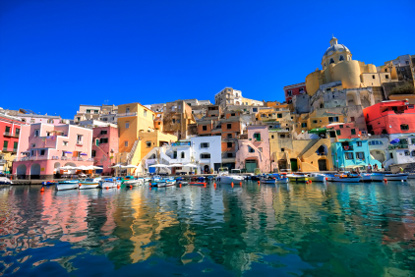
Procida is a small inhabited island situated in the Bay of Naples, approximately 3.3km off the coast of Campania in southern Italy. Located between Cape Miseno and the island of Ischia, this compact volcanic island spans less than 4.1 square kilometres, with 16km of jagged coastline. The island comprises three main harbour areas: Marina Grande, where ferries dock; Marina Corricella, known for its picturesque fishing village; and Marina di Chiaiolella in the south. With a population of 10,000 residents, Procida offers a more authentic Italian experience compared to its more tourist-oriented neighbours, Capri and Ischia. The island's highest point is Terra Murata, rising 91 metres above sea level, which historically served as a fortress and provides panoramic views of the Bay of Naples.
Interesting Facts about Procida
- Procida is the smallest of the three main islands in the Gulf of Naples, known for its vibrant, colourful fishermen’s houses that create a postcard-perfect waterfront.
- The island’s name derives from the Greek word Prochyta, meaning ‘poured out’ or ‘lying forth’, referencing its appearance from the sea.
- It was formed by four now-dormant volcanic eruptions, contributing to its jagged coastline and unique geological profile.
- Procida’s 16th-century Terra Murata district served as a fortified refuge against pirate attacks and later housed the Palazzo d’Avalos prison.
- The island was named Italy’s Capital of Culture in 2022, boosting its profile while maintaining an authentic, crowd-free atmosphere.
- Connected by footbridge to Procida, the tiny island of Vivara is a protected nature reserve within an extinct volcanic crater.
- Marina Corricella, its oldest fishing village with pastel buildings and boat-filled harbours, banned vehicle traffic to preserve its tranquil charm.
- Procida starred in films like Il Postino and The Talented Mr Ripley, with filming locations still drawing cinema enthusiasts.
- Local culinary specialities include lingua di Procida, a lemon-cream pastry, and seafood dishes using daily catches from Tyrrhenian waters.
- Archaeologists discovered Bronze Age Mycenaean pottery on Vivara, suggesting ancient Greek trading links long before later settlements.

History
Procida's rich history spans over three millennia, with archaeological evidence showing Mycenaean Greek settlements as early as the 16th century BCE. The island was formally colonised by Greeks in the 8th century BCE before becoming a favoured retreat for Roman aristocrats who valued its seclusion. Following the fall of the Western Roman Empire, Procida experienced various rulers, including the Goths, Eastern Romans, and Norman French, who dominated until the 13th century. The island's strategic importance in the Bay of Naples led to the construction of the Terra Murata fortress, which protected locals from frequent Saracen raids. Throughout the centuries, Procida passed through the hands of several ruling powers, including the Aragonese, Spanish Empire, and briefly the French during the Napoleonic Wars, before finally becoming part of the unified Italian state in 1860. The island's primary industries have historically centred on agriculture and fishing, with the latter remaining significant through the 18th and 19th centuries.
Main Attractions
Terra Murata
The medieval fortress of Terra Murata stands proudly at 90 metres above sea level, offering breathtaking panoramic views across the Bay of Naples. This historic fortified settlement emerged during a time of frequent pirate raids, when the local population sought refuge behind its protective walls. The area's most impressive structure is the Palazzo d'Avalos, a magnificent 16th-century Renaissance palace that served multiple purposes throughout its history, from a royal residence to a state prison. The palace's commanding position and architectural grandeur make it an unmissable landmark that tells the story of Procida's strategic importance through the centuries.
Marina Corricella
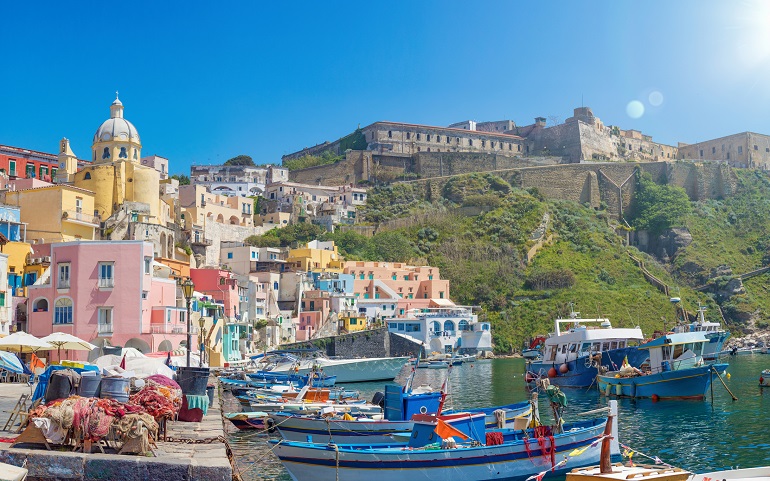
Marina Corricella stands as Procida's most iconic sight, a 17th-century fishing village that embodies the essence of Mediterranean charm. This car-free haven features a cascade of pastel-coloured houses tumbling down to the waterfront, creating a mesmerising spectacle of arches, domes, windows, terraces, and balconies. The village maintains its authentic character as a working fishing port, where local fishermen still sell their fresh catch directly from their boats. The waterfront is lined with excellent seafood restaurants, their tables set directly on the pier, offering diners an unforgettable setting to enjoy the local cuisine.
Marina Grande
Marina Grande, the island's main port and vibrant hub, welcomes visitors with a stunning display of pastel-coloured architecture and the impressive 12th-century Montefusco Palace, also known as Palazzo Merlato due to its distinctive battlements. This bustling area retains its traditional fishing village atmosphere while serving as the island's economic and social centre. The port area features numerous craft shops, cafés, and restaurants, alongside the iconic Church of Santa Maria della Pietà, whose baroque bell tower stands as a beloved symbol for the seafaring community. The nearby Grotte beach derives its name from the ancient tuff caves that were historically used to shelter boats during inclement weather.
Religious Heritage
The Abbey of San Michele Arcangelo represents the pinnacle of religious architecture on the island. This 11th-century Benedictine abbey showcases remarkable baroque artistry, including a spectacular coffered wooden ceiling adorned with pure gold and a central painting depicting Saint Michael vanquishing Satan. The church houses seventeen altars, a 17th-century wooden choir in the central apse, and four significant paintings by Neapolitan artist Nicola Russo from 1690. Among its treasures are an ancient baptistery, a precious statue of the Madonna del Carmine in wood and pure gold, and a fascinating collection of maritime votive offerings from shipwrecked sailors.
The Sanctuary of Santa Maria delle Grazie stands as one of Procida's most distinctive landmarks, its bright yellow façade and elegant bell tower creating a striking silhouette against the sky. Positioned dramatically on the hill overlooking Marina Corricella, this church forms an integral part of the Semmarezio area, also known as Piazza dei Martiri, and has become one of the island's most photographed locations.
Top Museums
Sea Museum (Museo del Mare)
Located in the historical building of the Nautical Institute "Francesco Caracciolo", the Sea Museum was established in 1996 to showcase Procida's deep-rooted maritime traditions. This museum preserves the essence of love, devotion, and passion for the sea, which are characteristic of the people of Procida, including captains, sailors, and fishermen.
The Sea Museum is divided into two main sections:
- A library with an adjoining historical archive, documenting the island's maritime history
- A sector dedicated to the votive and religious traditions of Procida's seafaring activities, including proverbs and folk songs about the sea
Visitors can explore a fascinating collection of navigation instruments, such as octants, sextants, hygrographs, and compasses, alongside various maritime artefacts.
Casa di Graziella Museum
Situated on the second floor of the Palazzo della Cultura in the village of Terra Murata, the Casa di Graziella Museum is dedicated to the fictional character Graziella from Alphonse de Lamartine's 1852 novel. This house-museum offers a captivating reconstruction of a typical 19th-century Procidan home.
The museum features:
- Authentic furnishings and traditional clothing from the 1800-1900 period
- Agricultural tools and furnishing accessories of the era
- A terrace offering stunning sea views
Although not actually belonging to the fictional Graziella, the objects on display provide valuable insights into the traditional life on the island during the 19th century.
Civic Museum of Procida "S. Tusa"
Located in Via San Michele, the Civic Museum of Procida "S. Tusa" is another cultural institution worth visiting. While specific details about its collections are limited in the provided search results, it likely offers exhibits related to the island's history and cultural heritage.
These museums collectively offer a comprehensive view of Procida's maritime legacy, cultural traditions, and historical significance, making them essential stops for visitors seeking to delve deeper into the island's rich heritage.
Local Cuisine
Procida's culinary heritage is deeply rooted in its maritime traditions and local agriculture, with fresh seafood and the island's famous lemons taking centre stage. The local restaurants serve an array of seafood dishes, including the daily catch brought in by fishing boats to the Marina Grande, where mussels in pepper broth (Cozze Impepata) is a beloved speciality. A must-try local delicacy is the unique insalata di limoni (lemon salad), made with Procida's distinctive lemons, mint, garlic, and chilli peppers, dressed with extra virgin olive oil. Beyond savoury dishes, the island offers delightful lemon-infused treats, including lemon-flavoured pasta, a special variation of Torta Caprese, and refreshing lemon granitas that perfectly capture the essence of this Mediterranean paradise.
Shopping
Procida's main shopping area stretches from Marina Grande harbour towards the historic centre along Via Vittorio Emanuele. The island specialises in local handicrafts and unique creations rather than chain stores, with notable shops including Creje for handmade bags and local perfumes, T2 Art Workshop for recycled art pieces, and La Bottega dell'Arte for traditional cribs and statuettes. The Nutrimenti bookshop offers an extensive collection of books about Procida's history and hosts cultural events. Most shops are concentrated around the harbour and Marina Corricella areas, with some additional venues near the southern beaches. It's advisable to carry cash, as many smaller shops prefer cash payments over cards.
Nature in and around Procida
Beach Destinations
Chiaia Beach, one of Procida's largest stretches of sand, offers a perfect setting for families with its shallow waters and excellent facilities. The beach provides stunning views across to the Sorrento Peninsula and features the popular La Conchiglia restaurant directly on the shoreline.
Pozzo Vecchio Beach, also known as Spiaggia del Postino, gained fame as a filming location for the acclaimed movie "Il Postino." This horseshoe-shaped bay features distinctive dark volcanic sand that creates a striking contrast with the intense blue Mediterranean waters. The beach's natural beauty is enhanced by its unspoiled setting and the gentle sound of waves breaking against the shore.
Chiaiolella beach combines natural beauty with modern amenities, offering visitors both pristine waters and convenient facilities. The beach features bathroom access, sunbed rentals, and various food and drink stands, making it ideal for full-day beach excursions.
Vivara Nature Reserve
The Vivara Nature Reserve, connected to Procida by a 362-metre bridge, represents a pristine natural paradise spanning 32 hectares. This crescent-shaped islet serves as a protected habitat for over 100 bird species and showcases the Mediterranean's most characteristic flora, including holm oaks, wild myrtle, and strawberry trees. The reserve, which became a state-protected area in 2002, offers visitors a chance to explore unspoiled nature while enjoying spectacular views of the surrounding waters.
Getting There & Around
To reach Procida, you must travel by sea as there is no airport on the island. The most common route is from Naples, where ferries depart from Calata di Massa (60-minute journey) and hydrofoils from Molo Beverello (45-minute journey). A shorter option is from Pozzuoli port, with a 35-minute crossing. Alternative routes include ferries from Ischia (25 minutes), Capri (2 hours), Sorrento (2 hours), and Positano (1 hour 45 minutes). Once on the island, which spans just 1.6 square miles, most attractions are accessible on foot, with the walk from the ferry port to Marina di Corricella taking only 10-15 minutes. For longer distances, visitors can use the local bus service with four routes covering the island, or take taxis from ranks near the port. Note that from April to December, non-residents are prohibited from bringing vehicles to the island, making public transport the primary means of getting around.
Best Time to Visit
The best time to visit Procida, the charming Italian island in the Bay of Naples, is during the shoulder seasons of late spring (May to early June) and early autumn (September to early October). During these periods, you can enjoy pleasant temperatures, fewer crowds, and most attractions and restaurants remain open. The weather is ideal for exploring the colourful streets, relaxing on the beaches, and taking boat tours around the island. June and July offer the driest conditions, but August can be quite busy as many Neapolitans flock to the island for their holidays. While Procida is a year-round destination, it's worth noting that some establishments may have reduced hours or be closed during the quieter winter months.