


| Contents |
|---|
Introduction
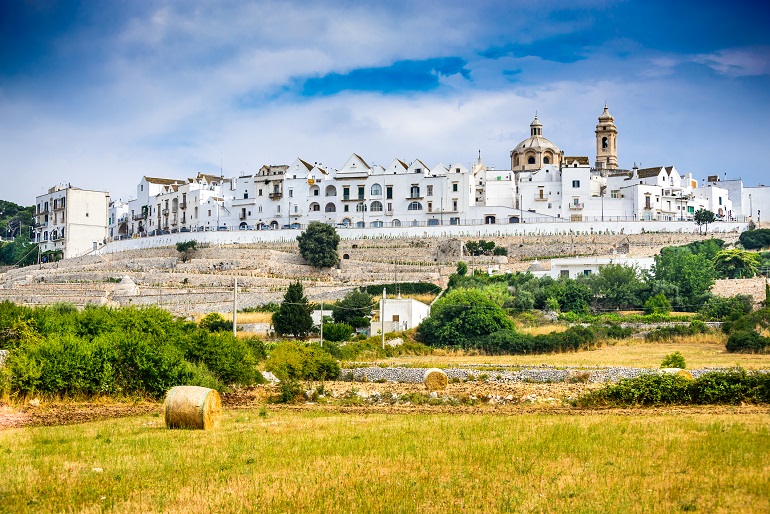
Locorotondo, whose name derives from Latin "Locus Rutundus" meaning "round place," is a charming hilltop town in Italy's Puglia region. Located in the Valle d'Itria between Alberobello, Martina Franca and Cisternino, this medieval settlement dates back to around 1000 CE when it developed as an unfortified hamlet under the jurisdiction of the Benedictine monastery of St. Stephen. The town is characterised by its perfect circular layout, pristine whitewashed buildings, and distinctive "cummerse"—houses with steep roofs made of local stone. Officially recognised as one of Italy's most beautiful villages, Locorotondo offers spectacular panoramic views from its terraces overlooking a countryside dotted with trulli dwellings, olive groves and vineyards. The historic centre features narrow winding streets, Baroque architecture, and several notable churches including the Chiesa Madre dedicated to St. George, the town's patron saint.
Interesting Facts about Locorotondo
- Locorotondo's name derives from the late Latin "Locus Rutundus," meaning "round place," due to the perfect circular shape of its historic centre.
- The town is officially recognised as one of "I Borghi più belli d'Italia" (The most beautiful villages of Italy) and has been awarded the Orange Flag of the Touring Club of Italy.
- Locorotondo was initially called Casale San Giorgio in honour of its patron saint, then Casale Rotondo, Luogorotondo, and finally received its current name in 1834.
- The settlement dates back to ancient times, with archaeological finds from between the 3rd and 7th century BCE, though the town's foundation occurred around 1000 CE as an unfortified hamlet under a Benedictine monastery.
- The historic centre is characterised by distinctive "Cummerse" - small whitewashed houses with sloping roofs paved in black limestone (chiancarelle) that resemble northern European architecture.
- Locorotondo has two patron saints: San Giorgio, celebrated with a market fair on 22-23 April, and San Rocco, who represents the town's liberation from the plague in the 17th century.
- The Locorotondo DOC wine designation was established in 1969, making it one of the longest-established DOCs in Puglia, and primarily features white wines in a region dominated by reds.
- The countryside surrounding Locorotondo is famous for its "jazzelere" (dispersed settlements) and abundance of trulli dwellings built around communal areas called "jazzile".
- The Sanctuary of the Madonna della Catena, located a few kilometres from the historic centre, features a 50-metre-high bell tower and hosts an annual procession on 15th August.
- Locorotondo's wine production specialises in varieties like Verdeca, Bianco d'Alessano, Fiano, Chardonnay, Primitivo, and Negroamaro.
- Palazzo Morelli, an 18th-century Baroque building in the town centre, features a distinctive dome, white façade, and the noble coat of arms of the Morelli family depicted as an elephant supporting a tower.
- The Mother Church of "St. George the Martyr" was built between 1769 and 1821, featuring a Renaissance-style façade with neoclassical elements.
History
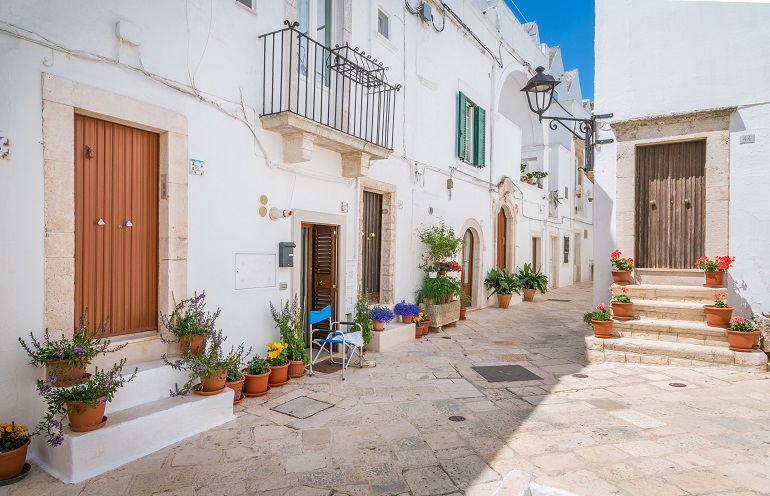
Locorotondo's origins stretch back to ancient times, with archaeological evidence indicating settlements dating to the 3rd millennium BCE. The area was initially inhabited by nomadic groups before more permanent tribes settled at the base of the hills. The foundation of the town as we know it today dates to approximately 1000 CE, when it began as an unfortified hamlet under the jurisdiction of the Benedictine monastery of St. Stephen in Monopoli. The first written record referring to "Locus Rotundus" (Round Place) appeared in 1195 during the Swabian rule, though the settlement itself developed around the Benedictine Monastery of Santo Stefano atop a hill over 400 metres high. Before adopting its current name in 1834, the settlement was variously known as Casale San Giorgio (in honour of its patron saint), Casale Rotondo, and Luogorotondo.
During the Medieval period, the small fiefdom was embroiled in the power struggles of noble families, passing between various dynastic houses including the Carafa and Orsini del Balzo families. The town witnessed the passage of the Angevins and numerous lineages, with some even dividing the territory in half. It wasn't until the 16th century that Locorotondo began to flourish and expand, benefiting from population growth. During this period, the powerful Carafa family fortified the village with defensive walls and constructed a castle, though these structures only remained standing until 1800. Notably, during the Medieval Age, Locorotondo was remarkably spared from the plague epidemic that devastated the rest of the Valle d'Itria, a phenomenon locals attributed to San Rocco but which was likely due to the disinfectant qualities of the lime-stone plaster covering the houses.
The late 18th century saw Locorotondo become a centre of revolutionary activity, caught up in the struggles to establish the Roman "Repubblica" and the Bourbon royal movement "Partenopea". The Caracciolo family, Dukes of Martina Franca and the last feudal lords, maintained control until the early 19th century. This period marked significant changes, with the demolition of the town's walls and castle. The 19th century also witnessed important economic developments, particularly through emphyteutic leases that led to the expansion of vineyards and the distinctive dispersed settlement pattern known as "jazzelere", with abundant trulli dwellings built around communal areas called "jazzile". Agriculture—particularly viticulture featuring the Bianco d'Alessano and Verdeca grape varieties used to produce the white DOC Locorotondo wine—remains central to the local economy to this day.
Main Attractions
Historic Centre (Centro Storico)
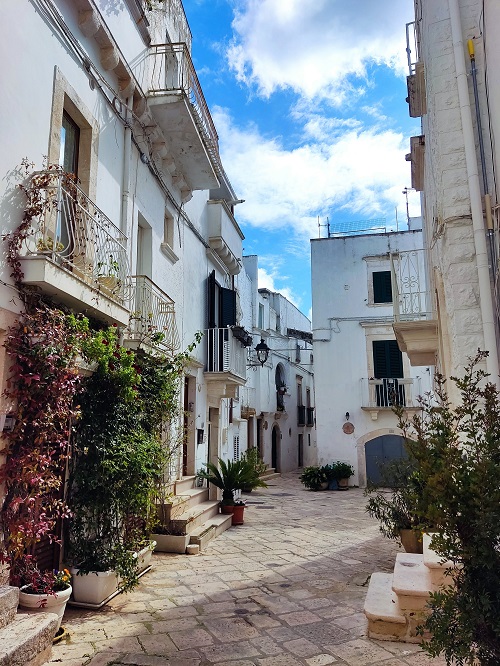
The historic centre of Locorotondo presents a mesmerising circular layout that gives the town its name, which translates to "round place" in Italian. As you wander through its labyrinthine network of narrow streets, you'll be enveloped by pristine whitewashed buildings that create a dazzling contrast against the azure Apulian sky. The centro storico evolved organically over centuries, with each generation adding to its unique architectural character. The traditional cummerse houses, with their distinctive sloping stone roofs, represent an architectural style that predates even the famous trulli of the region and showcases the ingenuity of local builders who worked with available materials to create dwellings perfectly adapted to the Mediterranean climate.
The circular arrangement of streets creates an almost maze-like quality, where each turn reveals charming corners, flowering balconies, and intimate piazzas. This layout was historically designed as a defensive measure, making it difficult for potential invaders to navigate, but today it offers visitors the delight of discovery as they explore. The pristine condition of the historic centre speaks to the town's commitment to preserving its cultural heritage, with strict regulations ensuring that renovations maintain the authentic character of the buildings. The gleaming white facades, often adorned with colourful flower pots and ornate ironwork, create a photogenic backdrop that captures the essence of Puglia's aesthetic charm.
Piazza Vittorio Emanuele
The heart of Locorotondo's social life beats in Piazza Vittorio Emanuele, a graceful public square that serves as both a meeting point and a gateway to the historic centre. Flanked by Porta Napoli on its western side, this ancient entrance once controlled access to the town and still stands as a testament to Locorotondo's medieval origins. The eastern boundary is marked by Porta Nuova, another historic gateway that frames picturesque views of the surrounding countryside. The piazza itself has evolved over centuries from a simple market square to a refined public space adorned with elegant paving stones and surrounded by buildings that showcase various architectural influences from Baroque to Neoclassical.
Throughout the year, this square transforms to accommodate seasonal celebrations, from spring flower festivals to summer evening concerts under the stars. Local residents gather here daily, maintaining the timeless Italian tradition of the evening passeggiata (stroll), creating a living tableau of community life that has remained essentially unchanged for generations. The surrounding cafés and shops occupy buildings that have stood for centuries, many featuring original architectural elements that tell the story of the town's evolution from a medieval settlement to a refined Baroque centre.
Punto Panoramico
The aptly named Punto Panoramico represents the culmination of Locorotondo's relationship with its surrounding landscape, offering what many consider to be the definitive view of the Itria Valley. Located near the Villa Comunale, this carefully positioned viewpoint captures the essence of the region's cultural landscape—a harmonious blend of natural features and human intervention that has evolved over millennia. The panorama encompasses a vast sweep of countryside, with the distinctive trulli dotting the landscape like scattered chess pieces on a green board, their conical roofs catching the light at different angles throughout the day.
This viewpoint achieves particular magic during the golden hour before sunset, when the low-angled light brings the texture of the landscape into sharp relief and bathes everything in a warm glow that has inspired countless paintings and photographs. The olive groves, some containing trees that have stood for centuries, appear silver-grey against the darker green of vineyards and the golden hues of wheat fields. From this vantage point, visitors can appreciate how completely the landscape has been shaped by agricultural practices, with every available patch of fertile soil cultivated and the very stones of the fields transformed into the dry-stone walls that create a delicate tracery across the countryside.
Belvedere Santa Maria della Greca
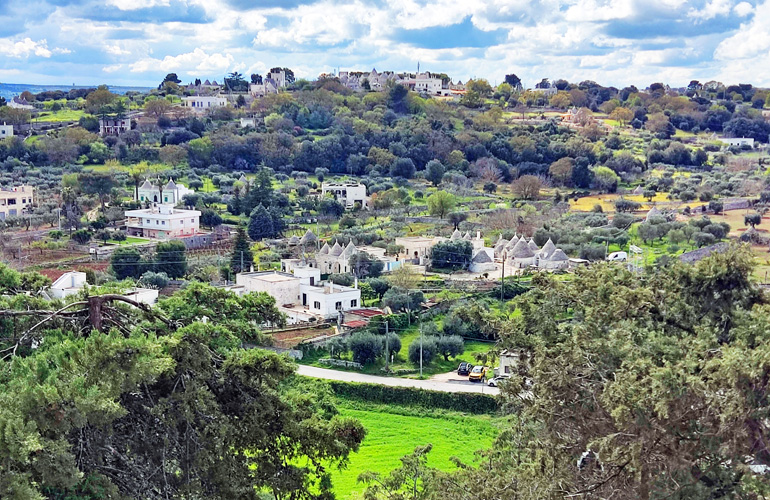
Perched along Via Nardelli, the Belvedere Santa Maria della Greca offers what many consider to be the definitive view of the Itria Valley, a panorama that has inspired artists and photographers for generations. This carefully designed viewing terrace provides an elevated vantage point from which to appreciate the undulating landscape that unfolds before you—a patchwork of vineyards, olive groves, and fields punctuated by the distinctive conical shapes of trulli farmhouses scattered across the countryside. The belvedere was created as part of urban improvements in the early 20th century, designed specifically to showcase the natural beauty that surrounds Locorotondo.
The view changes dramatically with the seasons—from the vibrant green of spring when wildflowers carpet the valley, to the golden hues of summer when the wheat fields ripen under the Apulian sun, to the silver-grey of winter when the ancient olive trees dominate the landscape. On clear days, visibility extends for miles, allowing visitors to appreciate the full extent of this cultural landscape that has been shaped by human activity for millennia. The strategic positioning of the belvedere also offers insight into why Locorotondo was established in this location, as it commands views in all directions, providing both defensive advantages and access to fertile agricultural land.
Mother Church of San Giorgio Martire
Dominating the skyline of Locorotondo's historic centre, the Mother Church of San Giorgio Martire stands as the town's most significant religious monument. Constructed between 1790 and 1825, this imposing Neoclassical structure replaced an earlier medieval church that had become too small for the growing community. The church's design represents a departure from the ornate Baroque style prevalent in the region, instead embracing the cleaner lines and classical proportions that were fashionable in European architecture during the late 18th century. Its Greek cross plan, crowned by an elegant central dome, creates a sense of harmony and balance that reflects the Enlightenment ideals of its era.
The interior of San Giorgio Martire reveals a treasure trove of artistic heritage, with each chapel and altar telling part of Locorotondo's religious history. Gennaro Maldarelli's masterful Last Supper (1841) demonstrates the high level of artistic patronage that the town could command, while the series of Baroque altars—preserved from the previous church—showcase the exquisite craftsmanship of local artisans. The church's acoustics, designed to amplify the human voice in an age before electronic amplification, create an atmosphere where even whispered prayers seem to resonate throughout the sacred space. The building stands as a testament to the community's devotion and artistic ambition, representing a significant investment of resources for what was essentially a small agricultural town.
Church of Madonna della Greca
The Church of Madonna della Greca holds the distinction of being Locorotondo's oldest surviving religious building, with foundations dating back to 1480. This modest structure bears witness to the Byzantine influences that once permeated the region, reflected in both its dedication to the "Greek Madonna" and elements of its original design. The simple façade, weathered by more than five centuries of Apulian sun and wind, features a delicate rose window that filters light into the interior, creating patterns that shift throughout the day. Flanking the entrance, statues of St. Peter and St. Paul stand as guardians, their features softened by time but still conveying a sense of solemn dignity.
Within the church, fragments of medieval frescoes offer tantalising glimpses of the building's original decoration, with faded saints and biblical scenes emerging from the plaster like memories from the town's distant past. The carved stone altar, a masterpiece of medieval craftsmanship, displays motifs that blend Christian symbolism with older traditions, telling the story of a region at the crossroads of multiple cultural influences. The church's position within the town has made it a constant in the lives of countless generations of Locorotondo residents, who have marked births, marriages, and deaths within its walls since the late Middle Ages.
Church of San Rocco
The Church of San Rocco stands as a testament to Locorotondo's enduring relationship with its patron saint, who has been venerated here since the plague epidemics of the 16th century. Built in the 18th century in the Baroque style that was then sweeping through southern Italy, the church features the characteristic exuberance of the period, with decorative elements that draw the eye upward toward heaven. The façade, though relatively modest compared to grander Baroque churches in larger cities, nonetheless displays the playful interplay of light and shadow, curves and angles that defines the style.
San Rocco takes on particular significance each year on 16 August, when the town celebrates its patron saint with a festival that has roots stretching back centuries. During this celebration, a statue of the saint is carried in solemn procession through the streets, following a route that has remained largely unchanged for generations. The church itself becomes the focal point of these festivities, transformed by floral decorations, special illuminations, and the presence of the faithful who come to pay homage to the saint credited with protecting the town from disease and misfortune. The building thus serves not only as a religious space but as a repository of community identity and shared history.
Trullo Marziolla
Standing in solitary dignity amidst the rolling countryside near Locorotondo, Trullo Marziolla represents the oldest documented example of the region's iconic architectural form. Dating precisely to 1559, as confirmed by an inscription on its structure, this ancient trullo offers insight into the origins of a building style that would come to define the landscape of the Itria Valley. Unlike the more elaborate trulli constructed in later centuries, Trullo Marziolla displays the pure functionality of the original design—a conical dry-stone roof constructed without mortar, using techniques passed down from prehistoric times, covering a simple square living space.
The trullo bears witness to the agricultural heritage of the region, having served generations of farmers who worked the surrounding fields. Its interior features a wine press carved directly into the natural bedrock, demonstrating how completely these structures were integrated with their environment and the agricultural activities they supported. The massive limestone blocks used in its construction were likely quarried from the very fields it overlooks, part of the process of clearing land for cultivation that shaped this cultural landscape. Standing before this ancient structure, visitors can connect with a building tradition that has remained remarkably consistent for centuries, adapting to modern needs while maintaining its essential character.
Palazzo Morelli
Palazzo Morelli stands as Locorotondo's finest example of aristocratic architecture, embodying the refined aesthetic of 18th-century Apulian Baroque. This elegant residence belonged to one of the town's prominent families, who used the building to display their wealth, taste, and social position within the community. The pristine white façade, characteristic of Locorotondo's architecture, is elevated by intricate decorative elements including ornate balconies supported by elaborate brackets, arched windows framed by delicate stonework, and a grand entrance portal that announces the status of the original owners.
The interior of Palazzo Morelli reveals the sophisticated lifestyle of the region's rural aristocracy, with a series of rooms arranged around a central courtyard in the Mediterranean tradition. Original frescoes adorn several ceilings, depicting mythological scenes and allegorical figures that demonstrate the family's cultural aspirations and connections to broader European artistic trends. The palazzo represents an important chapter in Locorotondo's social history, illustrating how wealth generated from the productive agricultural lands of the Itria Valley was translated into architectural statements that could rival urban palaces in their refinement, if not their scale.
Villa Comunale
Crowning Monte Grappa hill, the Villa Comunale provides Locorotondo with a verdant retreat that combines the formality of a designed garden with spectacular natural views. Created in the early 20th century as part of civic improvements that sought to provide public amenities for all residents, this park represents the democratisation of spaces that were once the exclusive domain of the aristocracy. Mature trees, carefully selected to provide shade during the intense Apulian summer, create a green canopy over winding paths that lead visitors through a series of garden rooms and viewpoints.
The park's elevated position makes it a natural belvedere, offering perhaps the most comprehensive panorama of the Itria Valley available anywhere in Locorotondo. From this vantage point, the relationship between the town and its surrounding landscape becomes clear—a relationship that has defined life here for centuries. The garden's design incorporates traditional Mediterranean elements including stone terraces, ornamental plantings of regional species, and carefully positioned benches that invite contemplation of the view. Throughout the year, the Villa Comunale serves as a green lung for the town, changing with the seasons from the vibrant blossoms of spring to the golden light of autumn afternoons.
Traditional Cummerse Architecture
The distinctive cummerse houses represent Locorotondo's unique contribution to vernacular architecture, predating even the famous trulli that have come to symbolise the region. These traditional dwellings, concentrated in the historic centre, are immediately recognisable by their gabled roofs covered with chiancarelle—thin slabs of local limestone arranged in overlapping layers to create a waterproof covering. This roofing technique, developed in response to local materials and climate conditions, creates a distinctive silhouette that sets Locorotondo apart from other whitewashed towns in the region.
The cummerse evolved to meet the needs of an urban population, in contrast to the rural trulli, with narrow frontages that maximised the number of dwellings that could be accommodated within the town walls. Their interiors typically follow a linear plan, with rooms arranged in sequence from front to back, often with a small courtyard at the rear that provided private outdoor space and improved ventilation. The whitewashed walls, typically refreshed annually, serve both practical and aesthetic purposes—reflecting the intense summer sun to keep interiors cool while creating the dazzling white townscape for which Locorotondo is famous. These buildings represent centuries of accumulated wisdom about living comfortably in the Mediterranean climate, with thick walls that provide thermal mass and carefully positioned windows that facilitate natural cooling through cross-ventilation.
Wine Culture and Heritage
Locorotondo's identity is inextricably linked to viticulture, with the town giving its name to one of Puglia's most distinctive white wines. The Bianco Locorotondo DOC, produced from local Verdeca and Bianco d'Alessano grapes, reflects the unique terroir of the Itria Valley, where limestone-rich soils and the moderating influence of both the Adriatic and Ionian Seas create ideal conditions for wine production. This winemaking tradition stretches back through millennia, with archaeological evidence suggesting that vines were cultivated here since pre-Roman times.
The landscape surrounding Locorotondo bears witness to this ancient relationship between people and vines, with vineyards occupying prime positions on gently sloping hillsides. Traditional training methods, including the distinctive alberello pugliese (little tree) system, can still be observed in older vineyards, though modern trellising has become more common in recent decades. Local wineries like Sirose Bufano, located just outside the historic centre, maintain this cultural heritage while embracing contemporary winemaking techniques. Their tasting rooms offer visitors the opportunity to experience the product of this landscape directly, with wines that express the mineral character of the soil and the bright acidity that comes from grapes grown under the Apulian sun. The wine culture of Locorotondo represents a living tradition that continues to evolve while maintaining its connection to the specific place that gives it its distinctive character.
Top Museums
Perle di Memoria Museum
The Perle di Memoria Museum (Pearls of Memory Museum) stands as an interactive exhibition dedicated to preserving and celebrating the ancient crafts and traditional knowledge of the region. Located in the Sant'Anna di Renna complex just outside the town centre, this immersive museum brings forgotten trades such as shoemaker, trullaro (trulli builder), and towing to vibrant life.
What makes this museum particularly special is its innovative approach to displaying history. Rather than static exhibits, the museum utilises advanced technology to animate antique objects, traditional country and artisanal utensils, and photographic evidence. As visitors move through the space, rooms open automatically, and exhibits come alive with sounds, videos, and even scents, creating a multi-sensory experience that fully envelops guests.
The interactive nature of the museum allows visitors to become active participants in their educational journey. Through simple gestures, photographs animate with projections and stories, enabling guests to autonomously decide which objects to learn about and which trades to explore in depth.
Archaeological Documentation Centre
Housed within the historic Palazzo Comunale (Town Hall), the Archaeological Documentation Centre offers visitors insight into the archaeological heritage of Locorotondo and its surrounding areas. The centre preserves and displays artefacts that tell the story of human settlement in the region throughout different historical periods.
Historical Archive of Locorotondo
Also located within the Palazzo Comunale, the Historical Archive contains valuable documents chronicling Locorotondo's past. These spacious rooms, open to visitors, provide researchers and history enthusiasts with access to important historical records that document the town's development and cultural evolution over the centuries.
The Town as a Living Museum
Beyond its formal museums, Locorotondo itself functions as a kind of living museum. The town's commitment to preserving its historical and architectural heritage has created an environment where visitors can experience authentic Puglian culture firsthand.
The pristine white buildings of the historic centre, with their distinctive sloping stone roofs known as "cummerse," the Mother Church of San Giorgio Martire with its impressive Baroque architecture, and the ancient Palazzo Morelli all serve as exhibits in this open-air museum of architectural and cultural significance.
Local Cuisine
The cuisine of Locorotondo exemplifies the rich gastronomy of Puglia's Itria Valley. The town is celebrated for its crisp Bianco Locorotondo DOC wine, which pairs splendidly with local specialities. Don't miss the bombette, succulent pork rolls stuffed with cheese and herbs, or carne al fornello, tender lamb skewered and grilled over oak charcoal. The handmade orecchiette pasta is typically served with turnip tops or hearty meat sauces, whilst the creamy burrata and caciocavallo cheeses showcase the region's dairy excellence. For those seeking authentic flavours, try the traditional white tripe roulade or gnummareddi (lamb offal rolls), dishes that have sustained local families for generations. Throughout Locorotondo, restaurants proudly serve these regional treasures, crafted from the freshest local ingredients according to time-honoured methods.
Getting There & Around
The most convenient way to reach Locorotondo is by hiring a car, with well-signposted roads and ample parking available at the underground car park near Piazza Aldo Moro for a modest fee in euros. Whilst public transport is an option, with direct buses from Bari taking approximately 1.5 hours (€1-€6) and trains connecting Locorotondo to nearby towns like Alberobello (€1, 12 minutes), services can be infrequent and sometimes require connections. Once in Locorotondo, the compact historic centre is best explored on foot (wear sturdy shoes for the slippery cobblestones), but local buses serve various parts of town, and hiring a bicycle offers a delightful way to venture into the surrounding Valle d'Itria countryside with its distinctive trulli houses and vineyards.