Italy Guide  |
|---|
|
| | Top Italian Cities |
|---|
|
| | Italian Regions |
|---|
|
| | Europe Guide |
|---|
|
| | Travel Tools |
|---|
|
|
|
|
 Ruins of Rocca Calascio, the highest fortress in the Apennines, Abruzzo. Ruins of Rocca Calascio, the highest fortress in the Apennines, Abruzzo.
Introduction

Taking up a good part of the Central Apennines, Abruzzo is one of the most mountainous regions in Italy, as well as one of the greenest. Roughly half of the region is taken by natural reserves, including two national parks. The symbol of the region is the Abruzzo Chamois. Other common animals include brown bears, wolves, deer, lynx, roe deer, snow vole, fox, porcupine, wild cat, wild boar, badger, otters and vipers.
With a land area of 10,763 km² (4,156 sq mi), the region is slightly larger than Lebanon or Cyprus. Geographically belonging to Central Italy, Abruzzo is officially part of Southern Italy due to its historic association with the Kingdom of the Two Sicilies. Although the region was impoverished until a few decades ago, it is now the wealthiest is Southern Italy in terms of GDP per capita.
Abruzzo doesn't have any big cities or compelling historical attractions, but it makes up for it with a plethora of picturesque mountain villages and some of the country's most stunning landscapes.
On 6 April 2009, earthquake of 5.8 on the Richter scale rattled L'Aquila, Abruzzo's regional capital, and the surrounding villages. Thousands of buildings in the medieval town were destroyed and nearly 300 people died, making it the deadliest earthquake in Italy since 1980. Some 65,000 people were left homeless for months.
The pasta maker De Cecco, considered by many Italians to be the best brand of pasta, is based in the village of Fara San Martino, on the eastern edge of the Maiella National Park.
Elio Di Rupo, the current Belgian Prime Minister, was born to immigrant parents from Abruzzo. He is the first and so far only head of government in Europe to be of 100% foreign ancestry.
Cuisine
Abruzzese cuisine blends elements of northern, central and southern Italian cuisines. It has been heavily influenced by the pastoral tradition of the Apennine Mountains, which cover over half of the region. Dishes are commonly flavoured with aromatic saffron and/or hot chili pepper.
Typical Abruzzese dishes include agnello casc' e ove (lamb stuffed with grated pecorino cheese and eggs), arrosticini (aka spierini or spidducc'; mutton skewers cooked on a brazier), gnocchi carrati (potato dumplings flavoured with bacon, eggs and pecorino cheese), maccheroni alla chitarra (narrow stripped pasta made on a guitar-like wooden box with strings, served with a sauce of tomato, bacon and Pecorino cheese), mozzarelline allo zafferano (small pieces of mozzarella cheese coated with a batter flavored with saffron), pastuccia (polenta stew with sausage, eggs, and cheese), scrippelle 'mbusse (crêpes stuffed with meat and vegetables and bathed in chicken broth), and spaghetti aglio e olio (spaghetti with garlic and oil, sometimes also with dried red chilli flakes).
Sulmona is the home of the Italian confectionery known a confetti, sugar coated almonds (similar to dragées) that are traditionally given to friends and relatives on weddings and other special occasions.
Abruzzo is one of Italy's top wine producing regions, with an annual production of over 4 million hectolitres (twice more than Tuscany). 17% of the wines belong to one of the eight Denominazione di origine controllata (DOC). The region's most famous wine is Montepulciano d'Abruzzo, one of the most widely exported DOC wines in Italy. Montepulciano d'Abruzzo is either a DOC or a DOCG (for wine produced around Teramo), and accounts for 80% of the DOC and all the DOCG production in Abruzzo.
Attractions
Attractions are listed geographically, from west to east (left to right) and north to south (top to bottom).
|
Around Gran Sasso National Park
| Gran Sasso National Park
|
|---|

 Gran Sasso National Park, established in 1991, is a natural wonder in central Italy spanning 2,014 square kilometres across three regions. The park boasts the highest peak in the Apennines, Corno Grande, standing at 2,912 metres, and is home to Europe's southernmost glacier, the Calderone. Visitors can explore ancient Roman ruins, including the Caecilia Metella road built in 116 BCE, which once traversed the park's territory. The park's rugged terrain served as a refuge for Italian partisans and Allied escapees during World War II. With over 200 kilometres of horse trails, hikers can discover diverse landscapes, from alpine plains to beech forests, and spot endemic flora like the Viola della Majella and the once-thought-extinct Yellow Adonis. Wildlife enthusiasts might glimpse the reintroduced Apennine chamois, golden eagles, or even the elusive Apennine wolf. |
| Santo Stefano di Sessanio |
|---|

 Santo Stefano di Sessanio, a picturesque medieval village perched at 1,250 metres. Originally known as Sextantia during Roman times, the village's name referred to its distance of six Roman miles from the important city of Peltuinum. This fortified settlement boasts structures dating from the 11th to 15th centuries and flourished under Medici rule in the 16th century. The village's prosperity was built on its renowned 'carfagna' wool, which was traded throughout Europe. Today, Santo Stefano di Sessanio enchants visitors with its limestone buildings, narrow alleys, and the remains of the Medici Tower, offering breathtaking views of the surrounding Abruzzo peaks. The village has been thoughtfully preserved as an 'albergo diffuso' or scattered hotel, allowing guests to experience luxurious medieval living whilst maintaining its authentic charm. |
| Castel del Monte |
|---|

Castel del Monte is a medieval and Renaissance hill town, named one of Italy's most beautiful villages. It boasts a rich history dating back to the 11th century BCE, with artefacts discovered in the valley below. The Romans conquered the area in the 4th century BCE, establishing 'Città delle Tre Corone' or 'town of the three crowns'. Today, visitors can explore the town's narrow streets, admire the Chiesa "Matrice" di San Marco with its dominant tower, and enjoy breathtaking views of the surrounding mountains. For a unique experience, plan your visit during the Night of the Witches in mid-August, when the entire historic district transforms into a stage for a folk drama performed in the local Castellano dialect. |
Other attractions
Farindola
 Rocca Calascio Fortress
Around Abruzzo National Park
|
Abruzzo National Park
|
|---|

 Abruzzo National Park, established in 1922 and officially recognised in 1923, is Italy's second-oldest national park and the oldest in the Apennine Mountains. This stunning protected area spans three regions: Abruzzo, Lazio, and Molise, covering approximately 50,000 hectares with an additional 80,000 hectares of buffer zone. The park's history dates back to 1860, when the idea of a royal hunting reserve was first proposed. It plays a crucial role in preserving endangered species such as the Marsican brown bear and the Italian wolf. Interestingly, the area has been inhabited since prehistoric times by Samnite shepherds, who utilised the natural mountain passages. Visitors can explore ancient beech forests, marvel at picturesque landscapes, and perhaps catch a glimpse of the park's diverse wildlife whilst learning about the region's rich cultural heritage. One notable archaeological site is the ancient town of Amiternum, which dates back to around the 5th century BCE, and was an important Roman municipium. |
| Scanno |
|---|

Scanno is a picturesque medieval village renowned for its well-preserved architecture and breathtaking landscapes. Nestled at 1,050 metres above sea level, Scanno overlooks a heart-shaped lake formed by a landslide at the end of the last ice age. The town's name derives from the Latin 'Scamnun', used by Romans to mark conquered territories. The town flourished in the Middle Ages, becoming renowned for its wool production, handwoven textiles, goldsmithing, and unique lacemaking called 'tombolo'. Scanno's rich cultural heritage is evident in its traditional costumes, which some believe have Asian Minor influences, and the 'Presentosa', a star-shaped engagement jewel. The surrounding area, including the Sagittario valley, was once vital for seasonal animal migration, regulated by Alfonso I of Aragon in 1447 CE. |
| Barrea |
|---|

Perched on a rocky ledge above Lake Barrea, the village of the same name offers stunning panoramic views of the surrounding Apennine mountains. The town's name is believed to derive from the Latin "barrium," a reference to the area's bountiful resources. Barrea's strategic location led to the construction of a defensive castle between the 11th and 12th centuries CE, which now stands as a testament to the village's medieval past. The town's Antiquarium museum houses fascinating funeral artefacts from the 6th century BCE, providing insight into the area's ancient civilisation. Today, Barrea serves as a gateway to the National Park of Abruzzo, Lazio and Molise, making it an ideal destination for nature enthusiasts and history buffs alike. |
Other attractions
Anversa degli Abruzzi
Castel di Sangro
Around Maiella National Park
| Majella National Park
|
|---|
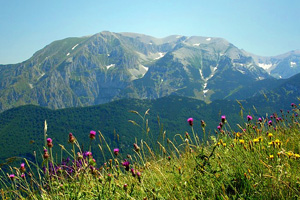
Majella National Park is a remarkable wilderness area dominated by the Majella massif, whose highest peak, Mount Amaro, soars to 2,793 metres. Named after Maia, daughter of Atlas and mother of Hermes in Greek mythology, this UNESCO Global Geopark boasts an extraordinary biodiversity with over 2,100 plant species and houses 78% of Abruzzo's mammal species. The park's limestone mountains were formed from a tropical seabed 100 million years ago, making it rich in fossils. Human history here stretches back 600,000 years to the Early Palaeolithic age, and the area includes a magnificent Roman sanctuary dedicated to Hercules Curinus from the 4th-3rd centuries BCE, where archaeologists discovered a bronze statuette and graffiti verses attributed to the poet Ovid. The park's unique position just 30 kilometres from the Adriatic Sea makes it one of the few mountain ranges with such proximity to the coast, whilst its diverse landscape encompasses deep valleys, caves with prehistoric paintings, and pristine wilderness areas where wolves, Marsican bears, and golden eagles roam freely. Visitors can explore hermitages carved into cliffs, trek through pristine valleys like Orfento, or marvel at Romanesque churches in medieval villages such as Caramanico Terme. |
| Roccacasale |
|---|
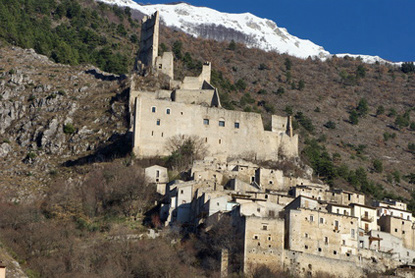
Roccacasale is a charming village with origins going back to around 800-900 CE, with evidence of earlier settlements found at "Colle Delle Fate". The imposing castle, which dominates the landscape, was constructed around 925 CE to defend against Arab and Byzantine invasions. Roccacasale played a significant role in various historical events, including the Fourth Crusades and battles between the Aragonese and Angevin forces in the 15th century. The village's strategic location on the slopes of Monte della Rocca offers breathtaking views of the Peligna Valley and Sulmona. Visitors can explore the ancient village's steep roads and narrow passageways, which lead to the ruins of the once-mighty castle. |
| Pacentro |
|---|

Pacentro, a medieval gem nestled in the Majella National Park at 700 metres above sea level, is one of Italy's most beautiful villages. According to local legend, the town was founded by Pacinus, a Trojan hero who journeyed from the banks of the Tiber, making it a place steeped in mythical origins. The village's rich history dates back to the 8th century CE, with its iconic Cantelmo-Caldora Castle being built by the Normans in the 11th century and later strengthened to defend against Saracen raids. Pacentro comes alive during the third week of August with historical reenactments that transport visitors back to 1450 CE, featuring bonfires, knighting ceremonies, and even witch trials. The village is particularly famous for being the ancestral home of pop star Madonna's paternal grandparents. For food enthusiasts, the local cuisine offers delectable traditional dishes, including the famous 'polta', a hearty meal made with beans, potatoes, and cabbage. |
Other attractions
Casoli
Sulmona
Around L'Aquila
| L'Aquila |
|---|
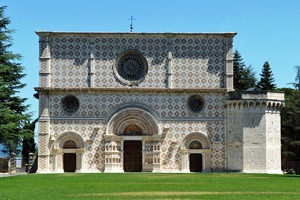
L'Aquila, the capital of the Abruzzo region, was founded in 1240 CE by Holy Roman Emperor Frederick II on the fascinating premise of unifying ninety-nine existing villages, each contributing to the city's development with its own church and fountain. This unique origin is commemorated in the city's iconic Fountain of the 99 Spouts. The area's history stretches back to ancient Roman times when the nearby city of Amiternum flourished, which was notably the birthplace of the Roman historian Sallustius. Remarkable archaeological remains including a theatre and amphitheatre at Amiternum near L'Aquila, and the impressive ruins of Alba Fucens near Avezzano. The Romans significantly developed the region, constructing an ambitious engineering project in 41 CE when Emperor Claudius began the partial draining of Lake Fucino through an artificial outlet. L'Aquila grew to become a significant medieval trading centre, particularly famous for wool, silk, and saffron commerce. The strategic location along the "via degli Abruzzi" made it a crucial crossroads between Florence and Naples. The city boasts fascinating architectural features, including the impressive Spanish Fort (Forte Spagnolo) which now houses the National Museum of Abruzzo, and the iconic Fountain of the 99 Spouts, built in 1272 to commemorate the 99 founding villages. Today, L'Aquila serves as a primary departure point for exploring the Gran Sasso d'Italia mountain group and has evolved into a popular skiing centre and summer resort. |
| Alba Fucens |
|---|
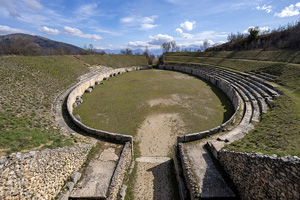
 Perched at 1,000 metres above sea level, Alba Fucens is one of Italy's highest and most remarkable Roman settlements, often called the "Pompeii of Abruzzo". Founded in 303 BCE as a strategic Roman colony, it originally housed 6,000 families and was protected by impressive polygonal walls stretching nearly 3 km. The archaeological site, which offers free admission, features a remarkably preserved amphitheatre, thermal baths with marine-inspired mosaics, and even the remains of a Roman wine bar complete with its original counters and sinks. The site gained notoriety as a high-security prison for captured foreign royalty, including Perseus, the last king of Macedonia, and Syphax of Numidia. The site's strategic importance is evident from its position at the crossroads of major Roman routes, including the Via Valeria which connected Rome to the Adriatic Sea. After flourishing for over seven centuries, the city met its demise following seismic events around the fifth century CE, though its final destruction came at the hands of Saracen raiders in the 10th century. |
Other attractions near L'Aquila
Avezzano - San Pelino
Bominaco
| Celano |
|---|
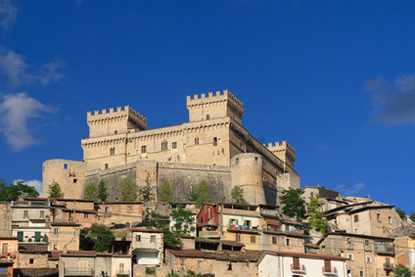
Celano Castle, also known as Piccolomini Castle, is a magnificent hilltop fortress. Built in 1392 by Pietro De' Berardi, the castle's strategic location once overlooked the now-drained Fucine Lake, an important site for the ancient Romans. The castle's rich history includes a dramatic siege in 1223 by Emperor Frederick II, who destroyed the original fortress and exiled the population. Today, visitors can explore the castle's impressive rectangular structure with four robust corner towers, an elegant Renaissance courtyard, the elegant "Fountain of Love," and museum of sacred art. The castle offers panoramic views of the surrounding Marsica region, which was once part of the territory of the Marsi, an ancient Italic people who fiercely resisted Roman expansion until their defeat in 89 BCE. |
Attractions elsewhere in Abruzzo
Atri
Colledimezzo
Civitella del Tronto
Goriano Sicoli
Pescara
Pietrasecca
Villa Santa Maria
|


 : Local interest
 : Moderately interesting
 : Outstanding place
 : Must-see in the country
 : Top cities in Europe