


| Contents |
|---|
Introduction
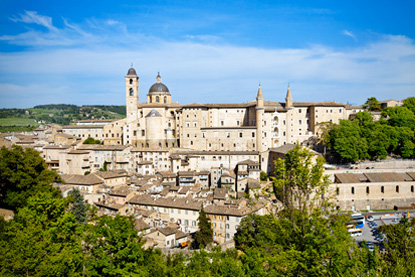
Urbino, a small hill town in Italy's Marche region, stands at 451 metres above sea level, with a population of 14,361 inhabitants. The town's historic centre, enclosed by Renaissance walls with intact bastions, has been a UNESCO World Heritage site since 1998. Originally a Roman settlement called Urbinum Mataurense, the town experienced its golden age during the 15th century under Federico da Montefeltro, when it became one of Europe's major cultural centres. The town attracted renowned Renaissance figures including Leone Battista Alberti, Piero della Francesca, and was the birthplace of the painter Raphael. Today, Urbino's compact historic centre preserves its Renaissance character, featuring the magnificent Palazzo Ducale, which houses the National Gallery of Marche, the Cathedral, and numerous other historic buildings.
Interesting Facts about Urbino
- Urbino's entire historic centre is a UNESCO World Heritage Site, celebrated for its remarkably preserved Renaissance architecture and cultural significance.
- The city became a European cultural beacon under Duke Federico da Montefeltro, whose 15th-century court attracted luminaries like Piero della Francesca and Leon Battista Alberti.
- Raphael, one of history's most celebrated painters, was born in Urbino in 1483 ? his childhood home now serves as a museum.
- The Ducal Palace's innovative design by Luciano Laurana revolutionised Renaissance architecture and now houses the National Gallery of the Marche with works by Titian and Raphael.
- Urbino's main square features unique acoustic properties allowing whispers against palace columns to be heard 40 metres away, used historically by guards.
- The city's steep, brick-paved streets still follow their original medieval layout, complete with special grooves to channel rainwater.
- Urbino hosts an annual kite festival in September where hundreds of elaborate handmade kites fill the skies above the Renaissance skyline.
- The University of Urbino, founded in 1506, occupies historic Renaissance buildings and maintains the city's tradition as an intellectual hub.
- Leonardo da Vinci advised on Urbino's defensive walls, though his designs were never fully implemented due to the city's rapid economic decline.
- Urbino's 14th-century Albornoz Fortress offers panoramic views across the Marche countryside from its hilltop position.
History
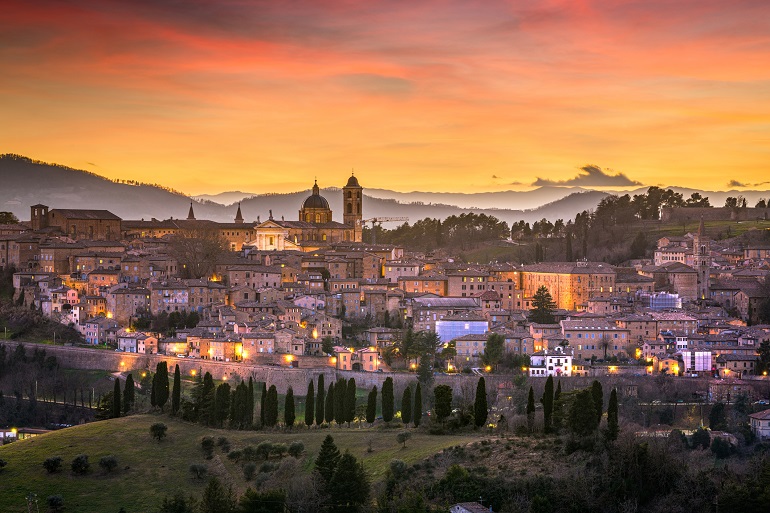
Urbino's origins trace back to ancient times when it was established as a Roman settlement called Urbinum Mataurense, meaning 'the little city on the river Mataurus'. The area had previously been inhabited by various ancient peoples including the Umbrians, Etruscans, Celts, and Gauls before the Romans arrived in the 3rd century BCE. The town's strategic position led to it becoming a fortified stronghold, particularly significant during the Gothic Wars of the 6th century.
The town's most magnificent period emerged during the Renaissance, particularly under the rule of Federico da Montefeltro from 1444 to 1482. During this golden age, Urbino transformed into one of Europe's most significant cultural centres, attracting renowned artists, mathematicians and humanists such as Leone Battista Alberti, Piero della Francesca, and Paolo Uccello. This extraordinary cultural environment fostered the talents of notable figures like Raphael, who was born in Urbino in 1483. The city's remarkable legacy is preserved within its Renaissance walls, which remain virtually intact today, complete with their original bastions.
The city's gradual decline began after 1626 when the dukedom was incorporated into the Papal States. A particularly challenging period occurred between 1797 and 1800 when French troops occupied the city, resulting in the loss of numerous important artworks which were relocated to Paris and Milan. Despite this decline, Urbino maintained its architectural splendour and historical significance, leading to its current status as a UNESCO World Heritage site. The town's perfectly preserved historic centre continues to be viewed as an 'ideal city', offering visitors a genuine glimpse into Renaissance Italy.
Main Attractions
Palazzo Ducale
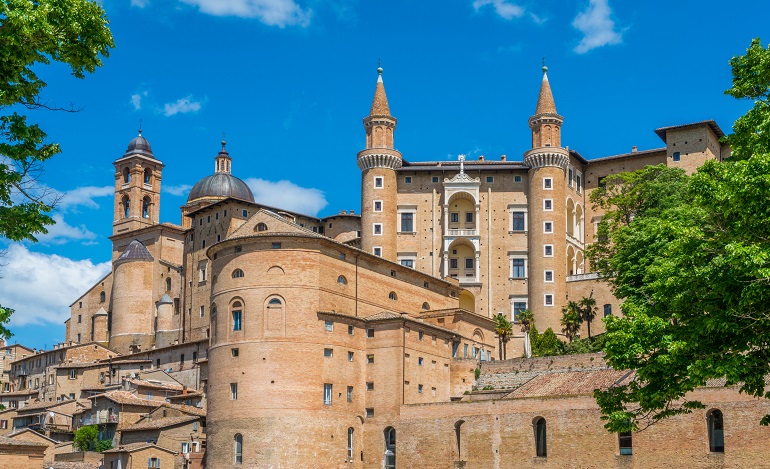
The Palazzo Ducale, or Ducal Palace, stands as the crown jewel of Urbino's Renaissance architecture. This magnificent structure, begun in the mid-15th century for Duke Federico III da Montefeltro, is not merely a palace but a testament to the artistic and cultural flowering of the Renaissance. Its twin towers and harmonious façade dominate the city's skyline, offering a glimpse into the grandeur of a bygone era. While the interior houses museums, the exterior alone is a masterpiece worth admiring. The palace's courtyard, with its elegant arcades and perfect proportions, exemplifies the Renaissance ideal of harmony and balance. As you walk around the palace, take note of the intricate stonework and the way the building seems to merge seamlessly with the hillside, a feat of engineering that has fascinated visitors for centuries.
Cathedral of Santa Maria Assunta
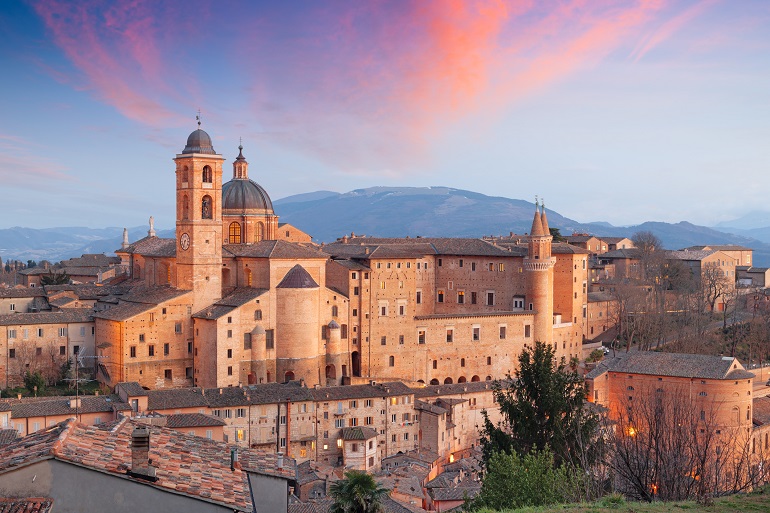
The Cathedral of Santa Maria Assunta, Urbino's most imposing religious edifice, stands as a testament to the city's spiritual heritage. Originally built in the 11th century and rebuilt in the 15th century, the cathedral underwent significant renovations after earthquakes in the late 18th century, resulting in its current Neoclassical façade. The cathedral's elegant exterior belies the treasures within, including impressive underground grottos carved from solid rock. These subterranean chapels add an element of mystery and spiritual depth to the cathedral experience. The cathedral's prominent position near the Ducal Palace underscores its importance in Urbino's religious and civic life. Its spacious interior, adorned with artwork and bathed in natural light, provides a serene space for reflection and admiration of ecclesiastical architecture.
Oratory of San Giovanni Battista
The Oratory of San Giovanni Battista, with its splendid neo-Gothic façade, is a hidden gem in Urbino's religious landscape. This small church, restored in the early 20th century, houses some of the most remarkable frescoes in the region. The interior walls are adorned with an awe-inspiring cycle of Gothic frescoes depicting the Crucifixion and scenes from the life of St. John the Baptist. These vibrant and detailed artworks, created by the Salimbeni brothers in the early 15th century, represent a high point of International Gothic style in Italy. The frescoes' vivid colours and narrative depth transport visitors back to the medieval world, offering insights into religious devotion and artistic techniques of the time. The oratory's intimate space allows for close examination of these masterpieces, making it a must-visit for art enthusiasts and history buffs alike.
Oratory of San Giuseppe
The Oratory of San Giuseppe, another of Urbino's religious treasures, is renowned for its unique Nativity Scene. This life-size representation, crafted from tuff and pumice stone, is a remarkable example of Renaissance sculpture. The nativity, created by Federico Brandani in the 16th century, is notable for its realism and emotional impact. The oratory itself, with its unassuming exterior, surprises visitors with the richness of its interior decorations. Beyond the nativity scene, the oratory houses other significant artworks, including sculptures and paintings that reflect the religious fervour and artistic excellence of Renaissance Urbino. The intimate scale of the oratory provides a stark contrast to the grandeur of the Ducal Palace, offering visitors a more personal and contemplative space to appreciate Urbino's artistic heritage.
Porta Valbona
Porta Valbona, one of the main gates of Urbino's ancient walls, serves as a grand entrance to the historic city centre. This impressive structure, with its imposing arch and decorative elements, dates back to the 16th century but was significantly restored in the 17th century. As you pass through Porta Valbona, you're stepping into the heart of Renaissance Urbino. The gate opens onto Piazza del Mercatale and leads to Via Mazzini, the city's main street. Its strategic location makes it not just a historical monument but a living part of Urbino's urban fabric. The gate's architecture, blending functionality with aesthetic appeal, reflects the city's commitment to beauty even in its defensive structures. Porta Valbona stands as a symbol of Urbino's past glory and its enduring charm, welcoming visitors as it has done for centuries.
Piazza della Repubblica
Piazza della Repubblica, the heart of Urbino's social life, is where five main streets converge, creating a vibrant hub of activity. This square serves as the city's primary meeting point, surrounded by charming cafés and traditional architecture that epitomise the essence of Italian urban life. The piazza's layout and buildings reflect centuries of history, with each façade telling a story of Urbino's evolution. Here, locals and visitors alike gather to enjoy a coffee, engage in lively conversations, or simply watch the world go by. The square's central location makes it an ideal starting point for exploring the city, with many of Urbino's key attractions within easy walking distance. During festivals and events, Piazza della Repubblica comes alive with colour and sound, embodying the spirit of community that has long been a hallmark of Italian culture.
Rampa Elicoidale
The Rampa Elicoidale, or Helical Ramp, is a marvel of Renaissance engineering hidden within the walls of Urbino. Located in the tower overlooking Piazza del Mercatale, this spiral ramp was ingeniously designed to allow horses to ascend to the level of the Ducal Palace. The ramp's gentle slope and wide turns demonstrate the innovative thinking of Renaissance architects, who sought to blend functionality with aesthetic appeal. As you walk up the ramp, you can almost hear the echoes of hooves from centuries past. The ramp not only served a practical purpose but also symbolised the Duke's power and sophistication, allowing him and his guests to make a grand entrance to the palace on horseback. Today, the Rampa Elicoidale offers visitors a unique perspective on Renaissance urban planning and architecture.
Raffaello Monument
The Raffaello Monument, located in Piazzale Roma, pays homage to Urbino's most famous son, the Renaissance artist Raphael. This bronze and marble statue serves as a reminder of the city's significant contribution to art history. The monument, depicting Raphael in a contemplative pose, invites visitors to reflect on the artist's genius and his enduring influence on Western art. The statue's placement in a public square underscores Urbino's pride in its cultural heritage and its commitment to honouring its illustrious past. As you stand before the monument, you're connected to a legacy of artistic excellence that stretches from the Renaissance to the present day. The area around the monument often serves as a gathering place for both locals and tourists, creating a space where art, history, and community intersect.
Fortezza Albornoz
Perched atop the highest hill in Urbino, the Fortezza Albornoz offers a commanding view of the city and the surrounding Marche countryside. Built in the mid-14th century at the behest of Cardinal Albornoz, this fortress has stood witness to centuries of Urbino's history. Although it was destroyed by insurgents in 1571 and subsequently rebuilt, it retains an air of medieval might. Today, the fortress is surrounded by the picturesque Parco della Resistenza, a public park dedicated to the Italian Resistance movement. Visitors can explore the fortress grounds, imagining the strategic importance it once held, and then relax in the park, enjoying panoramic views of Urbino's terracotta rooftops and the rolling hills beyond. The juxtaposition of the fortress's stern architecture with the peaceful park creates a unique atmosphere that encapsulates Urbino's blend of history and natural beauty.
Parco della Resistenza
The Parco della Resistenza, adjacent to the Fortezza Albornoz, is a tranquil green space that offers respite from the bustling streets of Urbino. This park, dedicated to the Italian Resistance movement of World War II, combines historical significance with natural beauty. Its elevated position provides stunning panoramic views of Urbino's historic centre and the surrounding countryside, making it a favourite spot for photographers and romantics alike. The park serves multiple purposes: it's a place of remembrance, a recreational area for locals, and an outdoor sculpture gallery featuring works by artists associated with Urbino's prestigious university. In the warmer months, the park comes alive with students and families enjoying picnics on the grass, while the changing seasons paint the landscape in a variety of hues. The Parco della Resistenza embodies Urbino's ability to harmoniously blend history, nature, and art in a single, beautiful location.
Top Museums
Galleria Nazionale delle Marche
Housed within the magnificent Palazzo Ducale, the Galleria Nazionale delle Marche is the crown jewel of Urbino's museums. This gallery showcases an impressive collection of Renaissance masterpieces, making it a must-visit for art enthusiasts.
The museum's collection spans from the 13th to the 18th century, featuring works by renowned artists such as Piero della Francesca, Raphael, and Titian. Highlights include Piero della Francesca's 'Flagellation of Christ' and the enigmatic 'Ideal City'.
As you explore the gallery, you'll also have the opportunity to admire the stunning architecture of the Palazzo Ducale itself, a masterpiece of Renaissance design commissioned by Federico da Montefeltro.
Casa Natale di Raffaello
For those interested in the life of the great Renaissance master Raphael, a visit to his birthplace is essential. Casa Natale di Raffaello offers a unique glimpse into the early life of this legendary artist.
The museum is housed in the very building where Raphael was born and spent his formative years. It features a collection of artworks, sketches, and artefacts that provide insight into Raphael's influences and the artistic techniques he mastered. The intimate setting allows visitors to forge a personal connection with Raphael's story and the Renaissance period that shaped his work.
Museo Archeologico Lapidario
Located on the ground floor of the Palazzo Ducale, the Museo Archeologico Lapidario offers a fascinating journey through the region's ancient history. The museum houses a rich collection of epigraphs, sculptures, and archaeological finds from the Roman and pre-Roman periods.
This museum provides an excellent complement to the Renaissance art found in the Galleria Nazionale delle Marche, offering visitors a broader perspective on the cultural heritage of Urbino and the surrounding Marche region.
Local Cuisine
Urbino's culinary heritage reflects its rich Renaissance history and geographical location in the Marche region. The local speciality crescia sfogliata, a layered flatbread dating back to the 15th century, is traditionally served hot and filled with the region's prized Casciotta d'Urbino cheese or the exquisite Prosciutto di Carpegna. The city's pasta dishes are equally noteworthy, featuring unique creations such as passatelli, made from breadcrumbs and Parmesan cheese, and vincisgrassi, a refined variation of lasagna layered with meat and white sauce, seasoned with cloves and nutmeg. Game dishes are particularly celebrated here, with coniglio in porchetta (roasted rabbit stuffed with wild fennel, garlic and pancetta) being one of the oldest and most cherished recipes. The area's proximity to truffle country makes it a paradise for truffle enthusiasts, particularly during the winter months when the prized white truffle is in season. The local Bianchello del Metauro wine perfectly complements these traditional dishes.
Shopping
The historic centre is home to elegant boutiques and artisanal workshops, where visitors can find unique items such as handmade ceramics, jewellery, and local crafts. Strolling through the cobblestone streets, shoppers can explore a variety of shops, from high-end fashion brands to charming local stores. Notable spots include the vibrant Takko Fashion for trendy clothing and various galleries and bookshops that reflect the city's rich cultural heritage.
Nature in and around Urbino
Urbino offers several enchanting natural spaces perfect for outdoor enthusiasts. The Parco della Resistenza, situated at the summit of the medieval quarter alongside the Fortezza Albornoz, provides breathtaking panoramic views of the city's rooftops, the elegant countryside, and even stretches to the coastline. This peaceful green space features outdoor sculptures and becomes particularly lively during summer months when students gather and various concerts take place. For those seeking more extensive natural exploration, the nearby Gola del Furlo State Nature Reserve presents a striking landscape where the Candigliano river flows through dramatic rocky walls, offering opportunities to spot diverse wildlife including golden eagles, hawks and herons. The reserve also includes La Golena Park, ideal for picnicking, and the Furlo Adventure Park with its three acrobatic courses suitable for family entertainment.
Getting Around
Urbino, situated in Italy's Le Marche region, is accessible despite not having its own train station. The nearest rail connections are in Pesaro (37 kilometres away) and Fano (49 kilometres away), both serviced by trains from major cities like Rome, Milan and Bologna. From these coastal towns, regular buses run to Urbino, with services departing every 30 minutes between 6:25 am and 8:30 pm. The journey by bus takes approximately one hour. For air travellers, the closest airport is Rimini, located 57 kilometres from Urbino, whilst other options include Ancona (87 kilometres) and Bologna (179 kilometres). Once in Urbino, the historic centre is quite compact and walkable, though notably steep. Visitors arriving at the main Piazza Mercatale can use a convenient elevator to reach Corso Garibaldi, avoiding the steep climb through the old gate. Those driving should note that the historic centre is a restricted traffic zone (ZTL), requiring parking outside the city walls.
Best Time to Visit
The best time to visit Urbino is during the shoulder seasons, particularly from mid-May to mid-June or throughout September, when you'll enjoy pleasant temperatures averaging between 20°C and 26°C. These periods offer an ideal balance of comfortable weather and fewer tourist crowds, along with more reasonable accommodation prices. The summer months of July and August can be quite warm with temperatures reaching up to 29°C, though the city's elevation helps moderate the heat compared to coastal areas. Spring and autumn visitors can expect moderate rainfall and comfortable conditions for exploring the historic old town, whilst winter months from December to February are quite cold with temperatures dropping to around 5°C and occasional snowfall.