


| Contents |
|---|
Introduction
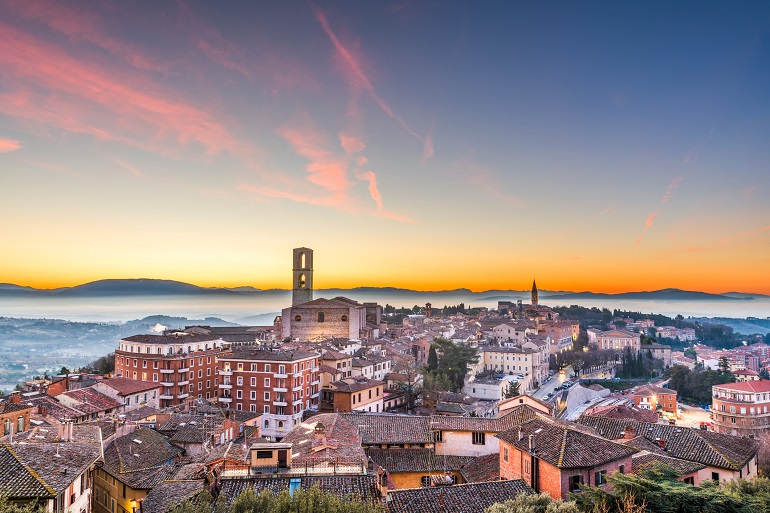
Perugia, the capital of Italy's Umbria region, sits atop a hill overlooking the Tiber valley between Rome and Florence. This historic city combines its rich Etruscan and medieval heritage with a vibrant modern culture. As home to two universities—the University of Perugia (founded in 1308) and the University for Foreigners—the city bustles with international students and maintains a distinctly cosmopolitan atmosphere whilst retaining its authentic Italian character. The city centre, connected by escalators through the fascinating Rocca Paolina fortress, features well-preserved Etruscan walls, medieval churches, and Renaissance architecture. Perugia is renowned for its cultural events, particularly the Umbria Jazz Festival held each July and the annual chocolate festival in October, celebrating the city's famous Perugina chocolate company. The main thoroughfare, Corso Vannucci, leads to the heart of the city at Piazza IV Novembre, where visitors can admire the 13th-century Fontana Maggiore and explore the city's numerous museums, including the Galleria Nazionale dell'Umbria, which houses significant works by Perugino and other Renaissance masters.
Interesting Facts about Perugia
- Perugia is home to one of Italy's oldest universities, founded in 1308, where students have walked historic halls for over seven centuries.
- The iconic Baci Perugina chocolates, known for their hidden love notes, were created in Perugia in 1922 as a symbol of Italian romance.
- An automated Mini Metro system uniquely connects the city’s lower districts to its hilltop medieval centre via a driverless train.
- Massive Etruscan walls dating back to the 3rd century BCE still encircle much of Perugia’s historic centre.
- The 13th-century Fontana Maggiore, adorned with intricate medieval sculptures, remains a centrepiece of Piazza IV Novembre.
- Perugia hosts Europe’s renowned Umbria Jazz Festival every July, attracting top international musicians.
- Beneath the city lies the Rocca Paolina, a 16th-century fortress built over medieval streets that visitors can still explore today.
- The griffin – a mythical eagle-lion hybrid – serves as Perugia’s enduring symbol, appearing on buildings and statues throughout the city.
- Perugia’s labyrinthine underground includes ancient Etruscan wells and tunnels accessible through guided tours.
- Local artisans continue centuries-old traditions of crafting colourful maiolica ceramics, a hallmark of Umbrian craftsmanship.
- Every autumn, the city transforms into a chocolate wonderland during the Eurochocolate festival, celebrating its sweet heritage.
History
Perugia's origins can be traced back to the Etruscans in the 6th-7th century BCE, though evidence suggests an earlier settlement existed in protohistoric times. The city occupied a strategic position between Etruscan and Umbrian territories, becoming the most important centre of the Upper Tiber Valley. As one of the 12 confederate cities of Etruria, known as the Dodecapolis, Perugia established itself as a powerful trading and defensive alliance.
The city's medieval period was marked by significant turbulence and development. After becoming a commune in the 11th-12th centuries, Perugia experienced what became known as the 'century of blood' due to fierce conflicts between the Oddi and Baglioni families. Despite these struggles, the city flourished artistically during the Renaissance, with notable figures such as Pietro Vannucci, master of Raphael, receiving honorary citizenship around 1485. The political landscape shifted dramatically in 1540 when Pope Paul III, responding to a popular revolt, dispatched papal militias and constructed the Rocca Paolina after destroying the Baglioni family homes.
The modern era brought further changes to Perugia's landscape. The city experienced French occupation in 1798 and underwent several uprisings in 1848 and 1859, which led to the destruction of the Rocca Paolina. In 1860, Perugia was finally incorporated into the newly unified Italian state. Today, the city stands as a vibrant cultural centre, home to a thriving university population and host to internationally renowned events such as Umbria Jazz and Eurochocolate. The city's rich heritage is still visible in its impressive architectural features, including two perimeter walls - the inner Etruscan wall with seven ancient stone gates and an outer Medieval ring that remains intact for several kilometres.
Main Attractions
Piazza IV Novembre
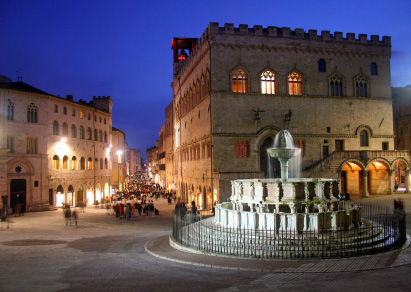
Standing as the beating heart of Perugia, Piazza IV Novembre represents one of Italy's finest medieval squares. At its centre, the magnificent Fontana Maggiore commands attention with its intricate carved reliefs depicting biblical scenes, zodiac signs, and tales from Roman history. Created by father and son sculptors Nicola and Giovanni Pisano in 1278, this pink and white marble masterpiece served both as a celebration of Perugia's achievement in bringing running water to the hilltop city and as a public declaration of medieval Christian values. Today, the square buzzes with life as students, tourists, and locals gather around the fountain, enjoying gelato or simply soaking in the atmospheric surroundings.
Palazzo dei Priori
The Palazzo dei Priori stands as one of Italy's greatest Gothic secular buildings, its massive bulk dominating Perugia's skyline since the 13th century. This architectural masterpiece features a facade adorned with distinctive triple-lancet windows, griffins (the symbol of Perugia), and impressive bronze sculptures. Inside, visitors can explore a maze of grand halls, including the spectacular Sala dei Notari with its ceiling covered in medieval frescoes depicting biblical scenes and moral allegories. The palace's bell tower, rising proudly above the city, offers breathtaking views across the Umbrian valley, while its imposing entrance, guarded by bronze griffins and a lion, speaks to the power and wealth of medieval Perugia.

Cathedral of San Lorenzo
Perugia's Cathedral of San Lorenzo presents an unusual sight with its unfinished facade facing not the main square but the side of Palazzo dei Priori. Built between the 14th and 15th centuries, this impressive structure combines Gothic and Renaissance elements in its architecture. The cathedral's exterior features striking pink and white stone stripes, while its side entrance is adorned with an elegant baroque portal. Inside, the vast nave houses numerous artistic treasures, including the Holy Ring (believed to be the Virgin Mary's wedding ring) and a remarkable deposition by Federico Barocci. The cathedral's choir stalls, carved from walnut wood in the 1400s, display extraordinary craftsmanship with their intricate designs and biblical scenes.
Corso Vannucci
Stretching majestically through the heart of Perugia's historic centre, Corso Vannucci serves as the city's elegant main thoroughfare. This wide, pedestrianised street runs for nearly a kilometre, lined with imposing medieval palaces converted into fashionable shops, traditional cafes, and elegant restaurants. Named after the famous painter Pietro Vannucci (known as Perugino), the corso comes alive during the evening passeggiata when locals participate in the time-honoured tradition of an evening stroll. The street's smooth stone paving, worn by centuries of footsteps, reflects the warm glow of traditional lampposts as day turns to dusk, creating an enchanting atmosphere that captures the essence of Italian city life.
Rocca Paolina
The Rocca Paolina represents one of Italy's most fascinating examples of Renaissance military architecture, built by Pope Paul III in the 16th century as a symbol of papal authority over Perugia. This fortress-palace complex includes a remarkable underground city, where visitors can walk through a network of medieval streets, complete with shops, houses, and churches that were buried rather than destroyed during the fortress's construction. The surviving structure includes massive walls, ramparts, and a series of escalators that transport visitors from the lower modern city to the historic centre above. The fortress's terraces provide spectacular panoramic views of the Umbrian countryside, particularly magical during sunset.
Ancient Structures
Etruscan Arch
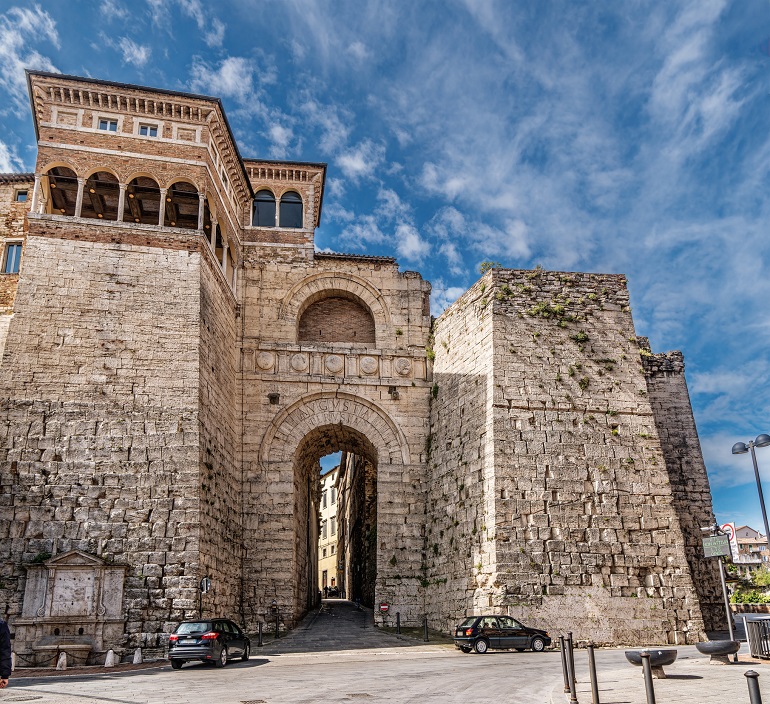
The Etruscan Arch, also known as Arco d'Augusto, stands as one of the most impressive remnants of Perugia's ancient past. Constructed in the 3rd century BCE and later restored by Emperor Augustus in 40 BCE, this monumental gateway represents one of the best-preserved Etruscan architectural works in Italy. The arch rises an impressive 19 metres high, built with massive travertine stone blocks fitted together without mortar. Its upper section features an elegant Renaissance loggia added in the 16th century, creating a striking contrast between ancient and medieval architectural styles. The arch's sheer size and engineering sophistication serve as a testament to the advanced capabilities of Etruscan builders.
Etruscan Well
The Pozzo Etrusco (Etruscan Well) represents an extraordinary feat of ancient engineering, dating back to the 3rd-2nd century BCE. This remarkable structure descends 37 metres into the earth, with a diameter of 5.6 metres, constructed entirely from travertine blocks. The well's perfect cylindrical shape and the precision of its construction continue to amaze engineers and architects today. Visitors can descend a modern staircase to view the well's interior, where the original Etruscan hydraulic system still functions. The well's construction required exceptional skill in both engineering and stone-cutting, demonstrating the advanced technological capabilities of Etruscan civilisation.
Medieval Aqueduct
The medieval aqueduct of Perugia, known locally as the Via dell'Acquedotto, offers one of the city's most unique walking experiences. Built in the 13th-14th centuries to supply water to the Fontana Maggiore, this impressive structure stretches for several kilometres across the city's hillside. Today, the top of the aqueduct serves as an elevated walkway, providing spectacular views over the Umbrian countryside and the city's medieval rooftops. The path is particularly atmospheric at sunset when the ancient arches cast long shadows and the surrounding hills are bathed in golden light. The aqueduct demonstrates the medieval engineers' remarkable ability to transport water uphill to the city centre using gravity alone.

Religious Architecture
Basilica of San Pietro
The Basilica of San Pietro, with its distinctive bell tower visible from across the city, represents one of Perugia's most significant religious monuments. Founded in the 10th century, this Benedictine abbey church showcases architectural elements from various periods, including Romanesque, Gothic, and Baroque. The basilica's interior dazzles visitors with its wealth of artworks, including frescoes by local masters, intricately carved choir stalls, and precious reliquaries. The adjacent monastery gardens, designed in the 17th century, feature geometric patterns, aromatic herbs, and ancient fruit trees, providing a peaceful setting for contemplation. The basilica's library contains thousands of rare manuscripts and early printed books, making it a treasure trove for scholars of medieval and Renaissance history.
Chiesa di Sant'Angelo
The Church of Sant'Angelo, one of the oldest churches in Perugia, stands as a remarkable example of early Christian architecture. Built in the 5th century on the foundations of a Roman temple, this circular church features sixteen ancient columns, believed to have been taken from the original pagan structure. The church's unique octagonal layout and its mixture of classical and early Christian elements make it an architectural historian's delight. The interior contains several important frescoes and sculptures, while the crypt below houses archaeological remains from the Roman period. The church's peaceful garden offers a quiet space for reflection and excellent views over the eastern part of the city.
Oratorio di San Bernardino
The Oratorio di San Bernardino presents one of the finest examples of Renaissance architecture in Umbria. Its polychrome facade, completed in 1461 by Agostino di Duccio, is a masterpiece of sculptural decoration, featuring intricate reliefs depicting scenes from the life of Saint Bernardino and allegorical figures representing Christian virtues. The oratory's interior, though more austere, contains significant artworks including 15th-century frescoes and wooden choir stalls. The building's location on a terrace above Piazza San Francesco provides visitors with stunning views of the surrounding countryside and the church of San Francesco al Prato below.
Top Museums
Galleria Nazionale dell'Umbria
The Galleria Nazionale dell'Umbria, housed in the historic Palazzo dei Priori, stands as a cornerstone of Perugia's cultural landscape. This prestigious gallery showcases one of Italy's richest art collections, spanning from the 13th to the 19th century. With 3,500 square metres of exhibition space spread across 40 rooms, a tower, and a chapel, the museum offers an unparalleled journey through 800 years of Italian art history.
The gallery's collection is particularly renowned for its focus on Umbrian artists, with monographic rooms dedicated to masters such as Pinturicchio and Perugino. In fact, the Galleria Nazionale dell'Umbria houses the world's most comprehensive collection of Perugino's works. Visitors can marvel at iconic masterpieces, including the polyptych of St. Anthony by Piero della Francesca, which takes pride of place in Room 13.
Nobile Collegio del Cambio
Located within the Palazzo dei Priori, the Nobile Collegio del Cambio offers a unique glimpse into Perugia's artistic and architectural heritage. This museum is particularly famous for its Sala delle Udienze, adorned with stunning frescoes by the renowned Italian painter Perugino. Originally established as a guild for money changers in the 15th century, the Collegio del Cambio now serves as a testament to Perugia's financial and cultural evolution.
Museo del Capitolo della Cattedrale di San Lorenzo
Adjacent to the San Lorenzo Cathedral, the Museo del Capitolo houses an impressive collection of sacred art and artifacts dating back to the 13th century. This museum offers a journey through the religious heritage of Perugia, showcasing liturgical items, ancient manuscripts, and exquisite paintings. One of its most prized possessions is a series of frescoes by renowned artists, highlighting the significant role that religious art played in the region's cultural development.
Museo Civico di Palazzo della Penna
Housed in a neoclassical palace, the Museo Civico di Palazzo della Penna is dedicated to contemporary art. The museum features frescoes by Umbrian painter Antonio Castelletti and ideal views in the Sala dei Paesaggi by decorator and scenographer Pasquale Angelini. It also hosts two permanent collections of high value: works by Gerardo Dottori and other Umbrian Futurists, and Joseph Beuys' Opera Unica.
National Archaeological Museum of Perugia
The National Archaeological Museum of Perugia, located within the San Domenico complex, stands as the most important archaeological collection in central Italy. The museum's exhibits trace the history of the region from the Paleolithic era through the Bronze and early Iron Ages, up to the Roman period. One section is dedicated exclusively to the city of Perugia, chronicling its founding and development from the 11th to the 8th centuries B.C. and into the Roman era.
Visitors can explore a comprehensive array of bronze artifacts, including tools, pottery, glassware, and Etruscan jewelry. The museum also boasts an impressive collection of cast objects, such as armor and shields crafted using the repoussé technique – a metalworking method where designs are hammered from the reverse side.
Cappella di San Severo
The Cappella di San Severo, part of the Camaldolese convent complex, functions as a small museum housing a significant fresco of the Trinity and saints. This artwork is particularly noteworthy as it represents a collaboration between two Renaissance masters: Raphael and Perugino. The fresco dates back to the period between 1505 and 1508 when Raphael worked on it, and 1521 when Perugino completed it.
House Museum of Palazzo Sorbello
Constructed in the late 16th century, Palazzo Sorbello is a historic building located in Perugia's city center, a short distance from the San Lorenzo cathedral. The building's entrance opens onto Piazza Piccinino, opposite the mouth of the Etruscan well, an important underground monument from the Etruscan era dating back to the 3rd century BCE.
Local Cuisine
Perugia's cuisine reflects the rustic traditions of Umbria, Italy's only landlocked region. The local fare centres around high-quality ingredients sourced from the surrounding countryside, with truffles being a particular highlight, used generously in pasta dishes and sauces. Traditional pasta varieties like tagliatelle, ciriole, and stringozzi are often served with rich game-based ragùs featuring wild boar or hare. The region's pork products are exceptional, including the herb-infused porchetta, prosciutto di Norcia, and unique specialities like mazzafegato, a sweet-spiced liver sausage. Local cheeses, particularly pecorino and caciotta, feature prominently in many dishes. The area's signature flatbread, torta al testo, serves as the foundation for delicious sandwiches filled with local cured meats. Game birds, especially pigeon prepared as palombacci alla perugina, showcase the region's hunting traditions, whilst dishes incorporating the prized Fagiolina del Trasimeno beans and foraged wild herbs demonstrate the area's deep connection to its agricultural roots.
Shopping
Perugia is centred around the wide, pedestrianised Corso Vannucci, the city's principal shopping thoroughfare. This elegant street, along with its connecting roads like Via Baglioni and Via Oberdan, houses numerous fashion boutiques, including prestigious designer names such as Max Mara, Falconeri, and Luisa Spagnoli. Fashion enthusiasts will appreciate the mix of high-street shops and exclusive boutiques like Paris Ricci and Lino Ricci. For those keen on local markets, Perugia hosts a weekly market on Tuesday mornings selling fresh food and clothing, whilst an antiques market takes place on the last weekend of each month in Piazza Italia. The covered market, Mercato Coperto, situated near Piazza Matteotti, is perfect for sourcing local produce and picnic supplies. Most shops maintain traditional Italian hours, opening from 9:00 to 13:00 and again from 15:30 to 19:30, though some tourist-oriented establishments may remain open throughout the day.
Nature in and around Perugia
Perugia and its surrounding region offer a wealth of natural wonders that make it a paradise for outdoor enthusiasts. The city sits amidst the verdant landscapes of Umbria, Italy's celebrated 'Green Heart', where visitors can explore the stunning Lake Trasimeno, the largest lake in central Italy, with its picturesque beaches and historic fishing villages. Nature lovers will be delighted by the Monti Sibillini National Park, featuring dramatic mountain peaks, wildflower-carpeted meadows, and extensive hiking trails. The breathtaking Cascate delle Marmore, Italy's tallest waterfall, can be found in the nearby Nera River Park, whilst the Monte Cucco Park boasts ancient beech forests and an impressive network of karst caves. For those seeking leisure closer to the city, Barton Park provides extensive walking paths and peaceful gardens, whilst the Carducci Gardens offer panoramic views over Perugia's rolling hills.
Giardini del Frontone
The Giardini del Frontone represents Perugia's oldest public gardens, offering a peaceful retreat from the bustling city centre. Created in the 18th century, these terraced gardens feature elegant stone balustrades, classical statuary, and carefully maintained flowerbeds. The gardens' design follows the traditional Italian style, with symmetrical layouts and geometric patterns. A central avenue lined with mature trees leads to a grand stone staircase, while hidden corners provide quiet spots for contemplation. During summer evenings, the gardens host outdoor cinema screenings and cultural events, making them a vital part of Perugia's social life.
Parco Regionale del Lago Trasimeno
Located just outside Perugia, the Regional Park of Lake Trasimeno encompasses Italy's fourth-largest lake and its surrounding landscape. This natural paradise offers visitors a chance to explore pristine beaches, dense forests, and charming fishing villages. The park features numerous walking and cycling trails, bird-watching opportunities, and water sports facilities. Three islands dot the lake's surface, each with its own unique character and history. The largest, Isola Maggiore, still maintains its traditional fishing village atmosphere and houses a 12th-century church. The park's diverse ecosystem supports a wide variety of flora and fauna, making it a haven for nature enthusiasts.
Getting Around
Perugia, the capital of Italy's Umbria region, sits atop a defensive hilltop and is accessible via multiple transport options. Visitors can reach the city by train through Perugia Centrale station, with journey times of approximately 2.5 hours from Rome and 2 hours from Florence. Upon arrival at the train station, located in the valley below the city, travellers can take a bus to the historic centre for €1.50, or use the convenient MiniMetrò, a driverless train running every two minutes until 21:00. Once in Perugia, the historic centre (Centro Storico) is best explored on foot, though be prepared for steep hills. The city's extensive bus network connects all major locations, including the hospital, train station, and shopping centres, with tickets valid for 70 minutes costing €1.50 from ticket offices or €2 from drivers. For those driving, it's advisable to park at Piazza Partigiani and take the series of escalators up to the old town, as the Centro Storico is largely restricted to vehicles and can be quite challenging to navigate due to its maze of cobblestoned one-way streets.
Best Time to Visit
The optimal time to visit Perugia is during the spring months from mid-April to mid-June, when temperatures are mild and pleasant, ranging from 17°C to 26°C. Whilst you might encounter some rainfall during this period, the weather remains quite agreeable for sightseeing and outdoor activities. September also offers an excellent alternative, with perfect weather conditions and fewer tourists than the peak summer months of July and August, which can be unbearably hot with temperatures reaching up to 29°C. It's advisable to avoid the period between October and December, as these months experience the heaviest rainfall of the year, particularly November which averages 96mm of precipitation.